
RAERAE REACTS · SHINee
Lucifer React: SHINee Put the Choreography in a Glass Box and Broke the Lock
Five men, one industrial earworm, and choreography so exact the camera mostly has the good sense to stop interrupting.
Artist
SHINee
Released
July 19, 2010
Runtime
03:58
Verdict
Second-generation precision with live wires exposed
Bottom line: “Lucifer” is control disguised as overload. The synths crowd the ceiling, the vocals keep finding air, and SHINee’s five-member choreography turns mechanical repetition into personality instead of sanding everybody into matching parts.
Release file
Official upload: SHINee “Lucifer” MVDaily+25KTotal views152.8M on verified SMTOWN.
Released: July 19, 2010 · Runtime: 03:58 · Release: second Korean studio album Lucifer.
Five-member lineup: Onew, Jonghyun, Key, Minho and Taemin. This historical React preserves all five performers in the official file.
Version: original Korean official MV, not the dance practice, Japanese version or later live arrangement.
Sources: exact verified SMTOWN upload and SM’s official release archive.
The synths refuse personal space
The production stacks electronic pulses, hard percussion and processed details until the track feels pressurized. There is almost no empty decorative air.
That density could become mud. SHINee survive it because the vocal arrangement keeps creating vertical space inside the machinery.
Meaning: control is the actual theme
The lyrics frame attraction as possession, confinement and the fear of losing autonomy. The production responds by making every loop feel locked in place.
This is not a healthy-relationship seminar, and the song knows it. Obsession sounds impressive precisely because the arrangement also makes it exhausting.
Onew gives the machine a human center
His rounded tone carries warmth through sharp electronic texture. He can make a line feel settled even while the instrumental keeps tightening.
That contrast prevents the track from becoming all chrome. Somebody has to sound like a person inside the system.
Jonghyun cuts upward through density
Power, brightness and precise attack let his voice clear the busiest moments without merely shouting over them. He turns pressure into lift.
The emotional urgency depends on that edge. The song needs a vocalist who can sound trapped and commanding in the same phrase.
Key makes character audible
His tone and diction create immediate identity, especially when the arrangement moves quickly between members. He does not disappear into the concept’s uniform surface.
That individuality is one reason SHINee’s precision never feels anonymous. Matching choreography does not require matching personalities.
Minho anchors the lower frame
Rap sections and physical presence pull attention downward after the higher vocal lines. The contrast gives the arrangement a floor.
The role is not to interrupt the song with mandatory rap. It is to change weight and reset the ear before the next melodic climb.
Taemin’s dance line was already an argument
Isolation, extension and control make complex movement read cleanly without removing its strangeness. He performs the mechanism and the person caught inside it.
The camera does not need to manufacture impact with cuts. His body finishes the sentence.
Five-member geometry stays readable
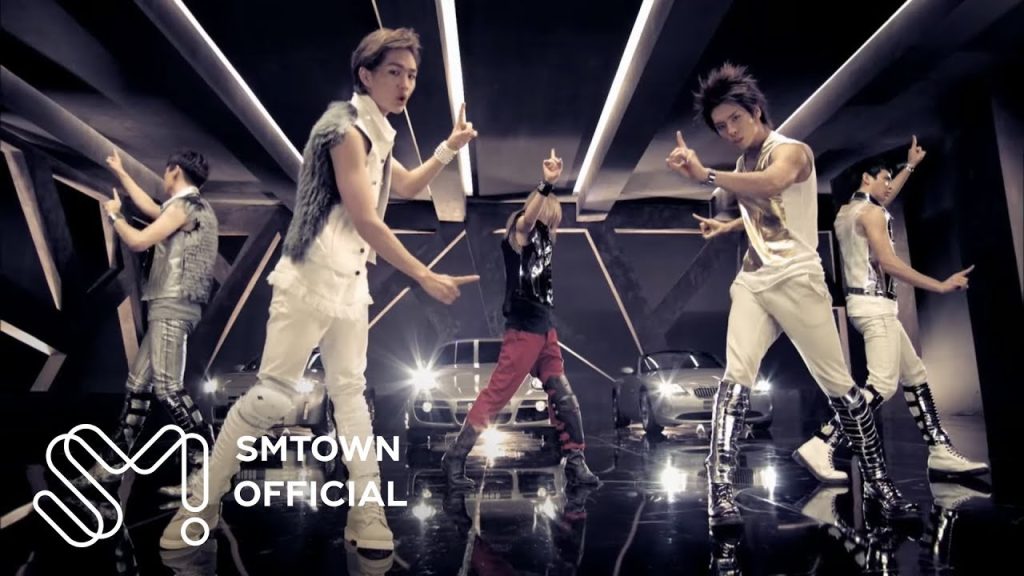
The choreography rotates centers, mirrors limbs and builds mechanical motifs without treating the members as replaceable pieces. Individual posture keeps the formation alive.
That is harder than synchronized timing. Precision earns admiration; distinct precision earns replay.
The hand choreography became a signature for a reason
Repeated arm paths translate electronic loops into visible structure. The gesture is memorable because it belongs to the track’s internal wiring.
A viral move before the challenge era still had to survive an entire performance. This one does.
The camera mostly respects the work
Wide and medium shots allow formations to complete, while close-ups arrive for vocal identity rather than constant panic. The edit trusts choreography as content.
Modern videos sometimes spend millions hiding dancers behind cuts. “Lucifer” remembers that the expensive thing in the room is the labor.
The styling is gloriously committed
Hair, metallic texture, fitted silhouettes and individual extremes make the era impossible to misdate. That is not automatically a flaw.
Fashion can become historical evidence. The looks tell us second-generation K-pop was willing to risk being ridiculous in pursuit of being unforgettable.
The chorus is an endurance device
Repetition locks the title into memory while sustained vocal pressure prevents the loop from becoming emotionally flat. The hook keeps tightening.
By the final return, the listener understands the relationship problem physically: there has been no clean exit from the pattern.
The bridge finds air without leaving the building
Vocals open the arrangement just enough to create contrast before the last push. The track does not pretend the machinery vanished.
That controlled release makes the finale hit harder. A song this dense needs one window, not a complete change of address.
What changed every time I replayed it: what I would change
A few solo beauty inserts age more awkwardly than the performance footage and break momentum without adding character. Give those seconds back to the five-member formation.
The choreography remains the strongest visual idea. The video is best whenever it stops decorating and lets the members work.
Influence should not flatten the people
“Lucifer” became a choreography reference point, but historical importance is not a substitute for listening to Onew, Jonghyun, Key, Minho and Taemin as five distinct performers.
Calling something iconic can become a lazy way to stop describing it. The file still deserves specific criticism, credits and names.
Breath control is hiding in plain sight
The choreography asks for sharp upper-body work, fast transitions and sustained tension while the recording keeps demanding clean melodic lines. Even in a music video, that physical design tells us what later stages must solve.
Performance difficulty is not only the number of counts. It is the collision between movement intensity and the vocal phrase waiting at the same second.
The verses distribute information efficiently
Short member turns introduce contrasting tones without making the song stop for roll call. Each entrance changes color, then feeds the next one before momentum drops.
That is arrangement discipline built for five identifiable voices. Nobody needs thirty seconds alone to establish a role.
Mechanical movement still contains groove
Angles and repeated pathways look engineered, but weight shifts prevent the choreography from becoming a robot demonstration. The members hit together without losing bounce.
That groove is why the dance remains watchable beyond technical admiration. Precision gives the skeleton; rhythm makes it breathe.
The sets turn limitation into a design rule
The video does not need dozens of locations. Lighting, reflective surfaces and controlled rooms keep attention on bodies while supporting the trapped, electronic atmosphere.
A tighter visual budget can expose weak performers. Here it works as confidence: the camera has nowhere more interesting to go than the formation.
Jonghyun belongs in the full sentence
Historical coverage must preserve his voice, performance and creative life without allowing later tragedy to swallow every earlier fact. “Lucifer” contains an active artist doing exact work, not foreshadowing.
Respect means naming what he contributed here. It does not mean turning a living performance into a memorial caption before the first chorus.
Exact-file discipline
This React reviews SMTOWN upload Dww9UjJ4Dt8 from July 19, 2010. Dance practices, Japanese versions, stages and remasters remain separate evidence.
The featured image, hero and social previews use one locally stored frame from this exact official MV.
RaeRae verdict
“Lucifer” puts obsession in a machine, assigns five men different jobs inside it and then lets the choreography show every moving part. It is crowded because the trap is crowded.
The synths still bite, the styling still refuses plausible deniability, and SHINee’s precision remains personal enough to make imitation look like tracing.