
The Dragonbone Chair
The castle is old, the road is long, the adults are hiding everything, and the mooncalf everybody underestimates is about to become the person holding the black sword. Yes, it takes its time. No, that is not the same thing as wasting it.
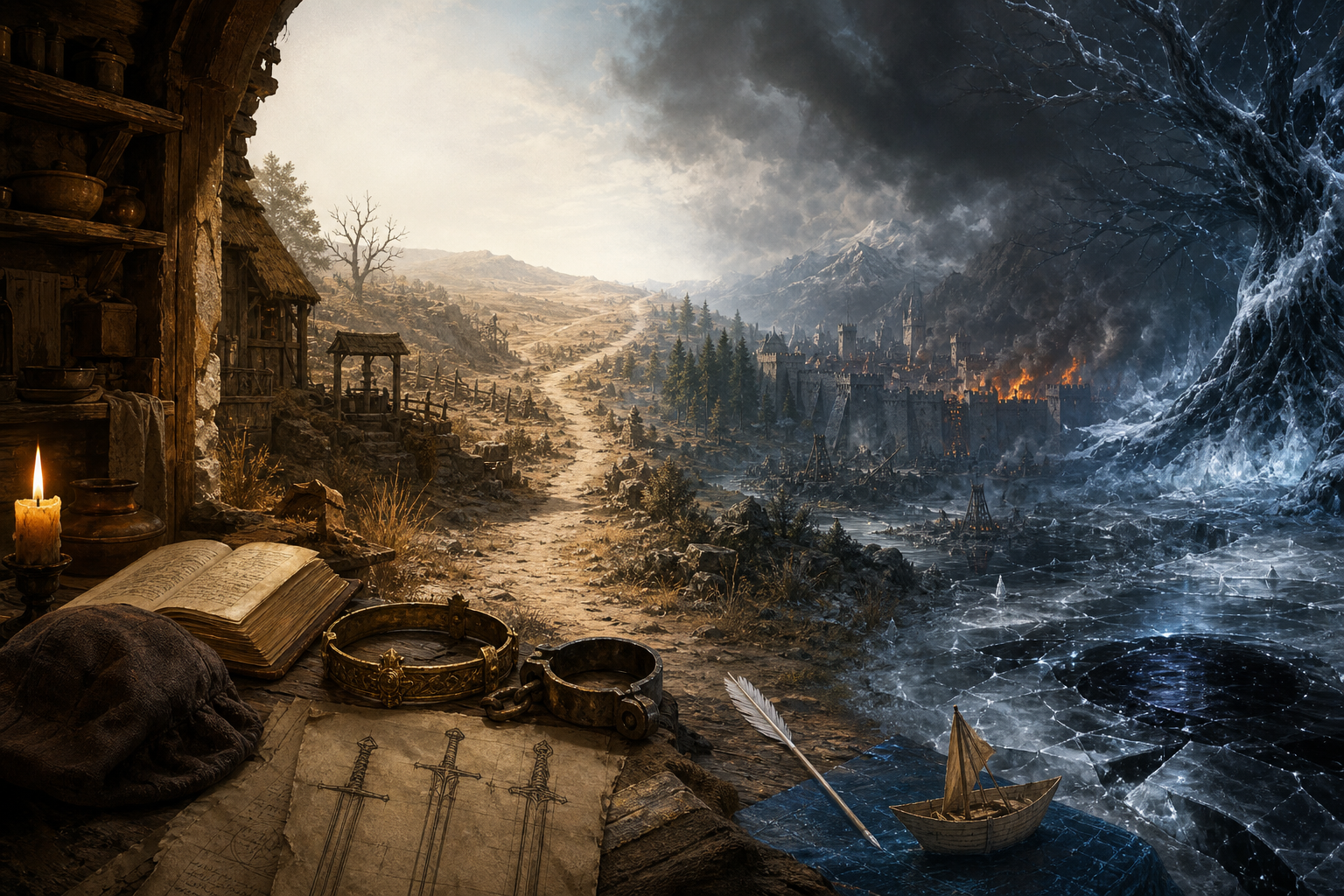
What changed every time I looked back
The “nothing is happening” book is quietly loading the floor with dragon bones
The first time through, The Dragonbone Chair can feel like Tad Williams invited us into a castle, handed us a candle, and then made us inspect every pantry before admitting the apocalypse was downstairs. On the completed read, the pantries are the point. This story is obsessed with who cleans a kingdom, who remembers its old names, who gets to call conquest righteous, and who notices the whisper inside a wall before the important men finish arguing about banners.
Fourteen-year-old Simon begins as a problem everybody has learned to step around. Rachel considers him lazy. The other servants consider him ridiculous. Morgenes sees intelligence but refuses to turn that intelligence into the heroic shortcut Simon wants. Simon himself has swallowed the general verdict: if greatness has not already recognized him, perhaps greatness is simply being slow. He wants the storybook version of usefulness—sword, message, danger, applause—because carrying wood and learning letters feel insultingly small.
Then King John enters the throne room and cries on the Dragonbone Chair. That scene tells us exactly what sort of fantasy we are reading. The legendary dragon-slayer cannot lift a cup. The chair is built from the bones of Shurakai, which means the kingdom’s most famous symbol of human victory is also a preserved corpse. John’s triumph has become furniture, his sons are already fighting over the room, and the old story cannot keep the new world alive merely by being beloved.
That is why the opening matters more after the ending. Simon survives Igjarjuk not by becoming a better legend than John. He survives dragon-immensity by remembering the embarrassingly ordinary name of the child he had been. The book starts with a king unable to escape the heroic identity everybody built for him. It ends with a boy refusing to let a dragon erase the small identity everybody else dismissed.
The part where I stopped reviewing politely
Yes, the book is slow. The question is whether the slowness is doing labor.
Let us not perform the sacred-fantasy ritual where every pacing complaint gets declared evidence that the reader is spiritually unfit for worldbuilding. The Hayholt material is patient enough to test knees. Simon wanders, shirks work, eavesdrops, misunderstands adults, gets distracted, and repeatedly fails to become the exciting person he has ordered from the universe. There are stretches where the book enjoys corridor atmosphere longer than I need it to.
But the completed structure earns most of that bill. The Hayholt must become a home before escape hurts. Rachel must be more than a comic disciplinarian before Simon’s dragon-vision reaches for her as one of the warm lives holding him to himself. Morgenes must teach Simon that books are magic and traps before a blood-marked manuscript becomes the object Jarnauga saves from Naglimund. Towser’s memories must feel like a lonely old man’s digressions before the series reveals memory as a political weapon.
The road north uses the same method. Binabik does not arrive as a portable lore dispenser. He feeds Simon, teases him, makes errors, withholds a crime, chooses obligations, and slowly becomes the person whose absence hurts. Jiriki does not arrive to certify Simon as Special Boy Number One. The White Arrow creates a debt that Simon does not understand, then becomes a test of whether privilege is still freedom when it abandons everybody else. Simon refuses to leave his companions. That choice matters because the novel has spent time making companionship more valuable than prophecy.
The pacing works least when transition feels like suspension rather than accumulation. Some travel beats restate cold, hunger, fear, and distance after the point has landed. A tighter book could preserve the emotional geography while losing pages. But the popular caricature—that hundreds of pages pass before anything happens—confuses explosions with events. John’s funeral, Elias and Josua’s practice-sword confrontation, Pryrates murdering a puppy, Morgenes refusing Simon’s forged destiny, Miriamele rejecting the marriage assigned to her, and the first whisper promising to take everything back are events. They simply happen to people before they happen to armies.
Who actually carries what
Simon is the center, but the book refuses to let “center” mean “only person with a life”
The mooncalf learns that adulthood is not a costume
He lies, sulks, longs, learns, fails, loves, and finally acts without waiting for a bard to confirm the pose. His largest victory is retaining himself.
The princess authors her own aliases
Malachias and Marya are not duplicate characters. They are survival tools created by a girl refusing Fengbald, Pryrates, Elias, and even well-meaning allies the right to route her body.
The funny guide has a jurisdiction waiting at home
He is competent without becoming infallible, gentle without becoming harmless, and loyal while carrying a crime serious enough to end Book 1 under sentence of death.
The prince becomes political after losing the fortress
His crown claim is not born in a cheering hall. It is born above burning Naglimund while he leads frightened people into exile with one hand and no army worth romanticizing.
Domestic authority is still authority
She begins as the person blocking Simon’s fun and becomes one of the people his soul reaches for at the edge of nonhuman eternity. The book understands that care often wears an apron and sounds annoyed.
Grief is an explanation, never an acquittal
He loves Hylissa, loves Miriamele possessively, resents Josua, wants certainty, and accepts Sorrow. His pain is real. So are the people crushed beneath the machinery he commands.
Miriamele deserves special emphasis because fantasy coverage often reduces her to “female lead who eventually ends up with Simon,” which is a crime against reading comprehension. In Book 1, they are emotionally linked, not yet a settled romance. Simon carries her blue scarf and sees her in the Sithi mirror. Miriamele is elsewhere trying to prevent a war, escape a coerced future, and survive adults who interpret access to her as governance.
Her disguises matter. Cropping and dyeing her hair, traveling as Malachias, and using Marya are decisions about mobility. She is a princess in a system where rank makes her visible and powerless at the same time. The book does not pretend every choice is wise. It does insist the choices are hers.
Josua’s treatment of Elias is the uglier mirror. He keeps trying to recover the brother inside the king. In the green tent he offers himself, Naglimund, and a search for Miriamele if Elias will cast Sorrow away. It is brave, loving, politically disastrous, and completely consistent. Jarnauga tells him he may be stretching memory into excuses. Correct. Love explains why Josua goes. It does not transform remembered honor into a security protocol.
The receipts under the legend
Human history keeps calling itself civilization while standing in somebody else’s house
The Hayholt is Asu’a wearing a new name. That fact is not a surprise garnish saved for a lore wiki. It is the novel’s central political architecture. Human kings occupy a Sithi city, decorate it with human victories, and inherit rooms whose older purposes remain active beneath them. The physical setting refuses the clean succession story the rulers prefer.
King John remembers expelling the Sithi as righteous necessity. Morgenes supplies the material underneath: iron, plunder, invasion, slaughter, retreat. Jiriki later answers Rimmersman nostalgia with the same correction. The Rimmersmen remember the western home they lost; the peoples displaced by their eastern arrival remember something else. Everybody has grief. Grief does not grant sole ownership of the historical sentence.
This is where the three swords become more than a fetch quest. Minneyar is sea-iron shaped through murder and memory. Sorrow is witchwood poisoned by iron, forged by Ineluki to save his people, and first used against the father who tells him salvation cannot cost the world’s soul. Thorn is black star-metal, physically alien, impossibly heavy until it chooses otherwise. The title names objects, but each object is history made portable and dangerous.
The prophecy works because the book slowly converts atmosphere into a checklist. Summer frost, moving shadows, blackened water, Bukken, Hunën, nightmare-strangled sleep, and the swords themselves enter the plot one by one. Nisses does not exist to make vague lines sound expensive. The riddle becomes operational without surrendering its ambiguity.
What works
The book makes convergence feel earned instead of scheduled
The emotional callbacks arrive carrying new information
Simon’s final declaration before striking Igjarjuk pays off Jiriki’s explanation of wolf-song: “I am; here I am.” The line is not inspirational wallpaper pasted onto the dragon fight. Simon converts the lesson into his own name. Likewise, Morgenes’s teaching about building a home inside one’s head becomes survival equipment on Urmsheim. The book rewards memory because memory is one of its subjects.
The villains do not all occupy the same moral temperature
Pryrates enjoys cruelty as practice. Elias is grief, entitlement, fear, and appetite weaponized through kingship. Utuk’ku operates at a civilizational scale where mortal allies are temporary instruments. Ingen Jegger brings professional devotion to monstrous work. Benigaris murders his father from behind and expects a banner to launder the story. These people cooperate without becoming interchangeable.
Wonder and horror share machinery
The Sithi mirror offers true summer in lost Enki-e-Shao’saye and also demonstrates that dream, distance, past, and perhaps future can be entered sideways. The White Arrow is beautiful gratitude and a binding obligation. Thorn is exquisite and apparently willing. The Dragonbone Chair is a triumph and a corpse. Williams rarely lets beauty arrive without asking what made it and what it wants.
The finale refuses the fake victory lap
Simon finds Thorn. Naglimund falls. Josua claims the crown after losing nearly everything. Miriamele escapes Elias but sails toward uncertainty. Binabik reaches home and becomes a prisoner. The quest succeeds, and success opens worse doors. That is exactly how a first volume should end when it belongs to a larger architecture.
What does not
Patience is a structural virtue, not diplomatic immunity
Some early Simon material repeats the same emotional note: bored, resentful, dreaming of adventure, ducking work. The repetition helps establish the boy’s immaturity and the castle’s routines, but the book occasionally collects more proof than the case needs. Readers who bounce are not hallucinating the drag.
The geographic and political density is thrilling once the factions start colliding, but names can arrive before their narrative weight. The owned-edition appendix helps, and our character directory will help more, but a reference section is not retroactive clarity. Some minor nobles and soldiers become distinct only at the moment they bleed.
The women have agency, but the story still places too much of their danger inside men’s decisions about marriage, protection, legitimacy, and possession. Miriamele fights that system; Vorzheva fights it; Maegwin inherits catastrophe; Rachel resists from domestic space. The critique exists inside the novel, which matters. It does not mean the experience stops being exhausting.
And yes, withholding is overused. Morgenes, Binabik, Jiriki, Jarnauga, and several supernatural mechanisms know things Simon needs. Sometimes silence protects him or reflects real limits. Sometimes it feels like the adults have formed a committee devoted to making the teenager walk into danger with exactly half a noun.
The ending and what it changes
Naglimund falls outside while Simon fights disappearance inside
The Harrowing is the political climax. Elias withdraws the human army, leaving a field so empty it reads as surrender. Josua knows better, but knowledge does not become enough time. The northern storm arrives with Norns, Hunën, the Red Hand, and Bukken already erupting inside the gardens. The Red Hand does not batter the gate like ordinary besiegers; it changes the rules around the gate.
Named deaths prevent the spectacle from floating free of consequence. Ostrael, the terrified young soldier Josua brought to the green-tent parley, dies under the assault. Eadgram bleeds out standing. Brother Eglaf is taken from prayer. Bishop Anodis clings to obedience until the creatures beneath the soil make his theology physically absurd. Jarnauga saves Morgenes’s blood-marked manuscript, gives Strangyeard the League token, calls him friend, and closes the final door from the wrong side.
Then the novel cuts from a fortress becoming hell to Simon becoming dragon. Igjarjuk’s blood expands his consciousness until the earth feels like body and human lives feel like sparks. The temptation is not evil in the cartoon sense. It is scale. Why return to one frightened body when one can feel the spinning world?
Because Rachel is sitting alone. Because Miriamele is at sea. Because Josua is watching Naglimund burn. Because Morgenes is still warning him. Because the gawky boy existed, and his existence matters even without grandeur. Simon remembers his name.
He wakes marked: scar across the face, hair turned white in a long streak, beard beginning, Thorn nearby. The body now displays growth as damage, survival, and transformation at once. He does not look like the opening scullion. He is not allowed to stop being him.
Final take
The slow road earns its avalanche
The Dragonbone Chair is not flawless, and “classic epic fantasy” is not a spell that turns every detour into sacred architecture. It is long. It repeats itself. It withholds information until the adults should be fined. Some readers will correctly decide the opening pace is not how they want to spend their mortal hours.
But the completed book knows what it is building. The castle routine becomes attachment. The old stories become contested evidence. The swords become manufactured history. The comic guide becomes a beloved prisoner. The princess turns disguise into authorship. The one-handed prince loses his fortress and finally claims responsibility for a kingdom. The boy everybody calls mooncalf faces a dragon and wins by remembering that being Simon is not a consolation prize.
That is the verdict: the book asks for patience, charges interest, and then pays in character, history, horror, wonder, and an ending that makes the next volume feel necessary rather than merely available.
On the record
What this review covers
Return to the Book 1 hub → · Open the complete Book 1 character directory → · Open the series hub → · Read Tad Williams’s profile →
Original character-free review artwork stored locally in the CVM Sekai Media Library. Editorial interpretation is CVM Sekai’s own.