
RaeRae Reacts · One Piece Episode 223
Zoro’s Strength Loses Its Guiding Loyalty
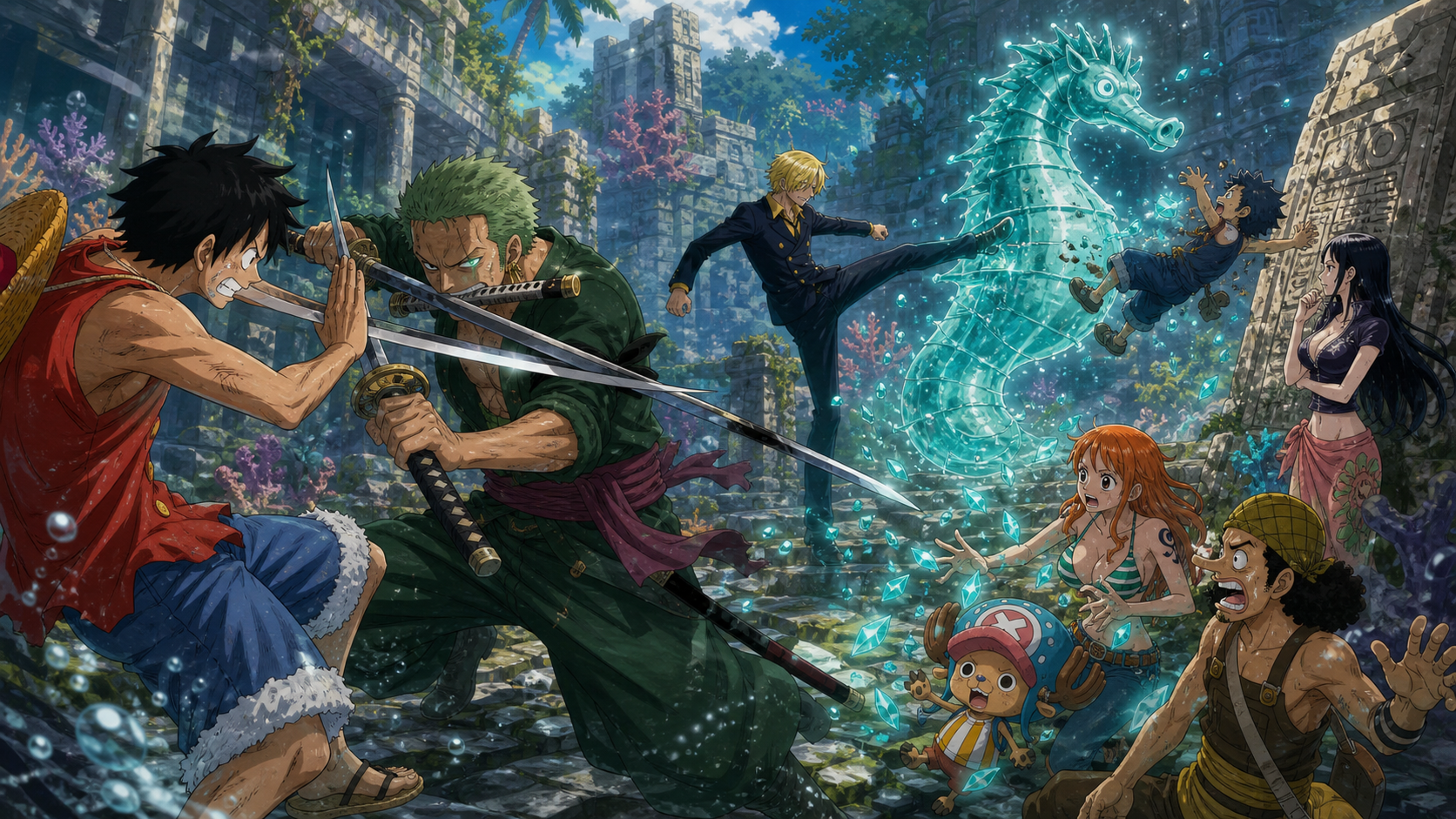
One Piece Episode 223 turns Zoro against Luffy while Robin and Sanji expose the memory-eating seahorse hiding behind the horn boy.
Bottom line: Zoro’s strength becomes terrifying when loyalty loses its history
One Piece Episode 223 turns Zoro against Luffy and proves that the swordsman’s loyalty never came from strength alone. The horn boy strips away shared memory, adds hypnosis, and leaves the crew facing the same body without the judgment that normally guides every blade. Luffy stays behind because he remembers who Zoro is even when Zoro cannot. That makes the fight less about winning and more about refusing to treat a stolen friend as an ordinary enemy.
Meanwhile, Robin’s investigation pays off at the Sea God’s Palace. The cloaked boy is involved, but the seahorse-shaped horn is alive and feeding on memory. Sanji’s kick separates child from creature, the boy loses his own stolen context, and the real thief finally becomes visible. I like the idea more than the execution. The creature is broad filler comedy. The distinction between manipulated participant and predatory system is much better than broad filler comedy has any right to be.
Episode facts and the revealed thief
Episode 223 aired in Japan on February 27, 2005. Junki Takegami wrote the screenplay with assistance from Hito Koyama. Hidehiko Kadota directed the episode, Kenji Yokoyama served as animation director, and Miyuki Sato and Fumihiro Uchikawa handled the art direction. The official title focuses on Zoro baring his fangs and standing before the crew like a wild beast.
This is the fourth chapter of the five-episode Ocean’s Dream story. The arc is anime-original and inspired by the PlayStation game. Episode 223 supplies the confrontation the previous episodes prepared: a divided crew, a controlled swordsman, one restored captain, one investigator who knows the visible answer is incomplete, and a memory predator waiting inside the route to the palace.
The forest makes every missing relationship harder to read
The crew moves through dense forest toward the Sea God’s Palace. Usopp and Chopper get chased by a snake and become separated from the others. That detour is played for tension and comedy, but separation matters because the group still lacks a stable shared history. Every split removes witnesses, context, and the reassurance of familiar roles.
Usopp and Chopper then encounter Zoro. He behaves awkwardly and keeps emotional distance. They cannot read the warning as quickly as their usual selves might because they do not remember his normal rhythms. A familiar silence would tell the complete crew something. To these half-strangers, silence is only another unknown.
Zoro recognizes Luffy as a target instead of a captain
When Zoro sees Luffy, hypnosis supplies a purpose for the strength memory loss left intact. He attacks with his swords drawn and intent sharpened. The crew recognizes that something is wrong, but recognition does not stop steel.
The scene works because Luffy knows the missing relationship from both sides. He remembers recruiting Zoro, trusting him in battle, hearing his promise after Mihawk, and watching him carry the crew’s danger without asking for applause. Zoro remembers none of those choices. Luffy has to fight with knowledge his opponent cannot share.
Luffy sends everyone forward because the mission still matters
Luffy tells the others to continue toward the palace while he stays with Zoro. That decision divides the work correctly. Robin’s group can reach the source of the theft. Luffy can prevent Zoro from cutting through the only people capable of ending the attack.
Captaincy becomes delegation under pressure. Luffy does not need every person beside him to prove courage. He gives Robin room to finish the investigation and accepts the personal cost of holding Zoro back. The plan is not elegant. The plan respects everybody’s job.
Oni Giri lands because Luffy refuses to see a disposable enemy
Zoro uses Oni Giri and brings Luffy down. The strike reminds viewers that trust normally protects the crew from one another’s full capabilities. Zoro does not become stronger under hypnosis. The usual limits disappear.
Luffy’s reluctance also matters. He can hit a hostile pirate without carrying years of affection into every movement. Zoro is different. Defending himself and rescuing Zoro occupy the same fight, and those goals do not always demand the same force. The episode may not animate the duel with the weight of a major canon battle, but the emotional problem is clear.
Nami gives the amnesiac crew a reasonable warning
On the route to the palace, Nami argues that Luffy and Robin could be lying. From her position, the warning is sensible. Two people claim to remember a relationship that everybody else cannot verify. One claims captaincy. The other directs the group deeper into an unfamiliar island. Caution is not betrayal when consent has been damaged.
The episode deserves credit for letting Nami say the uncomfortable thing. Fans know Luffy and Robin are trustworthy here. Sanji, Usopp, and Chopper do not have access to fan knowledge. They have to decide whether the evidence, the active memory loss around town, and their own instincts support continuing.
Sanji, Usopp, and Chopper choose Robin without pretending certainty
The three men continue with Robin. Their choice is not blind faith in a recovered biography. Robin has consistently separated observation from theory, admitted what she does not know, and updated her explanation when the stone revealed a deeper source. Her method earns enough trust for the next step.
This is one of the arc’s better quiet victories. The crew members do not remember loving one another, yet they can evaluate conduct happening in front of them. Robin treats them as people rather than possessions the captain needs returned. That respect helps them choose the search.
Nami follows the gold and accidentally follows the crew
Nami initially remains behind, then follows because Sanji is carrying her gold. The joke protects her pride. She does not have to announce that Robin’s reasoning affected her or that Luffy’s certainty feels strangely difficult to dismiss. Money supplies a practical excuse.
That excuse fits Nami better than a sudden emotional confession. Her relationship with the crew often hides care inside budgets, threats, routes, and complaints. Even without memory, she moves in the same direction because something she values is already traveling with them. The gold is real. The emerging attachment may be real too.
Robin turns legend into a working theory
At the Sea God’s Palace, Robin explains the story of a creature that survives by consuming memory. The legend connects the carved warning, the island’s damaged population, the shared dreams, and the horn. Archaeology provides more than flavor. Old testimony becomes evidence for a current threat.
Robin does not treat legend as unquestionable fact. She uses the account because the observed pattern matches. That approach distinguishes cultural memory from decorative lore. The island remembered the danger in stone after individual witnesses disappeared. The warning survived long enough for one reader to restore meaning.
The cloaked boy looks guilty because somebody else uses him
The boy approaches Nami and Usopp near the palace. He has carried the seahorse, appeared during attacks, and helped direct victims. Every visible clue points toward him. Sanji responds when the danger reaches Nami, launching a kick that sends the boy away from the creature.
The separation changes the case. The horn is not an object. The seahorse has agency, appetite, and control. The boy was participating, but participation existed inside manipulation. That does not erase every action. The revelation changes how responsibility should be assigned.
Sanji’s kick breaks the partnership and exposes the predator
Sanji’s attack interrupts the seahorse’s hold and knocks memories loose. The boy becomes confused after losing the context he carried and flees. His sudden vulnerability mirrors the harm inflicted on the island. A person who helped steal memory now experiences a blank world.
Sanji then catches the seahorse and beats the creature until more stolen memories return. The method is direct, physical, and very Sanji. Robin identifies the structure. Sanji makes the structure cough up what belongs to the victims.
The memory fragments return through force, not forgiveness
As the seahorse releases what was consumed, Sanji, Usopp, Chopper, and Nami regain their shared lives. Relationships flood back with the adventures, arguments, meals, losses, and promises attached. The scene moves quickly because the final episode still needs a larger counterattack.
I wanted more time with the emotional impact. Nami has just regained Arlong Park, her rescue, Alabasta, Skypiea, and the knowledge that the irritating people beside her are home. Chopper has regained his departure from Drum Island. Usopp remembers Kaya’s gift becoming their ship. Sanji remembers Zeff’s goodbye and every meal afterward. A few extra breaths would have helped.
Memory returns, but the crew still asks whether Zoro returned
The others immediately wonder about Zoro. Recovery does not count as complete while one person remains under the thief’s influence. Their concern proves the family structure faster than another celebration could. Restored memory points outward.
Sanji prepares to fight when Zoro approaches. His suspicion is reasonable because Zoro’s expression and posture still look hostile. Their rivalry returns with memory, but rivalry now carries the knowledge that each man protects the same crew. The tension works because affection does not make either of them sensible.
The seahorse uses Chopper’s voice as another stolen tool
The captured creature communicates through Chopper and announces a last resort. Using the doctor as a channel extends the violation. The seahorse does not only consume memory. The creature borrows bodies and relationships to deliver its threat.
The warning prevents the recovery from becoming an early ending. The crew knows the culprit, has regained most memories, and has reached the palace. The thief still holds enough power to attack through the very histories everyone just recovered.
Zoro and Luffy fight with an imbalance only the audience understands
Zoro fights to prove strength under a false direction. Luffy fights to preserve a bond grounded in real history. Both men bring familiar stubbornness, but the motives are not equal. Hypnosis has taken Zoro’s ability to judge the challenge.
This is why I do not read the duel as a fun answer to “who would win?” The setup removes consent and context from one fighter. The result tells us more about the danger of redirected loyalty than any honest comparison of power.
The real monster is appetite without relationship
The seahorse eats memories to survive and grow. Every victim becomes storage. Their grief, love, knowledge, and history matter only as fuel. That appetite stands opposite Luffy’s famous hunger. Luffy eats enormous meals but builds relationships with the people who feed him. The seahorse consumes the relationships themselves.
The contrast gives the creature a thematic job beyond being strange. One appetite creates shared tables and debts of care. The other leaves communities unable to recognize one another. Hunger is not automatically innocent or evil. The relationship around consumption decides who carries the cost.
What changed when I replayed the episode
On the first watch, I focused on Zoro attacking Luffy and Sanji kicking the culprit. On replay, Nami’s warning became the most important conversation. She asks the amnesiac crew to consider whether two confident people may be controlling them. That is exactly the question people with missing memories should ask.
Robin earns trust because she does not punish the question. Her evidence keeps holding. The others choose her route. Nami follows without surrendering her practical reason. The sequence respects skepticism while still allowing collective action.
The production carries two climaxes without fully breathing between them
The episode crosscuts between Luffy and Zoro in the forest and the palace revelation. The structure keeps pressure on both the physical obstacle and the mystery answer. Zoro’s blades provide danger while turquoise memory fragments make the theft visible.
The pace becomes crowded once Sanji exposes the seahorse. The boy loses memory, the creature is caught, several crew members recover, Zoro returns, and the last resort is announced in quick succession. The momentum works for a weekly cliffhanger. The emotional recovery deserves more room than the episode gives.
RaeRae’s verdict
Episode 223 gives the Ocean’s Dream arc its strongest conflict because every action tests the difference between power and relationship. Zoro’s strength without judgment threatens the crew. Luffy’s memory turns strength toward rescue. Robin’s evidence creates voluntary cooperation. The seahorse consumes lives without recognizing the people inside those lives.
The episode remains visibly anime-original, with a broad creature reveal and a compressed return of memory. The character logic carries the rough machinery. A crew is not safe because everybody is powerful. A crew is safe when powerful people remember why they chose one another and keep renewing that choice. Episode 223 takes that protection away, then makes the Straw Hats fight to restore more than facts.
Official source and next route
The official ONE PIECE episode guide confirms the February 27, 2005 broadcast date, production credits, Zoro confronting the crew, Luffy staying behind to stop him, and Sanji kicking the true seahorse culprit. Continue through the bounded Ocean’s Dream directory for Episode 224 and the memory thief’s final counterattack.