
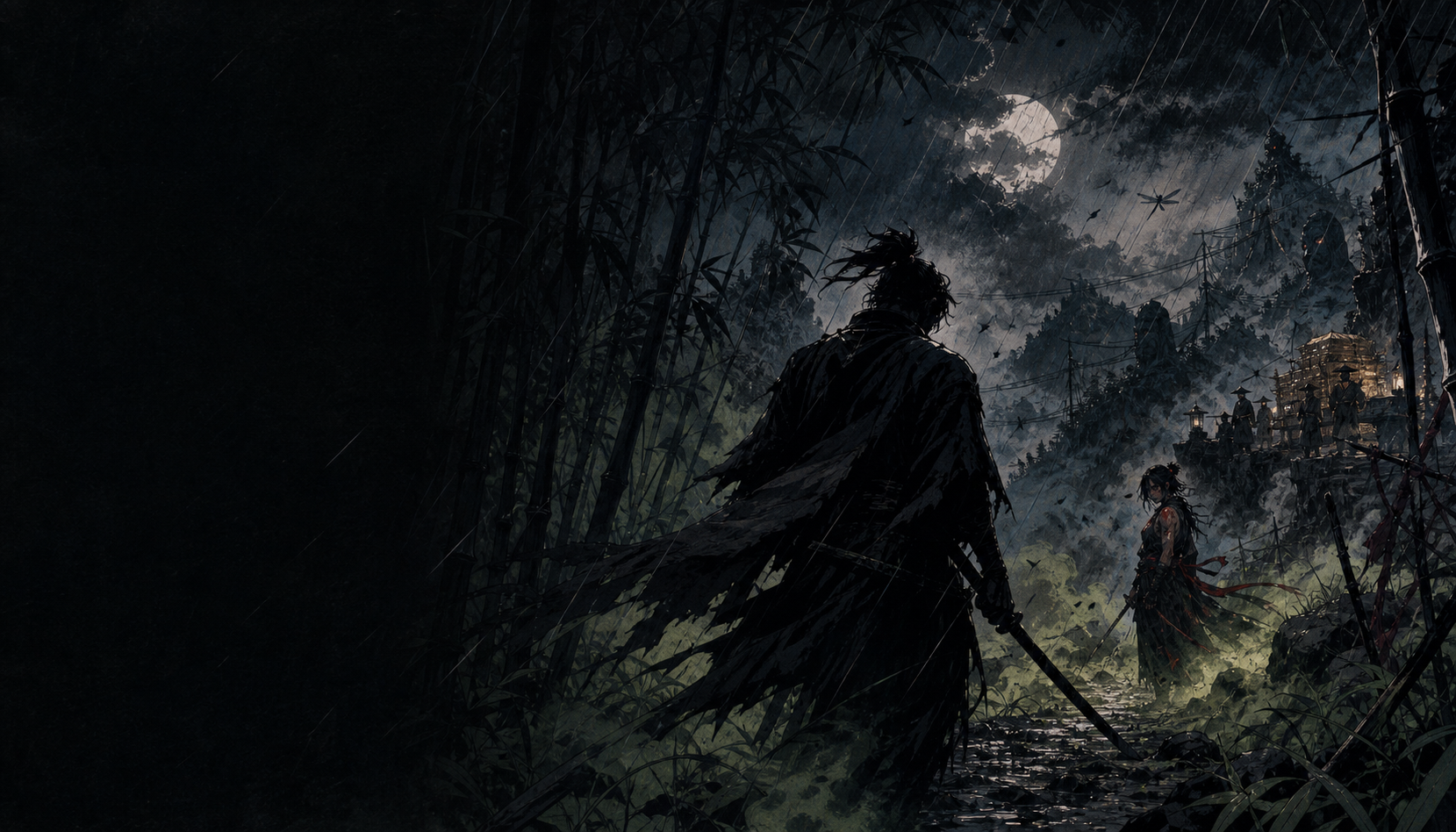
Ninja Scroll
A wandering swordsman, a poisoned woman, and a government spy cross a landscape where every ruler treats human bodies as equipment.
Ninja Scroll became a Western VHS-era initiation ritual partly because the movie looks dangerous from the first minute. Heads leave bodies. Bamboo becomes a weapon. Monsters move through shadows. Sexual violence, poison, plague, gold, and political betrayal arrive with almost no protective distance. Yoshiaki Kawajiri built an action film with extraordinary visual control, then filled that control with material that deserves more than nostalgic applause.
The film’s influence cannot be separated from the way overseas distributors sold anime during the 1990s. For many English-speaking viewers, Japanese animation arrived as proof that cartoons were not for children. Ninja Scroll supplied the blood-soaked evidence. That marketing opened doors and narrowed expectations at the same time. Anime could be adult, but “adult” often became shorthand for sex, gore, and cruelty. A serious review has to hold both truths: the film is a master class in animated action, and the film repeatedly uses a woman’s violated body as atmosphere, motivation, threat, and spectacle.
Inside this review
- My actual reaction
- The political machine beneath the monsters
- Jubei and the fantasy of independence
- Kagero deserves a harder reading
- The Eight Devils as political bodies
- How the action works
- Sexual violence and exploitation
- Key scene analysis
- The ending
- The Western VHS legacy
- Industry and cultural impact
- What aged well and what did not
My actual reaction: beautiful control inside an ugly world
Kawajiri’s command of movement becomes apparent immediately. Characters do not simply trade blows. They read terrain, test distance, hide information, and exploit physical limits. A sword can redirect force. A branch can become cover. Rain can reveal a body. Each supernatural ability produces a tactical problem rather than an unlimited power level.
That precision makes the film thrilling and morally uncomfortable. The same director who knows exactly when to withhold a sword strike also knows exactly how long an image of threat will linger. Craft does not neutralize content. Craft gives content force. When the material turns exploitative, technical skill can deepen the problem.
The best moments treat violence as information. Jubei learns through survival. Kagero calculates poison. Dakuan allows other people to absorb danger before revealing his plan. The Devils expose abilities gradually. Every encounter changes what the characters know. The weakest moments treat suffering as proof that the world is adult.
The political machine beneath the monsters
The plot follows Jubei Kibagami, a wandering swordsman forced into an investigation by Dakuan, a Tokugawa government spy. A plague has supposedly destroyed Shimoda village. The plague is a cover. The Devils of Kimon are moving gold connected to a hidden mine while their leader, Gemma Himuro, builds power through intrigue.
That summary can sound like a sequence of boss fights, but gold gives the monsters a political purpose. Supernatural bodies do not seek chaos for their own sake. Gemma uses them as covert labor in a struggle over wealth and authority. The monsters belong to a recognizable system of extraction.
The Tokugawa side is hardly clean. Dakuan poisons Jubei to secure cooperation. Government intelligence treats an independent fighter as a disposable asset. Both factions rely on secrecy, coercion, and deniable violence. The difference concerns which hierarchy receives the gold. Shimoda’s dead villagers reveal the cost. Powerful men contest resources while ordinary people become a cover story. “Plague” transforms political murder into natural disaster. Such language protects perpetrators by making victims seem unfortunate rather than targeted.
Kagero’s clan operates within the same logic. Her immunity to poison makes her valuable and isolates her from ordinary intimacy. The clan uses her body as an instrument. Gemma’s agents use bodies as weapons. Dakuan uses bodies as leverage. The whole story asks what remains of personhood when institutions reward usefulness and punish need.
Jubei and the fantasy of staying independent. Jubei enters as a ronin who sells skill without pledging permanent loyalty. That independence looks morally cleaner than service to corrupt lords. Freedom still depends on constant movement, marketable violence, and enough strength to reject bad terms. His past with Gemma explains the cost of hierarchy. Gemma manipulated Jubei’s comrades into killing one another. Jubei beheaded him and left. The apparent victory failed because Gemma can reconstruct his body. Personal revenge cannot end a system capable of reproducing leadership.
Jubei’s wire-assisted sword technique gives him range while preserving tactical limits. The weapon returns because he controls tension and angle. Visually, the technique turns a familiar sword into a relationship between body and space. He survives by understanding connection, despite claiming to live alone. Dakuan’s poison destroys the fantasy of pure independence. Jubei can refuse verbally, yet chemistry has already entered his body. Coercion makes the contract. The sequence mirrors broader labor relations in the film: those with institutional knowledge can impose risk on those whose bodies perform the work.
His growing care for Kagero challenges isolation. He listens, protects, argues, and eventually recognizes the humanity her clan reduced to function. The film sometimes slides toward making her death primarily meaningful for him. Still, their connection reveals a Jubei capable of more than detached competence.
Kagero deserves a harder reading than “tragic kunoichi”
Kagero is a skilled operative whose body has been altered through constant exposure to poison. She can kill through intimacy, making closeness dangerous. The premise turns a gendered history of using women as covert tools into literal body horror. Her immunity saves Jubei when she removes poison from his body. That act connects the thing that isolates her to an ability to preserve another person. The story could have developed a profound argument about bodily autonomy, disability, and institutional exploitation. Instead, Kagero receives limited space before death.
She is not passive. She tracks, fights, resists, and makes choices under pressure. Her anger at being rescued reflects professional pride and long practice in environments where vulnerability gets punished. Her attraction to Jubei grows alongside recognition that he does not treat her as a tool. The film nevertheless surrounds her with sexualized danger. Assault establishes Tessai’s brutality. Yurimaru weaponizes desire and jealousy. Her poisoned body makes sex fatal. Kagero’s narrative keeps returning to intimacy as threat, while male characters receive broader relationships to violence and ambition.
Her final moments aim for tenderness. She imagines a different life and gives Jubei her headband. The scene works because Emi Shinohara’s performance gives exhaustion and longing weight. The writing also converts an exploited woman into emotional fuel for the surviving man. Both readings belong in the room. A modern adaptation could preserve her poison condition while granting her goals beyond clan duty and romance. She could investigate the system that made her, form alliances, and survive long enough to decide whether intimacy must define healing. The original shows the outline of that richer character and then closes the path.
Dakuan is funny because the state learned charm. Dakuan looks frail, speaks lightly, and moves with absurd agility. His comic energy makes manipulation easier to accept. He poisons Jubei, withholds information, and frames coercion as practical necessity. That combination makes him more interesting than a trustworthy mentor. Dakuan serves order, not friendship. He may respect Jubei and Kagero, but respect does not stop him from spending their lives strategically. His small body contrasts with the Devils’ exaggerated forms. He survives through knowledge, timing, and institutional mandate. Power does not always look muscular. Sometimes power knows the map, the antidote, and the mission before everyone else. The comedy prevents the espionage plot from becoming unbearably grim. Comedy also risks softening abuse. Viewers should notice both effects. Dakuan’s charm belongs to his arsenal.
The Eight Devils turn social functions into monstrous bodies
Each Devil possesses a distinct bodily principle. Tessai turns skin to stone. Benisato controls snakes and sheds her skin. Mushizo weaponizes wasps. Utsutsu Mujuro sees without sight. Shijima moves through shadows. Zakuro turns corpses into explosives. Yurimaru conducts electricity through wire. Gemma rebuilds damaged flesh. The designs make action legible because every opponent changes the rules. Stone demands leverage. Swarms demand protection and environmental thinking. Invisible movement demands sensory attention. Regeneration demands more than cutting.
The group also resembles a bureaucracy of specialized violence. Each member performs one function for Gemma. Their extraordinary bodies become departments in a covert organization. Individual monstrosity serves centralized ambition. Gemma’s regeneration represents institutional persistence. A tyrant can lose a head and return because the conditions supporting tyranny remain. His body absorbs damage the way a regime absorbs scandal, replacing visible injury with continued command.
The Devils’ internal loyalties remain unstable. Desire, jealousy, rivalry, and fear disrupt discipline. Gemma uses those weaknesses while presenting himself as immortal order. The organization’s power rests on people who cannot trust one another. Some designs rely on gendered grotesquerie more than others. Male bodies become stone, insects, shadow, or wire. Female bodies become sexuality, skin, jealousy, and explosive corpses. The imbalance reveals the assumptions shaping adult animation during that period.
How the action works
Kawajiri stages combat around anticipation. A pause establishes distance. A small movement reveals intention. The cut arrives quickly. Aftermath receives enough time for the audience to understand cost. The bamboo fight with Tessai remains the clearest example. Vertical stalks divide the frame. Moonlight creates alternating visibility. Tessai’s stone weight bends the environment. Jubei cannot win through a stronger swing, so he uses a sword already embedded in the opponent and the force of Tessai’s own movement.
Utsutsu Mujuro’s duel changes rhythm. Blindness does not reduce the swordsman. Sound and pressure define space. Jubei respects his skill, and the encounter briefly escapes the uglier politics surrounding them. Two professionals test ability without torture or spectacle. Mushizo’s wasps turn the body into habitat. Jubei uses water and fire to change conditions rather than duel every insect. Strategy expands beyond direct contact.
The final ship fight combines confined space, fire, molten gold, and regeneration. Wealth becomes lethal material. Gemma pursues gold so completely that gold helps seal his fate. The symbolism is blunt and visually satisfying. Limited animation becomes an advantage when composition carries movement. Kawajiri can hold a threatening pose, snap into a decisive action, and use effects animation for impact. Fluidity matters less than timing and clarity.
The sexual violence cannot be waved away as “the era”
Tessai’s assault on Kagero establishes his cruelty and her poisoned defense. Narrative purpose does not settle ethical presentation. The camera prolongs exposure, turning a character’s terror into material for the viewer. Defenders sometimes argue that the scene shows evil rather than endorsing evil. Representation involves more than moral labeling. Framing, duration, point of view, and repetition determine whether a film witnesses harm or packages harm as sensation.
Kagero’s condition further ties sexuality to death. Her body has been made toxic by duty. The premise expresses profound alienation, yet the movie often seems more interested in tragic eroticism than her interior response. Yurimaru and Benisato receive sexuality as central characterization, while male Devils receive powers less tied to desirability. Such choices reflect a genre marketplace where adult content targeted presumed heterosexual male viewers.
Criticism does not require pretending the whole film lacks value. Mature viewing means refusing the bargain that technical brilliance buys immunity. A scene can be influential, narratively functional, and exploitative at once. The 4K restoration raises the question again. Preservation should not sanitize history. New presentation should include context, accurate content warnings, and criticism that treats Kagero as more than a collectible image from “edgy” anime.
Historical fantasy, samurai cinema, and the invented ninja. The film takes loose inspiration from the historical swordsman Yagyu Jubei and traditions of jidaigeki and chanbara cinema. The title Jubei Ninpucho signals a fictional scroll of ninja arts rather than documentary history. Historical shinobi work involved intelligence, infiltration, communication, disguise, and survival. Pop culture increasingly transformed ninja into black-clad supernatural assassins. Ninja Scroll embraces fantasy while retaining espionage, divided loyalties, and covert state violence.
The Tokugawa setting supplies a centralized order shadowed by rival domains and secret operations. Gold becomes political power because wealth can fund rebellion. Plague cover stories and village destruction fit the film’s paranoid vision more than a documented incident. Kawajiri draws from samurai-film grammar: lone wanderer, corrupt authority, doomed ally, skilled rival, and climactic duel. Supernatural bodies amplify familiar types rather than replacing them.
International audiences sometimes treated the movie as a window into ancient Japan. Such reception says more about distribution than accuracy. Exotic violence traveled easily because marketers could sell “forbidden Japan” beside cyberpunk futures. A responsible reading can appreciate cultural references while naming invention. The film belongs to modern genre history, not a recovered record of ninja life.
Kaoru Wada gives the violence weather. The score uses percussion, winds, strings, and ominous space to connect action with landscape. Music rarely turns Jubei into a clean superhero. Threat remains larger than one fighter. Rain performs almost as another instrument. Water reveals surfaces, slows movement, and cools color. Insects create a different sonic pressure. Buzzing makes invisible danger bodily before the swarm fills the frame.
Silence sharpens duels. A held breath or rustling stalk can carry more suspense than constant orchestral force. The soundtrack respects the same anticipation as the animation. English dubs changed vocal texture for overseas audiences, while the original cast brings specific theatrical restraint and intensity. Koichi Yamadera’s Jubei balances confidence with fatigue. Emi Shinohara gives Kagero dignity beyond the screenplay’s limitations.
Five scenes worth studying
The Koga team enters Shimoda. The mission begins with incomplete information and ends in slaughter. The sequence teaches viewers that institutional orders will not protect operatives from hidden risk. Jubei versus Tessai. Every visual element serves tactics. The scene became iconic because strategy, geography, and character arrive together. Kagero saves Jubei. Her poisoned body becomes an antidote. Tenderness, coercion, and bodily autonomy collide. The scene needs criticism precisely because the emotional idea carries power. The blind swordsman. Mujuro receives respect denied to most Devils. His duel suggests another film where skill and honor could exist outside grotesque escalation.
Gemma inside molten gold. Regeneration meets material that cannot be cut away. Political greed becomes a physical prison. The ending gives symbolism the satisfaction of an action mechanism.
The ending and the cost of walking away
Jubei defeats Gemma aboard a burning ship carrying stolen gold. Gemma’s regenerative body gets trapped within molten wealth and sinks. The image closes the political plot without cleaning the government that sent Dakuan. Kagero has already died. Jubei carries her headband, a compact memorial that risks reducing her to an accessory and also keeps her presence with him. The ambiguity fits the film’s larger failure to grant her a future. Dakuan offers Jubei continued government work. Jubei refuses. Independence returns, although experience has shown that refusal alone cannot keep institutions from reaching him. The walk into the distance restores the ronin image. Jubei has changed emotionally while his material life appears unchanged. That tension prevents complete closure. He survives the mission but does not build a new community.
The Western VHS legacy
Manga Entertainment’s English-language release placed Ninja Scroll among a group of titles marketed as adult alternatives to children’s cartoons. Video-store shelves, late-night screenings, magazine ads, and word of mouth turned the movie into a gateway. The strategy helped anime gain visibility while overrepresenting violence and sexual content. Viewers could mistake one profitable slice of Japanese animation for the medium’s identity. Domestic dramas, children’s films, romance, comedy, and experimental work received less aggressive promotion. The tape itself became part of memory. Dub performances, analog softness, cover art, censorship differences, and the act of sharing a cassette shaped reception. Influence traveled through social ritual as much as formal criticism. For young viewers, forbidden access intensified impact. “Not for kids” became a challenge. That context complicates nostalgia when the content includes sexual violence marketed as proof of maturity.
The film deserves preservation beyond nostalgia. The 2026 4K restoration brings linework, color, and composition back to theatrical scale. Preservation can renew critical conversation rather than merely polish a cult object.
Industry and cultural impact
BFI includes Ninja Scroll among key anime films, emphasizing the memorable escalation of combat. The movie demonstrated how an original feature could build a complete mythology without dependence on a manga franchise. Kawajiri’s visual style influenced international action animation, game cinematics, comics, and projects connected to The Animatrix. His combination of noir lighting, muscular anatomy, supernatural combat, and adult genre storytelling became globally recognizable. The film helped define a 1990s overseas image of Madhouse as a studio capable of sophisticated dark action. That reputation supported later circulation of diverse work, even when marketing emphasized one aesthetic. Fight design remains highly teachable. Clear powers, environmental counters, readable silhouettes, and decisive conclusions provide lessons that endless energy exchanges often miss.
The movie’s gender politics also influenced less admirable conventions. Assault as character introduction, eroticized vulnerability, and doomed female partners became common enough to feel like genre furniture. Influence includes patterns worth rejecting. Modern creators can take the spatial intelligence without copying the exploitation. Respecting a classic does not require repeating every assumption that traveled with the craft.
What aged well and what did not
The action direction remains exceptional. Geography stays clear. Powers have consequences. Bodies possess weight. Weather and architecture participate in combat. The political cynicism also holds. Governments manufacture narratives, operatives become disposable, and resource extraction hides beneath security language. The plague cover story feels disturbingly modern. Kagero’s treatment aged badly because the problem was always present. Her competence cannot compensate for a narrative repeatedly organized around violation and death. Modern audiences possess better language for naming the imbalance. The villains vary in quality. Strong visual concepts sometimes substitute for character. The episodic structure creates momentum and limits emotional depth.
The historical setting looks persuasive without being reliable history. Viewers should enjoy fantasy while resisting claims that supernatural assassins reveal authentic ninja culture. The film’s adult reputation deserves recalibration. Graphic content makes a work restricted, not automatically mature. Genuine maturity appears in political structure, tactical consequence, and moral ambiguity. Exploitation sometimes undermines those achievements.
The body as battlefield, evidence, and property
Ninja Scroll keeps returning to bodies because every political arrangement becomes physical sooner or later. Officials issue orders from safe rooms, but hired fighters swallow poison, lose blood, carry scars, and die on roads their employers may never see. The Shogunate, the Yamashiro clan, and the Devils of Kimon speak through bodies that can be purchased or discarded. Jubei’s wandering life looks free beside those systems, yet even his freedom becomes negotiable once Dakuan places poison inside him.
Dakuan turns Jubei’s body into a contract without consent. Jubei works because his pulse has become leverage. Kagero’s body has already undergone a harsher version of the same conversion. Her clan transformed her into a toxin carrier, then treated the damage as professional usefulness. Both heroes enter the story with governments already claiming authority over their flesh.
Jubei may refuse a lord, clan, or title, but another man can still dose him and direct his next steps. Kagero has less room to refuse because gender and rank tighten the trap. Their partnership grows from shared exposure to institutional ownership. Even Tessai’s stone skin fits this pattern. His apparent invulnerability is a fantasy of perfect masculine independence. Kagero’s poison destroys that fantasy from within. The woman whom the system treated as contaminated becomes the one person capable of defeating a man who believes hardness makes him untouchable.
The landscape does half the fighting. Kawajiri rarely treats setting as decoration. Bamboo bends, branches conceal, water changes speed, roofs divide sight lines, and narrow corridors turn numbers into a liability. The environments explain why each confrontation develops differently. Ninja Scroll lets terrain write the rules. The bamboo-forest attack is the clearest example. Tessai’s weapon cuts through space with enough force to make distance dangerous. Jubei cannot simply close the gap, so the forest becomes cover, obstacle, warning system, and source of visual rhythm. Falling trunks measure force before dialogue can explain anything.
Rain creates reflections, obscures movement, and makes every wound feel colder. Darkness never becomes a blanket that hides weak drawing. The animators preserve readable silhouettes and directional motion, so viewers can follow danger while characters struggle to do the same. The ship in the final act compresses political ambition into a floating trap. Gold, gunpowder, bodies, and betrayal occupy the same unstable structure. Every flame threatens the treasure and every corridor limits escape. Gemma wants durable power, yet his final arena burns and sinks around him.
Why the monster-of-the-mission structure works. The Eight Devils could have produced an empty boss ladder. Each villain arrives with a signature ability, tests the heroes, and exits through a violent set piece. The film avoids pure repetition by making each encounter reveal a different weakness in the alliance. Tessai establishes that Kagero’s curse can become tactical power. Benisato brings seduction, surveillance, and body horror into the conflict. Mushizo makes infestation literal. Utsutsu Mujuro offers the strange dignity of a swordsman who wants a worthy contest. Shijima turns shadows and duplication into doubt. Yurimaru’s electrical violence comes tangled with rivalry and wounded loyalty. Zakuro converts corpses into tools. Gemma gathers the separate horrors into one governing intelligence.
The Devils model a corrupt organization whose members remain useful because they are isolated from one another. Jealousy, possession, and competition prevent solidarity. Gemma manages talent by encouraging fractures. The heroes survive through the opposite movement: suspicion slowly becomes coordination. The structure also gives the film a folktale quality. Travelers enter a haunted province, meet dangers tied to places and elements, learn the hidden rule behind each danger, and continue toward the source. Modern genre packaging sits over an old narrative skeleton.
The gold plot is not background noise. The stolen gold can look like an excuse to move Jubei from one fight to another, but money explains the conspiracy better than revenge alone. Gemma wants material power large enough to challenge the Shogunate. The plague story hides extraction, and the devastated village becomes acceptable collateral. Dead villagers cannot report what soldiers removed from their land. A frightened government can quarantine a region without asking who profits. Dakuan understands the stakes, but the spy’s correct diagnosis does not make his methods clean. State survival and individual welfare remain separate moral questions.
Gemma’s faction is monstrous, but the official side employs Dakuan, tolerates disposable operatives, and benefits from secrecy. Jubei is not defending a healthy public order. He is preventing a worse seizure of power while trying to keep a few people alive. The burning gold completes the idea. Wealth meant to purchase an army becomes dead weight and molten punishment. Gemma clings to the material proof of his future authority until the treasure helps destroy him.
How home video changed the movie’s meaning abroad
Many English-language viewers did not encounter Ninja Scroll as one Japanese theatrical release among many. They found a cassette or disc marketed as dangerous adult animation. A movie shaped by Japanese period fantasy, chanbara, horror, and ninja folklore became evidence in a Western argument that animation could contain sex, gore, and moral ugliness. The argument was useful because television schedules had trained many viewers to associate animation with children. The argument was also limiting because adulthood became confused with explicitness. The film opened a door while the packaging narrowed the doorway.
Dubbing and home-video circulation added another layer. A localized voice track can increase access, but tone, register, and historical texture shift when dialogue moves across languages. Viewers who grew up with one dub may remember a slightly different Jubei, Kagero, or Dakuan from viewers who used subtitles. The cassette era encouraged repetition. Owners rewatched single films because collections were expensive and rental shelves were limited. Favorite fights were rewound. Disturbing scenes became harder to dismiss. Visual details accumulated. That material habit helped build the movie’s cult status.
Why preservation and theatrical revival matter. A 4K revival can sound like another anniversary product, but restoration changes what audiences can inspect. Kawajiri’s compositions depend on color separation, fine effects work, layered shadows, and fast readable movement. Poor transfers flatten those choices. The 2026 North American theatrical screenings place a home-video legend back in a communal room. Audience laughter, discomfort, and silence expose how reception has changed. Some action beats still produce collective awe. Sexual violence may create a more critical response than older promotional language anticipated.
Responsible canon formation requires both access and argument. A film cannot be examined if rights holders allow prints and masters to decay. A film also should not be protected from criticism merely because restoration was expensive. Viewers deserve to see the craft clearly and judge the choices clearly. Legacy is not a trophy placed above debate. Legacy is the continuing ability to provoke debate because the work remains available, specific, and difficult to replace.
The Kagero problem has no tidy defense. Admiring Kagero’s intelligence does not solve the structural problem surrounding her. The screenplay gives her meaningful competence, then repeatedly routes danger through sexualized violation and finally removes her so Jubei can carry grief forward. Viewers can recognize the tragedy while asking why the woman’s pain performs so much narrative labor for the man. A different version could preserve the poisoned-body premise without using assault as the primary proof of cruelty. Kagero might have confronted clan leaders who designed her condition. She might have chosen exile, command, or revenge after the mission. Her survival could have forced Jubei to negotiate partnership beyond a single crisis.
The existing film cannot be rewritten by generous interpretation. Kagero’s agency and exploitation coexist. Viewers are responding to real strengths and real injuries inside the same character. My response remains divided. Kagero is the person I most want the movie to respect, and she is the person the movie most often frames through punishment. Her best scenes show discipline, judgment, and exhausted self-knowledge. Her worst scenes reveal how easily adult animation once mistook sexual brutality for instant seriousness.
Jubei, Kagero, and the politics of being useful. Every major institution in the story evaluates people through usefulness. The Koga clan values Kagero because poison has changed her body into a weapon. Dakuan values Jubei because skill and independence make him difficult for Gemma to predict. Gemma values the Devils because their specialized bodies can perform tasks ordinary soldiers cannot. Personal loyalty survives only while utility continues. Kagero understands that calculation better than Jubei. He can walk away from a bad employer because his sword gives him bargaining power and because no clan currently owns his identity. She receives orders through a chain of command that has already defined sacrifice as duty. Her professionalism should not be mistaken for enthusiastic consent. Discipline can become the language people use when refusal carries no meaningful option.
Dakuan exploits the difference between them. He bargains with Jubei through poison and information, while he treats Kagero’s existing loyalty as available infrastructure. His humor softens the transactions for the audience, not for the people paying the price. The character remains compelling because competence and ruthlessness arrive in the same small frame. Gemma offers the worst version of usefulness. He turns difference into hierarchy and hierarchy into expendability. A Devil’s extraordinary ability earns proximity, never safety. Once a subordinate fails, sentiment disappears. Immortality has removed any need for mutual dependence from Gemma’s worldview. Everyone else becomes temporary equipment.
Jubei and Kagero move toward another model during the journey. Each begins by assessing the other tactically. Trust develops through repeated choices that exceed the contract. Assistance becomes personal rather than merely efficient. The shift is modest, but the surrounding world makes modest care feel radical.
Why the fights remain readable after three decades. Action clarity begins before contact. Kawajiri establishes who occupies the space, where escape might exist, and what each fighter believes. The audience receives enough information to anticipate danger without predicting the solution. Suspense grows from the difference between knowing the rule and knowing whether Jubei can exploit that rule in time.
Distinct silhouettes help. Tessai’s mass communicates force before he swings. Yurimaru’s wires create thin geometric threats. Mujuro’s controlled posture separates him from the more theatrical Devils. Jubei’s loose clothing and low stance suggest adaptability. Kagero’s movement carries training and restraint. Character design supports tactics instead of merely decorating personalities.
Editing follows physical cause. A hand moves, a weapon travels, an obstacle reacts, and damage appears. Fast cuts rarely erase the connecting action. Modern productions sometimes increase cut frequency to manufacture intensity from incomplete choreography. Ninja Scroll usually finds intensity inside the movement itself. Stillness carries equal importance. Pauses allow fighters to listen, calculate, and recognize altered conditions. Those pauses also let fear enter. A viewer can imagine the next strike because the movie has explained the space. When violence resumes, speed feels earned.
The film understands that supernatural ability needs limits. Stone skin can be compromised. Regeneration can become imprisonment. Invisible threads require placement. Swarms can be disrupted. The rules may be fantastical, but tactical consistency gives the action credibility. That design influenced how many viewers understood anime combat. Spectacle did not need to mean incoherence. A brief duel could reveal personality, hierarchy, intelligence, and geography while still delivering a memorable finish. The lesson remains available to filmmakers working in animation, games, and live action.
The movie’s version of adulthood. Western marketing often presented graphic anime as proof that cartoons were not only for children. Ninja Scroll certainly challenged the narrow assumption, but a rating and a mature perspective are different achievements. Blood, nudity, and cruelty establish restricted content. Maturity requires thought about why those elements appear and whose experience receives attention. The political material earns the adult label more convincingly than shock. Good and evil do not align neatly with government and rebellion. Work contracts hide coercion. Public-health language conceals extraction. Skilled employees become disposable. Desire can coexist with restraint, and affection cannot reverse structural harm. Those tensions ask adult questions without announcing them.
The sexual material is far less consistent. Several scenes use violation as shorthand for villainy or danger. Kagero’s condition supplies genuine tragedy, yet the framing sometimes turns her vulnerability into spectacle. The film wants viewers to condemn exploitation while also benefiting from sexualized exposure. That contradiction weakens the moral authority of the surrounding drama. A modern audience does not need to choose between censorship and unquestioning celebration. Context allows a more honest response. Viewers can recognize the labor behind the animation, understand the distribution moment, reject harmful framing, and continue discussing the film. Critical attention is not a purity test.
The strongest adult quality may be the absence of total repair. Jubei completes the mission but cannot restore the village, reform the Shogunate, or return Kagero’s stolen possibilities. Political evil loses one operation rather than disappearing. He walks away carrying knowledge instead of victory’s usual emotional cleanliness.
Easter eggs, lineages, and details worth watching. The Japanese title, Jubei Ninpucho, connects the hero to a broad entertainment tradition built around Yagyu Jubei, the semi-legendary swordsman repeatedly reinvented by novels, films, television, manga, and games. Kawajiri’s Jubei is not a historical biography. The familiar name invites audiences into a lineage of wandering-swordsman fiction.
The one-eyed historical image associated with Yagyu Jubei becomes more complicated here because Utsutsu Mujuro, the blind swordsman, carries the film’s most explicit sensory limitation. His hearing and spatial awareness transform disability into combat method without pretending that perception equals magic. The duel becomes a conversation between different ways of reading space.
Watch how weather separates factions. Jubei often moves with wind, rain, or changing natural light, while Gemma’s operations gather around mines, ships, stored gold, and enclosed structures. The contrast is not absolute, but nature repeatedly gives the wanderer tactical possibility while accumulated wealth traps the ruler. Snakes, wasps, poison, electricity, stone, shadow, and fire turn the Devils into a corrupted elemental system. Their powers resemble nature but operate through hierarchy and control. Kagero’s poison sits uneasily between categories because her body was manufactured by training rather than chosen as identity.
The headband that Jubei carries after Kagero’s death provides a quiet alternative to speeches. The object is small enough to travel and personal enough to resist official history. Governments record missions and clans record service. A private token records the person those systems failed to know. The final gold imagery also echoes a familiar Buddhist and folk warning about attachment, although the movie does not develop a formal religious argument. Gemma’s desire for power becomes weight. He cannot release the treasure or the body that has sustained his ambition. Regeneration without transformation leaves him repeating the same hunger.
Fans should remain careful with influence claims. Similar imagery does not prove a direct production connection. The safe and more interesting approach is to trace shared problems: readable combat, specialized villains, poisoned intimacy, immortal antagonists, and political conspiracies hidden beneath supernatural adventure. Later works may resemble Ninja Scroll without every resemblance becoming a documented homage.
What the plague cover story says about public fear. The false plague at Shimoda works because fear can close a road faster than soldiers. Travelers avoid the area, officials gain an excuse for restricted access, and the dead become evidence for the lie rather than witnesses against the conspirators. Gemma’s plan weaponizes a public-health response without requiring the disease to exist.
The idea carries uncomfortable relevance beyond the period setting. Communities facing danger depend on trustworthy information, yet secrecy creates opportunities for extraction. A quarantine can protect lives, conceal violence, or perform both functions under different authorities. The film does not build a full theory of public health, but the plot understands that information controls movement.
Dakuan responds with another form of secrecy. He knows more than Jubei and Kagero, releases facts when useful, and treats uncertainty as operational advantage. The official spy opposes Gemma’s conspiracy while using related habits of information control. Their goals differ. Their willingness to manage other people’s knowledge creates the moral rhyme. Jubei’s skepticism becomes a survival skill because every explanation arrives from someone with an agenda. He tests claims against bodies, terrain, and behavior. The approach resembles detective work more than heroic faith. In a world flooded with strategic lies, observation becomes the only temporary ground.
Why the ending refuses a franchise-shaped reward. Jubei receives no office, public ceremony, restored clan, or romantic future. Dakuan offers another job, and the wanderer declines. The refusal matters because a conventional reward would place him inside the same machinery the story has spent two hours exposing. Walking away does not create perfect freedom. Jubei remains a sword for hire whose safety depends on continued skill. The road promises uncertainty rather than justice. Still, refusing Dakuan preserves a boundary. Jubei can be coerced once without allowing coercion to become identity.
Kagero’s absence prevents triumph from settling. Her death means that the surviving man carries the story while the person most damaged by clan service cannot choose a different life. The imbalance should bother viewers. The movie gains emotional force from that loss and deserves criticism for needing the loss. The final movement therefore contains victory, grief, and unresolved politics. Gemma is gone. The gold is lost. One state operation ends. The institutions capable of producing another Kagero, another Dakuan, or another disposable village remain intact. Jubei’s road continues because the world has not become safe enough for rest.
Final take
Ninja Scroll remains a landmark because Kawajiri understands action as decision. Every strong fight asks what a body can do, what an opponent knows, and how terrain changes the answer. The same precision makes the film’s failures impossible to dismiss. Kagero’s body carries too much of the movie’s claim to adult danger while her inner life receives too little room. Nostalgia cannot repair that distribution. The political story gives the carnage meaning. Gold, state secrecy, clan obedience, and bodily specialization create a world where monsters are employees before they are supernatural. Rating: Important, visually masterful, and ethically compromised. Watch with context. Admire the bamboo fight. Study the timing. Refuse the lazy idea that criticism threatens appreciation. Criticism proves the movie remains worth arguing with.
Sources and further reading
- Madhouse: Ninja Scroll, official studio credits and release date.
- BFI Sight and Sound: 50 key anime films, canon context and fight legacy.
- BFI: Anime, the little word that conquered the world, international distribution context.
- BBFC: Ninja Scroll, content classification history.
- JustWatch U.S., current rental and purchase availability checked August 13, 2026.
- Crunchyroll News: Ninja Scroll 4K screenings, 2026 restoration release dates and production credits.