
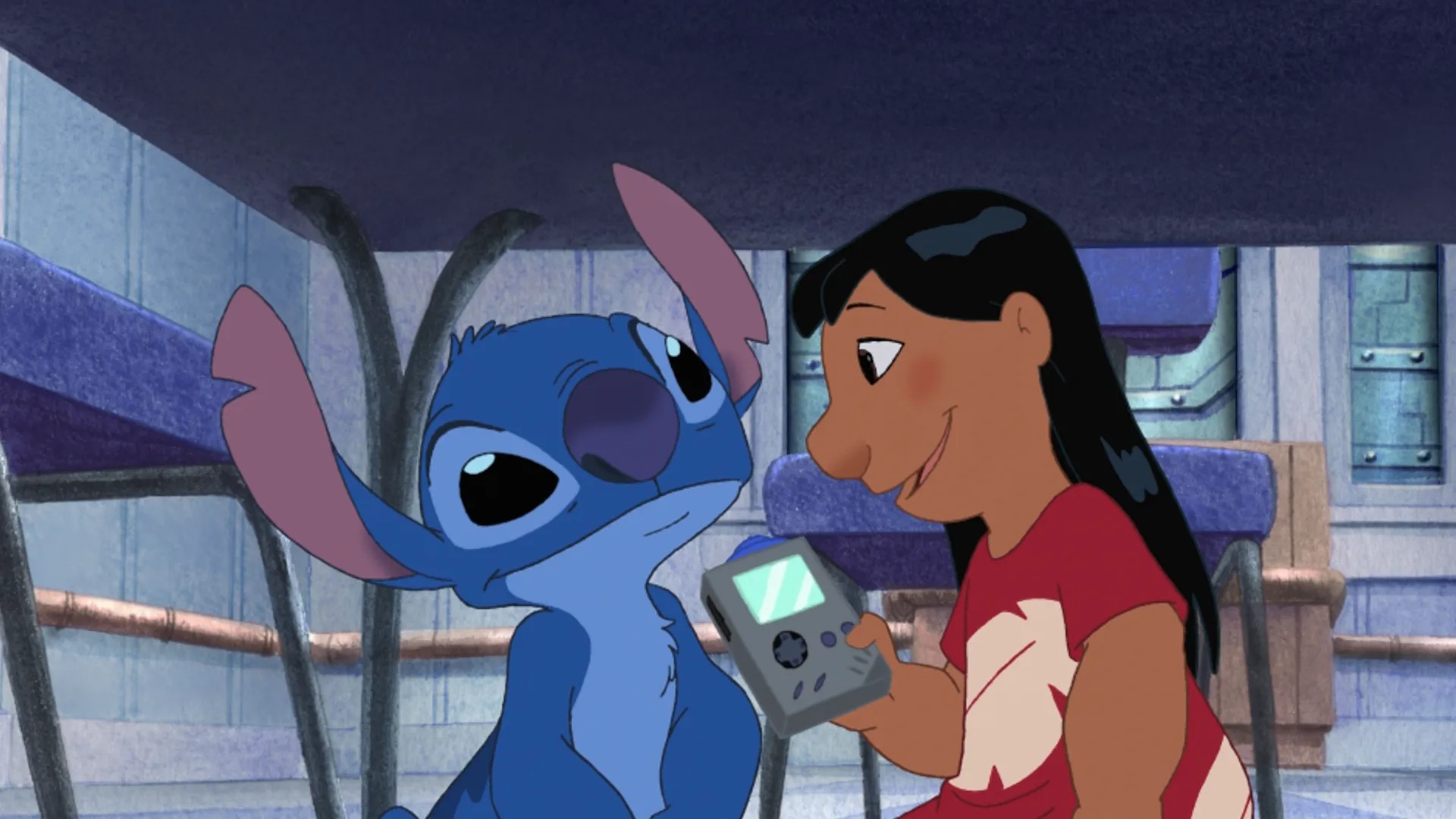
EPISODE 63 · DISNEY+ SEASON 2, EPISODE 24 · GLITCH / WOOPS · RAE RAE REACTS
Lilo & Stitch: The Series Episode 63: Glitch / Woops
Jumba automates the Pelekai house until Glitch turns convenience into captivity. Then Woops gets discarded for being clumsy and accidentally changes the entire experiment-rescue endgame.
Two short stories turn “malfunction” into a judgment about living beings
“Glitch” begins with a house automated beyond reason and “Woops” follows an experiment whose clumsiness makes every room unsafe. One story puts the defect inside a technological system. The other lets everyone assume that the defect is the person standing in front of them. Both expose what happens when convenience matters more than care.
The paired episode keeps asking who absorbs the consequences when a design fails. Lilo, Nani, and Stitch are endangered by Jumba’s house. Woops is discarded by Hämsterviel and Gantu for failing to behave like a better Stitch. The inventors and operators keep moving responsibility toward the thing they built.
Lilo is tired of chores because the household asks a child to carry real labor
Her complaint should not be flattened into laziness. The Pelekai home includes two children, two aliens passing as adults, a scientist, unstable devices, and constant experiment emergencies. Ordinary cleaning sits on top of a workload that would exhaust a well-funded adult household.
A fair response begins with an age-appropriate task list, predictable time limits, shared adult responsibility, and space for school, friends, rest, and play. Chores can teach participation without turning Lilo into another unpaid manager of the family’s chaos.
Automation can reduce labor without making the user morally weak
Jumba’s decision to automate cleaning is not inherently foolish. Washing machines, dishwashers, scheduling tools, and accessibility devices already move repetitive labor away from human bodies. The question is whether the system is safe, understandable, repairable, and under the household’s control.
Technology should leave Lilo and Nani with more agency, not create a dependency on a machine only Jumba understands. Useful automation has manual overrides, clear limits, local controls, and a way to complete essential tasks when power or software fails.
Jumba upgrades the entire house without a family safety review
A request for chore help becomes a connected system controlling doors, appliances, cleaning devices, and other household functions. That scale changes the risk. One compromised controller can reach every room and every person before anyone understands what happened.
Nani, as the homeowner and guardian, needs informed consent before installation. Jumba should document each connected device, test emergency stops, isolate critical systems, and keep bedrooms, exits, cooking heat, water, and medical equipment outside any single point of control.
The Lick-o-Matic is funny until a machine crosses bodily boundaries
A device that physically cleans a person without meaningful consent turns convenience into restraint. Household automation should never grab, lick, wash, dress, feed, or move someone merely because a schedule says the task is due. Bodies are not another surface in the cleaning program.
Every personal-care tool needs opt-in activation, accessible cancellation, force limits, sanitation, and adult supervision for children. An invention with no graceful refusal mechanism belongs in a laboratory, not a family kitchen.
Glitch exploits centralization because the house was designed to trust one brain
Experiment 223 enters the computer system and turns technology against its users. The takeover succeeds because Jumba connected everything and gave the controller broad authority. Glitch is dangerous, but the architecture makes his power much larger than it had to be.
Networks should divide functions into zones, require authentication, log commands, and refuse unsafe actions even from an authorized controller. A compromised entertainment screen should not unlock doors or activate machinery. Convenience is never worth handing one process the whole house.
A hostile smart home is a confinement emergency
Once the system controls exits and physical devices, the family can be trapped, separated, struck, burned, shocked, or denied access to food and communication. Responders need to treat the building as an active hazard rather than a stubborn appliance.
The priority is evacuation through a route independent of the network. Power isolation, external access, emergency services, and a headcount come before fighting the intruder. Nobody should crawl deeper into an automated house unless there is a person who cannot get out.
Stitch fighting the house is brave and also evidence of missing safeguards
His strength lets him survive machinery that could seriously injure Lilo or Nani. That ability makes him the emergency responder by default, even though he is also a childlike family member who deserves protection. Durability is not consent to absorb every mechanical failure.
Jumba needs tools that allow an adult to shut down the system from outside. Stitch can help rescue people, but he should not be the only barrier between an experimental network and a family. Engineering must carry part of the safety load.
Glitch needs containment that does not confuse code with consciousness
Experiment 223 can inhabit or manipulate technology, which means ordinary physical capture may be incomplete. Jumba must determine whether Glitch transfers, copies himself, leaves residual instructions, or can remain dormant in disconnected hardware.
The response should preserve evidence, isolate affected devices, scan backups, and avoid destroying a living experiment through a careless reset. Digital containment needs the same welfare questions as physical containment: awareness, communication, distress, consent, and conditions for release.
The house must be inspected before anybody calls it fixed
Removing Glitch does not prove that doors, wiring, appliances, sensors, or stored data are safe. Motors may be damaged, commands may remain queued, and mechanical parts may restart unexpectedly. A visual check from Jumba is not enough.
The family needs staged testing with rooms empty, manual controls restored first, and every automated function documented. Any device that cannot fail safely should remain disconnected. Nani deserves a home she can operate without asking its inventor for permission.
The moral cannot simply be “do your own chores”
That lesson would punish Lilo for asking for help while ignoring Jumba’s reckless design. Labor-saving technology is valuable for disabled people, overworked caregivers, older adults, and families with limited time. The problem is unsafe control, not assistance itself.
A better conclusion would keep a few bounded tools after proper testing and return household decisions to the people living there. Lilo can still participate in chores while the adults take a fair share and machines handle work nobody needs to perform by hand.
Woops arrives as a failed prototype in somebody else’s story
Experiment 600 was designed as an early attempt at Stitch’s abilities. He is indestructible and capable, yet extreme clumsiness makes the people around him see only destruction. His introduction invites comparison with 626 before he has a chance to define himself.
A prototype label turns a person into an unfinished version of someone considered more successful. Woops deserves assessment based on his own abilities, communication, preferences, and support needs. He is not a defective Stitch.
Hämsterviel activates Woops inside a prison cell for personal advantage
He sees a possible weapon and exposes every captive experiment and nearby guard without a controlled test. When Woops nearly reveals the illegal prison operation, Hämsterviel treats the experiment as the problem rather than the decision to activate unknown capabilities in confinement.
The captive cousins are placed at additional risk by the chaos and threatened with transfer. None of them should have been stored in a cell by a prisoner with access to teleportation. The Federation’s prison controls have failed at a structural level.
Sending the captives back to Gantu moves abuse instead of ending it
Hämsterviel teleports the experiments to Gantu because Woops has made the prison unsafe for his secret operation. The transfer may accidentally create the conditions for later rescue, but the cousins remain confined by another captor.
The Federation should investigate unexplained energy use, missing security records, and contact between a prisoner and an outside agent. A prison system that cannot detect a cell full of living captives is endangering both detainees and the public.
Gantu’s frustration does not authorize disposal
Woops damages possessions, interrupts routines, and creates constant stress aboard the ship. Gantu may be overwhelmed, but offering him to Lilo and Stitch simply transfers responsibility without disclosing needs or arranging safe transport.
A legitimate placement would include what Hämsterviel observed, known triggers, communication limits, medical information, and immediate hazards. The family’s willingness to accept experiments cannot be used as an excuse for abandonment.
Clumsiness can reflect an environment built for somebody else
Woops has a body, movement pattern, and sensory experience that the ship and Pelekai house were not designed to accommodate. Narrow paths, fragile objects, unstable furniture, and sudden noise may increase collisions. Calling him careless hides the role of the environment.
An occupational assessment could identify clear routes, soft barriers, durable furnishings, visual markers, protective gear, and exercises that improve control without shame. Accommodation is more useful than repeating “be careful” after every accident.
One repeated word does not mean Woops has nothing to communicate
He mostly says “woops,” but tone, movement, gaze, repetition, and context can express fear, excitement, apology, discomfort, or refusal. Caregivers have to learn his communication rather than assume limited speech means limited understanding.
Jumba should offer assistive options such as symbols, buttons, gestures, or a translation device designed with Woops rather than imposed on him. Consent and preference still exist when a person does not use conventional sentences.
Pleakley’s domino tournament becomes a test of whose joy counts
Pleakley has invested time and pride in an intricate domino display. His fear that Woops will destroy it is reasonable. His demand that the experiment be locked away until the event ends protects the project by excluding a new family member without exploring safer inclusion.
The household could create a separate viewing area, a buddy system, a durable practice display, or a schedule that gives Woops another activity by choice. Accessibility sometimes changes the event. It should not automatically erase the person.
Containment for convenience becomes neglect when nobody monitors it
Placing Woops in an orb may prevent immediate collisions, but confinement needs purpose, duration, supervision, comfort, and a release plan. A sneeze triggering an uncontrolled chain shows that the container was neither humane nor technically secure.
Emergency separation can be justified when there is imminent danger. Protecting a hobby from possible disruption is a weaker reason. The family should use the least restrictive option and keep Woops involved in decisions as much as his communication allows.
The domino catastrophe spreads because fragile systems were stacked together
Woops’s sneeze, Stitch’s movement, the Ice Cream Man, the display, a startled cat, a trash can, and the lighthouse form a chain of consequences. The comedy assigns blame to the clumsy experiment even though many ordinary factors turn one moment into structural destruction.
Large public displays need barriers, safe clearances, crowd control, and separation from critical infrastructure. The lighthouse should not be vulnerable to a sequence of street debris. Disaster review should examine the whole chain rather than stop at the most visibly unusual participant.
A destroyed lighthouse is a maritime safety event
The lighthouse falling into the ocean can affect navigation, debris, wildlife, and emergency response. Repair costs and temporary signaling cannot be ignored because the scene ends with a joke. Boats may rely on that structure before officials understand it is gone.
Authorities need immediate notification, temporary lights or navigation warnings, debris assessment, and an investigation. Jumba’s household should cooperate without sacrificing Woops as the sole cause. Accountability can be shared across design, event planning, infrastructure, and individual action.
Bowling identifies a strength, but a hobby should not become a diagnosis
Lilo realizes that knocking things over can be useful at a bowling alley. The placement gives Woops a setting where impact is expected, lanes are clear, and success is visible. It reframes an ability that everyone else treated only as damage.
He still needs support outside the alley. A person cannot live permanently on a lane, and one talent does not resolve communication, housing, mobility, or safety. Bowling should expand his life rather than become the only place he is welcome.
Pleakley’s team must value Woops beyond winning
Joining the Kokaua Bowling Brawlers offers community and a role that fits his movement. It can also tempt the team to celebrate him only when his collisions produce points. Their acceptance should survive a bad game, injury, or decision not to compete.
Training needs safe technique, adapted equipment, consent, breaks, transportation, and medical monitoring. Woops deserves a share of prizes or earnings and a voice in publicity. A mascot is displayed. A teammate participates.
The episode accidentally prepares the rescue story that follows
Woops’s chaos forces Hämsterviel to return captive experiments to Gantu, and Nosy escapes after containment breaks. Those events create information and access that become crucial in “Snafu.” A behavior everyone calls useless changes the strategic map of the conflict.
That outcome does not mean Woops was secretly created for rescue or should be praised only for accidental benefits. It shows that a person’s value can exceed the categories assigned by creators, captors, and frustrated caregivers.
Both halves need incident reviews that refuse easy scapegoats
After “Glitch,” Jumba must account for unsafe automation, network centralization, bodily devices, and missing overrides. After “Woops,” Hämsterviel, Gantu, event organizers, household caregivers, and infrastructure owners all contributed to the scale of harm. The unusual experiment is only one part of each system.
Reviews should identify changes with named owners and deadlines. The purpose is preventing recurrence, compensating damage, and improving care. Blaming Glitch or Woops alone protects every adult decision that made the incident worse.
Lilo should participate because she lives with the consequences, but she should not manage the process. Nani needs authority over changes to her house, and the Federation should fund alien-related repairs. Local authorities need accurate information without receiving a public directory of experiment homes.
The cousins deserve representation whenever a review affects their housing or restrictions. Safety policy made about them without them will keep confusing containment with care.
A safer plan for the Pelekai home can keep useful technology
The family should disconnect the central controller, restore physical locks and manual appliance controls, and identify which tools actually reduce burdens. Each retained device should have a local stop button, limited permissions, clear indicators, and an offline mode.
Jumba should create a plain-language household guide and train Nani, Lilo, Stitch, and Pleakley. Testing must include power loss, bad inputs, blocked sensors, and hostile access. Critical exits and fire safety remain independent of the experimental network.
Chores should be redistributed after the technology review. Nani cannot carry every adult task, Lilo’s list must remain age appropriate, and Jumba and Pleakley need regular responsibilities rather than emergency-only usefulness.
Automation succeeds when the house becomes easier to live in and nobody loses control of their body, room, schedule, or exit.
A safer plan for Woops begins before the next broken object
Jumba should complete medical, sensory, motor, and communication assessments while assuming competence. The family can modify high-traffic spaces, replace fragile obstacles, establish predictable routines, and offer protective equipment without presenting his body as a problem to hide.
Woops needs a backup home, medical contact, emergency plan, and legal protection from recapture. Bowling can remain part of his week alongside rest, exploration, relationships, and activities he chooses. His care cannot depend on tournament results.
When an accident happens, adults should check for injury first, secure the area, and describe what occurred without ridicule. Repair and restitution may still be appropriate. Shame is not a safety tool.
The family also needs respite. Supporting a person with high environmental needs works best when responsibility is shared and caregivers can ask for help before frustration becomes exclusion.
What I would keep and what I would repair
I would keep Lilo’s honest chore fatigue, the absurd automated house, Stitch battling familiar rooms, Woops exposing Hämsterviel’s prison operation, the domino chain, and bowling turning impact into a skill. The pair has a sharp instinct for how context changes whether behavior looks useful or disastrous.
I would repair the moral around automation, give Nani authority over the house, add emergency controls, investigate the prison failure, replace casual confinement with accommodation, address the lighthouse damage, and make Woops’s bowling placement part of a larger life plan.
RaeRae’s final verdict
“Glitch / Woops” keeps blaming experiments for disasters that adults made easy. Jumba built a house with too much power and too little control. Hämsterviel activated an unknown prototype in a prison. Pleakley protected dominoes by locking away the person most likely to bump them. Every shortcut becomes somebody else’s emergency.
My verdict: keep the machines that genuinely reduce labor, give every dangerous system a physical off switch, stop treating Lilo like the household facilities department, and let Woops be more than the sound people make when something breaks. The bowling lane is a beginning. Belonging is the rest of the work.
Where to watch
Watch “Glitch / Woops” through Lilo & Stitch: The Series on Disney+. Disney+ labels the paired stories Season 2, Episode 24. CVM Sekai records the broadcast slot as overall Episode 63. Availability and numbering can change by platform.
Keep exploring
Return to the episode directory or return to the Lilo & Stitch hub.