
EPISODE 62 · DISNEY+ SEASON 2, EPISODE 23 · MRS. HASAGAWA’S CATS / ACE · RAE RAE REACTS
Lilo & Stitch: The Series Episode 62: Mrs. Hasagawa’s Cats / Ace
Mrs. Hasagawa quietly builds an enormous experiment family while Jumba panics because one creation came out purely good. Both stories expose how badly institutions judge strange lives from the outside.
One broadcast slot holds two stories about how adults define worth
“Mrs. Hasagawa’s Cats” and “Ace” look like unrelated short adventures. One follows an older neighbor caring for a house full of experiments she calls cats. The other follows Jumba trying to prove that he remains evil enough for a professional club. Both stories ask who gets to decide whether a strange life is useful, dangerous, respectable, or embarrassing.
The pairing becomes more interesting when the labels are placed beside each other. Mrs. Hasagawa sees companions where Lilo sees uncontained experiments. Mortlegax sees evidence of moral decline where the family sees rehabilitation. The characters are arguing about classification while the experiments keep revealing themselves through what they do.
Lilo and Stitch begin by helping a neighbor with ordinary work
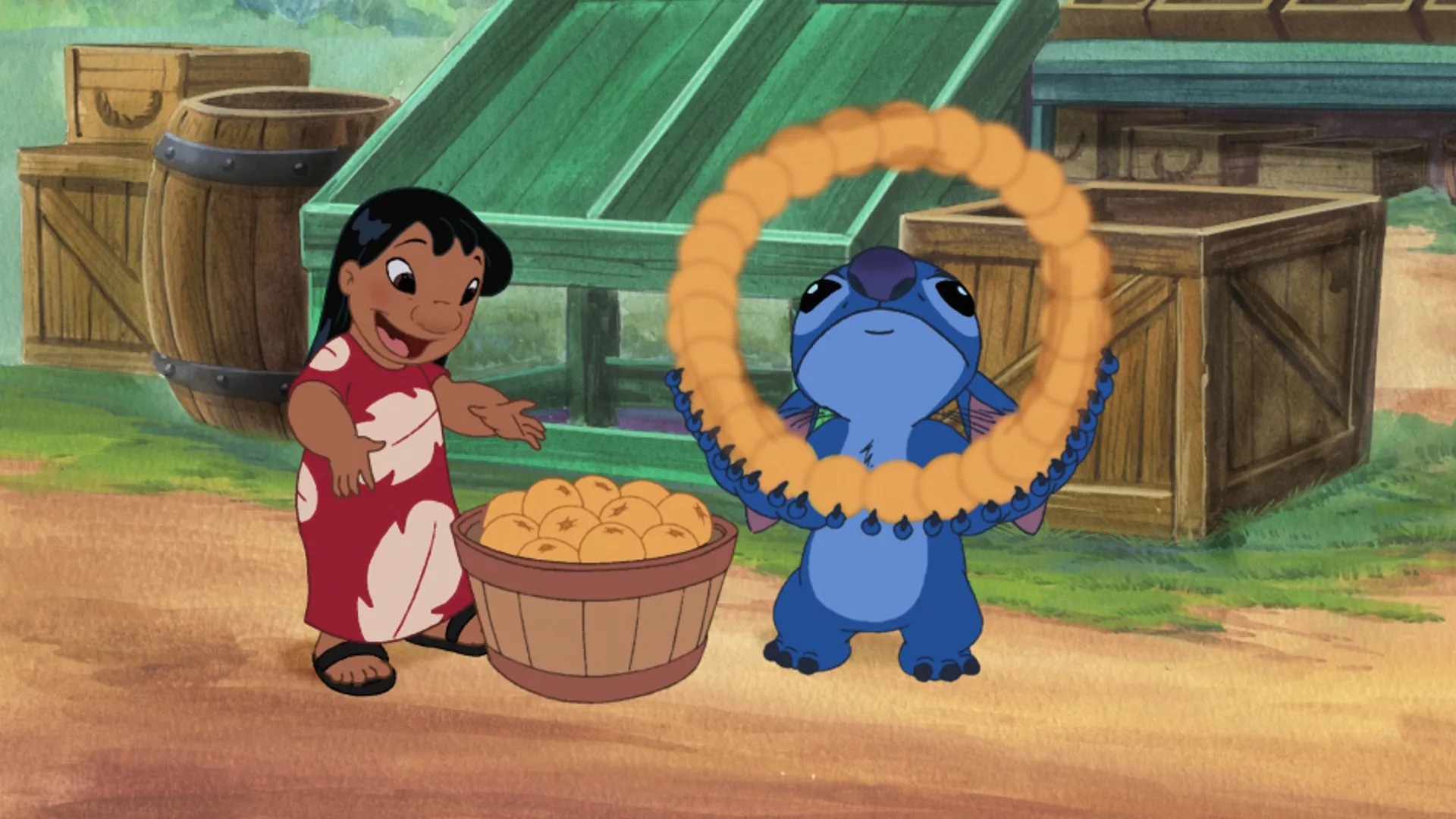
They organize Mrs. Hasagawa’s fruit stand and clean her yard before discovering anything alien. That beginning matters because community is built through small repeated acts, not only dramatic rescues. The children notice that an older neighbor needs help and give their time before a capture mission gives them a reason.
A responsible support plan would still ask what Mrs. Hasagawa wants done, which tasks are safe for children, and whether she needs regular assistance from adults. Kindness becomes more durable when it is arranged around the recipient’s choices instead of a sudden burst of volunteer energy.
A bowl that appears to hold apricots reveals a containment failure
The discovery of experiment pods among household objects is funny and alarming. Dormant genetic experiments should never be mistaken for fruit, toys, decorations, or medicine. Their presence shows how thoroughly Jumba’s lost cargo has entered ordinary domestic life without warning labels or reliable tracking.
Jumba and the Federation need a retrieval system based on location, public education, and safe reporting. Residents should know how a pod looks, what activates it, and whom to contact without touching it. Lilo should not remain the island’s only practical hotline.
Mrs. Hasagawa calling the experiments cats is not permission to dismiss her
Lilo and Stitch initially treat the description as confusion. Older adults are often spoken around when younger people decide that an unusual statement proves incompetence. The episode eventually shows that Mrs. Hasagawa has observed the creatures, fed them, lived with them, and developed relationships with them.
The respectful response is to ask specific questions. How many are there? What do they eat? Has anyone been hurt? Which abilities has she seen? Does she want help? Accuracy and dignity can exist together even when her chosen word is biologically wrong.
Nineteen experiments in one house require more than a cute reveal
The home contains a large group with different bodies, abilities, triggers, needs, and risk levels. A shared room cannot automatically meet every requirement. Some may damage structures, produce dangerous material, steal objects, alter behavior, or become distressed by crowding.
Jumba should complete individual health checks and compatibility assessments. The house needs fire planning, secure storage, sanitation, ventilation, sleeping areas, escape prevention, and a way for Mrs. Hasagawa to call for help. Affection is necessary care, but it cannot replace infrastructure.
The experiments choosing Mrs. Hasagawa changes the capture question
Lilo and Stitch arrive expecting to gather loose cousins and assign them elsewhere. The group’s attachment to Mrs. Hasagawa interrupts that assumption. They have already formed a household with routines that the rescuers did not create and should not casually dissolve.
Placement should consider the experiment’s preference, the caregiver’s informed consent, safety, and whether support can make the home sustainable. “One true place” should emerge from a relationship rather than from whoever carries the capture container.
Mrs. Hasagawa needs informed consent about what her cats actually are
Her love for them does not remove the family’s duty to explain that they are alien genetic experiments. She needs honest information about their origins, powers, possible activation conditions, medical care, and the enemies who may try to capture them.
Consent obtained through a comforting fiction is weak consent. Mrs. Hasagawa can continue calling them cats as an affectionate family name after she understands the facts. Respecting her language cannot mean withholding risk.
Gantu ignoring the household does not make it secure
Gantu appears but does not pursue the experiments. His lack of interest may protect them for one afternoon, yet Hämsterviel’s priorities can change and another tracker could locate the house. A concentrated group creates an obvious target.
The family should reduce public exposure, establish evacuation routes, use alarms that Mrs. Hasagawa can operate, and avoid publishing the complete roster. A welfare check must also confirm that security measures do not turn her home into a prison.
Caregiving this large can become exploitation in either direction
Mrs. Hasagawa may gain companionship and practical help, but nineteen dependents can overwhelm money, food, cleaning, appointments, and sleep. Conversely, experiments with useful abilities might be expected to perform endless household labor because they live there.
The arrangement needs shared responsibilities suited to each person, protected rest, outside assistance, and regular private check-ins. Housing cannot depend on productivity. Care also cannot depend on one older woman remaining healthy forever.
A succession plan is part of loving the household
The episode celebrates the home without discussing what happens if Mrs. Hasagawa is hospitalized, moves, loses income, or dies. Avoiding that subject does not protect anyone. It makes a future emergency more likely to scatter the experiments again.
Lilo, Nani, Jumba, and the Federation should identify backup caregivers and preserve the group’s relationships. Legal status, veterinary or medical access, property rights, and emergency funds need answers before a crisis. Family planning includes the future nobody enjoys imagining.
The experiments deserve names that do more than catalogue their functions
Numbers and ability labels help Jumba identify risks, yet a home cannot be organized like a weapons inventory. Mrs. Hasagawa’s affection offers another way of seeing them, but each cousin should have some say in the name used every day.
Individual identity becomes especially important in a crowded household. Caregivers need to distinguish preferences, symptoms, fears, and relationships instead of treating the group as interchangeable cats. Visibility is protection.
The first segment quietly argues that competence can look eccentric
Mrs. Hasagawa’s language and crowded home appear chaotic to outsiders. Still, she has managed relationships that Lilo and Stitch assumed required immediate intervention. The story lets an older woman know something the heroes have not learned yet.
That does not make every condition safe or every concern ageist. It means assessment should begin with evidence rather than appearance. A home can be unconventional and loving while still needing resources, safeguards, and honest conversation.
Ace begins with Jumba afraid that goodness will damage his reputation
Mortlegax, leader of the Evil Genius Organization, questions whether Jumba remains evil because his experiments now help people. Jumba experiences rehabilitation as professional embarrassment. He would rather perform cruelty than admit that his creations have developed lives beyond their original programming.
The joke lands because the organization makes its standards explicit. The uglier truth is that many institutions protect identity by punishing evidence of change. Jumba has to decide whether membership matters more than the family and cousins standing in front of him.
The attempt to stage evil turns the cousins back into promotional material
Lilo and Stitch help construct proof that Jumba’s creations remain dangerous. Footage and demonstrations strip the cousins of the context in which they learned control and found community. Their worst moments become clips used to improve their creator’s standing.
They should have consent over recordings that expose their abilities or locations. A rehabilitation story belongs partly to the person who did the work. Jumba cannot claim their former harm as his achievement and their present goodness as an inconvenience.
Lilo’s participation exposes how loyalty can pull a child into adult dishonesty
Lilo wants to protect Jumba from losing something he values, so she joins a deception aimed at an authority figure she barely understands. Her care is real. The plan is still an adult problem that should not require a child to manufacture evidence of evil.
Jumba should explain the organization’s demands and release Lilo from responsibility for his status. If a professional association requires harm, losing membership may be the healthiest outcome. Children should not carry the emotional cost of an adult leaving a toxic institution.
Mortlegax treats moral change as defective performance
The E.G.O. measures Jumba by whether his inventions continue producing harm. It has no category for accountability, repair, or a creation becoming different from its design. Improvement is interpreted as incompetence because the institution’s purpose is preservation of evil identity.
An organization like this cannot be reformed through better public relations. Jumba’s safest response is to document any crimes, protect targets and experiments, withdraw access to his research, and leave. Membership is not neutral when dues and prestige support future harm.
Ace is labeled a failure because he was born good
Experiment 262 was intended to be evil and instead acts with courage and care. Jumba’s embarrassment places the creator’s intention above the created person’s actual character. Ace has done nothing wrong. The design brief is what deserves rejection.
Calling goodness a flaw also reveals how labels can follow an experiment before behavior is observed. Ace should not have to perform a spectacular rescue to earn the basic presumption that his life has value.
Gantu declines the capture because Hämsterviel sees no use in goodness
The villains’ disinterest spares Ace but exposes their value system. They pursue cousins for abilities that can be weaponized and abandon one who will not cooperate with harm. Safety based on being commercially useless to an abuser is unstable.
Ace still needs protection, documentation, and community. Hämsterviel may later decide that a heroic experiment can be coerced, copied, or used as bait. Rescue planning cannot rely on the villain maintaining the same opinion.
The fire rescue proves character through choice rather than code
Ace enters a burning house to save a trapped kitten, escapes with a bedsheet as a parachute, and helps control the fire. The action demonstrates courage, practical judgment, and concern for a vulnerable life. It is more persuasive than any speech about whether he contains evil programming.
The rescue should still be examined for safety. Firefighters need to know his abilities, structural conditions, and whether another person is inside. Heroism is admirable, but a repeatable emergency role requires training and coordination rather than permanent improvisation.
Ace should not become unpaid emergency infrastructure
Finding a place as a local do-gooder sounds perfect until every fire, rescue, and dangerous errand becomes his obligation. A person who enjoys helping can still become exhausted, injured, or unable to respond. The community cannot reduce public safety budgets because an experiment appeared.
Ace needs training, protective equipment, medical care, rest, and the right to refuse. If he works with emergency services, compensation and representation should be arranged for his benefit. His home remains secure on days when he saves nobody.
The kitten rescue joins both halves of the episode in a useful way
The first story questions whether experiments can be family members inside a home described as full of cats. The second uses an actual cat to reveal Ace’s instinct to protect. Care moves across species and refuses the categories that other characters use to determine worth.
That connection is stronger than treating the two shorts as random scheduling. Mrs. Hasagawa and Ace both expose the limits of an institution looking at unusual lives from outside. Behavior, attachment, and consent provide better evidence than labels alone.
Jumba losing E.G.O. membership is a consequence worth celebrating
Mortlegax revokes the membership after seeing Ace act heroically. Jumba may experience humiliation, but the loss separates him from an organization built around harm. The family can acknowledge his disappointment without pretending the club was harmless.
Leaving also creates obligations. Jumba should secure his research, revoke credentials, watch for retaliation, disclose threats, and examine whether E.G.O. benefited from any of his past work. Separation begins accountability rather than finishing it.
The family’s replacement club can define belonging without demanding performance
Lilo, Nani, Stitch, Pleakley, Jumba, and Ace form their own group. The gesture works because membership comes from relationship rather than a test of evil or heroism. Nobody needs to cause a disaster or rescue a kitten to qualify.
The new club should resist becoming another institution centered on Jumba’s reputation. It can support the cousins, organize community care, share food, record needs, and make room for people who are neither spectacularly good nor entertainingly bad.
The altered production history deserves a note without overtaking the story
The completed “Ace” segment reportedly replaced material involving a large wave after the 2004 Indian Ocean earthquake and tsunami made that imagery painfully inappropriate. Production choices exist inside real history, and changing a children’s episode can be an act of care rather than cowardice.
A guide should preserve that context with reliable sourcing and restraint. Real deaths are not trivia added to make an episode sound important. The relevant point is that creators reconsidered spectacle when the meaning of that spectacle changed outside the studio.
The household needs an immediate welfare plan after the credits
Jumba should inventory every experiment without publishing the address, assess individual abilities, test the home for hazards, and ask Mrs. Hasagawa what help she wants. Nani can coordinate local adult support, but she should not inherit another unpaid full-time care system.
Each cousin needs a medical baseline, emergency contact, food plan, sleeping space, and opportunity to remain with the group or request a different placement. The Federation should fund modifications because its failed containment helped create the situation.
Mrs. Hasagawa needs accessible alarms, transportation, respite, and a backup guardian. Visits should preserve her privacy and avoid treating her home like a zoo. Support personnel must learn every resident’s name and communication style.
A review date should be scheduled before anyone declares the arrangement solved. Successful care is measured over time, not by one affectionate ending.
Ace needs a future that includes goodness without compulsory heroism
Ace should be offered emergency training because he has shown interest and ability, not automatically assigned to it. He may also enjoy ordinary work, art, games, friendships, or quiet days that have nothing to do with rescuing strangers. His programming does not define the entire range of a life.
Jumba owes him a direct apology for hiding and devaluing him. The apology should name the harm, avoid excuses about professional culture, and be followed by changes in how all experiments are described. Ace does not need to comfort his creator for feeling ashamed.
Public attention after the rescue creates privacy and safety risks. Any interview, photograph, or civic honor requires consent and a plan that does not expose his home. Hero recognition should never become a locator beacon for Hämsterviel.
The family club can celebrate his goodness while also letting him be complicated. Moral worth does not require flawless behavior.
What I would keep and what I would repair
I would keep Mrs. Hasagawa’s confident affection, the enormous cat reveal, the cousins choosing their household, Jumba’s ridiculous fear of losing evil credentials, Gantu’s indifference, Ace’s kitten rescue, and the family forming a club that values him.
I would add informed consent, a real safety assessment for the crowded home, caregiver support, a succession plan, privacy around experiment locations, an apology from Jumba, and employment protections before Ace becomes the island’s permanent volunteer rescue department.
RaeRae’s final verdict
“Mrs. Hasagawa’s Cats / Ace” uses two compact stories to embarrass every authority that thinks a label tells the whole truth. The eccentric neighbor may understand her household better than the rescuers. The supposedly defective experiment may have the clearest moral instincts in the room. The evil-genius club may be the least intelligent institution anybody encounters.
My verdict: let Mrs. Hasagawa keep her family with actual support, let Ace be good without making him work for his housing, and let Jumba’s revoked membership stay revoked. If an organization calls compassion a defect, the certificate was never worth framing.
Where to watch
Watch “Mrs. Hasagawa’s Cats / Ace” through Lilo & Stitch: The Series on Disney+. Disney+ labels the paired stories Season 2, Episode 23. CVM Sekai records the broadcast slot as overall Episode 62. Availability and numbering can change by platform.
Keep exploring
Return to the episode directory or return to the Lilo & Stitch hub.