
EPISODE 60 · DISNEY+ SEASON 2, EPISODE 21 · LAX · RAE RAE REACTS
Lilo & Stitch: The Series Episode 60: Lax
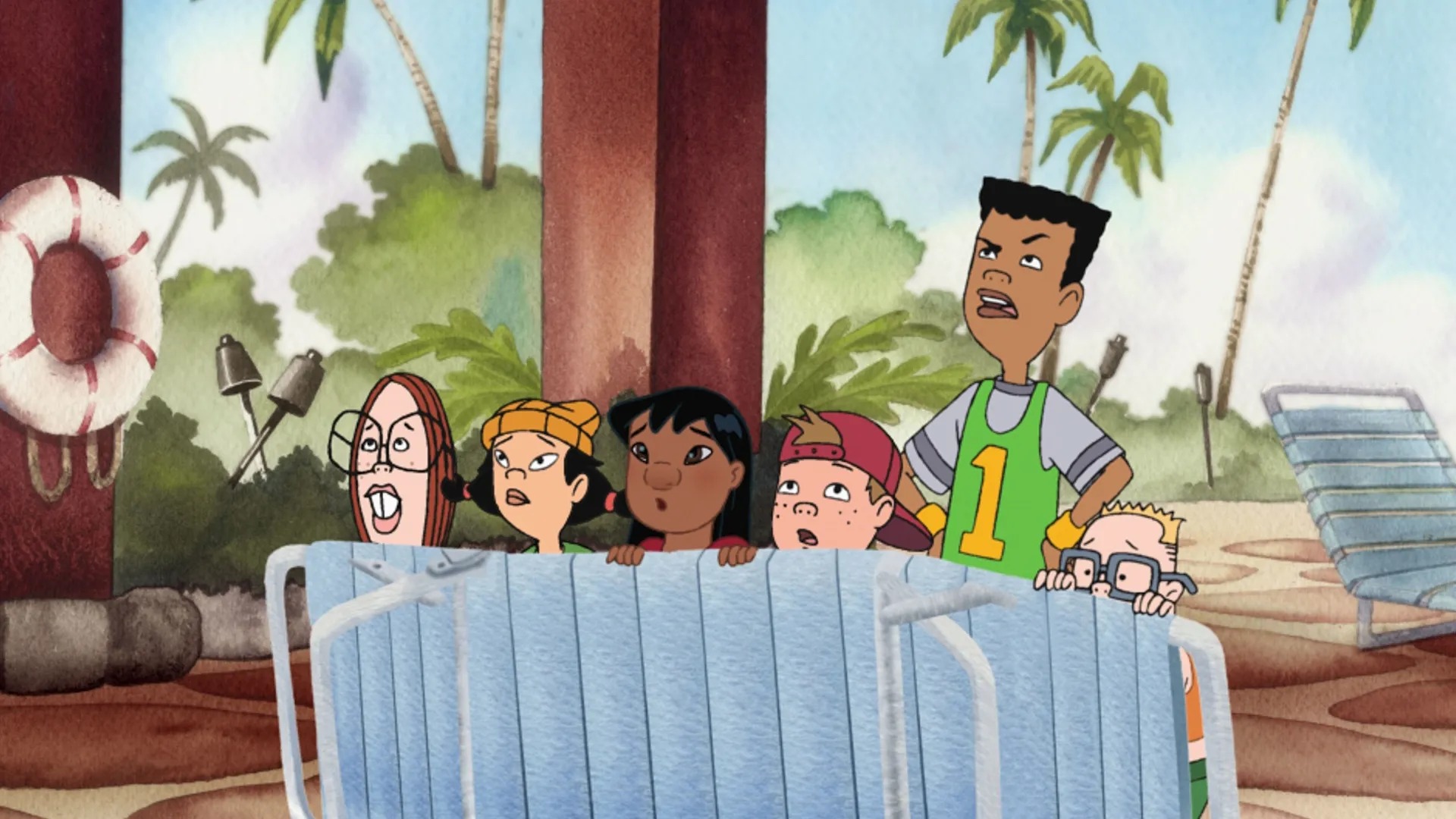
Experiment 285 turns people extremely relaxed and machines completely idle. With Stitch, Jumba, and Pleakley impaired, Lilo joins the Recess gang while Gretchen’s new planet becomes Hämsterviel’s experiment-tracking satellite.
A messy house activates another crisis before Nani reaches work
Nani tells the household to clean, then drives through water that activates Experiment 285’s pod. The chain connects ordinary family chores to alien hazards scattered through public space. Nobody in the car knows that a puddle has changed the island’s risk level.
Jumba needs weather-resistant tracking for dormant pods and Nani needs a household plan that does not leave all experiment safety to children after she leaves.
Lax suppresses effort rather than offering restorative rest
Experiment 285 fires a ray that makes people abandon work and machines stop operating. The effect may look like relaxation, but targets do not choose the pause, duration, or consequences. Compelled disengagement is neurological interference.
Rest restores agency when a person decides what the body needs. Lax removes agency and can leave responsibilities unattended until harm occurs.
Stitch’s sudden laziness is a symptom, not a moral failure
After exposure, Stitch cannot sustain the experiment hunt. Lilo may experience this as abandonment because she relies on him, but criticism cannot reverse an altered nervous system. He needs protection and monitoring.
The family should document exposure time, move him away from hazards, and avoid assigning shame to behavior produced by the ray. Support comes before motivation.
Jumba and Pleakley being disabled exposes the absence of adult backup
When both adults are zapped, scientific knowledge and supervision become unavailable. Lilo again inherits command without a trained adult who can interpret the experiment or operate equipment.
The household needs written profiles, remote Federation support, and trusted local contacts. A response system that collapses when two people rest was never resilient.
Machine shutdown turns Lax into an infrastructure weapon
The ray can stop vehicles, communications, medical devices, security systems, ventilation, elevators, and observatory equipment. A playful “lazy” label hides the possibility of injury or death when technology quits mid-operation.
Responders must establish distance, cut traffic, identify critical systems, and use manual backups. No chase should push Lax toward hospitals, roads, airports, or utilities.
The Recess gang arrives on vacation with their own social ecology
T.J., Spinelli, Gretchen, Gus, Vince, and Mikey bring a group shaped by playground cooperation, disagreement, and shared rules. The crossover works when they remain a community rather than six recognizable cameos.
Their vacation also means adults owe them protection. Familiar competence does not make visiting children an emergency workforce for an alien incident.
Vince and Mikey losing motivation changes the group’s balance
Lax’s ray removes abilities the gang normally relies on, including Vince’s physical energy and Mikey’s emotional participation. Friends may become frustrated because the change looks like a choice.
The group needs to recognize impairment, redistribute tasks, and stop measuring loyalty through productivity. A friend remains part of the team while unable to perform.
T.J. organizes quickly, but leadership needs limits
T.J. is skilled at turning children into a plan, which helps Lilo after adult support fails. He can coordinate observation and communication without pretending everyone should enter danger.
A responsible plan assigns retreat points, buddies, and a stop condition. Leadership includes deciding that a mission exceeds the group’s capacity.
Spinelli’s courage can become exposure when nobody slows her down
Spinelli moves directly toward threats and may interpret caution as weakness. Lax punishes that certainty because bravery cannot prevent a neurological beam.
The team should pair her with reflective protection, cover, and a role that uses decisiveness without making her the shield. Courage deserves equipment.
Gus contributes through attention rather than force
Gus is often treated as the least intimidating member, yet caution and rule awareness can identify risks others ignore. An alien hunt benefits from someone who asks whether the plan is safe.
The crossover should value his observations before a crisis proves them. Teams fail when confidence is mistaken for competence.
Gretchen’s planet discovery begins as legitimate inquiry
Gretchen uses the observatory to investigate an object she believes may be a new planet. She follows evidence with excitement, and the possibility matters to her intellectual identity. The satellite reveal does not make the investigation foolish.
Science includes revising a conclusion when stronger evidence appears. Her ability to recognize Hämsterviel’s technology is a success of method, not a failed dream.
Hämsterviel’s locator satellite turns the sky into surveillance infrastructure
The object tracks experiments and directs Gantu, making every activated cousin easier to capture. It also occupies space where civilians may mistake it for an astronomical object or ordinary communications equipment.
Disabling the satellite requires assessing debris, signals, ground control, and whether destruction will endanger people. Surveillance removal still needs technical responsibility.
Gretchen continues working because discovery is fun to her
Lax’s effect may fail or weaken when a target experiences work as enjoyable. That exception complicates the episode’s definition of labor. Effort is not one emotional category, and pleasure does not make a task effortless.
The immunity should not become a demand that everyone love work. People deserve rest even when their job is meaningful, and burnout cannot be solved by choosing a better attitude.
Reflective surfaces provide a defensive option without attacking Lax
His beam can be blocked or redirected by mirrors or other reflective material. That gives responders a way to approach while reducing physical force.
The method needs controlled angles so a deflected ray does not strike bystanders or critical equipment. Protective tools are useful only with a clear perimeter.
The temporary effect still creates lasting consequences
Motivation returns after time, but missed medication, abandoned vehicles, lost work, damaged trust, or injuries do not reverse automatically. Temporary impairment can produce permanent outcomes.
Recovery includes medical assessment, correcting records, compensating losses, and explaining that targets were exposed. “It wore off” is a clinical observation, not complete repair.
Lilo should not have to drag an impaired Stitch through the mission
She physically moves Stitch while trying to capture Lax because no adult response remains. The image plays as comedy and reveals how much labor has been assigned to one child.
The safer choice is sheltering Stitch and seeking allies, which she eventually finds in the Recess gang. Care sometimes means leaving the mission briefly.
An airport placement can become nonconsensual sedation
Lax ends up making grouchy tourists relax at the airport. Travelers may be stressed because of missed flights, disability needs, immigration concerns, emergencies, or legitimate service failures. A beam that removes urgency can make them easier to manage rather than genuinely well.
No passenger should be altered without informed consent. Staff convenience is not a therapeutic purpose.
Airport safety makes the placement especially risky
If the ray reaches pilots, ground crews, security staff, baggage systems, vehicles, or medical equipment, operations could fail. Even a relaxed traveler may miss boarding, medication, or a child in their care.
Any voluntary use would require a separate controlled area, screened participants, strict range limits, and immediate monitoring. The main terminal is the wrong laboratory.
Lax deserves rest that is not a service he performs for others
His nature is associated with relaxation, but he should not become a wellness device on permanent duty. Housing, food, companionship, and healthcare cannot depend on how many tourists he modifies.
He may enjoy quiet environments or helping consenting people take breaks. The family must discover preferences beyond the beam.
The crossover timeline can stay messy while the characters stay coherent
Recess and Lilo & Stitch carry different implied timelines, which makes strict continuity difficult. The episode works best as a character meeting rather than proof that every calendar aligns.
T.J. should plan, Gretchen investigate, Spinelli confront, Gus observe, Vince move, Mikey empathize, and Lilo understand experiments. Consistency of character matters more than forcing dates.
Calling impairment laziness makes care harder to access
The episode uses “lazy” as the visible symptom because targets stop moving toward obligations. That label invites moral judgment before anyone checks whether the person can initiate action, sustain attention, process urgency, or resist the ray. The same mistake happens outside science fiction when fatigue or executive dysfunction is treated as a character defect.
Lax exposure is temporary and artificial, but the response can model better habits. Ask what changed, check for physical causes, reduce immediate risk, and offer concrete assistance. Repeating commands louder will not restore a nervous system that has lost access to effort.
Friends should avoid using preexisting stereotypes against the target. Mikey’s calmness, Vince’s confidence, Stitch’s appetite, or Pleakley’s avoidance may look familiar while the degree and onset reveal a medical event. Baseline knowledge helps identify impairment without defining the person by it.
When the ray wears off, nobody should demand extra labor as punishment for the time lost. Recovery may include exhaustion, embarrassment, and practical consequences. Support restores participation more reliably than shame.
The satellite is both intelligence evidence and a falling-object hazard
Hämsterviel’s locator provides a path back to operators, signal history, targeted experiments, and Gantu’s instructions. Destroying it immediately may stop tracking while erasing evidence needed to locate other devices or prove the conspiracy. Gretchen and Jumba should preserve data before disabling the system when time allows.
Any physical attack on the satellite must calculate orbit and debris. Fragments can threaten spacecraft, communications systems, or people if they reenter. A children’s show can skip the mathematics, but the response plan should still prefer controlled shutdown over spectacular explosion.
Ground teams need confirmation that tracking has ceased. A dark screen at the observatory does not prove backups are offline or stored coordinates were deleted. The Federation should scan for redundant transmitters and notify protected experiment households of possible exposure.
Gretchen deserves credit for the discovery in terms that protect classified identities. She found an artificial object through observation and revised the planet hypothesis. That scientific achievement remains real even if the public explanation must be limited.
Post-exposure recovery must repair tasks without measuring human worth
People affected by Lax may wake to missed flights, unfinished work, unattended children, failed equipment, or damaged relationships. A coordinated response should identify which consequences require urgent correction and which obligations can be forgiven or rescheduled.
Employers and schools need confirmation that absence resulted from exposure without receiving unnecessary medical detail. Targets should not face discipline for behavior they could not control. Privacy matters because a label of laziness can persist after the actual condition ends.
Machines require inspection before restart. A device that stopped mid-cycle may contain pressure, heat, moving parts, corrupted data, or partially completed safety steps. Simply turning everything back on can create a second incident.
The family should follow up after twenty-four hours and again later if symptoms return. Temporary effects are claims to test, not permission to close the case. Anyone who still struggles deserves care without being accused of enjoying the break.
A voluntary relaxation program still needs clinical and labor boundaries
If Lax enjoys helping people relax, the safest model would be a separate wellness room away from airport operations. Adults could opt in after receiving information about duration, side effects, missed obligations, medication, transportation, and the inability to consent on behalf of companions.
Participants should complete boarding, childcare, and safety tasks first. Nobody operating a vehicle, aircraft, machine, security post, or medical device can receive the ray. Staff should screen for conditions that make sudden reduced motivation dangerous and maintain observation until the effect fades.
The program must never be used by employers, airlines, security officers, or family members to make a complaining person easier to manage. A legitimate grievance remains legitimate. Relaxation cannot replace refunds, accessibility, accurate information, or respectful service.
Lax needs scheduled hours, rest, compensation held for his benefit, and an advocate who can stop the program. His care continues if nobody opts in. Otherwise the airport has converted an experiment designed to disable workforces into unpaid emotional regulation for customers.
What I would keep and what I would repair
I would keep the vacation crossover, the observatory, Gretchen’s satellite discovery, the gang losing different forms of effort, and reflective defense. Lax exposes how quickly a team equates productivity with loyalty.
I would add medical care, adult emergency support, infrastructure precautions, and replace the airport-beam placement with a voluntary, protected relaxation program.
RaeRae’s final verdict
“Lax” brings the Recess gang to Kauaʻi, turns effort off one friend at a time, and hides Hämsterviel’s surveillance satellite inside Gretchen’s new-planet discovery. The comedy works because every dependable role becomes temporarily unavailable.
My verdict: shelter the zapped people, protect critical machines, let Gretchen keep the scientific win, and stop relaxing travelers without permission. Rest is care when someone can choose it. A beam that removes choice is control wearing vacation clothes. Nobody should have to prove constant usefulness, but nobody should lose the ability to decide when effort ends.
Where to watch
Watch “Lax” through Lilo & Stitch: The Series on Disney+. Disney+ labels it Season 2, Episode 21, while Apple labels the same story Season 2, Episode 20. CVM Sekai records it as overall Episode 60. Availability and numbering can change by platform.
Keep exploring
Return to the episode directory or return to the Lilo & Stitch hub.