
EPISODE 59 · DISNEY+ SEASON 2, EPISODE 20 · SHUSH · RAE RAE REACTS
Lilo & Stitch: The Series Episode 59: Shush
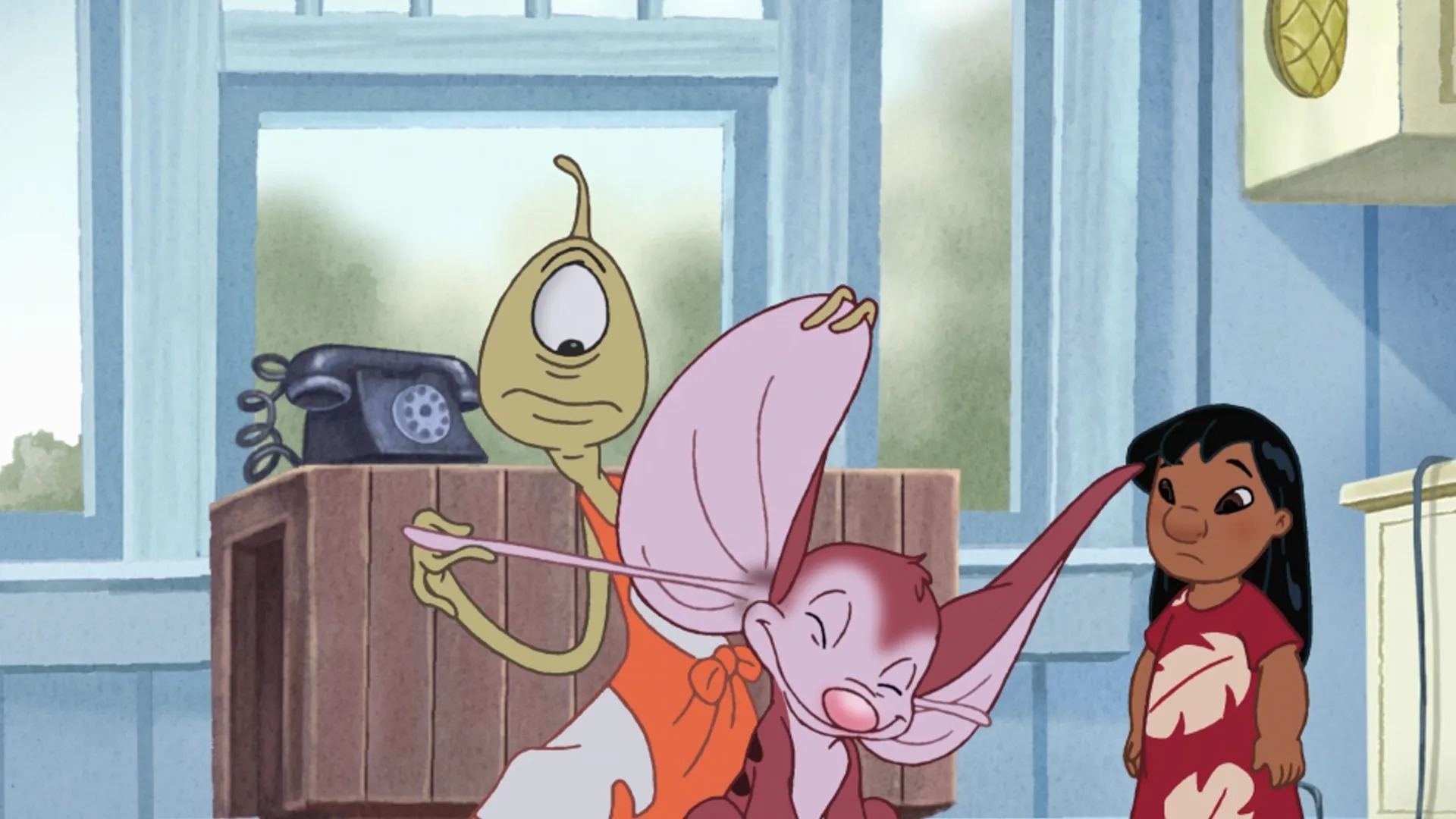
Lilo uses Experiment 234 to listen to private conversations, mistakes Mertle’s discarded dolls for discarded friends, and starts a social rupture that Hämsterviel exploits. Accurate sound becomes false certainty when context disappears.
Shush turns private speech into portable entertainment
Experiment 234 can isolate distant conversations and replay them through the speaker in his tail. The ability makes private words feel like a broadcast waiting to happen. Lilo and Stitch are fascinated before considering whether the speakers agreed to be heard.
Curiosity is understandable, especially for a child often excluded from adult information. Access still creates responsibility. Hearing something accidentally is different from directing a surveillance tool toward a person.
The playground activation begins with another unsecured pod
Children with water toys accidentally activate Shush after a struggle over the pod. The sequence places alien technology inside an ordinary play area where nobody knows the hazard. Gantu, Lilo, and Stitch all prioritize possession over clearing civilians.
A safe response would isolate the object, move children away, and identify the experiment before pursuit. The repeated pod failures show a system problem, not charming bad luck.
Enhanced hearing captures words without their social frame
Shush can select a conversation while excluding surrounding context. The listener may miss who is present, what object is being discussed, earlier sentences, facial expression, sarcasm, and shared history. Accuracy at the sound level can produce a false conclusion at the meaning level.
Surveillance often creates confidence because the recording feels objective. The episode demonstrates that a true fragment can still support an untrue story.
Lilo listens to Nani and David because uncertainty already feels dangerous
Adult conversations about relationships affect Lilo’s home, yet she may not be invited into every detail. Shush offers relief from waiting and asking. The eavesdropping lets her believe she can prevent change by learning it first.
Nani is right to set a privacy boundary, and she should also explain what information Lilo will receive when family decisions affect her. Predictable communication reduces the temptation to spy.
Nani’s phone call belongs to Nani even inside a shared house
Family closeness does not eliminate privacy. Nani may speak to David about affection, frustration, work, or ordinary plans without turning the conversation into household property. Lilo’s fear does not grant unrestricted access.
A practical boundary includes closed-door signals, no surveillance experiments near calls, and a way for Lilo to ask whether a conversation concerns her without demanding the content.
Stitch warns Lilo before the Mertle mistake
Stitch recognizes that using Shush against Mertle is wrong and tries to stop Lilo. His judgment matters because he is often cast as the impulsive one. Here, Lilo’s desire for information outruns the cousin supposedly learning restraint.
The warning gives Lilo a clear choice. Her later apology must acknowledge that she ignored both Mertle’s privacy and Stitch’s attempt to protect her from the consequence.
Mertle’s cruelty does not remove her right to private speech
Mertle has bullied Lilo repeatedly, which makes suspicion emotionally plausible. It does not make every private conversation available for monitoring. Rights cannot depend on whether the listener likes the subject.
Lilo can document behavior directed at her and seek adult support. Secretly gathering unrelated speech creates new harm and makes legitimate complaints easier for others to dismiss.
The word “girls” becomes a verdict because Lilo expects rejection
Shush captures Mertle dismissing old dolls, but Lilo assumes she means the hula girls. The interpretation fits Lilo’s existing belief that Mertle is disloyal and cruel, so she stops testing alternatives.
Confirmation bias is not stupidity. It is the mind preferring information that supports an established pattern. Responsible listening requires asking what else the words could mean before acting.
The hula girls punish Mertle without verifying the claim
Lilo shares a conclusion based on covert audio, and the group isolates Mertle. They treat access to a private fragment as stronger evidence than direct conversation. Social punishment moves faster than verification.
The girls should ask Mertle what she meant, describe the concern without replaying private audio publicly, and allow response. Friendship cannot be governed by anonymous intelligence drops.
Lilo briefly gains the group she wanted through misinformation
When the hula girls side with Lilo, she receives belonging that Mertle usually controls. The victory makes correction emotionally expensive because admitting the error may return Lilo to the edge of the group.
That pressure explains delay but cannot excuse it. Honest belonging requires the group to value Lilo without needing Mertle’s humiliation as admission payment.
Mertle’s retaliation grows from harm and remains dangerous
After being rejected, Mertle accepts Hämsterviel’s offer to catch experiments. Her anger makes manipulation easier, but she still chooses to join a harmful project before the mind-control device is applied.
Accountability should distinguish that initial decision from actions performed under direct control. Feeling betrayed deserves support, not permission to endanger others.
Hämsterviel targets a hurt child because isolation creates leverage
He approaches Mertle when she believes her friends discarded her. Instead of offering care, he converts anger into labor and then removes her agency with a headband. The recruitment pattern is predatory.
Adults need to notice abrupt isolation and secret contact before a villain reaches the child. Mertle’s difficult behavior does not make her responsible for an adult exploiting vulnerability.
The mind-control headband makes Mertle a patient and victim
Once the device controls her, Mertle cannot meaningfully consent to missions, combat, or capture. Responders should prioritize safe removal, medical assessment, and preservation of evidence rather than treating her as a willing android.
Jumba’s ability to remove the headband is useful, but he must check for neurological injury, memory gaps, conditioning, and delayed effects after the visible control ends.
Gantu’s return adds another adult competing over a child and experiment
Gantu attempts to recapture Shush to repair his standing. The conflict places Mertle, Lilo, and Stitch between adults pursuing status through control of Experiment 234.
A safe operation would extract the children and secure Shush without turning them into combatants. Gantu’s employment crisis does not authorize armed intervention near minors.
Petting Shush is a stop signal, but it needs his consent too
Touching Shush’s head ends his eavesdropping because he relaxes and folds his ears. The mechanism offers a humane interruption compared with force, yet people should not assume unlimited permission to touch him.
Training could pair a verbal or visual stop cue with voluntary contact. Shush needs a way to signal when touch is unwelcome and a reliable method to disengage independently.
Shush needs a privacy protocol before he enters any household
The family should define prohibited targets, private zones, emergency exceptions, data retention, playback rules, and deletion. Nobody should use him to monitor romance, friendships, school disputes, or ordinary family conversation.
If he hears sensitive information accidentally, the default response is silence and no recording. Curiosity is not a public-interest exception.
A CIA placement does not solve the ethics of surveillance
Cobra Bubbles places Shush in intelligence work because the ability fits. Government employment may redirect the power toward threats, but a badge does not create consent, legal authority, accuracy, or humane conditions.
The agency needs warrants, oversight, minimization rules, audit logs, limits on retention, and protection for privileged or unrelated speech. Shush must also be an employee with rights rather than biological equipment.
Intelligence work can reproduce Jumba’s original weapon design
Shush was created to collect enemy conversations. Assigning him to another security organization may change the employer without changing the function. Rehabilitation should expand his choices rather than declaring the original programming good because the state uses it.
He may enjoy investigative work, sound engineering, rescue listening, or quiet companionship. The decision needs his participation and a genuine option to refuse.
Cobra owes Shush protection from classification and isolation
A secret agency may hide Shush’s existence, restrict movement, and prevent ordinary relationships in the name of security. Those conditions can become another form of captivity even with comfortable facilities.
His placement needs independent welfare checks, social contact, medical care, rest, and a path to leave the role. National security cannot erase personhood.
Mertle deserves a correction as public as the accusation
Lilo’s misinformation changes how the hula girls treat Mertle. A private apology alone leaves the social damage in place. Lilo needs to tell the same group that she listened secretly, lacked context, and reached the wrong conclusion.
Mertle can accept or reject the apology. Repair is the action of correcting the record and changing behavior, not controlling the target’s response.
The hula group needs a better conflict process
A single report should not trigger immediate exile, especially when the evidence comes from surveillance. The girls need expectations for direct questions, adult help, privacy, and consequences proportionate to verified behavior.
That process must also address Mertle’s real bullying. Correcting this false accusation cannot turn her into an innocent person in every other conflict.
Misinformation spreads because each person adds confidence, not evidence
Shush supplies a real fragment, Lilo supplies an interpretation, and the hula girls supply social enforcement. At each step, the claim sounds stronger because another person repeats it. Nobody adds new evidence. Agreement becomes a substitute for verification.
The group also loses track of source quality. They know Lilo heard Mertle, but they may not understand that the listening was covert, partial, and detached from visible context. A responsible report must preserve those limits instead of presenting the conclusion as a direct quotation.
Once Mertle is excluded, her anger appears to confirm the accusation. That is circular reasoning: the punishment creates the behavior later treated as proof that punishment was deserved. The girls need to separate reaction to harm from evidence about the original conversation.
Correction must follow the same route as the rumor. Lilo should identify the misunderstood dolls, explain how the recording was obtained, and ask everyone who repeated the claim to stop. Quiet regret cannot reach all the people who received a confident false story.
Surveillance data needs minimization, deletion, and access controls
Shush may replay what he hears, which means private speech can persist beyond the moment. The family needs to know whether the sound is biologically stored, how long it remains, who can trigger playback, and whether one conversation can be copied or transmitted.
Minimization means Shush should collect only what an authorized purpose requires. Unrelated family, medical, romantic, legal, or child speech must be excluded and deleted. Listeners cannot keep entertaining fragments because they may become useful later.
Access should require more than proximity to his tail. A consent signal, named operator, logged purpose, and automatic expiration would reduce misuse. Shush needs the ability to refuse playback when disclosure would harm someone or violate an agreement.
If deletion is impossible, the placement becomes riskier. Cobra’s agency must plan for memory security without isolating, sedating, or controlling Shush. Protecting data cannot become permission to imprison the being who carries it.
Mertle’s recovery must separate willing choices from controlled actions
Mertle agrees to help Hämsterviel while angry, then loses agency under the headband. Investigators should establish a timeline: what she understood before attachment, what commands followed, what she remembers, and whether threats or deception shaped the initial agreement.
She may feel guilt for harm committed while controlled and embarrassment about being used. Adults should avoid telling her either that none of it matters or that all of it defines her. Recovery needs factual accountability paired with recognition of coercion.
The headband itself is evidence and a medical hazard. Jumba should preserve it after removal, document how it connects to cognition, and create a screening plan for delayed symptoms. Nobody should reactivate it for demonstration.
Mertle also deserves protection from public ridicule. Her peers can know she was manipulated without receiving intimate details of neurological effects. Privacy remains important even for someone whose private speech started the episode’s conflict.
Shush needs labor rights if Cobra calls him an operative
An operative has duties, training, compensation, rest, representation, and the ability to report unsafe orders. Calling Shush a cute intelligence asset would strip the title of every protection while keeping the agency’s access to his body.
He needs an independent guardian or advocate fluent in his communication. Mission consent should be evaluated each time, with limits on duration, targets, and exposure. Refusal cannot result in loss of housing, food, medical care, or family contact.
The agency must protect his hearing as well as the information he gathers. Enhanced auditory sensitivity may make loud environments painful or damaging. Quiet housing, protective equipment, recovery periods, and specialist care are workplace necessities.
Retirement must be real. If Shush later chooses another life, he should leave without being treated as classified property or a security threat. A one true place becomes false the moment the door locks from the outside.
What I would keep and what I would repair
I would keep Shush’s tail speaker, Lilo’s temptation, the doll misunderstanding, Mertle’s recruitment, and Stitch serving as the moral warning. The episode has a clean demonstration of how accurate audio can produce false certainty.
I would deepen Mertle’s recovery, make Lilo correct the group publicly, and treat the CIA placement as an ethical problem requiring consent and oversight.
RaeRae’s final verdict
“Shush” gives Lilo the ability to hear what people say when she is absent and discovers that access does not equal understanding. One private fragment costs Mertle her friends, gives Hämsterviel an opening, and turns a playground experiment into intelligence property.
My verdict: stop the playback, ask what the sentence meant, remove the headband, correct the rumor, and make Cobra show the warrant. Shush can hear almost everything. The hard part is learning when nobody has the right to listen.
Where to watch
Watch “Shush” through Lilo & Stitch: The Series on Disney+. Disney+ labels it Season 2, Episode 20. Apple labels the same story Season 2, Episode 23 and incorrectly calls Shush Experiment 411; the established franchise number is 234. CVM Sekai records it as overall Episode 59. Availability and numbering can change by platform.
Keep exploring
Return to the episode directory or return to the Lilo & Stitch hub.