
EPISODE 55 · DISNEY+ SEASON 2, EPISODE 16 · WISHY-WASHY · RAE RAE REACTS
Lilo & Stitch: The Series Episode 55: Wishy-Washy
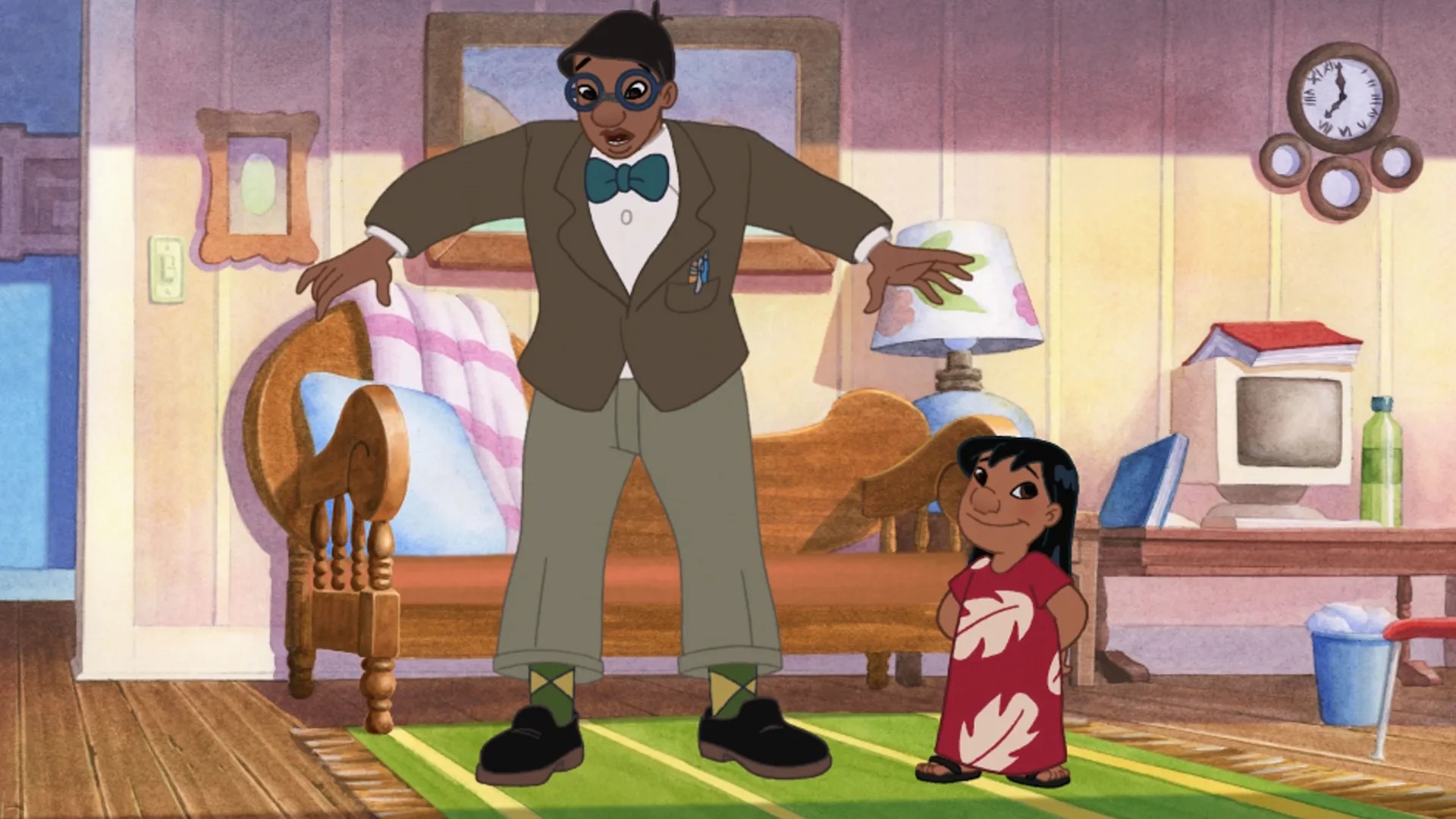
Lilo finds a wish-granting experiment and tries to turn David into the partner she thinks Nani needs. Literal magic collides with grief, consent, matchmaking, and a child’s fear that her family is not normal enough to stay together.
Lilo’s wish begins with fear, not romance
Lilo wants Nani and David to marry because marriage looks like a structure that might make the family harder to break. She has already lost both parents and lived under the threat of separation. “Normal” is less a lifestyle preference than a child’s attempt to purchase permanence.
That fear deserves tenderness before correction. Lilo is still wrong to redesign David and steer Nani’s relationship, but adults need to answer the insecurity beneath the plan: her home does not become legitimate only when a man joins it.
Nani is already a complete guardian without a husband
The episode risks treating Nani’s single guardianship as an unfinished family shape. She works, parents, grieves, sets boundaries, and keeps Lilo safe under impossible scrutiny. Marriage may add love or support, but it cannot certify work she is already doing.
Lilo needs language that honors the household she has. Jumba, Pleakley, Stitch, David, and neighbors can contribute without forcing every relationship into a nuclear-family template.
David’s affection is not an application for replacement father
David cares about Nani and Lilo, yet Lilo treats his relationship as a vacancy-filling process. He becomes a candidate whose intelligence, attractiveness, and usefulness can be upgraded until Nani chooses him. That removes his right to be loved as himself or decline a role.
A child may hope adults marry, but she cannot be responsible for engineering the outcome. Nani and David need privacy, consent, and room to define commitment without making Lilo manage their future.
Wishing David into genius changes him without permission
Wishy-Washy grants Lilo’s desire for the smartest man in the world, and David begins speaking beyond the family’s comprehension. The transformation affects cognition, communication, identity, work, relationships, and possibly neurological health. David never agrees to any of it.
Good intentions do not create medical consent. Restoring him should be the immediate priority, followed by an honest explanation and a check for memory, distress, or lingering effects.
Intelligence does not make a partner more worthy of love
Lilo assumes greater intelligence will make David more attractive to Nani. The wish turns a human relationship into a ranking problem where one measurable trait should unlock commitment. Nani may value David’s kindness, reliability, humor, and respect more than abstract brilliance.
The result also isolates David because communication collapses. Intelligence without mutual understanding does not create intimacy. A relationship is built through choices, not a magically improved résumé.
Wishy-Washy’s literalism is predictable after Jumba’s ruler story
Jumba explains that wishing to become supreme ruler of the universe turned him into a measuring ruler. That history proves Experiment 267 interprets language literally and unpredictably. Continuing to make casual wishes around him is reckless after the hazard is known.
The household needs silence protocols, written wording review, and a moratorium until reversal is understood. A cute wand does not make reality alteration safe for improvisation.
Every overheard sentence can become an unauthorized command
Wishy-Washy grants wishes he hears, which makes ordinary speech dangerous. People say “I wish” to express frustration, fantasy, grief, or politeness without intending a command. Experiment 267 collapses that distinction.
Consent requires an activation phrase, named requester, confirmation, scope, duration, and cancellation method. Without those safeguards, the experiment turns private emotion into public reality.
Children cannot carry informed consent for reality alteration alone
Lilo understands that wishes have consequences in stories, but she cannot calculate every legal, medical, ecological, and relational outcome. Adults should not hand her an active reality-changing experiment and rely on clever wording.
Her participation can include questions and supervised planning. Final authorization needs accountable adults, independent review, and a tested reversal. Protecting Lilo from that burden respects her intelligence.
The wish meter turns desire into a scarce resource
Wishy-Washy has a finite capacity that drains as wishes are granted. Scarcity encourages competition, hoarding, and pressure to spend the remaining power on whoever claims the greatest need. The experiment’s body becomes a battery people argue over.
Nobody asks whether granting wishes hurts him or whether depletion changes his cognition. His health must come before the household’s list of improvements.
Turning white and being called useless is a brutal measure of worth
When the wish supply is exhausted, Wishy-Washy loses color and is described as useless. The language reveals how quickly rescue becomes conditional on productivity. A cousin who cannot perform his designed function is still alive and deserving of care.
The family should monitor recovery, nutrition, mood, and whether capacity returns naturally. Rest is not failure, and exhaustion should never be treated as permission to discard him.
Literal wishes punish ambiguity rather than teaching communication
The comedy depends on words having multiple meanings and the experiment selecting the worst one. That can encourage careful language, but it may also blame speakers for consequences no reasonable listener would impose. Conversation normally relies on context and repair.
Wishy-Washy needs a clarification step instead of weaponized pedantry. Asking “Do you mean this?” would transform him from a trap into a participant.
Nani’s irritation is evidence that the plan ignored her
Lilo expects the changed David to impress Nani, but Nani experiences a partner who suddenly communicates differently and behaves without explanation. Her frustration is not ingratitude. She did not request a new David or agree to evaluate one.
The relationship belongs to Nani and David. Lilo’s fear can be discussed without turning Nani’s romantic choice into a family emergency she must resolve on demand.
David deserves restoration before anybody judges the result
The household focuses on whether each wish worked as intended, but David is a person under involuntary alteration. They should stop experimenting, remove him from public exposure, and restore his baseline with consent.
Afterward, David may feel violated that traits were selected for him. An apology must name the transformation, the matchmaking pressure, and the use of his body as a test.
Gantu and Hämsterviel would turn wishes into coercive infrastructure
Experiment 267 can alter people and material conditions, making him valuable to anyone seeking conquest. Gantu’s pursuit is therefore more than another capture attempt. Hämsterviel could force wishes, drain the meter, and treat literal mistakes as acceptable casualties.
Protection requires secure housing, limited knowledge of his location, and a rule that Wishy-Washy cannot be compelled to perform for the Federation, Jumba, or the family.
A wish cannot solve grief by replacing what was lost
Lilo’s desired family structure reaches toward parents who are gone. Marriage might give her another caring adult, but it cannot restore the original household or guarantee nobody leaves. Magic cannot make grief obey a safer timeline.
She needs consistent reassurance, memory, counseling, and adults who can tolerate the fear without promising impossible permanence. The honest answer may feel smaller than a wish, but it can be trusted.
Nani and Lilo need a conversation about future relationships
Nani can explain that dating David does not automatically mean marriage, and marriage would not erase Lilo’s place. She can also set a boundary: Lilo may share hopes and worries but cannot modify either adult.
Lilo deserves to know how major household changes would be discussed with her. Inclusion can reduce the urge to control what feels secret and dangerous.
Wish governance must include refusals and reversals
A safe protocol would ban wishes involving another person’s body, mind, identity, relationship, property, or legal status without consent. Requests affecting the environment or public must receive broader review.
Every approved wish needs precise wording, a test scale, a rollback condition, witnesses, and documentation. Wishy-Washy must be allowed to refuse even a carefully written request.
His one true place should not be an endless request line
A wishing booth, charity service, or miracle business would invite exploitation and make every refusal look cruel. People in crisis could pressure him with needs no individual creature should be forced to rank.
A humane home gives him play, relationships, medical care, and long periods where nobody asks for anything. His power may remain unused while his life remains full.
Lilo has learned to treat adult stability as a problem she must solve
Cobra’s scrutiny and Nani’s employment crises have taught Lilo that one mistake can threaten the household. She watches money, relationships, and adult moods because safety has repeatedly depended on them. Wishy-Washy gives that hypervigilance a wand and tells her she can finally fix the variables herself.
That is parentification wearing fairy wings. Lilo is trying to manage Nani’s romantic future so the family will become structurally safer. She should be allowed to name fears and preferences, but adults must carry responsibility for housing, income, legal guardianship, and partnership decisions.
Nani can reduce uncertainty by explaining what plans exist if work changes, who would help in an emergency, and how Lilo would be included if David became more involved. Concrete information will not erase grief, but it gives the child something sturdier than guessing from adult conversations.
The family also needs to stop celebrating Lilo only when she solves an alien crisis. Her value cannot depend on rescue work, emotional insight, or producing a clever one true place. She deserves childhood time where the household remains intact without her managing it.
“Normal family” is a moving target that keeps the Pelekais ashamed
Lilo’s imagined normal includes a married couple, recognizable roles, and fewer reasons for outsiders to question the home. Yet the franchise’s emotional center is a family built from two sisters, an alien, and chosen relatives who arrived through chaos. Normality would require erasing the very relationships that kept them alive.
The desire is understandable because institutions often reward familiar households. Nani may be judged more harshly as a young unmarried guardian, while Lilo sees classmates use conventional families as evidence of superiority. The pressure is social even when no single character states it directly.
A stronger episode would separate stability from conformity. Stable families communicate, meet needs, repair harm, and maintain dependable care. They can include siblings, friends, partners, aliens, elders, and people who live elsewhere. Marriage is one possible relationship, not a quality-control stamp.
Lilo can want David nearby without treating Nani as unfinished. She can also miss her parents without asking a new adult to replace them. Giving each feeling its own name prevents one magical solution from carrying impossible emotional work.
Reality alteration needs an ethics board, not better phrasing alone
Careful wording reduces literal accidents but cannot make every wish ethical. A perfectly precise command could still violate a person, transfer wealth, alter memory, erase evidence, change an election, or damage an ecosystem. Grammar is a safety tool, not moral authorization.
Jumba should disclose Wishy-Washy to an accountable galactic authority that is independent of Hämsterviel and his own laboratory. Any testing needs voluntary adult participants, minimal scale, medical monitoring, and a guaranteed rollback. Requests involving children or nonconsenting targets should be prohibited.
The experiment must also have representation because everyone else benefits from defining his power. Someone should advocate for his health, privacy, and right to refuse. A meter on his body cannot become public inventory that strangers monitor while demanding miracles.
Emergency use would remain difficult. Saving a life may justify a narrow wish when no safer option exists, but responders still need evidence that the wording will not trade one victim for another. Unlimited possibility increases responsibility rather than removing it.
Recovery must restore agency, records, and relationships
Reversing David’s intelligence change is only the first step. The family should confirm his memory, language, work ability, emotional state, and physical health. Any public record created while altered may need correction, including statements, purchases, promises, or decisions other people assumed were voluntary.
Nani needs space to process that her relationship was manipulated in her own home. She should not be pushed to comfort Lilo immediately or reassure David before understanding what happened. David likewise deserves privacy from jokes about whether the improved version was better.
Lilo’s apology should avoid making her grief an excuse. She can explain the fear, name the choices she made, and ask what repair each adult needs. Nani can accept the feeling without accepting the behavior, which models love that survives accountability.
Wishy-Washy should be included without being blamed as a machine. He followed programming and may not understand why obedience caused harm. Rehabilitation teaches confirmation, refusal, and context while making clear that the adults failed to supervise both him and Lilo.
What I would keep and what I would repair
I would keep Lilo’s understandable longing for security, the ruler joke, David’s incomprehensible genius, and the way literal wishes expose careless assumptions. The premise fits a family whose deepest desire is permanence.
I would repair David’s consent, reject the idea that Nani needs upgrading through marriage, protect Wishy-Washy from depletion, and give Lilo a direct conversation about grief and future change.
RaeRae’s final verdict
“Wishy-Washy” gives a grieving child access to a flying reality editor and acts surprised when she tries to rebuild her family. The comedy belongs to literal language, but the ache belongs to Lilo believing Nani, David, and normality can be arranged into a guarantee.
My verdict: restore David, let Nani choose her own relationship, stop spending an experiment like a battery, and tell Lilo the family she has already counts. A marriage certificate cannot promise nobody leaves. Honest love can promise that decisions will not be made around her in secret.
Where to watch
Watch “Wishy Washy” through Lilo & Stitch: The Series on Disney+. Disney+ renders the title without the hyphen and labels it Season 2, Episode 16. CVM Sekai records it as overall Episode 55. Availability can change by region.
Keep exploring
Return to the episode directory or return to the Lilo & Stitch hub.