
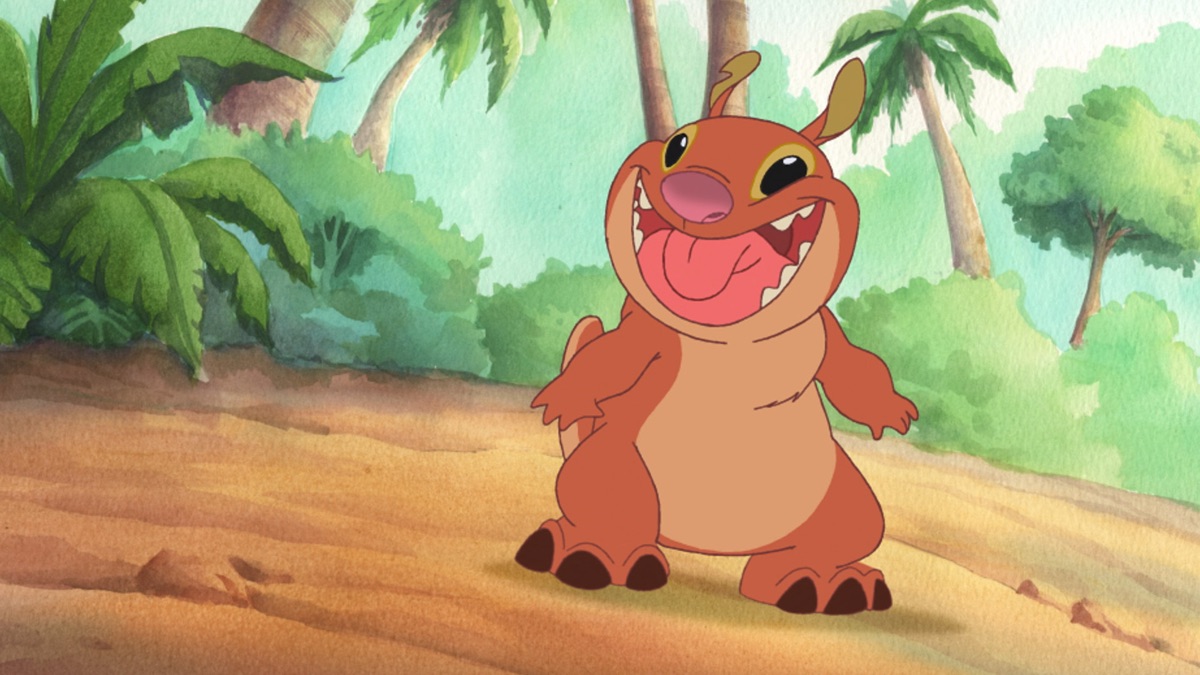
EPISODE 50 · APPLE SEASON 2, EPISODE 14 · RETRO · RAE RAE REACTS
Lilo & Stitch: The Series Episode 50: Retro
Nani’s wealthy old friends invite the family onto a yacht while believing she is a vice president. Experiment 210 arrives, strips people and technology back to primitive states, and turns class performance into a maritime caveman emergency.
Nani’s old friends return with a version of her life that never happened
Ellen and Lona come back to Kauaʻi believing Nani is a vice president. The misunderstanding gives Nani access to the successful adult identity she may once have imagined before grief, guardianship, unstable work, and alien emergencies changed the route. She wants the friends to see achievement rather than struggle.
That desire is painfully human. Nani has spent years being evaluated as a worker and guardian, so one dinner where nobody looks at her with concern feels like relief. The lie still creates a trap because every detail of her real life must become evidence she failed to hide.
Class shame enters before anybody boards the yacht
The invitation comes from wealthy friends with a boat and assumptions about Nani’s career. Money shapes the evening through clothing, manners, language, and what the family thinks sophisticated people are allowed to notice. Nani begins editing the household before anyone openly insults it.
Economic status is not moral status. Working at the rental hut, raising Lilo, and maintaining a crowded home are achievements even when they do not produce a title. The episode works because Nani knows that and still feels the pressure.
Pretending to be high class turns the family into performers
Lilo, Jumba, Pleakley, and Nani dress and behave according to an imagined wealthy standard. Every person must remember the story, suppress familiar habits, and monitor everyone else. Dinner becomes unpaid theater where one mistake could expose the whole household.
Passing may offer temporary safety, but it drains attention and increases panic. Honest boundaries would be easier: Nani can share what she chooses, decline career details, and let her friends meet the family without handing them every hardship.
Lilo is asked to protect an adult’s social fiction
A child should not have to manage a guardian’s lie during a formal dinner. Lilo must monitor what she says while also navigating unfamiliar rules and an active experiment. If she tells the truth, Nani may feel betrayed; if she maintains the story, she becomes responsible for deception she did not create.
Nani owes Lilo a clear release from that burden. The child can use basic privacy without inventing a corporate biography for her sister.
Jumba and Pleakley are expected to pass as a different kind of human
They already spend much of their Earth life disguised. The yacht adds another layer where they must imitate wealthy social behavior while hiding species, history, and experimental knowledge. Their mistakes are comic because the performance is impossible by design.
The family should recognize that constant concealment has a cost. Safety may require the alien secret, but class performance is optional. Nobody needs to master yacht etiquette to deserve a seat at dinner.
Experiment 210 reduces living beings and technology to primitive states
Retro wraps his tongue around a target and reverses development. Weapons, tools, animals, and people become earlier forms. The power does not transport anyone through time; it changes the body or object in the present without consent.
That makes Experiment 210 a transformation weapon. A person may lose language, memory access, motor control, clothing, medical support, and legal capacity in seconds. The household needs more than a warning that the cousin is “retro.”
Calling transformed people cave people can erase the medical crisis
The episode uses prehistoric caricature for comedy, but Lilo, Jumba, Pleakley, Ellen, and Lona have undergone involuntary cognitive and physical change. They cannot advocate for themselves as usual and may be unable to understand danger.
Responders should use respectful language, preserve privacy, and treat the group as patients. Reduced speech or altered behavior does not remove personhood.
Transformation does not reveal anybody’s true economic status
Apple’s summary jokes that Retro exposes the family’s real class, but becoming prehistoric does not uncover poverty. It removes accumulated technology and learned behavior from wealthy and working people alike. A yacht owner and a rental-hut employee both become vulnerable bodies when the social props disappear.
The episode actually reveals how fragile class performance is. Titles, clothing, boats, and manners can shape treatment, but none determines human worth.
The yacht becomes dangerous as technology regresses
A modern vessel depends on navigation, propulsion, radios, pumps, electrical systems, fuel controls, fire suppression, and structural equipment. Retro can reduce tools to primitive forms while the boat remains on open water. One tongue strike may disable the system keeping everyone alive.
The captain should stop the voyage, send a distress call, issue flotation devices, and account for every passenger. A social dinner cannot outrank maritime safety.
Open water changes the stakes for every transformed guest
People with reduced judgment may wander, climb, fight, or fall overboard. Clothing and footwear may no longer fit. A person who could swim before may not understand the environment after transformation.
The unaffected crew must secure rails, remove hazards, maintain close supervision, and avoid physical restraint unless necessary for immediate safety. Rescue plans should assume communication barriers.
Nani is left to manage a crisis she helped bring aboard
Her lie creates the social setting, but Retro creates the biological emergency. Both truths matter. Nani should take responsibility for concealing information and allowing the cousin near guests without turning herself into the cause of Jumba’s weapon design.
She needs to contact help, protect the transformed people, and tell Ellen and Lona the truth once they can understand it. Accountability is specific; shame tries to make the whole person guilty.
Stitch encounters Retro before the family understands the risk
Stitch’s habit of approaching cousins gives Retro access to the household and yacht. The mission has normalized bringing unknown powers close to civilians before identification is complete. Friendship does not make that sequence safe.
New experiments should be evaluated in a controlled location with Jumba’s records available. A formal dinner full of people who do not know aliens exist is the worst possible testing ground.
The guests never consented to alien exposure
Ellen and Lona invite Nani’s family onto a yacht without knowing one guest can transform them. They accept ordinary social risk, not covert biological experimentation. Their wealth or assumptions do not reduce the family’s duty to protect them.
After restoration, they deserve medical care, an honest explanation within security limits, and the right to decide whether future contact feels safe.
Restoration needs verification, not a quick visual check
If Jumba reverses Retro’s effect, responders must confirm that memory, cognition, anatomy, medication, implants, dental work, and injuries return correctly. A person who looks normal may still have lost time or retained distress.
Follow-up should include private examinations and written information about symptoms that require care. The family should never pressure guests to laugh before they have processed what happened.
Personal possessions may also need restoration
Retro can alter objects, which means phones, medical devices, identification, navigation equipment, clothing, and heirlooms may be destroyed or transformed. Some items carry data or accessibility functions that cannot be replaced by appearance alone.
The Federation and Jumba should fund restoration or replacement. Guests should not pay for damage caused by an experiment the family brought aboard.
Ellen and Lona’s response determines whether they were friends with Nani or her title
Once the vice-president story collapses, they can judge, pity, withdraw, or meet the actual person standing in front of them. Real friendship makes room for changed circumstances and asks why Nani felt unable to tell the truth.
Nani also has to accept that honesty may change the relationship. She cannot control their reaction, only whether she keeps performing for it.
An apology should not become a confession of inferiority
Nani can say she lied about work and involved the family in maintaining it. She does not need to apologize for her job, income, home, sister, or alien relatives. Those are not failures hidden beneath the deception.
A healthy apology names the choice, the impact, and the repair. Class shame would turn it into proof that she never belonged on the yacht.
Lilo needs reassurance that the real household is not embarrassing
Children notice when adults conceal work, money, housing, accents, or relatives. Lilo may conclude that she is part of what Nani needed to hide. That belief would deepen the child’s existing fear that being different makes the family unsafe.
Nani should tell her directly that the lie came from Nani’s insecurity, not Lilo’s worth. The family can learn etiquette without treating itself as a problem requiring disguise.
Retro’s power needs consent controls and protective equipment
His tongue is the delivery mechanism, so a comfortable guard or trained signal may prevent accidental contact while allowing eating, breathing, and communication. The device should be designed with Retro rather than used as permanent punishment.
Caregivers need to know range, duration, reversibility, targets, and whether repeated transformations cause harm. Containment rules should apply to objects and animals as well as people.
A Mesozoic zoo raises more problems than it solves
One source describes Retro working at a wildlife preserve by turning modern animals into prehistoric forms. The spectacle sounds profitable and extremely dangerous. Animals cannot consent to radical transformation, and a reversible display may still cause pain, stress, ecological risk, or medical damage.
A humane one true place should never depend on transforming captive animals for entertainment. If Retro’s ability has scientific value, research requires independent animal-welfare oversight and a strong presumption against use.
Curing disease would also require evidence and consent
Another franchise source associates Retro with curing disease by reverting affected cells or bodies. That possibility is more defensible than a dinosaur attraction, but the risks are enormous. Reversion might remove beneficial development, immunity, memory, or healthy tissue along with illness.
Any medical use must begin with laboratory evidence, informed adult consent, child protections, independent ethics review, and a reliable reversal. Retro is not a miracle cure because a DVD extra found a clever sentence.
Retro can belong without transforming anybody
The series often searches for a useful job, yet some powers are too invasive for routine employment. Retro deserves housing, relationships, play, and care even if the safest choice is rarely using his original function.
Belonging should not depend on producing prehistoric animals or experimental medicine. His life can be valuable before a practical application is approved.
What I would keep from Retro
I would keep Nani’s class anxiety, the yacht as a pressure cooker, the family’s attempted performance, and the way Retro strips away every status symbol in seconds. The episode gives Nani a mistake that grows from understandable insecurity rather than carelessness alone.
I would add maritime emergency procedures, patient-centered restoration, and a direct conversation between Nani and Lilo. I would reject the wildlife-preserve dinosaur job unless the animals are entirely non-sentient simulations. No zebra needs to become a triceratops so tourists can take pictures.
The episode understands embarrassment better than it understands repair
Nani’s performance is funny because every detail requires another lie. A job title changes how she must describe the rental hut, Lilo, Stitch, Jumba, Pleakley, and the ordinary limits of the family budget. She cannot protect one false claim without temporarily treating the people she loves as evidence that needs explaining. That is the emotional damage beneath the yacht comedy.
The script resolves the physical disaster faster than the relational one. Restoring a body does not automatically restore trust, and admitting the truth does not tell Lilo what she feared hearing. Nani needs a quieter scene after the chaos where she names the exact mistake: she wanted approval from old friends so badly that she acted as if her real work and family were insufficient.
Ellen and Lona also deserve room to respond as people rather than props in Nani’s lesson. If they valued the executive title more than Nani, the friendship was already weak. If they would have welcomed the truth, then the lie denied them the chance to show it. Either outcome gives Nani useful information, but only an honest conversation can reveal which friendship she actually has.
That conversation could make Retro more than a transformation gag. His power removes modern surfaces in seconds, while the apology asks everybody to stop using status as a surface in the first place. The theme works when the episode refuses to confuse wealth with civilization, poverty with primitiveness, or embarrassment with proof that a person has failed.
RaeRae’s final verdict
“Retro” puts Nani on a yacht with two old friends, a fake executive title, an alien family trying to perform wealthy manners, and Experiment 210 licking everybody back toward prehistory. The episode is loud, physical comedy wrapped around a quiet fear: what if the people from your past see the life you actually have and decide it is smaller than the life you should have built?
My verdict: Nani lied, but her job and family were never shameful. Retro caused a medical and maritime emergency, not a class reveal. Restore every person and object, compensate the guests, tell Lilo she was never the embarrassing part, and give Experiment 210 a safe life that does not require turning wildlife into a theme park. The yacht had money. The Pelekai house had ohana. Only one of those survived the caveman dinner.
Where to watch
Watch “Retro” through Lilo & Stitch: The Series on Disney+. Apple labels the story Season 2, Episode 14, while CVM Sekai records it as overall Episode 50 in the complete aired-order directory. Apple’s synopsis also calls Retro Experiment 321, but the established franchise number is 210. Availability can change by region.
Keep exploring
Return to the episode directory or return to the Lilo & Stitch hub.