
EPISODE 48 · SEASON 2, EPISODE 9 · PLOOT · RAE RAE REACTS
Lilo & Stitch: The Series Episode 48: Ploot
Illegal dumping activates Experiment 505. Ploot removes the island’s trash by turning it into expanding toxic sludge, Stitch gets sick from eating garbage, and the ocean sends everybody’s bad decisions directly back to town.
The episode begins with people throwing trash where they think nobody will see it
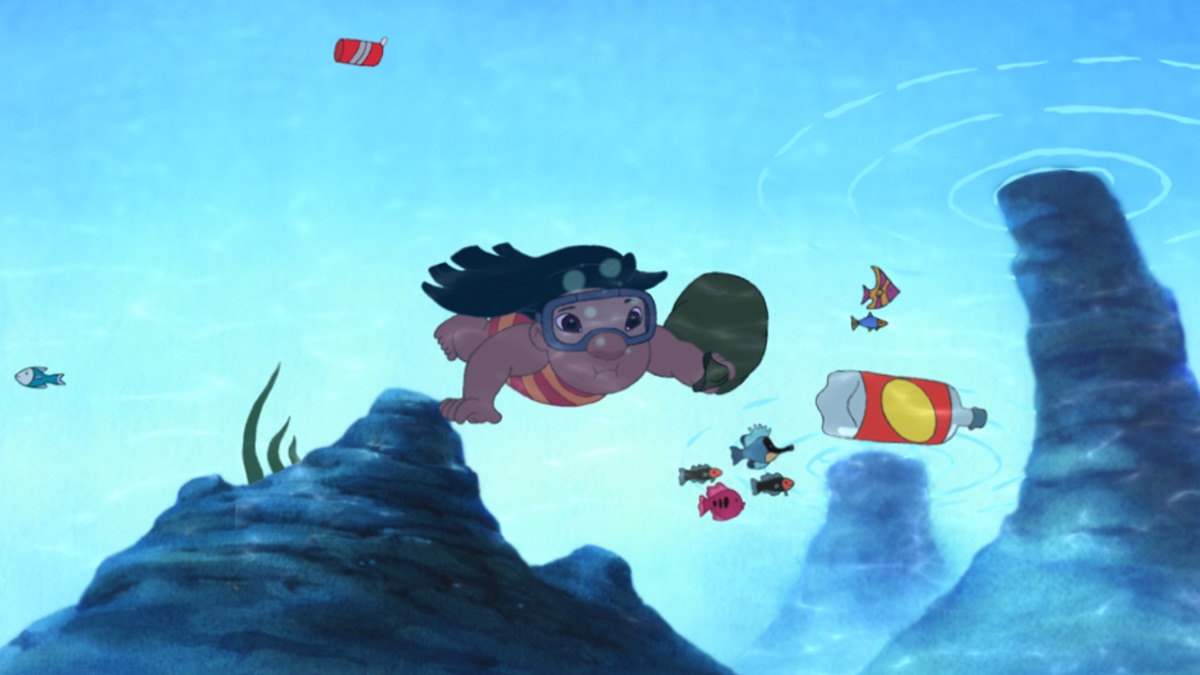
A bag of garbage is dumped over a cliff and falls into Pudge’s underwater grotto. The act is casual because the polluters treat distance as disappearance. Once the bag leaves their hands, they imagine the responsibility has left too. The ocean becomes the place where consequences are hidden.
Illegal dumping is not a harmless shortcut. Wildlife encounters plastic, metal, chemicals, spoiled food, fishing line, and objects that can cut, trap, poison, or block digestion. The person who throws the bag saves a few minutes while the ecosystem inherits years of cleanup.
Pudge’s grotto makes pollution personal
Lilo’s relationship with Pudge gives the underwater space meaning beyond scenery. Contamination enters a place connected to ritual, grief, routine, and care. The damage is environmental and emotional because somebody’s beloved place has been treated as empty.
Cleanup should include Lilo’s knowledge without making her responsible for the whole site. Adults and local authorities need to remove hazards, test water and sediment, document sources, and prevent further dumping.
Experiment 505 activates inside the waste stream
Ploot’s pod is carried in the garbage and activated when it reaches water. The episode turns pollution into both cause and fuel: human disposal awakens a weapon designed to convert accumulated trash into expanding toxic sludge. The discarded material does not vanish. It changes form and comes back larger.
That is an excellent monster rule because waste systems often hide transformation. Garbage becomes leachate, smoke, microplastics, contaminated soil, methane, or exported burden. “Away” is a direction, not a destination.
Ploot cleans by collecting, but his purpose is contamination
At first, Experiment 505 appears useful. He gathers trash from the grotto, beach, and town. A small body removing litter looks like the exact cousin an island needs. Then the collected material becomes sludge and his body grows with every load.
A visible reduction in litter does not prove a safe process. Waste must be sorted, contained, transported, treated, recycled where appropriate, and monitored through final disposal. Ploot skips every step after collection.
The numbering error needs a clear editorial note
The episode refers to Ploot as Experiment 515 even though the established number is 505 and Experiment 515 belongs to Deforestator, who also appears. CVM Sekai should record the aired inconsistency without reproducing it as fact.
The directory uses Experiment 505 for Ploot and notes the on-screen mistake. Canon errors are part of the production record, but they should not become permanent metadata errors on every connected page.
Beach cleanup should never depend on one child and one alien
Lilo and Stitch work on the shoreline because they care, but the volume and hazards exceed what children should handle. Broken glass, needles, chemicals, sharp metal, animal remains, and unstable debris require trained adults and protective equipment.
Community cleanups need gloves, grabbers, closed shoes, first aid, sorting stations, hydration, adult supervision, and a rule that unknown substances are marked rather than touched. Children can participate without becoming unpaid hazardous-waste crews.
Stitch eats trash and becomes a patient
Stitch’s appetite and durability often turn unsafe behavior into a gag. In “Ploot,” eating garbage causes a rare alien illness and removes him from the rescue. His body can survive enormous force while remaining vulnerable to contamination, spoiled material, chemicals, and pathogens.
The family needs to stop treating indestructible as medically invulnerable. A hazardous ingestion requires identification of the material, poison consultation, symptom monitoring, hydration guidance, and clear thresholds for emergency care.
Illness changes the team without making Stitch a failure
Stitch normally supplies strength, tracking, and protection. When he becomes sick, Lilo must act without the partner she expects. He may feel guilty because his own choice contributed to the illness, but shame will not improve recovery.
His job is to rest and accept care. Lilo’s job is not to pretend she needs nobody. A resilient team has backups and allows members to become patients without losing dignity.
Jumba and Pleakley owe Stitch competent care
The adults remain with Stitch while Lilo confronts the wider threat. They should document symptoms, prevent further ingestion, isolate contaminated material, and contact Federation medical resources. Guessing from memory is not enough for a rare alien illness.
Pleakley’s Earth knowledge and Jumba’s biological knowledge need to work together. Neither expertise should be dismissed because the other person enjoys mocking it. This is exactly the moment when the household needs both.
Lilo goes after Ploot without her usual physical protection
Her determination is admirable and frightening. A child approaches a rapidly growing sludge experiment while the strongest family member is ill. The adults should never make solo courage the emergency plan.
She needs communication, protective clothing, a safe route, a rescue team, and permission to withdraw. Heroism should not require a child to absorb institutional failure because nobody else arrived.
Ploot’s sludge is an unknown hazardous mixture
He combines whatever he collects: household waste, food, metal, plastic, oil, chemicals, biological material, and street runoff. The resulting mud may be corrosive, infectious, flammable, or toxic through skin contact and inhalation. Nobody knows because the mixture changes with every meal.
Residents need evacuation, exposure screening, clean water, protective equipment, and accurate public warnings. Cleanup crews should sample before disturbing the sludge, since moving it can spread contamination through dust and runoff.
Flooding streets turns pollution into an accessibility crisis
Mud blocks roads, entrances, sidewalks, drains, and emergency routes. People using wheelchairs, walkers, strollers, bicycles, or medical transport may lose safe passage first. Workers cannot reach jobs, caregivers cannot reach family, and ambulances may be delayed.
Emergency planning must prioritize accessible evacuation and transportation. A city is not recovered when the sludge is gone from the tourist view while residents remain trapped behind damaged infrastructure.
Storm drains connect the town to the ocean again
Sludge spread through streets can enter drains and return to coastal water, carrying the original trash and new contaminants with it. Ploot creates a loop where dumping in the ocean comes back through town and then threatens the ocean again.
Crews need drain barriers, containment berms, vacuum recovery, and disposal sites prepared for contaminated material. Washing the streets with hoses would move the problem instead of solving it.
Natural air freshener becomes a countermeasure, not a cleanup plan
Jumba and Pleakley discover that a natural air freshener can shrink Ploot to his original size. The reversal stops the expanding experiment, which is essential. It does not automatically neutralize every substance he already released.
The family should distinguish containment of Ploot from remediation of the island. Soil, water, buildings, wildlife, and exposed people still need assessment after the cousin is small.
The phrase natural does not guarantee safety
The countermeasure is described as natural, but plants and natural compounds can irritate lungs, trigger allergies, harm animals, or react with chemicals in sludge. The ingredient list, concentration, delivery method, and affected area still matter.
Responders should use the minimum effective amount, protect bystanders, and monitor environmental effects. “Natural” is a source description, not a complete risk assessment.
Pleakley’s environmental concern finally gets operational value
Pleakley often talks about Earth as a protected wildlife reserve, and the family treats his alarm as dramatic. Here, ecological knowledge helps identify a way to interrupt Ploot. The person everyone rolls their eyes at becomes part of the solution because the crisis is exactly inside his field.
The household should preserve that lesson after the mud dries. Pleakley deserves input on pollution prevention, habitat protection, and safe experiment placement before the next emergency begins.
The original dumpers need accountability beyond a scolding
The people who threw the bag did not design Ploot, but their illegal disposal activated him and contaminated a sensitive site. They should participate in investigation, pay appropriate cleanup costs, and complete consequences grounded in repair.
Accountability should also examine why legal disposal felt inconvenient or inaccessible. Enforcement works better alongside clear collection schedules, affordable services, public bins, hazardous-waste options, and education.
Waste workers are the invisible experts this episode needs
Sanitation workers understand routes, materials, equipment, contamination, and what happens after a bag leaves the curb. Ploot imitates collection while erasing every professional safeguard that makes collection public health work.
The response should involve those workers as experts, provide hazard pay and protective gear, and avoid sending them into alien sludge without information. Applause does not replace safe conditions.
Cleanup labor should not fall onto the same harmed community
Residents already lose access, property, time, and health. Asking them to volunteer every hour of cleanup can deepen the burden while the Federation and Jumba avoid the cost. Community participation is valuable when chosen and supported.
The responsible institutions should fund professional remediation, replace damaged property, provide temporary lodging, and compensate lost work. Ohana does not mean the victims clean everything for free.
Ploot’s intent and Ploot’s design are separate questions
Experiment 505 follows a function Jumba built into him. He may not understand that collecting trash creates toxic flooding or that people experience his growth as attack. That affects how caregivers approach rehabilitation, but it does not make the danger imaginary.
Assessment should examine communication, awareness, triggers, control, and whether he can stop collecting. Safety may require containment while specialists help him develop choices beyond programming.
A useful placement cannot be “eat the town’s trash forever”
The obvious temptation is to put Ploot in waste management because he collects pollution. That would repeat the function that caused the disaster and expose him to an endless stream of harmful material. A one true place must protect the community and the experiment.
He might assist with sealed sorting or detection under supervision if the sludge conversion can be disabled. He also has the right to a life where usefulness is not measured by how much garbage his body can absorb.
The island needs prevention more than a magical cleanup cousin
Ploot’s arrival reveals a system already producing litter and illegal dumping. Catching him removes the dramatic symptom while leaving the waste stream intact. Tomorrow’s bags will still reach beaches and water unless collection, reduction, reuse, and enforcement improve.
Businesses can reduce packaging, residents need accessible disposal, visitors need clear expectations, and public agencies must fund infrastructure. Individual cleanup matters, but prevention changes the volume entering the system.
Pudge and other wildlife need a recovery assessment
Removing visible litter does not prove the grotto is healthy again. Animals may have swallowed fragments, become coated in sludge, abandoned nests, or moved away from altered water. Plants and reef organisms may retain contamination after the shoreline looks clean.
Wildlife specialists should survey the grotto, rescue affected animals, test tissue and water where appropriate, and keep people out until the site is stable. Monitoring needs to continue after the emergency crews leave because ecological damage can appear slowly.
Lilo should receive an honest update about Pudge rather than a vague promise meant to comfort her. Caring for a place includes learning what was harmed, what recovered, and what protection is still needed.
Stitch needs a recovery plan after the crisis
Once the island is safe, Stitch’s illness should not disappear between scenes. He needs follow-up testing, a list of substances to avoid, supervision around trash, and food that meets sensory and nutritional needs without turning every appetite joke into punishment.
Lilo may also carry fear after facing Ploot alone. The family should talk about what happened, thank her, and promise that future emergency plans will bring trained help rather than depending on her courage.
What I would keep from Ploot
I would keep the ocean dumping, the experiment that looks helpful while quietly converting waste into a larger disaster, Stitch becoming too sick to rescue anyone, and Pleakley’s environmental knowledge contributing to the countermeasure. The episode understands that pollution returns in another form.
I would add protective gear, professional cleanup, consequences for the dumpers, and a real placement plan for Ploot. I would also put the 505 versus 515 numbering error directly into the franchise guide so nobody has to wonder whether Deforestator changed careers.
RaeRae’s final verdict
“Ploot” is what happens when people throw one bag over a cliff and discover that the ocean has receipts. Experiment 505 collects the mess, grows into a sludge machine, and spreads the consequences across the same town that wanted the garbage out of sight. Meanwhile, Stitch eats trash and learns that nearly indestructible is not the same as having a stomach approved for landfill sampling.
My verdict: treat the sludge as hazardous, treat Stitch as a patient, treat Pleakley like the Earth expert he keeps saying he is, and make the original dumpers face the cleanup bill. Ploot needs containment and humane rehabilitation, not a permanent job swallowing everybody else’s waste. If the solution to garbage creates more contamination than the garbage, congratulations, you invented a worse trash can.
Where to watch
Watch “Ploot” through Lilo & Stitch: The Series on Disney+. Apple labels the story Season 2, Episode 9. CVM Sekai also records it as overall Episode 48 in the complete aired-order directory. The episode calls Ploot 515, but the established franchise number is 505; Experiment 515 is Deforestator. Availability can change by region.
Keep exploring
Return to the episode directory or return to the Lilo & Stitch hub.