
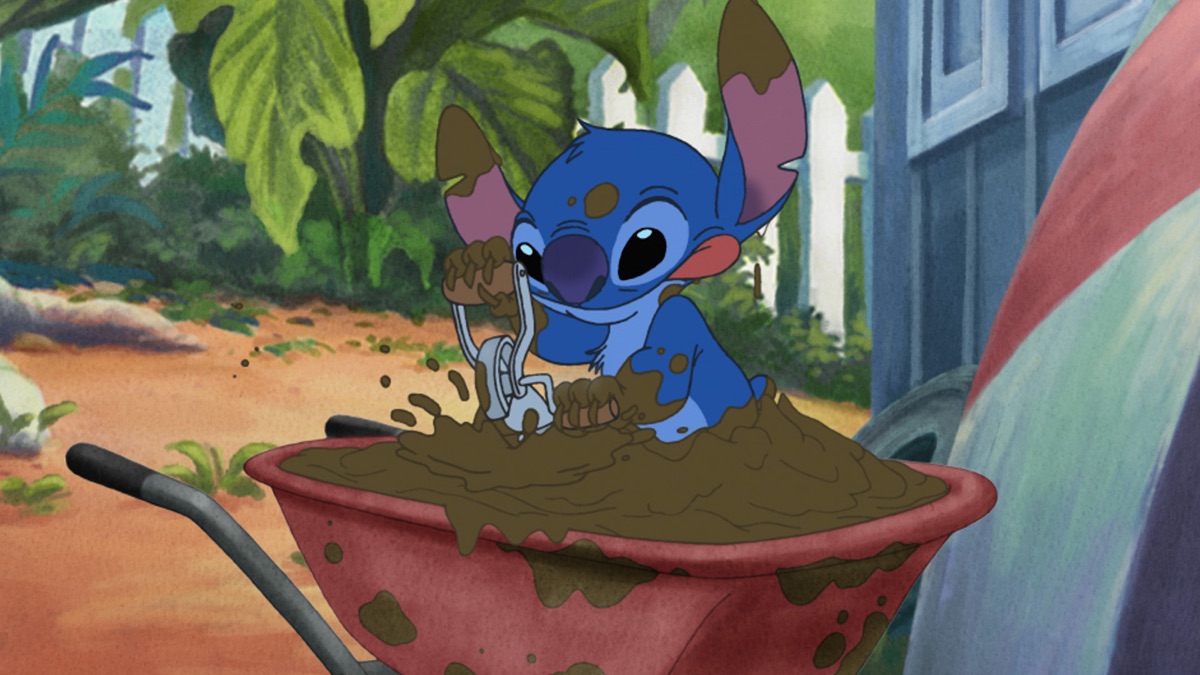
EPISODE 46 · SEASON 2, EPISODE 7 · CHECKERS · RAE RAE REACTS
Lilo & Stitch: The Series Episode 46: Checkers
Lilo’s parade idea is rejected. Experiment 029 crowns her queen, obedience replaces respect, every day becomes a holiday, and Pleakley somehow ends up detained for defying royalty.
A parade-float rejection becomes the opening wound
Hale Kaiulu is planning for the Coconut Queen Festival, and Lilo offers an idea for the float. Moses chooses Mertle’s princess-castle concept instead. A child can survive having an idea rejected, but Lilo experiences the decision inside a long history of Mertle receiving social approval while her own imagination is treated as strange.
Adults should explain the criteria, invite revisions, and make room for multiple contributions. A group project does not need to become a referendum on one child’s worth. Lilo needs to hear that an idea can lose without the person becoming a loser.
Experiment 029 crowns a wearer by removing everyone else’s choice
Checkers sits on a person’s head and causes living beings nearby to worship and obey that wearer as royalty. The crown appears to grant leadership, but it actually replaces consent with hypnosis. Authority produced through mind control is domination wearing ceremonial decoration.
Jumba designed a power that can rewrite social relationships instantly. He owes the community an activation warning, range data, reversal procedure, and protective plan. “Do not wear the cute crown-shaped cousin” should have been sentence one.
Lilo accepts the crown while she is hurt and angry
She has just watched her idea lose and wants the recognition she could not earn in the room. Checkers supplies immediate devotion without negotiation. The appeal is emotional before it is political: Lilo wants people to listen, value her, and stop laughing.
That context explains the choice without making it harmless. Children need safe ways to recover from humiliation before a powerful shortcut appears. Nani and Moses could offer attention, validation, and another role in the parade rather than leaving Lilo alone with rejection.
Obedience is not respect
The hypnotized household praises Lilo, follows commands, and treats every preference as law. None of it proves they understand or admire her. Checkers turns people into an audience that cannot disagree, which deprives Lilo of the honest relationships she wanted.
Respect includes the possibility of refusal. A person who chooses to help, challenge, or celebrate Lilo gives her something real. Compelled applause may feel good for a moment, but it cannot answer loneliness.
Declaring every day a holiday sounds generous until life stops
Lilo uses royal authority to create endless holidays. Children cheer, work pauses, and responsibility disappears. The decree is funny because rest feels wonderful, yet schools, hospitals, utilities, food systems, transportation, and caregiving cannot close indefinitely.
A good holiday is planned, funded, and supported by people who keep essential services running. It should not force workers to provide everyone else’s leisure without choice or pay. Celebration needs infrastructure.
Nani loses authority inside her own home
Checkers makes Nani obey the child she is responsible for protecting. The guardianship relationship is inverted without consent, leaving Nani unable to set limits even when Lilo’s choices create danger. That is frightening beneath the comedy.
After the effect ends, Nani needs recognition as a victim of mind control rather than blame for what she did while compelled. Lilo should hear how the loss of agency felt and participate in repair without being shamed as irredeemable.
Moses cannot teach while royal command replaces judgment
A teacher’s role depends on professional discretion, fair rules, and responsibility to all students. Under Checkers, Moses cannot evaluate Lilo’s orders or protect the class from escalating behavior. The school becomes an extension of one child’s mood.
The hālau needs an emergency plan for cognitive manipulation. Staff should know how to evacuate unaffected children, identify the source, contact trained help, and document actions taken under compulsion.
Mertle becomes an enforcer because proximity to power rewards cruelty
Lilo makes Mertle and the other girls bodyguards. They begin arresting “troublemakers” who resist the queen. Mertle’s existing appetite for status finds a system where punishment earns approval and no target can challenge her authority.
The hypnosis affects consent, but the episode also shows how roles shape behavior. Afterward, the girls need a careful account of what they remember, what they chose, and what the power compelled. Accountability should distinguish those layers without dismissing harm.
“Troublemaker” is a label that hides the actual disagreement
People are detained for defying Lilo, not for causing a defined injury. The label transforms dissent into misconduct and lets enforcers avoid explaining what rule was broken. Pleakley can become a prisoner because the category expands around whoever is inconvenient.
Any legitimate safety system needs published rules, evidence, proportionate responses, and an appeal. A child’s annoyance cannot become probable cause.
The arrests turn a fantasy into a civil emergency
Once residents are detained, the crown’s effect has moved beyond silly decrees. People lose liberty under orders they cannot meaningfully contest. Their families may not know where they are, what conditions they face, or when release will come.
Recovery requires immediate release, medical checks, records correction, return of property, and support for anyone frightened or injured. Calling the event a game would deepen the harm.
Lilo steps down when she sees what her power enabled
Her decision to remove Checkers matters because nobody forces it. She recognizes that the system she enjoyed has become abusive and chooses to give up authority. That capacity for moral correction is more meaningful than the obedience the crown manufactured.
An apology should name both intent and impact: she wanted to be heard, used mind control, and allowed people to be detained. Repair can include helping free residents, restoring the float project, and listening without demanding immediate forgiveness.
A child can cause serious harm without becoming a monster
Lilo abuses power, but flattening her into a bad child would repeat the rejection that made the crown attractive. She is grieving, lonely, impulsive, and still responsible for choices once she understood the effect. Those truths can coexist.
Adults should set consequences that teach safety, empathy, and restitution. Humiliation, exclusion, or permanent distrust would make the next shortcut more tempting rather than less.
Gantu steals Checkers and repeats the same fantasy at a larger scale
Gantu takes the crown and declares himself king. He has spent the series obeying Hämsterviel, failing missions, and craving recognition. Checkers offers the control he rarely experiences. His domination grows from injury and ambition, just as Lilo’s did, but his adult responsibility is greater.
He immediately turns people into servants. The episode refuses the idea that the right wearer could make coercive authority good. The mechanism corrupts every relationship because nobody around the wearer remains free.
Stitch and Reuben are immune for a technical reason, not superior virtue
Experiments created after Checkers are unaffected, leaving Stitch and Reuben able to resist. Their immunity creates a rescue path, but it should not become proof that unaffected people are morally stronger than victims. Everyone else has been neurologically compelled.
The immune cousins need to protect victims without ridiculing them. They should remove the crown, avoid unnecessary force, and preserve evidence of who acted under influence.
The cousins organize collective resistance
Stitch and Reuben rally other experiments to oppose Gantu. The scene turns the experiment community into more than a collection of individual powers. They recognize a threat to shared freedom and act together.
Their response also shows why rehabilitation and relationships matter. Cousins who have safe homes and community ties can protect one another. Containment alone would never build that solidarity.
Removing the crown must protect Checkers too
Checkers is attached to Gantu’s head and functions as the source of hypnosis, but he is also a sentient experiment caught in the conflict. Rescue tactics should avoid treating him as disposable equipment. He may have limited control once worn.
A safe removal method needs protective gear, distance tools, and a containment space that does not punish him for the wearer’s commands. Jumba should determine whether Checkers experiences fear, coercion, or physical stress during use.
Victims may remember obeying commands they hated
Mind control can leave people with memories of their bodies performing actions against their values. They may feel shame even when responsibility rests with the crown and wearer. Some may not remember anything, which creates a different fear around missing time.
The community needs private debriefing, counseling, and factual information about the effect. Nobody should be pressured to forgive Lilo or Gantu to make the episode end comfortably.
The Coconut Queen tradition should remain ceremony, not command
The festival’s queen represents community celebration, not literal authority. Checkers exploits the visual language of crowns and royalty by making symbolism operational. The result exposes how easily pageantry can be confused with entitlement when everyone is told to applaud.
Nani later participates in the parade, and the float can return to collaboration. The celebration works when the queen serves the event rather than ruling the people attending it.
Nani becoming Coconut Queen changes the emotional ending
Nani spends so much of the franchise working, worrying, and cleaning up consequences. Seeing her ride the float gives her a moment of visibility that is celebratory rather than crisis-driven. She is chosen because the scheduled queen is unavailable, but the family transforms the float around her.
The moment should remain hers. Lilo can cheer without turning Nani into proof that the chaos was worthwhile. Joy after harm does not cancel the need for accountability.
Checkers has no revealed one true place, and that is honest
A power based on involuntary worship does not have an obvious community job. Forcing a cute placement would disguise the danger. Some cousins need a life centered on safety, relationships, and learning control rather than public usefulness.
A humane temporary home would prevent unapproved wearing, give Checkers mobility and companionship, and let specialists study protective options with his consent. “Unresolved” is better than an exploitative answer.
The Federation needs defenses against cognitive experiments
Checkers joins a growing list of cousins who alter memory, judgment, perception, sleep, or identity. The island’s responders still improvise each time. That failure places civilians and the experiments at repeated risk.
Standard defenses could include detection, shielded transport, medical protocols, consent-preserving containment, exposure logs, and an immune response team. Lilo’s scrapbook cannot carry planetary neurological safety by itself.
Leadership means preserving disagreement
Lilo wants people to follow her idea, but healthy leadership makes room for better ideas, criticism, and refusal. The float committee’s rejection hurts; the answer is a fairer process, not a crown that erases the process.
She can learn to advocate, revise, build a coalition, or contribute one strong element to a shared design. Those skills are slower than hypnosis and far more durable.
The float committee needs a repair process too
Once the hypnosis ends, the adults may be tempted to focus entirely on Lilo’s behavior and forget the ordinary rejection that began the episode. Moses did not cause the crown, but the committee still benefits from examining whether children understood how the decision was made and whether everyone had a meaningful role afterward.
A transparent process could publish the theme, budget, safety limits, and selection method before ideas are submitted. Children might combine elements, vote after discussion, or rotate who leads different parts. Mertle’s castle can be selected without giving her ownership of the entire event, and Lilo’s contribution can survive without requiring total control.
Repair is strongest when the institution changes alongside the child. If adults only tell Lilo to accept losing gracefully, they miss the chance to teach the whole group how fair collaboration works.
Freedom after hypnosis needs active restoration
Removing Checkers stops the command, but people may hesitate because they spent hours learning that disagreement brought arrest. Authority can leave an echo after the mechanism disappears. Leaders and caregivers must say clearly that old decrees are void, refusal is safe, and nobody owes continued service.
Residents should receive accurate information about exposure and a way to report property loss, injury, or detention. Children who acted as guards need support returning to peer relationships. The community should also decide who keeps Checkers temporarily and how another wearer will be prevented.
Freedom is more than the absence of a crown. It includes confidence that speaking, leaving, resting, and disagreeing will no longer trigger punishment.
What I would keep from Checkers
I would keep the rejected float, the rapid slide from harmless decrees to arrests, Lilo choosing to step down, and Stitch and Reuben organizing the cousins. The episode understands that absolute power becomes dangerous long before the person wearing it thinks of herself as cruel.
I would add explicit victim care, a direct apology from Lilo, and a protected placement for Checkers. I would also make Jumba answer why Experiment 029 had no documented safety control beyond “take the crown off.”
RaeRae’s final verdict
“Checkers” starts with Lilo wanting one parade idea taken seriously and ends with political prisoners, Gantu in a crown, and an experiment-led uprising. That escalation is ridiculous in exactly the right way. A child says every day is a holiday, and five minutes later Pleakley is in custody because nobody wrote down what counts as treason.
My verdict: Lilo’s pain was real, her rule was wrong, and stepping down was the first genuinely queenly thing she did. Checkers deserves protection from being worn, the victims deserve care, and the hālau needs a clearer float-selection process. If your leadership requires everybody nearby to lose the ability to disagree, you are not beloved. You are standing under an alien hypnosis crown.
Where to watch
Watch “Checkers” through Lilo & Stitch: The Series on Disney+. Apple labels the story Season 2, Episode 7. CVM Sekai also records it as overall Episode 46 in the complete aired-order directory. Availability can change by region.
Keep exploring
Return to the episode directory or return to the Lilo & Stitch hub.