
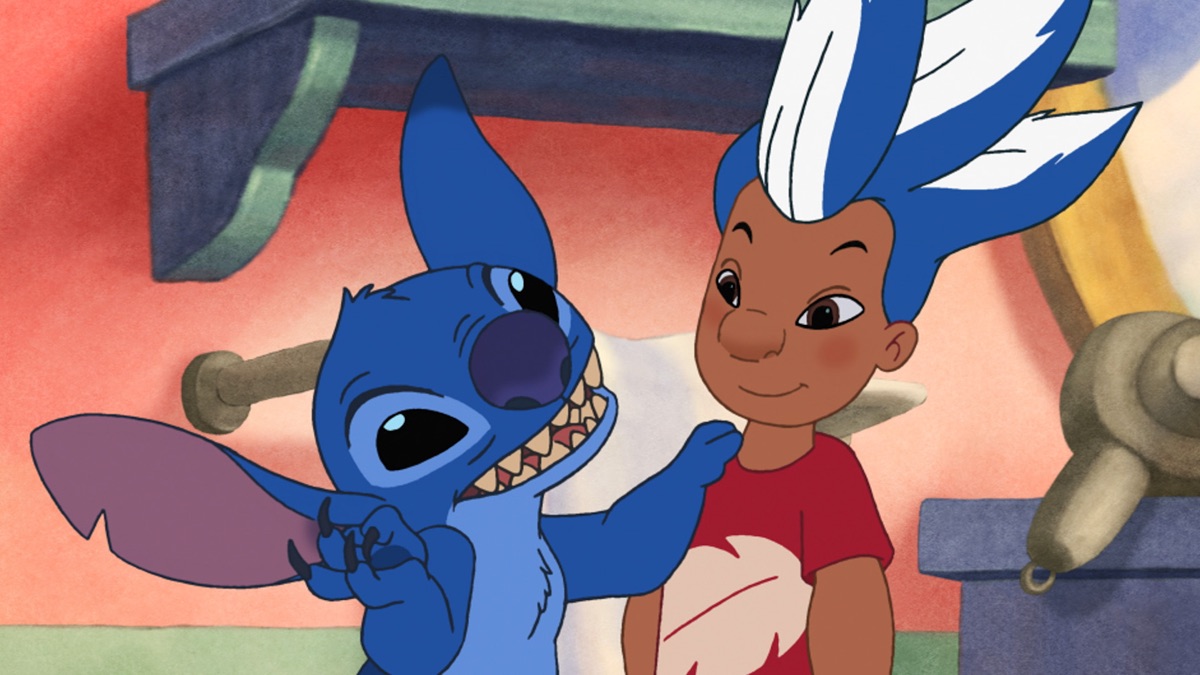
EPISODE 42 · SEASON 2, EPISODE 3 · SWAPPER · RAE RAE REACTS
Lilo & Stitch: The Series Episode 42: Swapper
Lilo plans a party to prove she is not weird. Experiment 355 swaps her mind with Stitch, Victoria arrives, and the entire idea of passing as normal collapses before anybody can finish the snacks.
Lilo throws a party to prove she is normal, which is already the trap
A new girl named Victoria moves nearby, and Lilo wants one clean chance to make a friend before Mertle decides what Victoria should believe about her. Instead of inviting Victoria into the noisy truth of the Pelekai household, Lilo plans a “Lilo’s Not Weird” party. The title hurts because it turns friendship into an audition where Lilo must disprove the accusation that follows her everywhere.
Children learn quickly when belonging appears conditional. Lilo has been told that her interests, grief, anger, imagination, and attachment to Stitch make her too much. The party is her attempt to control the evidence. She does not need a better performance of normal. She needs a social world where difference is not treated as a warning label.
Victoria arrives with her own chance to choose
Victoria is new, which means she has not yet inherited Mertle’s whole story about Lilo. That uncertainty gives Lilo hope and makes every mistake feel enormous. A friendship should grow through shared time, curiosity, and the ability to recover from awkward moments. Lilo treats the first visit as a final judgment because rejection has trained her to expect no appeal.
Adults can help by refusing to frame one party as a social test. Nani could remind Lilo that Victoria may also be nervous and that neither child owes instant intimacy. The goal is a safe afternoon, not a lifetime contract signed before dessert.
Experiment 355 makes identity physically negotiable
Swapper is a two-headed experiment whose power moves minds between bodies. The effect is more invasive than a costume or disguise. A person loses control of their own face, voice, strength, movement, and access while someone else operates the body everyone recognizes as theirs.
That power can expose assumptions about identity, but it also creates a direct consent crisis. Nobody agrees to the exchange, chooses its duration, or receives instructions for reversal. Jumba designed a device that can relocate consciousness and then stored the safety manual somewhere between “probably fine” and “I forgot.”
Lilo inside Stitch’s body inherits power without practice
Lilo suddenly has Stitch’s strength, speed, claws, density, senses, and physical habits. Knowing what Stitch can do is different from knowing how his body calibrates force. A child trying to gesture, open a door, or protect herself can cause harm before she understands the new scale.
The safe response would remove hazards, create space, and let her practice basic movement with supervision. Nobody should demand that she perform as Stitch or use his abilities to solve the party. She is a displaced child who needs orientation before heroics.
Stitch inside Lilo’s body becomes medically vulnerable
Stitch loses the durability that normally lets him survive collisions, falls, explosions, and impulsive decisions. Lilo’s human body cannot absorb the same force. His instincts remain tuned to a body built for destruction, so every familiar movement becomes a risk to the child whose body he is borrowing without choice.
He needs clear rules about stairs, traffic, food, water, sharp objects, and physical conflict. More important, he needs to understand that Lilo must live with any injury after the swap ends. Care for another person’s body means acting for their future, not only surviving the present.
A body swap does not transfer permission
Lilo’s body still belongs to Lilo even while Stitch is controlling it, and Stitch’s body still belongs to Stitch. Neither person can consent to haircuts, photographs, medical procedures, public performances, punishment, or intimate contact for the other. Familiar appearance does not equal familiar permission.
Nani should treat both bodies as occupied by people in crisis. She can ask before touching, explain necessary safety actions, preserve privacy, and avoid discussing either person as if the body standing nearby cannot hear. The swap complicates consent; it does not erase it.
Names and pronouns should follow the person, not the visible body
Everyone needs a shared communication rule: address Lilo when Lilo is speaking, even if Stitch’s face is moving, and address Stitch when Stitch is inside Lilo’s body. The distinction prevents confusion and protects personhood. Calling them only by appearance would make each person disappear behind the body others expect.
The episode uses vocal performance and behavior to keep the gag legible, but the household needs more than audience cues. Wristbands, written names, repeated confirmation, and private questions could help during any future swap. Swapper exists, so the family cannot pretend this will remain a one-time problem.
The party becomes unsafe when secrecy outranks care
Lilo still wants Victoria’s visit to look normal, so admitting the swap feels like surrender. That pressure encourages both Lilo and Stitch to perform one another rather than ask for help. A social event should be postponed when a child has been involuntarily moved into an alien body. Nobody loses moral points for rescheduling snacks during a consciousness emergency.
Nani can tell Victoria there has been a family emergency without revealing private details. Honesty does not require broadcasting alien biology. It means choosing health over a presentation designed to satisfy children who already decided Lilo is strange.
Mertle’s bullying has become an internal narrator
Mertle does not have to stand in every room to control it. Lilo anticipates the insult, edits herself around it, and measures each choice against how Mertle might use it later. That is one of bullying’s lasting effects: the target starts enforcing the bully’s rules even in her absence.
Support should help Lilo identify whose voice she is hearing when she calls herself weird. Nani can validate the hurt without agreeing that acceptance requires erasure. School staff also owe intervention. A child should not have to create a flawless home showcase because adults allowed a peer hierarchy to harden.
Victoria deserves truth without being recruited as a judge
Victoria is invited to know Lilo, but the party quietly assigns her another role: determine whether Lilo qualifies as normal. That is too much power and too little context for a new child. She should be free to enjoy the visit, leave if uncomfortable, ask questions, and form her opinion over time.
Lilo can disclose the swap only when safety requires it and with Stitch’s privacy considered too. Friendship does not demand immediate access to every family secret. Trust grows through choices that both children can understand and revisit.
Swapper refusing to reverse the exchange changes the incident
Once Experiment 355 understands the distress and refuses to restore Lilo and Stitch, the event becomes ongoing confinement. The two-headed cousin is exercising power over two people’s bodily autonomy. Mischief cannot cover the seriousness of forcing someone to remain displaced.
Containment may be necessary to stop additional swaps, but coercion alone will not teach Swapper why the act caused harm. The family needs a communication method, incentives for cooperation, and a consequence plan that does not involve hurting him until he complies.
Two heads do not automatically mean one uncomplicated decision-maker
Swapper’s design raises questions the episode does not have time to answer. Do both heads share one consciousness? Can they disagree? Does each control part of the power? Is refusal coming from both? Treating the cousin as a visual mechanism skips the personhood inside the mechanism.
Jumba should evaluate communication, cognition, and preference without using difference as proof of incapacity. If the heads possess distinct perspectives, both need a voice in treatment and placement. If they are one person, caregivers still need to understand how that person experiences the body.
Jumba’s covered container is not a rehabilitation plan
After the crisis, Jumba covers Swapper’s enclosure with a towel to prevent visual targeting and another exchange. That may reduce immediate risk, but sensory deprivation and indefinite confinement are not a humane long-term solution. The towel protects everyone by making Swapper’s world smaller.
A proper enclosure could use directional shields, monitored openings, communication tools, enrichment, and scheduled interaction. The goal is safe participation rather than permanent darkness. If eye contact triggers the power, design around the trigger without erasing the experiment’s access to other people.
The family needs a body-swap emergency protocol
Swapper proves that identity verification belongs in the household safety plan. The first steps should be: secure the experiment, stop driving and hazardous activity, identify each consciousness with private facts, document the time, contact Jumba and medical support, and notify trusted adults without creating public spectacle.
The protocol should also protect accounts, signatures, school attendance, medication, and legal decisions. A person in somebody else’s body should not be able to consent to contracts or access private records merely because their face passes the usual check.
Healthcare would need to treat body and mind as separate records
If Lilo is injured while inside Stitch, the clinician must document the body receiving treatment and the person experiencing it. If Stitch harms Lilo’s body, Lilo will inherit the physical consequence after reversal. Ordinary charts are not built for that split, but the risk is real inside this world.
Jumba and the Federation should provide specialists who understand experiment effects. Every patient deserves an explanation they can understand, privacy during examination, and follow-up after returning. Reversal does not guarantee that memory, fear, pain, or neurological effects vanish.
The swap makes punishment especially dangerous
An adult who sees Lilo’s body misbehaving may discipline Lilo even though Stitch made the choice. Someone confronting Stitch’s body may use force that Lilo experiences. Appearance-based punishment becomes both inaccurate and potentially traumatic.
Consequences must wait until identity is established and immediate safety is restored. Accountability can follow the person who acted while still considering confusion, unfamiliar motor control, and coercion. The body’s owner should never be punished for damage another consciousness caused.
Lilo and Stitch learn each other through inconvenience
The episode’s emotional value comes from forcing both characters to inhabit limitations the other normally manages without explanation. Lilo discovers that extraordinary strength is hard to regulate. Stitch discovers that human vulnerability changes every decision. Empathy grows because each person has to protect what the other will eventually reclaim.
That insight should not romanticize the violation. People should not need their bodies taken to respect one another. The family can preserve the lesson by talking afterward about what surprised them, what felt frightening, and what support each person wants in ordinary life.
Stitch performing Lilo can expose how adults read children
Adults often respond to a child’s face, tone, posture, and reputation before listening to content. Stitch inside Lilo may be treated as the same girl despite behaving differently, which reveals how much interpretation is attached to appearance. Lilo inside Stitch may be feared before she says anything.
Careful adults should notice inconsistency without interrogating either person in public. Ask open questions, offer privacy, and avoid assuming deception. In a world full of transformation experiments, behavior changes deserve curiosity and safety checks before blame.
The story’s comedy depends on impersonation, but dignity still matters
Body-swap episodes usually invite viewers to laugh at one character failing to perform the other. The joke can come from mismatched habits without mocking disability, body shape, speech, gender expression, or cultural identity. Lilo and Stitch are funny because they know each other well and still cannot reproduce a whole person.
A person is more than a list of gestures. The failed impersonations prove that identity includes memory, relationships, embodied practice, and private context. Nobody becomes Lilo by wearing her face, and nobody becomes Stitch by gaining his claws.
Victoria’s friendship matters because she sees the mess and stays curious
The best outcome is not that Lilo successfully hides every strange detail. It is that Victoria encounters a complicated household and has room to decide whether she likes Lilo anyway. Acceptance based on a perfect performance would collapse the moment another pod gets wet.
A durable friendship can include boundaries, surprise, and a slow explanation of what is safe to share. Victoria does not have to understand every experiment on day one. She only has to treat Lilo as a person instead of a rumor.
One true place is unresolved, and that should remain an open case
Swapper does not receive a clear placement that channels the power safely. Leaving him in Jumba’s covered container may end the episode, but it does not establish a life. An experiment capable of consensual swapping could potentially assist rescue, accessibility research, or controlled training, but only after rigorous safeguards and genuine agreement from every participant.
Until then, the family needs a temporary placement with light, space, communication, supervision, and no access to unwilling targets. Temporary should have a review date. Otherwise a towel becomes a quiet life sentence.
Jumba must answer for creating a person whose gift violates others
Experiment 355 was designed to destabilize identity and control. Jumba cannot act surprised when the power causes exactly that harm. He owes Swapper more than containment because he built the cousin without a safe way to use, suppress, or understand the ability.
Accountability includes research into reversal, voluntary power control, protective equipment, therapy, and restitution for Lilo and Stitch. It also includes telling the Federation what other experiments can alter minds or bodies before those pods activate near another child.
What I would change after the minds return home
I would add a quiet scene where Lilo and Stitch confirm that they are themselves, check their bodies for injuries, and decide what they want the other to know about the experience. Nani would apologize for any mistaken assumptions, even if she acted reasonably with limited information. Jumba would write an actual protocol instead of producing a towel.
I would also let Lilo tell Victoria one imperfect truth: this family is strange, and she is tired of treating that as a confession. Victoria could choose friendship without becoming a prize that proves Lilo acceptable.
RaeRae’s final verdict
“Swapper” is funny because Lilo and Stitch know each other better than anyone and still discover that operating the other person’s body is a disaster. Under the gags sits a serious question about what remains yours when your face, voice, strength, and movement are temporarily controlled by somebody else. The answer has to be your identity, privacy, history, and right to reclaim your body.
My verdict: cancel the normality audition, keep Victoria, build the emergency protocol, and take the towel off Experiment 355 once a safe enclosure exists. Lilo does not need to prove she is ordinary enough for friendship. Stitch does not need to perform humanity perfectly to deserve bodily autonomy. And Jumba absolutely needs a searchable database titled “Things My Experiments Can Do to Your Consciousness” before he is allowed near another pod.
Where to watch
Watch “Swapper” through Lilo & Stitch: The Series on Disney+. Apple labels the story Season 2, Episode 3. CVM Sekai also records it as overall Episode 42 in the complete aired-order directory. Availability can change by region.
Keep exploring
Return to the episode directory or return to the Lilo & Stitch hub.