
EPISODE 24 · SEASON 1 · SINKER · RAE RAE REACTS
Lilo & Stitch: The Series Episode 24: Sinker
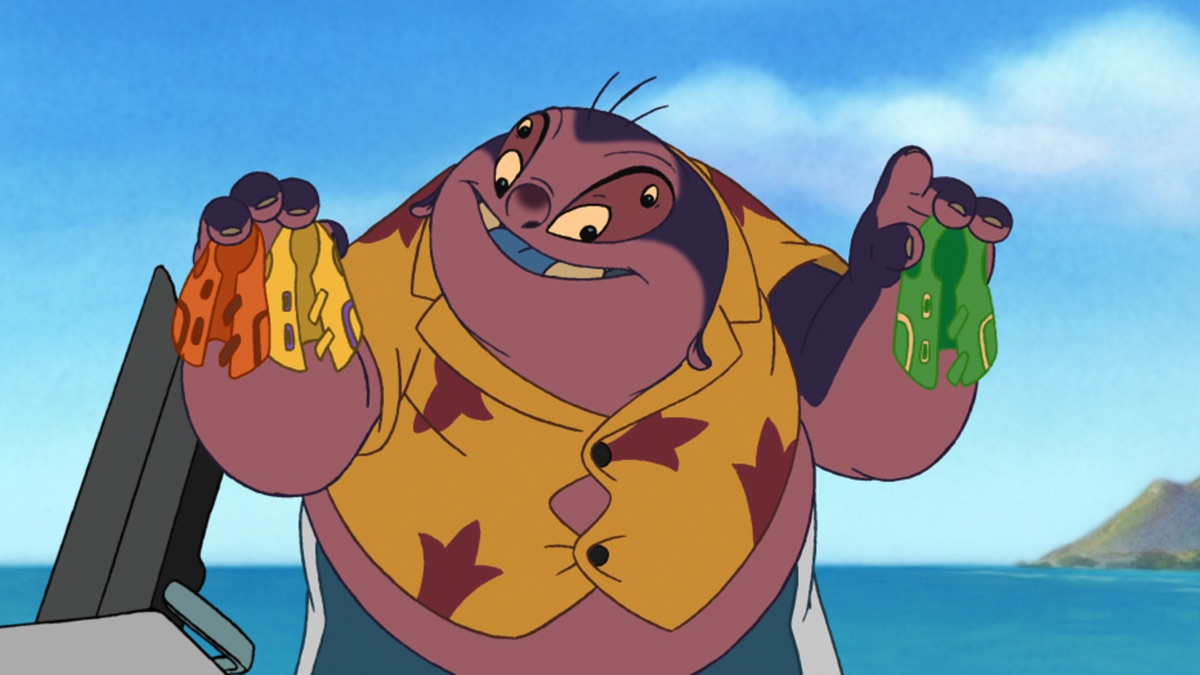
Experiment 602 was built to sink ships. The island needs rescue, repair, and a future where he belongs to himself.
Sinker turns a boat race into an argument about purpose
“Sinker” introduces Experiment 602 through the violent function Jumba assigned him: slice ships apart with a dorsal fin and send them beneath the water. A regatta makes the danger immediate because boats carry families, workers, and children rather than abstract military targets. The episode has to move quickly, but the idea underneath the chase is ugly in a useful way. Somebody designed a living body around maritime destruction, then left an island community to absorb the risk.
Sinker is not a naval weapon after activation. He is a person waking inside a purpose chosen before he could speak. Lilo’s challenge is larger than stopping the next damaged hull. She has to imagine a future where the same strength serves life without becoming another institution’s property.
RaeRae check-in: get Lilo off the rescue boat
Lilo can swim, think under pressure, and communicate with experiments better than most adults. None of those talents make a child the correct lead responder during a maritime emergency. Water changes every mistake. Currents, fuel, lines, damaged fiberglass, panic, and weather can turn confidence into tragedy within seconds.
A real response needs life vests, trained operators, radios, throw lines, medical support, and somebody monitoring conditions. Lilo can identify Sinker from a safe position. The Galactic Federation can fund the adults who should have been present before she climbed aboard.
The regatta is community life, not disposable scenery
A local boat race carries family pride, skills taught across generations, volunteer labor, and money invested long before the starting signal. When a hull is destroyed, the loss includes equipment, work hours, entry fees, transportation, and the memory attached to the boat. Animation can replace the object next week. The household may carry that debt for years.
Repair has to become part of the ending. Jumba and the Federation owe compensation. Racers deserve honest information about what happened. Nobody should be asked to accept financial loss because the creature responsible eventually found a cute placement.
Keoni is allowed to be scared
The story often positions Keoni as Lilo’s crush before treating him as a child in danger. His boat becomes a target, and he may feel pressure to remain impressive while Lilo watches. Fear is not failure. A damaged vessel is an emergency even when the episode wants romantic embarrassment.
Adults should help him process the incident without making Lilo responsible for emotional repair. Keoni can care about Sinker’s future and still be angry about the boat. Compassion does not demand immediate comfort from the person harmed.
A dangerous design is not a guilty soul
Sinker’s dorsal fin performs exactly as designed. That fact describes engineering, not morality. Jumba created the capacity and the conditions. The experiment activates without education, context, or a safe environment. Blaming him for instinct before offering guidance would repeat the original abuse.
Accountability begins once Sinker understands choices and consequences. Even then, repair should teach rather than erase personhood. A community can name harm clearly while refusing to reduce somebody to the worst thing their body can do.
Stitch sees the old assignment inside a new cousin
Stitch knows what life feels like when every room expects destruction. He was designed to ruin cities, provoke anger, and survive retaliation. Sinker’s ship-cutting purpose reflects the same logic in a specialized body.
That history gives Stitch a role beyond muscle. He can model control, warn against the rush of proving power, and show that family does not disappear after an accident. Solidarity should include helping with repair, not simply defending Sinker from consequences.
Jumba keeps describing war crimes like product features
Jumba’s explanations often arrive with inventor pride: large fin, efficient hull damage, excellent sinking capacity. Sir, those ships contain people. The cheerful technical language separates creation from bodies in the water, which is how violent systems make design feel neutral.
He owes Sinker and the community a full risk profile. Which materials can the fin cut? Can the motion happen involuntarily? What triggers activation? Which barriers are safe? How does stress affect control? Safety cannot depend on another late sentence that begins after the boat splits.
The Federation owes maritime restitution
The experiments were created under the Federation’s failed oversight and transported through its custody. When capsules land across Hawaiʻi, local residents inherit hazards without consent. Calling Lilo a partner does not transfer the government’s liability to her family.
The Federation should pay for vessel replacement, environmental assessment, rescue costs, lost income, and long-term care for Sinker. An intergalactic institution can locate Earth for arrests. The same institution can locate a claims department.
Gantu wants the weapon Jumba promised
Hämsterviel would use Sinker against ships, ports, and escape routes. Gantu sees capture as employment because his survival depends on delivering assets. The system converts a person into leverage before asking whether the person wants any part of the conflict.
Gantu’s own precarity adds tragedy without creating innocence. He knows what coercive labor feels like and still brings coercion to someone smaller. Breaking that cycle would require refusing the boss, not passing the fear downward.
Ocean rescue can be a true place if Sinker chooses
A creature who moves powerfully through water and can affect sinking objects may become an extraordinary rescue partner. The placement transforms destructive design into protection without pretending the original purpose was harmless. That emotional reversal fits the series beautifully.
Choice remains essential. Rescue work is dangerous, traumatic, and demanding. Sinker needs training, compensation, protective equipment, rest, and permission to decline a call. Gratitude should never become a permanent emergency shift.
Rescue workers are not equipment
People celebrate heroic responders and then underfund their care. Sinker could become the island’s solution for every damaged boat while nobody asks what repeated exposure to panic and loss does to him. A useful body can hide an exhausted mind.
The rescue team needs rotations, debriefing, medical checks, and backup plans. Sinker should have days when the ocean is play rather than work. A true place does not require constant proof of worth.
The water belongs to more than the race
A sliced boat can release fuel, paint, batteries, plastic, and debris. Coral, fish, seabirds, and coastal communities absorb consequences after the spectators leave. The ocean is not a blue floor beneath the action.
Containment and cleanup should follow every damaged hull. Local experts need authority over recovery. Sinker can help locate debris if safe, but the adults responsible for the event must fund the work instead of turning another task into his punishment.
Hawaiʻi should not become an alien testing range
The series repeatedly treats the island as the place where Jumba’s abandoned experiments can activate, fail, and be rehabilitated. Residents never chose to host this program. Their land, water, businesses, and children carry consequences from a conflict created elsewhere.
Lilo’s compassion makes recovery possible. Her compassion should not excuse colonial logic that treats an island as available terrain. The Federation owes local governance, consultation, and resources rather than arriving only when capture serves its interests.
Boat safety requires more than knowing how to swim
Strong swimmers drown when impact, entanglement, cold shock, injury, or exhaustion changes the situation. Every racer needs a fitted life vest, emergency signal, float plan, and weather briefing. Rescue boats need trained operators and clear passenger limits.
The episode can keep its fun without teaching children that bravery replaces equipment. Lilo wearing a life vest makes her smarter, not weaker. Safety gear belongs in the hero image because preparation is part of heroism.
Lines become hazards during panic
Ropes save lives and also create entanglement risk around propellers, fins, and moving bodies. Stitch cannot grab every line and pull harder. The team needs practiced signals, designated roles, and cutting tools available to trained adults.
Sinker’s fin makes line placement especially important. Equipment should be adapted around his body rather than forcing him into a human rescue pattern. Working with the power is safer than pretending anatomy does not matter.
Keoni’s boat deserves a real repair plan
An apology without replacement leaves Keoni’s family carrying the cost. Somebody should document damage, recover usable parts, obtain estimates, and provide transportation while repairs happen. If the vessel cannot be restored, restitution should reflect labor and sentimental value as well as market price.
Sinker can participate in repair only if the process is safe and voluntary. Making him work off an impossible debt would turn accountability into bondage. Jumba and the Federation hold the deeper financial responsibility.
Lilo cannot become the island’s unpaid dispatcher
Every newly activated experiment brings another emergency call into Lilo’s childhood. She identifies abilities, negotiates surrender, blocks Gantu, proposes placement, and performs follow-up care. Adults praise the result while normalizing the workload.
A proper program would employ local responders, cultural advisors, veterinarians or alien medical specialists, social workers, and environmental teams. Lilo could advise with Nani’s consent and strict limits. Homework and sleep should outrank intergalactic case management.
Nani sees the liability nobody else wants to name
Nani knows one accident can threaten rent, employment, custody, and stability. A maritime incident expands the risk across other families. Her caution is not a failure to believe in Lilo. Nani understands how institutions leave ordinary people holding consequences.
She deserves advance information and authority to stop unsafe plans. Jumba lives under her roof. His expertise does not outrank her responsibility for Lilo. Household consent applies to scientists too.
What made me laugh
Stitch approaching a boat race like a personal athletic rivalry is completely believable. Every buoy becomes a challenge. Every rope becomes something he can pull with unnecessary intensity. Nani probably hears the insurance premium rising from shore.
Jumba recognizing Sinker only after maritime chaos begins also belongs in the family’s recurring comedy ledger. Maybe label the capsules before scattering them across an inhabited planet.
What made me mad
I get angry when the episode treats property loss as background once the experiment becomes sympathetic. People can care about Sinker and still need their boats repaired. Compassion that requires victims to absorb every cost is cheap compassion.
I also refuse the idea that Lilo should enter open water to prove love. Adults with rescue training can protect Sinker without risking a child. The Federation has ships. Send one.
Sinker needs trauma care after every rescue
Saving somebody from drowning means entering another person’s worst minute. Even a successful rescue can leave sensory memories, fear, guilt, and pressure about the next call. An experiment designed for destruction may carry additional distress when a damaged vessel resembles his original function.
Debriefing should include emotional care rather than only performance review. Sinker needs permission to say a rescue frightened him. Heroism without vulnerability becomes another cage.
A true place needs a home on land too
The rescue station may fit Sinker’s work, but he needs private space, companionship, healthcare, food, play, and access to water that is not an emergency zone. Sleeping beside equipment does not count as housing.
A good placement lets him belong to a community beyond the uniform. Neighbors should know favorite foods and annoying habits, not only the number to call when a boat takes water.
Training must include the right to stop
Rescue cultures can glorify pushing through exhaustion. Sinker may feel obligated to continue because everyone calls his power perfect for the job. A stop signal should end participation without debate when conditions feel wrong.
Supervisors need backup resources rather than emotional pressure. One small alien cannot become the entire island’s maritime infrastructure. Redundancy protects both the community and the rescuer.
The quiet scene I wanted
After the race, I wanted Keoni and Sinker beside the damaged boat while adults handled paperwork nearby. Keoni could explain what the vessel meant to his family without turning the speech into punishment. Sinker could listen and touch one intact piece carefully.
Later, both could watch the repaired boat return to water. Repair would become visible, and forgiveness could grow from action rather than a quick smile before the credits.
The next race should remember what happened
Communities often rush back to normal after an emergency because cancellation feels like surrender. The next regatta should continue, but continuation needs visible learning. Organizers can strengthen rescue staffing, inspect routes, brief families, and establish a wildlife and debris response before another starting signal.
Sinker should be invited as a neighbor rather than displayed as the creature who ruined last year. If he wants to join the safety team, pay him and introduce him with dignity. If he wants to watch from shore with snacks, that choice deserves equal respect. Recovery means the community can hold memory without trapping one person inside the incident forever.
The Episode 24 verdict
“Sinker” takes Experiment 602 from ship destroyer to potential rescuer, which gives the series one of its clearest reversals of assigned purpose. The episode becomes richer when the audience keeps looking at the people, labor, ecology, and money surrounding that transformation.
My verdict is life vests, paid rescue work, environmental cleanup, and a replacement boat charged directly to the Galactic Federation. Let Sinker save lives when he chooses. Then let him leave the station and have a life nobody needs rescuing from.
Where to watch
Watch “Sinker” through Lilo & Stitch: The Series on Disney+. Availability can change by region.
Keep exploring
Return to the episode directory or return to the Lilo & Stitch hub.