
EPISODE 10 · SEASON 1 · KIXX · RAE RAE REACTS
Lilo & Stitch: The Series Episode 10: Kixx
Stitch gets kicked directly in the ego, and Lilo has to teach him that losing a fight does not erase his place in the family.
Stitch finally meets a fight he cannot win by being Stitch
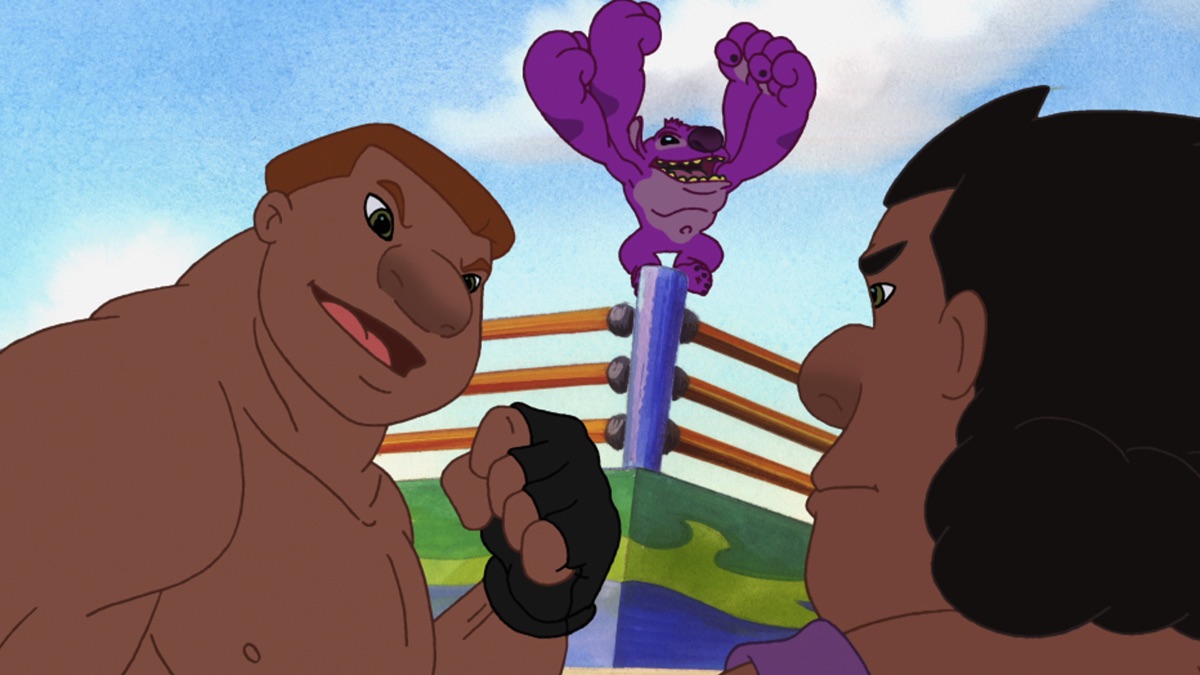
“Kixx” gives Experiment 601 a brutally simple power: he can out-kick the creature who has built an identity around being stronger than everybody in the room. The first loss is physical. The deeper injury lands in Stitch’s pride. Strength has protected him, entertained him, and helped him feel valuable inside the family. Kixx turns that certainty into a bruise.
The episode works because the rivalry is not only about stopping another experiment. Stitch has to survive being ordinary at the exact skill he considers proof of exceptional worth. Lilo sees the emotional problem before he can name the wound. Training becomes less about building a better attack than teaching Stitch how to remain himself after defeat.
RaeRae check-in: somebody please regulate Jumba’s fight club inventory
Jumba created a specialized combat experiment, stored the fighter in a tiny pod, lost the pod over an inhabited island, and now offers commentary while children manage the confrontation. That sequence should end with a hearing. Instead, everybody accepts another backyard emergency because family comedy has normalized galactic negligence.
Kixx deserves care, but civilians deserve protection from an expert kicker with no orientation to the world. Jumba should arrive with pads, restraints designed without cruelty, medical supplies, and a full behavioral file. Lilo should not improvise a rehabilitation program while Stitch absorbs repeated blows.
A loss attacks the story Stitch tells about himself
Stitch knows he was designed to be nearly indestructible. Physical dominance becomes the one biography nobody can dispute. Family gives him new meaning, yet old programming still whispers that usefulness equals power. When Kixx wins, Stitch does not only lose a contest. He loses the shortcut that tells him why he matters.
That insecurity feels painfully human. People attach identity to beauty, intelligence, productivity, toughness, or being the reliable one. Then illness, age, competition, or simple bad luck removes the advantage. The frightening question arrives immediately: if the trait disappears, who stays? Lilo’s answer is family, but Stitch has to believe the answer from inside his own shame.
Training can teach patience or feed obsession
A training montage looks productive because movement creates visible progress. Repetition can build skill, confidence, and bodily awareness. Repetition can also become punishment when the trainee believes worth depends on winning. Lilo has to keep Stitch focused on learning instead of turning every exercise into revenge preparation.
Humiliation makes that choice harder. Anger provides energy, but anger narrows attention. Technique asks Stitch to notice balance, timing, distance, and recovery. The body becomes something to understand instead of a weapon to unleash. That shift makes the eventual confrontation emotionally credible.
Lilo becomes a coach without becoming a commander
Lilo knows Stitch well enough to challenge him without treating him like equipment. She can recognize when pride is blocking attention. She also knows that mockery would deepen the wound. Her coaching works through relationship: watch, try again, stop pretending the loss did not hurt.
A commander needs obedience. A coach needs participation. Stitch improves because he chooses to remain in the process after failure. Lilo supplies structure and belief, but she cannot perform the lesson for him. That balance gives her authority without reproducing Jumba’s habit of treating experiments as functions.
Kixx is more than the opponent in Stitch’s lesson
The episode risks reducing Experiment 601 to a training obstacle. Kixx has a body built for combat, but a body is not a destiny. What does he enjoy when nobody challenges him? Does constant kicking feel joyful, compulsory, frightening, or simply familiar? Those questions should shape his future.
Lilo’s one-true-place promise requires curiosity about the person after the fight ends. A gym could offer structure and safe movement, yet a gym could also exploit him as entertainment. Placement must include consent, rest, protection, and relationships that do not vanish when he stops winning.
Masculinity hides inside the bruised pride
Stitch and Kixx are coded through competitive toughness. Neither one is supposed to admit fear. Physical dominance becomes a language for rank, and losing threatens social identity. The episode can be read as a small argument about how boys and men are taught to convert vulnerability into another contest.
Lilo interrupts that pattern by making learning relational. She does not ask Stitch to become less strong. She asks him to stop using strength as the only acceptable emotion. Frustration, embarrassment, dependence, and trust enter the training yard. That expansion is healthier than another victory pose.
Technique defeats the fantasy of natural superiority
Stitch begins with extraordinary physical gifts. Kixx has a more specialized design. The matchup reveals that raw advantage has limits. Observation, preparation, and adaptation matter when instinct stops producing easy wins. Talent opens possibilities. Practice determines whether a person can respond when circumstances change.
The lesson avoids the opposite fantasy that effort guarantees victory against every obstacle. Some bodies and systems retain advantages. Training gives Stitch options, not moral entitlement to win. His growth comes from engaging reality instead of demanding reality confirm his self-image.
Failure becomes useful only after shame loosens its grip
People love saying failure teaches, but failure often teaches nothing while humiliation is screaming. Stitch first experiences the loss as evidence that something is wrong with him. Lilo helps convert the event into information: Kixx has patterns, Stitch has habits, and both facts can be studied.
That conversion requires safety. A person learns from failure when belonging does not disappear with the result. Lilo’s loyalty gives Stitch room to examine mistakes without treating examination as self-erasure. Family becomes the place where defeat can remain an event instead of becoming an identity.
Gantu keeps confusing capture with competence
Kixx offers Gantu another chance to prove value to Hämsterviel. He approaches the experiment as property and the confrontation as a performance review. Every reckless decision makes sense inside a workplace where the boss rewards possession, humiliates failure, and never pays the cost of collateral damage.
Gantu’s physical size mirrors Stitch’s dependence on strength. Both characters know what happens when power stops guaranteeing respect. Stitch has Lilo to help rebuild identity. Gantu has an employer who weaponizes insecurity. The comparison makes Gantu more understandable without making his choices harmless.
Nani would recognize the pressure to perform
Nani lives under constant evaluation. Employers, social workers, neighbors, and bills turn ordinary mistakes into evidence about whether she deserves stability. Stitch’s crisis is different, but the emotional mechanism is familiar. One failed performance threatens the story a person tells about competence.
I wanted Nani inside this conversation. She could tell Stitch that losing a shift, argument, or inspection does not erase the labor already performed. She could also remind Lilo that coaching somebody you love requires limits. Nani has earned authority on surviving systems that treat one result as a whole identity.
The body keeps the scorecard even when the crowd leaves
Combat stories celebrate impact, then move quickly past pain. Stitch may be durable, but repeated kicks still shape behavior. Flinching, anger, and hesitation can remain after visible injuries disappear. A thoughtful training plan would include recovery instead of treating rest as weakness.
Kixx needs the same care. A body designed to deliver force also absorbs force through joints, muscles, and balance. If his true place involves martial arts, health must matter more than spectacle. Nobody should be praised into permanent injury because audiences enjoy the movement.
What made me laugh
Stitch approaching technical kickboxing with the confidence of a creature who believes extra arms settle every argument is perfect. The correction arrives quickly and loudly. Jumba offering scientific commentary from a safe distance adds another layer of nerve.
Lilo’s coaching energy also works because she commits completely. A handmade plan becomes sacred law. Stitch may be an alien superweapon, but he is still getting corrected by a small girl who has decided his footwork is embarrassing.
What made me mad
The adults allow Lilo to manage another dangerous encounter because she produces results. Competence becomes exploitation when responsibility keeps expanding without authority or protection. Jumba built Kixx. The Federation lost Kixx. Lilo should not carry the liability.
I also wanted more interiority for Experiment 601. Defeating Stitch gives Kixx narrative importance, but personhood begins after the function. Let him express preference, fear, boredom, or delight beyond combat. A cousin is not a boss battle waiting for placement.
A true place cannot be a permanent arena
A martial-arts setting may suit Kixx because training offers structure, movement, and rules. The placement becomes ethical only if he can refuse matches, develop relationships, and exist without entertaining spectators. A ring is a workplace, not automatically a home.
Lilo’s best placements transform destructive design without demanding self-rejection. Kixx can keep the joy of movement while learning consent and control. The community can value his skill without owning his body. That future takes more imagination than naming him champion and leaving.
Strength has always been Stitch’s survival language
Before Lilo, Stitch survived through escape, intimidation, and physical advantage. Strength prevented capture and kept vulnerability hidden. The habit cannot disappear because somebody says family once. His nervous system still expects weakness to invite control. Kixx activates that old fear with every successful strike.
Lilo’s coaching becomes powerful because she offers a different survival language. Ask for help. Study the problem. Rest. Trust somebody enough to be seen failing. Those skills look softer than combat, but each requires courage Stitch never needed while running alone. The episode lets emotional strength enter through physical training.
Competition can reveal character without deciding worth
A contest creates pressure, and pressure exposes habits. Stitch rushes. Kixx relies on specialization. Lilo observes. Those revelations help everyone grow. Trouble begins when the result becomes a moral ranking. Winning does not make Kixx better. Losing does not make Stitch less deserving of respect.
Children receive ranking systems everywhere: grades, sports, popularity, behavior charts, talent shows. “Kixx” can offer a needed countermessage. Results provide information about one performance under specific conditions. A score cannot measure loyalty, curiosity, courage, or the ability to repair harm after pride makes a mess.
The coach also needs support
Lilo carries Stitch’s frustration while planning exercises and watching for danger. Coaching looks empowering, yet emotional labor can exhaust the person providing structure. Nobody asks whether she feels frightened seeing Stitch injured or whether another experiment crisis has interrupted school and sleep.
Nani, Jumba, and Pleakley should share that burden. Lilo can remain the relationship expert without becoming the only person responsible for motivation. Children deserve praise for empathy and permission to stop working. Her value should never depend on rescuing every creature correctly.
What real accountability for Jumba would look like
Jumba should document Kixx’s abilities, known triggers, physical limits, and safe training conditions. He should provide protective equipment and identify adults qualified to supervise. He should explain the experiment’s original purpose without treating that purpose as destiny. Then he should listen when Kixx communicates something the design file missed.
Accountability is less dramatic than redemption speeches. Accountability means boring records, repeated consent, maintenance, money, and changed procedure. The franchise loves Jumba enough to make that growth possible. I want the story to love the family enough to require the work. Every new crisis should change how the next recovery happens. If Episode 601 produces the same improvised response as Episode 001, the adults have learned less than the children. Growth needs to appear in systems, not only feelings. A labeled cabinet and an emergency phone tree would make me cheer almost as loudly as Stitch landing the perfect counter. Give Nani a key, give Lilo protective gear, and give every experiment a medical record that recognizes personhood. Preparation is care wearing sensible shoes, and this household desperately needs a pair for every person living there, starting right now without another delay.
The Episode 10 verdict
“Kixx” gives Stitch a needed defeat and uses physical comedy to explore pride, practice, and identity beyond natural strength. Lilo’s coaching makes the episode emotionally warmer than a simple tournament story. She protects his dignity without protecting him from the work.
My verdict is one bruised ego, several excellent kicks, and another invoice for Jumba. Let Stitch lose. Let Kixx become a person after the match. Give both fighters recovery time. Then make the Galactic Federation explain why a child remains head coach of its unsupervised rehabilitation program.
The quiet aftermath I wanted
After the final confrontation, I wanted Stitch and Kixx sitting beside the training mats with ice packs. No score, no audience, no demand for friendship. Stitch could acknowledge the loss. Kixx could choose whether to demonstrate one technique without turning the moment into dominance.
Lilo could bring water and ask what Kixx wants next. Nani could arrive with food, notice every bruise, and give Jumba the look that means explanations are overdue. Growth would feel complete because care continues after victory.
Where to watch
Watch “Kixx” through Lilo & Stitch: The Series on Disney+. Availability can change by region.
Keep exploring
Return to the episode directory or return to the Lilo & Stitch hub.