
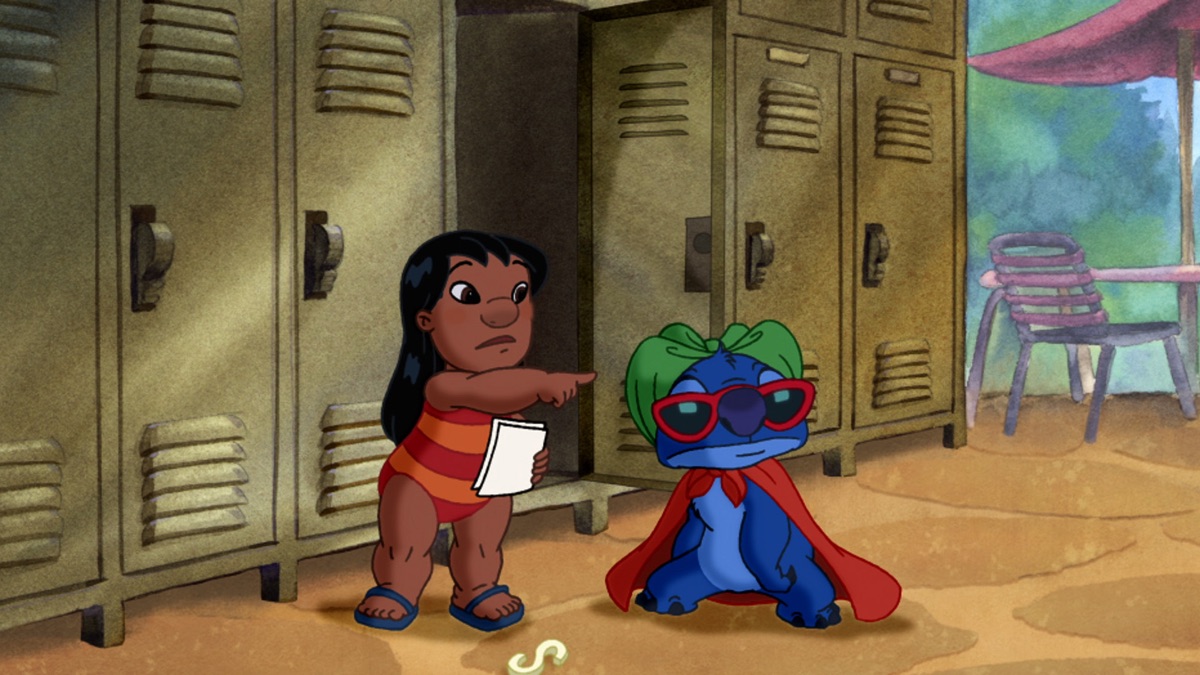
EPISODE 7 · SEASON 1 · CANNONBALL · RAE RAE REACTS
Lilo & Stitch: The Series Episode 7: Cannonball
A happy aquatic experiment makes a tsunami, and once again one grieving child has to invent the humane emergency plan.
The wave arrives before anybody understands the warning
“Cannonball” begins with the kind of disaster this series loves: a beautiful Hawaiian shoreline, ordinary people moving through an ordinary day, and one alien power capable of turning the ocean into a weapon. Experiment 520 does not look like a villain. Cannonball looks playful, round, and delighted by motion. The danger comes from scale. One happy splash becomes a wave large enough to erase homes, jobs, roads, and every comforting boundary between land and water.
That mismatch gives the episode comedy, but the threat deserves to feel frightening. Water has no interest in who started the problem or who deserves mercy. Lilo and Stitch cannot punch a tsunami into submission. They have to understand Cannonball, protect the island, and find a place where his natural behavior can exist without making everybody else pay for the consequences.
RaeRae check-in: this baby is a municipal emergency
I love a cute creature. I also need Jumba to stop releasing creatures whose hobbies require an evacuation map. Cannonball is adorable in the exact way a loose fire hose is adorable when the hose has eyes and wants praise. Everybody keeps meeting experiments as personalities after the damage begins, when the responsible sequence would involve containment records, power assessments, and a phone number that does not lead to an alien inventor pretending surprise.
Lilo approaches Cannonball with empathy because she recognizes fear beneath the chaos. Stitch approaches the problem as a competitor because splashing is one of his spiritual gifts. Both responses make emotional sense. Neither response substitutes for infrastructure. I am once again asking the Galactic Federation to fund the household performing its hazardous cleanup work.
Cannonball is not evil, and danger still counts
The series keeps returning to a useful moral problem. A creature can lack cruel intent and still create unacceptable harm. Cannonball follows his design. Waves are the result, not a moral confession. Lilo understands that innocence should shape the solution, yet innocence cannot erase flooded property or frightened neighbors. Care requires holding both truths without reducing either one.
Children are often handed a fake choice between punishment and permissiveness. “Cannonball” offers a better possibility. Learn the need behind the behavior, establish a boundary, and find an environment where the person can live without constant failure. That approach is harder than labeling somebody bad. The approach also produces an actual future instead of an endless cycle of shame and emergency.
The island is a home, not an empty adventure set
A giant wave carries different meaning on an island than a generic action sequence would suggest. Homes, roads, family businesses, burial places, and community memory occupy limited ground. Tourism advertising may sell the ocean as a permanent blue backdrop, but residents live beside a force capable of changing every practical decision. The episode uses that reality for spectacle without fully examining the economic aftermath.
I wanted one scene of cleanup. I wanted somebody counting damaged equipment, checking on elders, and asking whether the next wave could arrive overnight. Disaster stories often stop when the danger becomes visually quiet. Communities do not receive that luxury. The labor begins after the camera has enjoyed the destruction.
Lilo listens for the person inside the power
Lilo’s strongest skill is not alien detection. Her strongest skill is refusing to let a frightening ability become the whole definition of a being. She studies Cannonball’s delight, fear, and need for movement. She asks what kind of life could make the experiment safe and happy. Adults with more authority repeatedly fail to ask that basic question.
Her empathy does not come from softness alone. Lilo knows what happens when a community decides one difficult trait explains an entire child. She has been called strange, disruptive, and badly behaved while grief sits underneath the behavior. Cannonball’s waves are much larger than her outbursts, but she recognizes the same social impulse to treat removal as easier than understanding.
Stitch meets a power he cannot solve with strength
Stitch enjoys physical challenges because strength gives him certainty. Cannonball changes the rules. A wave absorbs force, redirects movement, and makes brute power look small. Stitch has to cooperate, follow Lilo’s plan, and accept that protecting somebody may require restraint instead of domination. That adjustment marks genuine growth from the destructive creature introduced in the first film.
The episode also lets Stitch remain funny. He can be competitive, jealous of a new experiment, and thrilled by the water while learning a moral lesson. Growth does not sand away personality. The best Stitch stories preserve the chaos and change the purpose behind the chaos.
Gantu treats every experiment like a promotion opportunity
Gantu enters with the same institutional tunnel vision: capture the experiment, satisfy Hämsterviel, and prove professional worth through possession. He does not evaluate Cannonball as a living being or consider what a tidal-wave generator could do near civilians. The mission becomes a performance review conducted with plasma weapons beside the ocean.
His desperation is comic until we notice how often employment pressure drives the danger. Gantu has tied identity to rank after losing status with the Federation. Hämsterviel exploits that wound. Every failed capture makes Gantu more reckless because success appears to promise restoration. The series understands that humiliation can recruit people into terrible jobs, even when the scripts rarely sit with the idea for long.
Finding the one true place cannot mean hiding the problem
The franchise phrase “one true place” sounds comforting, but placement carries ethical weight. A convenient hiding spot is not a home. Cannonball needs water, room, companionship, supervision, and protection from people who would weaponize his ability. The correct place must respect his nature while keeping nearby communities safe.
That standard should apply to every experiment. Lilo’s instinct is generous, yet one child cannot maintain dozens of specialized accommodations alone. The family needs help from scientists, local authorities, and the Federation. Celebration at the end of a rescue cannot conceal the long-term work required to make belonging real.
The disaster has a class dimension
Flood damage does not land equally. Wealthier owners may have insurance, savings, transportation, and somewhere else to sleep. Working families can lose wages, tools, food, and housing in one afternoon. Nani already lives close to the edge. An alien wave damaging her car or workplace could threaten custody as quickly as any official review.
The episode keeps the tone light, so those consequences stay outside the frame. My brain refuses to leave them there. A family story about unstable housing and precarious employment cannot summon a tsunami without raising material questions. Somebody has to pay for repairs, and that somebody should be the intergalactic agency that misplaced the experiment pods.
What made me laugh
Cannonball’s joy is contagious until the water starts rearranging the coastline. Stitch responding to a specialized tidal-wave power with the confidence of somebody who has never met a contest he did not enter is exactly right. Jumba explaining a catastrophic design flaw after activation remains his most reliable contribution to household peace.
The comedy works because every character follows a recognizable instinct. Lilo tries friendship. Stitch tries competition. Jumba tries vocabulary. Pleakley tries panic. Gantu tries kidnapping. Nobody pauses long enough to admit that the entire crisis began because the pods were stored with less care than leftover soup.
What made me mad
The adults continue letting Lilo take the closest position to experimental danger. Her bond with the creatures is valuable, but emotional skill does not make a child disposable. Jumba should lead containment. Pleakley should contact the Federation. Gantu should stop firing weapons near populated shorelines. Nani should receive truthful information before another emergency affects her job or guardianship.
I also wanted Cannonball’s consent to matter more clearly in the final arrangement. A place can look perfect to observers while failing the person expected to remain there. Show him choosing, returning voluntarily, or visibly relaxing. Belonging should be demonstrated through the resident’s response, not announced by somebody else.
The Episode 7 verdict
“Cannonball” succeeds because the central experiment turns a simple rescue into a question about accommodation. Cannonball needs freedom to move. The island needs protection. Lilo refuses the lazy conclusion that one need must cancel the other. The episode moves quickly, delivers a memorable water threat, and gives Stitch a problem strength cannot settle.
My verdict is joyful aquatic chaos with an unpaid public-works bill. Protect Cannonball. Protect the coastline. Let Lilo guide the emotional conversation without making her the emergency department. Then send every repair invoice to Jumba, Hämsterviel, and the Galactic Federation in that order.
A children’s show can still respect disaster
Family animation does not need graphic suffering to acknowledge consequences. A wet photograph, a ruined food supply, a closed road, or one neighbor sweeping mud from a doorway could give the wave weight. Small aftermath details would tell young viewers that rescue includes repair. Spectacle becomes richer when the world remembers what happened after the action music stops.
The franchise already understands domestic stakes. Nani worries about groceries, employment, social workers, and the condition of the house. Connecting Cannonball’s power to those established pressures would deepen the episode without making the story joyless. Lilo could still celebrate the rescue. Celebration would mean more after the family helped somebody recover.
Jumba’s science needs an ethics department
Jumba describes powers as clever achievements because invention remains his preferred measure of value. Experiment 520 proves why technical brilliance without ethical planning becomes everybody else’s emergency. A creature designed to create tidal waves requires a purpose, a protected habitat, and safeguards before activation. Jumba built the ability first and left moral responsibility for a child to discover later.
His redemption cannot depend entirely on becoming lovable around the family. Accountability requires records, warnings, equipment, and honest disclosure. Imagine how many crises could be prevented if Lilo received a complete experiment catalog instead of learning each power while somebody is being chased. Jumba owes the household more than exposition delivered three seconds before impact.
Why Gantu and Cannonball mirror each other
Both characters possess force larger than their emotional support systems. Cannonball turns excitement into waves. Gantu turns humiliation into aggression. Neither one receives patient guidance from the authority that shaped the problem. Cannonball gets Lilo. Gantu gets Hämsterviel, a boss who rewards desperation and keeps failure emotionally useful.
The difference is choice. Cannonball acts through design and limited understanding. Gantu repeatedly chooses capture, intimidation, and collateral danger. His pain explains the pattern without excusing the pattern. I still want the series to imagine a true place for him outside rank and obedience, because a person who only knows hierarchy will keep mistaking domination for belonging.
The ocean is not scenery
Hawaiian stories become shallow when the ocean functions as a blue decoration behind universal plots. The ocean shapes food, travel, work, memory, danger, and identity. Cannonball’s power enters that relationship with enormous force. The episode gains meaning because a wave on Kauaʻi touches a living community rather than an anonymous action backdrop.
A deeper version would let local knowledge help solve the crisis. Someone who reads tides, knows reefs, or understands evacuation routes could contribute beside alien science. Lilo should not be the only Hawaiian person whose knowledge matters. Community competence would keep the island from feeling like a playground that waits for visitors and extraterrestrials to create the plot.
What Cannonball teaches the experiment family
Every recovered experiment changes the meaning of family for Stitch. He begins as the only creature whose destructive design has been redirected through love. Cannonball proves that transformation cannot look identical for everybody. Stitch learns domestic routines and uses strength to protect the household. Cannonball needs open water and a safe outlet for energy. Equality does not require identical placement.
That lesson matters beyond the alien premise. Families often confuse fairness with giving every person the same rule, resource, or environment. Real care pays attention to different bodies, needs, limits, and talents. Lilo keeps building a family organized around accommodation instead of sameness. The work is messy, expensive, and occasionally responsible for a tidal wave, but the moral imagination remains generous. Nobody earns belonging by becoming easier for authority to manage. The environment must change alongside the person, or inclusion becomes another pretty promise with no practical support.
The quiet aftermath I wanted
After the rescue, I wanted Lilo and Nani walking the damaged beach together. Lilo could explain Cannonball’s fear and the new placement. Nani could explain why safety planning matters even when nobody intended harm. The conversation would let affection and accountability share the same scene.
Cannonball deserved a final moment in calm water, making one controlled wave and watching the energy travel harmlessly across open space. Stitch could join without turning the moment into conquest. Lilo could laugh because everybody survived, then hand Jumba a clipboard labeled disaster expenses. That would be my perfect ending.
Where to watch
Watch “Cannonball” through Lilo & Stitch: The Series on Disney+. Availability can change by region.
Keep exploring
Return to the episode directory or return to the Lilo & Stitch hub.