
EPISODE 6 · SEASON 1 · HOLIO · RAE RAE REACTS
Lilo & Stitch: The Series Episode 6: Holio
Mertle has a universe-ending charm bracelet, Nani has a workplace inspection, and only one crisis comes with paperwork.
A charm bracelet should not contain extinction
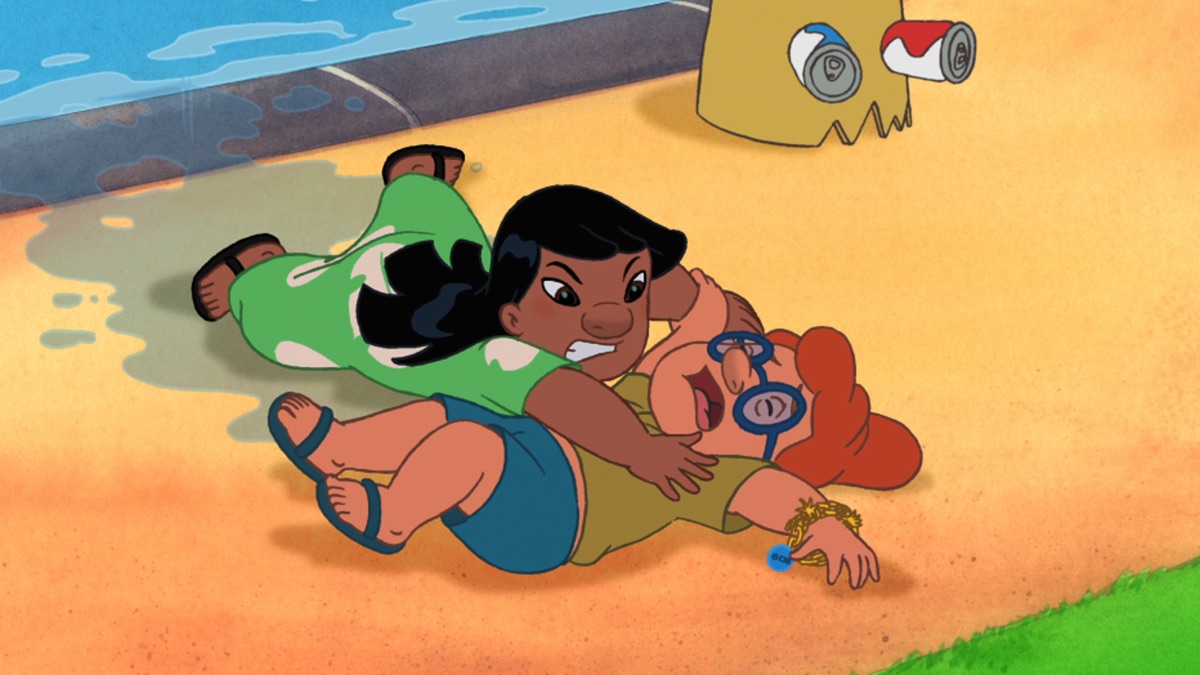
“Holio” hides Experiment 606 inside a birthday bracelet. The object is small, decorative, personal, and designed to travel against the body. Nobody expects a charm to become a black hole capable of swallowing the universe. That mismatch gives the episode instant comic danger and proves again that the pod spill contaminated ordinary life at the worst possible scale.
A child can activate the experiment by getting the charm wet. No galactic scanner catches the object. No recall notice reaches the community. Jumba’s illegal inventory has entered the gift economy, where wrapping paper apparently provides the only containment standard.
Mertle receives danger as status jewelry
The bracelet matters because Mertle’s birthday celebration turns possessions into social proof. A charm can show friendship, taste, and belonging. The experiment pod slips into that system and gains protection because the object looks valuable enough to wear. Nobody questions the charm while everyone is admiring the gift.
Mertle’s status often depends on controlling who receives invitations and approval. Holio creates a threat she cannot manage through popularity. Physics does not care who leads the hula group. The episode briefly levels the social room by giving everybody the same gravitational problem.
Lilo has to save somebody who keeps hurting her
Lilo could enjoy watching Mertle lose control of the party. She does not have that luxury because the activated experiment threatens far more than one bully’s accessories. Rescue asks her to protect people who rarely protect her socially. The moral burden is unfair and reveals her character.
Protecting Mertle does not require friendship or forgiveness. Lilo can oppose harm while still naming the cruelty between them. That distinction keeps heroism from becoming emotional servitude. She saves a life because life matters, not because Mertle earned access to her loyalty.
Nani is being inspected during a cosmic emergency
The B-story puts Nani under workplace scrutiny while the universe starts folding around a charm. She has to prepare, perform competence, manage appearance, and protect income without receiving the information that would explain why her household keeps behaving like a disaster zone. Galactic chaos remains everybody else’s adventure until consequences reach her employment file.
The contrast is funny because the scales are absurd. A company inspection should feel small beside a black hole. For Nani, the job can determine food, housing, and custody stability, so the inspection is also an existential threat. Two universes are collapsing at once, and only one has paperwork.
Women keep performing normalcy while men improvise science
Nani has to make the house and work life look controlled. Lilo has to manage Mertle, Stitch, the experiment, and the rescue. Jumba supplies alarming information after the danger activates. Pleakley reacts. The gendered labor pattern remains visible even inside an alien comedy.
Competence becomes something the women must demonstrate continuously while the male-coded characters receive room for eccentricity and error. Nani cannot shrug and call the inspection an Earth custom. Her mistakes cost stability. Jumba’s mistakes become episode premises.
Holio is a person shaped like a catastrophe
Experiment 606 appears as a black-hole generator capable of consuming matter far beyond any personal intention. The power creates immediate containment needs. The experiment also wakes inside a bracelet without orientation, language, or control. A being can be dangerous and vulnerable at the same time.
Calling Holio evil would confuse design with choice. Calling the danger harmless would ignore everybody being pulled toward destruction. Rehabilitation requires a plan that respects personhood while treating the physical risk seriously. Lilo’s family keeps trying to build that impossible middle with no institutional support.
Scale changes faster than the characters can process
The episode begins with a tiny object and escalates toward universal annihilation. That pace produces comedy because characters keep applying household solutions to astrophysics. Grab the bracelet. Keep the charm dry. Chase the pod. Stop the suction. Nobody has time to ask why an illegal scientist built a portable singularity.
The escalation also mirrors Nani’s life. A small workplace problem can become an income problem, then a housing problem, then a custody problem. Different physics, same chain reaction. One overlooked detail pulls everything nearby into danger.
Water remains the worst activation system imaginable
Kauaʻi contains rain, ocean, sinks, drinks, pools, humidity, and people carrying water everywhere. Dehydrated pods activate through contact with the most ordinary substance in the setting. Experiment 606 demonstrates why the design is indefensible. One wet charm can threaten existence.
Jumba should have provided sealed transport, water detection, a complete map, and emergency response before anyone went home. Instead, the family keeps discovering pods through accidents. The series depends on that premise. RaeRae will continue billing the premise for negligence.
Stitch cannot outmuscle gravity forever
Stitch’s strength gives him options most characters lack, but a black hole turns strength into a temporary delay. Matter moves according to forces larger than one body. The action works because he has to coordinate with Lilo and respond to the experiment rather than simply win a fight.
Episodes that limit brute force reveal his growth. A designed weapon learns rescue, timing, trust, and restraint. Protecting a community requires more than being the strongest person in the room, especially when the room is entering a singularity.
Mertle’s birthday is still emotionally real
Mertle behaves cruelly across the series, but birthdays can carry vulnerability, status anxiety, and fear of social failure. The bracelet may symbolize being seen by the group. Losing control of the celebration can feel catastrophic before the actual cosmic catastrophe arrives.
That emotional context does not excuse bullying. The context makes her more than a target waiting for punishment. Children who control social groups often depend on group approval themselves. Holio exposes how quickly that control disappears when the object producing attention becomes dangerous.
The party guests follow value until value becomes risk
A beautiful charm attracts interest. A black-hole charm produces flight. The object has not changed owners, but social meaning reverses immediately. Mertle’s circle looks stable while possessions and presentation support the arrangement. Crisis tests whether anybody stays to help.
The episode could use that moment to compare popularity with relationship. Lilo and Stitch move toward danger because rescue matters. Guests move away because the party contract did not include sacrifice. One response is understandable. The contrast remains revealing.
Jumba’s explanation is not a safety system
Jumba can identify Holio and describe the threat. Knowledge after activation helps solve the crisis. Knowledge stored only inside his head leaves everyone dependent on his presence and timing. A complete archive should exist before the next charm reaches a birthday table.
The family needs searchable records, pictures, activation risks, containment steps, communication guidance, and ethical notes. Jumba delivers trivia like a proud inventor. Nani needs an operations manual and compensation.
A black-hole body requires community-level accommodation
Holio cannot receive a casual household placement. Safe living may require specialized space, monitoring, voluntary control training, emergency equipment, and people able to respond without treating the experiment as a prisoner. The cost should belong to the creator and galactic institutions, not one struggling family.
Accommodation at this scale reveals whether personhood survives expense. Cheap inclusion is easy to celebrate. Expensive inclusion tests policy. If the only affordable solution is exile, the system has not created belonging.
The one true place must not become permanent containment
A remote astrophysical or waste-management role may use Holio’s ability safely. The placement could support research, controlled disposal, or cosmic navigation if Holio chooses the work and retains relationships. The same facility could become a cage described with professional language.
Consent, mobility, independent advocacy, and regular family contact separate placement from confinement. A dangerous body does not erase civil rights. Safety planning needs review because a solution designed during panic can become permanent before anybody asks whether a better life is possible.
Nani deserves disclosure before the inspection
Lilo, Stitch, Jumba, and Pleakley often hide experiment crises to protect Nani or avoid consequences. Secrecy leaves her performing competence without access to the facts affecting her home. Protection becomes another form of exclusion when the person carrying risk cannot participate in decisions.
Nani should know which pods remain missing, what powers could affect the property, and who to call. Her employment and custody are already tied to household stability. Keeping her uninformed does not reduce the stakes. Secrecy removes her agency.
Workplace inspections reward appearance over context
An inspector sees punctuality, order, presentation, and whether Nani meets company expectations. The inspector does not see grief, guardianship, unpaid alien care, or a singularity forming elsewhere. Performance becomes the visible measure because systems prefer evidence they can score quickly.
Nani’s competence is real. The demand that she hide every crisis to prove competence is destructive. A humane workplace would recognize caregiving, emergency leave, and material constraints instead of treating stability as a personal aesthetic.
What made me laugh
A universe-ending threat hanging from a birthday bracelet is exactly the kind of scale mismatch this series handles well. Stitch fighting suction while party decorations enter orbit gives the animators a clear visual game. Jumba discussing a black hole with the same tone he uses for a mildly inconvenient cousin remains peak creator nonsense.
The B-story sharpens every joke because Nani is trying to look employable while reality refuses to stay on the floor. The cosmic disaster and clipboard disaster compete until both feel equally terrifying for different reasons.
What made me mad
Nani’s livelihood remains vulnerable because the household conceals a galactic emergency she did not cause. Mertle’s bracelet can destroy existence because nobody secured the pods. Lilo performs field rescue. Jumba supplies exposition. The Federation remains somewhere else with a budget.
The episode calls the family resourceful. I call them abandoned by every institution with actual equipment. Resourcefulness becomes exploitation when authorities rely on the same people surviving preventable crises repeatedly.
The episode accidentally understands precarious labor
Nani’s inspection turns one evaluation into a threat against the whole household. Workers in precarious jobs often know a late arrival, visible family crisis, or manager’s opinion can produce consequences far beyond one shift. The black hole exaggerates how quickly stability can disappear.
Her stress is not smaller because the alien plot has larger physics. Material stakes determine emotional scale. Saving the universe matters. Keeping the job that feeds Lilo also matters. A family cannot live on cosmic gratitude.
The Episode 6 verdict
“Holio” gives us a sharp episode engine: tiny charm, impossible power, birthday politics, and Nani trying to survive inspection. Experiment 606 forces the family to address danger beyond Stitch’s strength while the human B-story reminds us that employment pressure can feel equally consuming.
My verdict is purple gravitational chaos with a labor complaint attached. Save Mertle. Protect Holio. Tell Nani the truth. Secure the remaining pods. Send Jumba and the Federation every invoice. Nobody should have to pass a company inspection while the universe is being swallowed beside the refreshments.
The quiet aftermath I wanted
Nani should learn what happened before somebody congratulates the household on another secret rescue. Lilo should explain why the bracelet could not stay a gift. Mertle should experience gratitude without being forced into instant friendship. Holio should receive a calm introduction outside the emergency.
Then the inspector should see Nani solving a crisis no employee handbook could imagine and approve the file immediately. Competence has been demonstrated. The pineapple entering orbit can be deducted as a business loss.
Why the bracelet is such a good choice
A bracelet looks harmless because jewelry belongs to the language of affection, status, and memory. Mertle wants the object because birthday gifts confirm who matters inside her social circle. Lilo understands that language even while standing outside the circle. Turning one charm into a black hole makes the emotional logic visible. The object meant to prove Mertle is adored becomes a force that pulls every person and possession toward her. That joke is mean, precise, and much smarter than a random monster attack.
The danger also grows through accumulation. One charm looks decorative. A whole bracelet promises abundance. The episode quietly asks how many objects can be added before possession becomes burden, and how much power can be worn before power begins wearing the owner. Mertle never asked for cosmic responsibility. She asked for a birthday present that would look expensive in front of other children. Adult negligence turned that ordinary desire into an extinction event.
Lilo saves Mertle without pretending they are friends
Lilo has every reason to resent Mertle. The cruelty between them does not vanish when Holio activates, and the rescue does not need a sentimental rewrite to become meaningful. Lilo acts because a child is in danger. Moral action carries more weight when the person being saved has failed to earn affection. The episode lets Lilo be hurt, angry, and decent at the same time.
That choice protects Lilo from the sugary expectation that a good girl must forgive immediately. Rescue is not reconciliation. Compassion is not surrender. Mertle can survive because Lilo intervened and still owe Lilo accountability tomorrow. I wish more family television trusted children with that distinction. Kindness becomes stronger when kindness does not require amnesia.
Where to watch
Watch “Holio” through Lilo & Stitch: The Series on Disney+. Availability can change by region.
Keep exploring
Return to the episode directory or return to the Lilo & Stitch hub.