
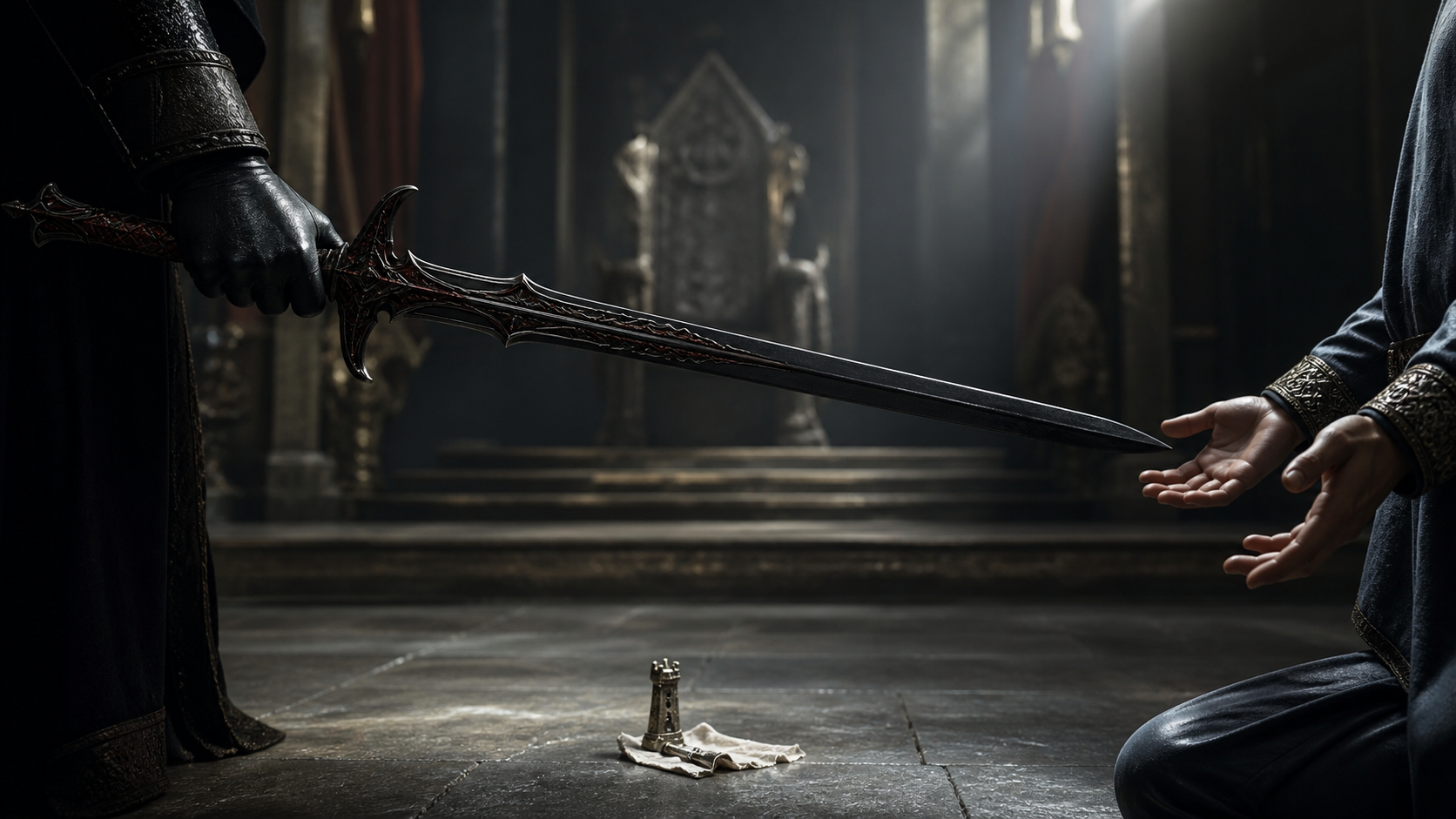
Josua Offers His Life for Sorrow
Josua cannot outfight the king holding Sorrow, so he does something more dangerous: he makes Elias choose what kind of king he is where everybody can see.
The moment
Surrender becomes the sharpest weapon in the room
Josua offers his life. On paper, that sounds like defeat: the imprisoned brother, unarmed and politically cornered, places himself before Elias and the ancient sword. In practice, the gesture strips the confrontation of fog. Elias can no longer pretend the problem is procedure, disobedience, or temporary security. The choice is brother-killing or release.
Josua’s body becomes the argument because every safer argument has already failed. He cannot compel justice through force. He can compel clarity by refusing to protect Elias from the meaning of his own command. The sword may belong to the king, but the moral pressure belongs to the man kneeling before it.
Why it hits
The scene tests kingship at the exact point Elias is weakest
Elias needs resistance to look treacherous so punishment can feel like order. Josua’s offer denies him that comfort. An unarmed brother accepting death cannot easily be framed as a battlefield threat, especially in front of witnesses whose loyalty still depends on believing the crown retains some boundary.
Sorrow makes the test worse. The weapon promises decisive power, but Josua exposes how frightened that power is. If Elias must use an ancient black sword to silence the one person willing to say no, then the sword is not proving authority. It is revealing that authority has become unable to survive contradiction.
Aftershock
Mercy does not repair the relationship; it publishes the fracture
Elias does not kill Josua in that room, but the spared life is not reconciliation. The confrontation gives every observer a receipt. Josua has shown that opposition exists inside the royal family and that the king’s judgment can be bent by humiliation, fear, and whatever Sorrow amplifies.
From there, Naglimund is not merely a rival fortress. It becomes the political afterlife of this scene: the place where Josua’s refusal gathers soldiers, refugees, and legitimacy. The offer works because it survives beyond the immediate decision. Elias keeps the sword. Josua leaves with the more dangerous object—the memory of a king who had to be challenged into mercy.
On the record
The scene receipt
Return to The Dragonbone Chair hub → · Open every Book 1 React → · Open the series hub →