
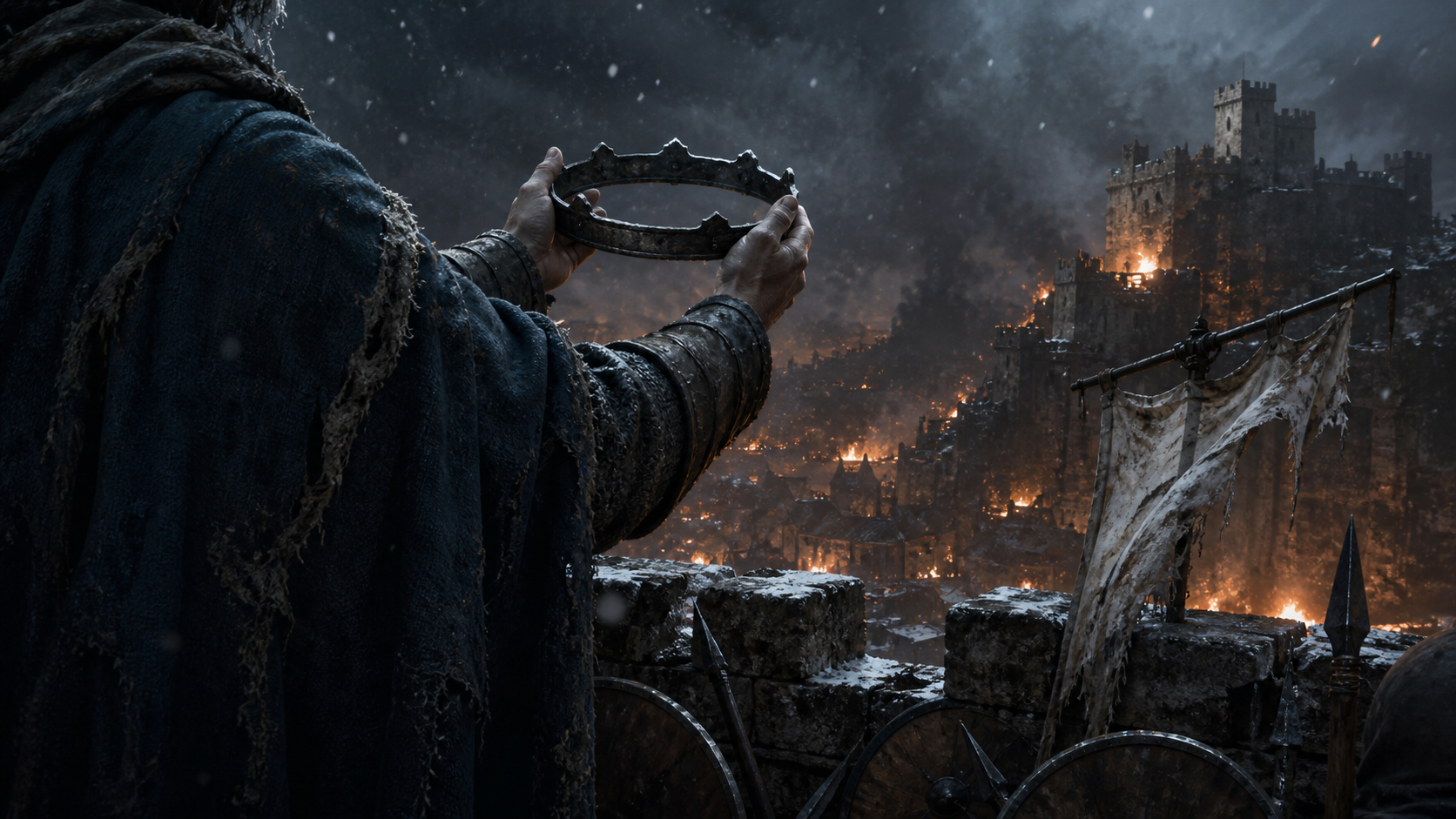
Josua Claims the Crown Above Burning Naglimund
Josua does not receive a clean throne room, a cheering court, or even an intact fortress. He claims leadership with Naglimund burning beneath him and survivors watching what the promise will cost.
The moment
The crown is accepted where triumph has already failed
Josua claims the crown above burning Naglimund. The setting refuses every comforting image of accession. Walls have failed, people are dead or fleeing, and the fortress meant to protect resistance has become evidence that courage alone does not defeat the forces gathered against them.
That is precisely why the claim matters. Josua is not reaching for a prize secured by victory. He is making himself answerable to ruin. The crown becomes a public statement that the surviving struggle will have a named center and that he will not ask others to carry danger while remaining merely the principled brother on the sidelines.
Why it hits
Legitimacy arrives through responsibility, not possession
Elias possesses the throne, royal machinery, Sorrow, and the language of lawful succession. Josua possesses far less and accepts far more uncertainty. The contrast does not automatically make every future decision correct, but it explains why frightened people may treat his claim as morally serious.
He takes the title after seeing what resistance costs, not before. Naglimund’s fire prevents the gesture from becoming romantic. Anyone who follows him now understands that the crown cannot promise safety. Its only honest promise is shared exposure: the claimant will stand inside the consequences with everyone else.
Aftershock
The burning fortress becomes the first court of a disputed king
Josua’s new kingship begins without stable territory, secure inheritance, or a victorious army. It begins as a network of survivors, witnesses, debts, and incomplete information. That fragility will shape every alliance that follows. He must build authority relationally because he cannot simply announce that the institutions beneath him are functioning.
The moment also closes the circle opened by his offer before Sorrow. There, Josua forced Elias to reveal what kind of king he was becoming. Here, the same man accepts the obligation to be judged by his own claim. Refusal was not enough. Above Naglimund, opposition turns into responsibility.
On the record
The scene receipt
Return to The Dragonbone Chair hub → · Open every Book 1 React → · Open the series hub →