
RAERAE REACTS · Girls’ Generation
I Got a Boy React: Girls’ Generation Changed Songs Mid-Sentence and Made the Argument Historic
Nine women, several songs fighting inside one track, and enough performance authority to make structural chaos feel like choreography.
Artist
Girls’ Generation
Released
December 31, 2012
Runtime
05:05
Verdict
Genre whiplash with command
Bottom line: “I Got a Boy” works because Girls’ Generation never apologize for the switch-ups. The track cuts from bubblegum talk to rap, electro, chant and power vocals like somebody is changing radio stations during an argument, while nine distinct performers keep the personality continuous.
Release file
Official upload: Girls’ Generation 소녀시대 “I GOT A BOY” MVDaily+17.6KTotal views280.6M on SMTOWN’s verified channel.
Video published: December 31, 2012 · Album release: January 1, 2013 · Runtime: 05:05.
Nine-member lineup in this file: Taeyeon, Jessica, Sunny, Tiffany, Hyoyeon, Yuri, Sooyoung, Yoona and Seohyun.
Release: title track from the fourth Korean studio album I Got a Boy.
Sources: exact SMTOWN upload; SM Entertainment album release material and credits.
The song opens by interrupting itself
A spoken gossip setup barely establishes the room before percussion, bass and attitude barge in. The track behaves like several friends telling one story at once, each convinced her detail is the important one.
That framing turns structural chaos into character. The switches do not sound random because the lyrics and delivery already taught us to expect interruption.
This is not one genre with decorations
Hip-hop rhythm, bubblegum melody, electro pressure, chant hooks, R&B phrasing and a rock-sized vocal peak all demand real space. The production does not blend them into polite compromise. It cuts.
Those hard borders create the thrill. A smoother version might be easier to program between two other songs, but it would lose the sensation of nine personalities wrestling one conversation into pop.
The tempo reset is still rude
The famous “let’s bring it back to 140” moment does not gently guide the listener. It announces that the song knows exactly how disorienting it has been and intends to do it again.
That self-awareness is the difference between a mess and a controlled mess. The track points at its own machinery, laughs, and slams the next section into place.
Nine members are the continuity system
Taeyeon and Jessica can lift the ceiling, Tiffany gives English phrases bite, Sunny brightens transitions, Hyoyeon grounds the rhythm, Yuri and Sooyoung sharpen the performance frame, Yoona anchors the visual narrative and Seohyun keeps melodic lines clean.
The instrumental keeps changing clothes, but the member identities remain legible. That is why the audience can follow the song without needing a flowchart during every listen.
Taeyeon does not rescue the track; she crowns it
The climactic vocal would be cheap if everything before it were merely waiting for a high note. Taeyeon enters after the song has already built tension through rhythm, switching and group delivery.
Her power seals the argument instead of replacing it. The moment lands because the arrangement finally lets one line stretch after spending so long cutting phrases into pieces.
Jessica’s tone is structural glue
Jessica’s bright, slightly icy color slices through dense production. In a track crowded with textures, that immediately recognizable tone tells the ear where it has landed.
Her presence also fixes this video in the nine-member history. Later lineups and performances matter, but this exact file cannot be rewritten around a future roster.
Hyoyeon owns the rhythmic center
Hyoyeon’s dance attack and grounded delivery make the hip-hop sections feel inhabited rather than borrowed for styling. She understands where the beat sits in the body.
The concept asks all nine members to sell tougher phrasing, but Hyoyeon gives those sections their natural center of gravity. The others rotate around that credibility.
Tiffany knows how to weaponize a phrase
English fragments could become novelty signposts. Tiffany delivers them with enough confidence and rhythmic shape that they function as transitions, hooks and attitude at once.
Her voice also carries the conversational setup. She sounds like somebody telling you news she has already judged, which is exactly the energy the track needs.
The fashion looks like several closets formed a coalition
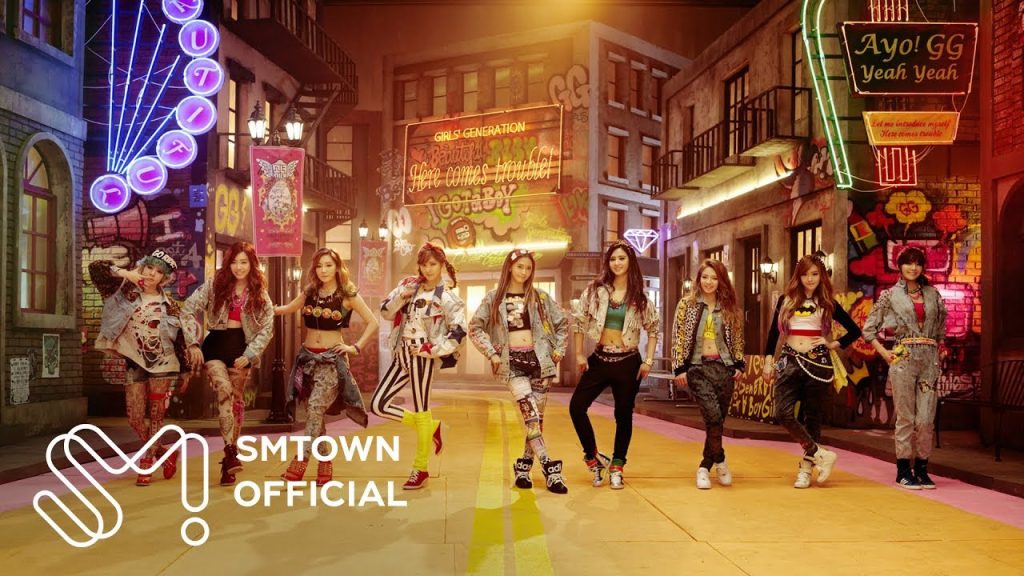
Streetwear, varsity cues, bright hair, patterned tights, caps, chains and candy-colored rooms collide without pursuing one elegant silhouette. The visual excess mirrors the arrangement.
It should look dated; it is a 2012–2013 statement, not a neutral capsule wardrobe. The interesting part is how decisively the group makes the era specific.
The box sets become an advantage
SM’s constructed rooms are visible as sets, but the video uses that artificiality like a stage musical. Color, props and camera movement reset with the song sections.
A realistic location would not automatically improve this. The track keeps changing internal worlds, so a designed environment can change grammar just as quickly.
Choreography organizes the argument
Formation changes clarify who owns each section, and the group repeatedly snaps back into readable geometry after moments of individual chaos. The dance acts like punctuation.
Without those resets, five minutes of visual and musical switching could become exhaustion. The choreography tells the eye when a new clause begins.
The camera respects performance more than lore
The video offers a light romantic premise, but it does not bury the song under a detective story. Close-ups, group shots and movement remain the priority.
That choice aged well. Fans can debate the boy and the conversation, but the lasting evidence is nine women taking control of an arrangement that could swallow a less experienced group.
The chorus is simpler than the journey
After so many switches, the main hook relies on direct repetition and an instantly readable melodic phrase. It gives the audience a place to return.
A complicated chorus would be one argument too many. The song needs a recognizable home address even if it keeps leaving through different doors.
What changed every time I replayed it: what still irritates me
Not every transition earns equal affection. A few switches feel clever before they feel musical, and the track can resemble a highlight reel designed by somebody afraid of silence.
But the nerve matters. A safer edit would remove the very friction that made the song a reference point for later sectional K-pop production.
Meaning: influence should not become amnesia
Later songs that pivot between genres did not all descend from one 2013 single, and Korean pop had mixed styles long before this release. Still, “I Got a Boy” made abrupt sectional construction internationally visible on a huge stage.
Give it credit without turning history into one origin myth. The song became a landmark because Girls’ Generation delivered the experiment at full scale.
The final vocal run ends the debate
The late power-vocal section and last group return transform accumulated chaos into payoff. The song has spent minutes refusing one lane, then proves the members can still arrive together.
That landing is why the structure feels complete instead of abandoned. The track does not calm down; it learns how to finish loudly.
Exact-file discipline
This React reviews SMTOWN upload wq7ftOZBy0E, published December 31, 2012. Reuploads, dance practices, live stages and remasters remain separate files.
The canonical local frame comes from this exact MV, and the featured image, hero and social previews use the same attachment.
RaeRae verdict
“I Got a Boy” is five minutes of pop refusing to wait its turn. Some transitions still elbow the listener in the ribs, and that is part of the record.
Girls’ Generation make the chaos readable through identity, choreography and vocal command. The song changes its mind constantly; the group never loses theirs.