
The Dead Sea Scrolls Explained
World, Lore & Guides
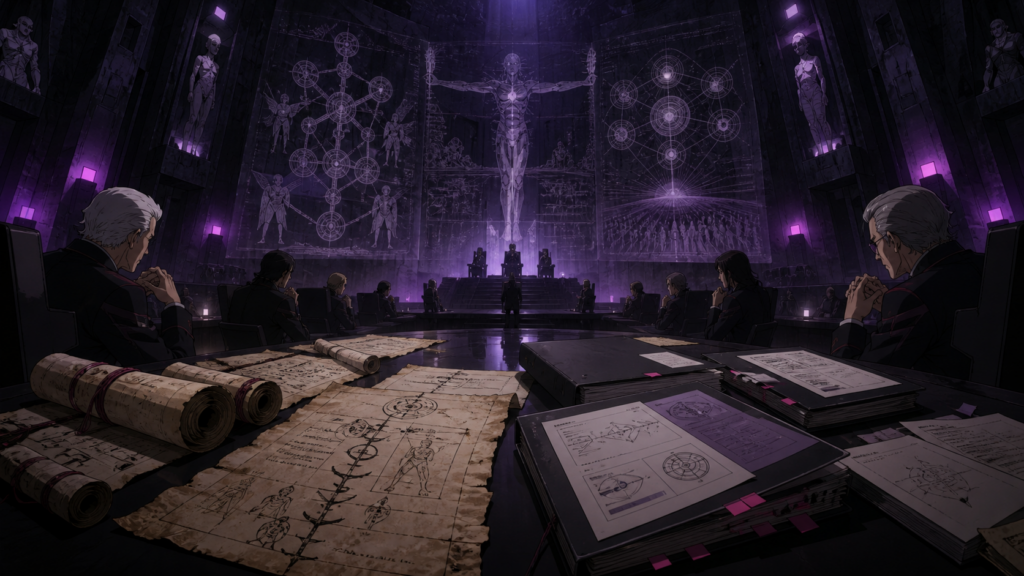
Evangelion Dead Sea Scrolls are not the same documents historians discovered near Qumran. The franchise uses the familiar name for ancient records that contain information about Adam, Lilith, the Angels, the Spears, and the sequence SEELE believes can lead humanity into Instrumentality. Public religious history and SEELE’s classified “Secret Dead Sea Scrolls” occupy different levels of the story.
SEELE treats the secret records like prophecy, technical manual, and project schedule at the same time. The committee appears to know when Angels will arrive, which pieces must survive, and what conditions are required for its preferred version of Third Impact. That knowledge makes SEELE powerful. The committee’s interpretation of the knowledge makes SEELE dangerous.
The real-world name is borrowed, not copied
The real Dead Sea Scrolls are ancient Jewish manuscripts discovered in caves near the Dead Sea beginning in the 1940s. Evangelion borrows the name because the words carry associations with hidden scripture, apocalyptic expectation, damaged fragments, and religious authority.
The anime does not claim that the historical manuscripts secretly contain Eva construction diagrams. The story creates fictional classified scrolls within its own world. Treating every religious image as a one-to-one theological code produces more confusion than insight. Evangelion combines names and symbols to build a modern apocalypse run through laboratories and committees.
What the Secret Dead Sea Scrolls contain
The series never hands viewers a complete translated document. Characters refer to the Scrolls through SEELE’s scenario, predicted Angel appearances, and conditions surrounding Instrumentality. The content must include enough knowledge for SEELE to prepare across decades.
That preparation includes Second Impact, the creation of Gehirn and NERV, Evangelion development, pilot selection, the preservation or use of Seeds of Life, and the expectation that a final sequence will follow the defeat of the Angels. SEELE knows more than the staff fighting each weekly battle, but the exact limits of that knowledge remain intentionally unclear.
The distinction matters. SEELE can possess a plan without possessing perfect certainty. The committee reacts when Gendo changes the timetable, when Unit-01 gains an S² Engine, when the Spear leaves Earth, and when NERV’s assets stop serving the expected route. Those reactions show leaders adapting interpretation to events rather than calmly watching an infallible script unfold.
What SEELE means by the “scenario”
SEELE’s scenario is the committee’s intended route from the Angel war to Human Instrumentality. The word gives political choices the tone of technical necessity. If an event belongs to the scenario, sacrifice becomes compliance. If an event departs from the scenario, SEELE treats the deviation as a threat to humanity rather than a threat to its own control.
The scenario requires the Angels to be defeated because rival Adam-based life cannot be allowed to seize the future first. The scenario requires Evangelion units capable of participating in an Impact ritual. The plan requires access to Lilith, Unit-01, the Mass Production Evas, Spears, and souls. The precise configuration changes as assets are lost or captured.
SEELE also needs secrecy. Most NERV workers believe defeating Angels will prevent Third Impact. The committee intends to use victory as the opening for a human-directed Impact. The same people who save humanity from one extinction route unknowingly preserve the machinery for another.
Prediction is not moral authority
SEELE behaves as if knowledge of future events grants the right to decide what those events should mean. Predicting Angel attacks does not establish consent for Instrumentality. Understanding human loneliness does not authorize dissolving every human boundary.
The committee avoids that problem by describing humanity as incomplete. Completion sounds like medicine for a defective species. The language places SEELE above ordinary people as the group mature enough to choose the treatment.
Evangelion repeatedly shows the opposite. SEELE’s members fear death, uncertainty, and individual limitation. Their grand philosophy turns private terror into universal policy. The Scrolls provide information. SEELE supplies the ideology.
How Gendo uses the same timetable
Gendo does not reject the larger machinery. He uses NERV, the Eva project, Rei, Adam, Lilith, and SEELE’s resources while preparing a different ending. His goal centers on reunion with Yui rather than SEELE’s collective vision of human completion.
The conflict therefore does not pit a defender of human freedom against authoritarian SEELE. Gendo plans to redirect the same forced transformation toward his own desire. Both sides assume that billions of lives can become material for a result they consider emotionally necessary.
Gendo’s advantage comes from operational control. SEELE may hold the scenario, but NERV holds bodies, facilities, pilots, and immediate access. The committee eventually responds with cyberattack, political authority, and military invasion because prophecy cannot substitute for possession.
The Spear leaves the timetable
NERV uses the Spear of Longinus against Arael, an Angel attacking Asuka from orbit. The weapon remains beyond practical retrieval afterward. SEELE objects because the Spear is not merely a battlefield weapon. The object belongs to the control system surrounding Seeds of Life and Impact rituals.
Gendo accepts the loss because saving the immediate operation also changes which version of Instrumentality remains available. Unit-01 later becomes a substitute or central vessel in SEELE’s revised ritual. The episode demonstrates how a tactical decision can reshape the supposed ancient scenario.
Unit-01 becomes a threat to SEELE
When Unit-01 consumes Zeruel’s S² Engine, the Eva becomes capable of operating without ordinary external power. SEELE sees the development as an unscheduled awakening. A living unit derived from Lilith, carrying Yui’s soul and no longer dependent on NERV’s power cable, can exceed the committee’s planned control.
Yui’s presence adds another will that the Scrolls cannot reduce to equipment. SEELE and Gendo treat Unit-01 as a component. Yui treats the body as a means to preserve evidence that humanity existed. The same object belongs to three incompatible futures.
Why SEELE needs the Mass Production Evas
The Mass Production Evas give SEELE a ritual force outside Gendo’s direct NERV units. Dummy systems remove visible child refusal from the cockpit. S² Engines provide independent power. Replica Spears provide tools that can transform during the ritual.
During The End of Evangelion, the units destroy Unit-02 and arrange themselves around Unit-01. SEELE attempts to bring its scenario into physical form after losing confidence in Gendo. The committee’s scripture becomes military logistics.
Does everything happen exactly as written?
No complete canon document exists for comparison, so claims of perfect fulfillment exceed the evidence. SEELE recognizes broad stages and critical pieces. Characters still make choices that redirect the result. Rei rejects Gendo. Shinji rejects permanent Instrumentality. Yui preserves Unit-01. Asuka fights. Misato gets Shinji to the launch cage.
Those choices are central because Evangelion opposes the belief that people are only roles inside an inevitable script. SEELE’s scenario may anticipate an Impact. The scenario cannot guarantee what a separate consciousness will choose when the boundary of the world opens.
The Rebuild continuity uses a different scenario
The Rebuild films retain SEELE, ancient planning, Impact rituals, Spears, and Gendo’s manipulation, but the cosmology and sequence differ. Multiple Adams, Near Third Impact, Eva-13, new Spears, the Anti-Universe, and Additional Impact belong to a route that cannot be explained through the original series alone.
Gendo eventually dismisses or shuts down SEELE after the committee’s role ends. The moment reverses the original power relationship. He has used the old planners, moved beyond their stage of the project, and prepared a more personal transformation.
Why the Scrolls matter to Evangelion's larger argument
The Scrolls let powerful adults claim that history already chose the outcome. That claim is useful because inevitability removes accountability. Second Impact becomes a necessary stage. Child pilots become required components. Secrecy becomes protection. Instrumentality becomes completion rather than mass coercion.
The franchise answers through people who refuse assigned roles. Rei refuses Gendo. Kaworu refuses the extinction of humanity. Shinji refuses permanent merger. The choices do not erase the plan’s damage, but they prove that knowledge of a scenario is not ownership of every person inside the scenario.
The bottom line
The Secret Dead Sea Scrolls are Evangelion’s hidden archive of origins, Angel events, and Impact conditions. SEELE uses that archive to construct a scenario for Human Instrumentality. The documents explain how the committee prepares. The documents do not prove that the committee’s desired ending is sacred, moral, or inevitable.
SEELE’s greatest trick is not predicting the apocalypse. The committee convinces institutions that prediction grants permission to manage the apocalypse. Evangelion breaks that confidence by allowing the supposed components to become people again.
Canon receipts used in this guide
- Neon Genesis Evangelion, especially Episodes 14, 21, 22, 23, and 24
- The End of Evangelion (1997)
- The Rebuild of Evangelion film continuity