
Carla
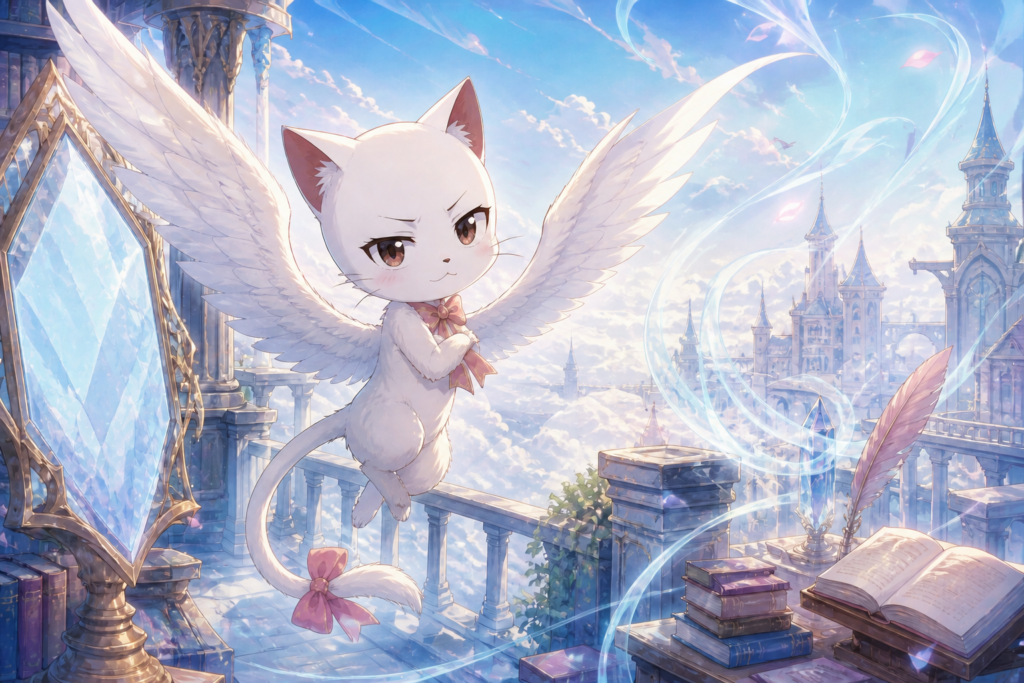
CVM Sekai character profile
Bottom line
Carla is not Wendy Marvell‘s flying hall monitor. She is an Exceed, an Aera user, a precognitive mage and a displaced child whose first understanding of herself comes from a government lie.
Extalia sends eggs to Earth-land before disaster. The public story says those children have a mission tied to killing Dragon Slayers. Carla’s visions make that fiction feel personal. She grows up beside Wendy believing protection may require control and that failure could expose both of them to a threat she cannot fully explain. Then Edolas reveals the truth.
The eggs were evacuated. Queen Shagotte foresaw Extalia’s fall. The assassination story was cover. Carla’s biological mother and homeland exist, but neither gets to replace the child, partner and chosen family she became with Wendy. That is Carla’s real arc: not learning to relax because Happy keeps flirting.
Carla’s arc is learning that foresight supplies information, not ownership. Love can warn. Love can argue. Love still has to let the other person choose.
Carla, Charles and the naming boundary
The English-language character is widely called Carla. The official Japanese Fairy Tail: 100 Years Quest site romanizes her name as Charles while displaying シャルル in Japanese.
This profile uses Carla because that is the established English localization for the site’s audience. Charles belongs in the aliases and localization note, not as a reason to switch names every paragraph and make the reader feel like two cats entered the room.
Carla is a white Exceed with brown eyes, a pink bow and a white tail. When using Aera, white feathered wings appear. The bow is part of her recognizable design. A brown-tipped tail is not, which is why the rejected first local hero stays rejected.
Her licensed manga entrance is Chapter 132, “Allies, Unite!” on K MANGA, alongside Wendy and the Cait Shelter delegation. Television material introduces them at the opening of the Oración Seis alliance. Yui Horie is Carla’s Japanese performer in the main series and sequel.
Public official pages do not provide a clean canonical birthday, height or age. Exceed chronology, egg evacuation and the seven-year Fairy Sphere gap also make a simplistic age box less useful than it looks. Those numbers stay out.
Cait Shelter gives her a child to protect and a home that cannot last
Carla enters the story as Wendy’s partner from Cait Shelter. Wendy is shy, young and expected to contribute healing to an alliance fighting Oración Seis. Carla responds with suspicion and control because she understands danger more readily than trust. She is often right that Wendy is at risk.
She is not automatically right about what Wendy should do. Cait Shelter is later revealed as an illusion sustained by Roubaul. Its members exist to give Wendy a community after Mystogan leaves her there. Carla’s life inside that community is emotionally real even when the institution is materially fabricated.
That distinction matters for both girls. They lose a guild, a routine and the adults who made the routine feel permanent. The explanation does not turn grief into embarrassment. Carla’s protective severity makes sense in that context. Every home she knows contains a hidden expiration date. Understanding the pattern does not mean Wendy must surrender her choices to Carla’s fear.
Nirvana proves Wendy has judgment beyond Carla's protection
During the Nirvana conflict, Wendy chooses whether to heal Jellal under pressure. Carla knows the danger and the history surrounding him is incomplete. Wendy acts anyway.
The decision matters for Carla because protection can become a habit of assuming the protected person is not competent. Wendy is young. She is also a trained healer making an ethical choice in a crisis. Carla’s role is to warn, question and stay beside her. Carla must not become the owner of Wendy’s magic.
That shift happens gradually. Fairy Tail does not flip Carla from strict guardian to cheerful sidekick. She learns to trust Wendy’s judgment while remaining the person most likely to say, “This plan has six missing steps and Natsu is one of them.” Frankly, every guild needs one.
Extalia builds a religion around fear
Edolas reveals that Carla and Happy are Exceeds from Extalia. The society presents Exceeds as divine beings above humans. Queen Shagotte’s position depends partly on the belief that she holds supernatural authority over life and death. The political structure is built on performance.
Shagotte has precognitive visions. She cannot casually decide who dies. The mythology around her power stabilizes a fearful society and supports hierarchy. That does not make Shagotte a cartoon tyrant. The deception reveals a leader whose fear shapes policy.
She foresees Extalia’s destruction and sends eggs to Earth-land. Evacuation saves children. The cover story tells the public that the eggs carry a mission involving Dragon Slayers. Saving lives and lying about why can happen in the same decision. The rescue deserves credit. The children inherit separation, false identity and fear.
The false assassination mission becomes Carla's private burden
Carla’s visions give her fragments of the future. She interprets those fragments through the mission story Extalia supplied. That creates a cruel loop. She believes she may have been sent to harm Dragon Slayers. Wendy is a Dragon Slayer. Carla loves Wendy. The more she cares, the more threatening her own origin appears.
Happy does not share the same certainty. His rejection of the assassination story matters because it gives the narrative another Exceed response. He does not accept institutional purpose simply because authority attached it to birth.
Carla eventually confronts the lie and rejects it too. The order matters: egg evacuation, mission propaganda, Carla’s interpretation, Edolas disclosure and chosen rejection. Compressing that into “Carla was sent to kill Wendy but changed her mind” is false and crueler than canon. She was evacuated. The mission story was not the truth of her birth.
Shagotte is her biological mother, not her new owner
Edolas connects Carla to Queen Shagotte as her biological mother. That revelation gives Carla origin, resemblance and an explanation for precognition. The revelation does not displace Wendy.
Biological connection matters. Chosen history matters too. Shagotte made a decision under catastrophic pressure that separated mother and child. Carla survived because of it. Carla also grew up with a false mission and no usable parental explanation.
A complete relationship analysis can hold gratitude, anger, curiosity and distance at once. Fairy Tail often treats reunion as emotional settlement. Real reunion is the beginning of new questions. Carla does not remain in Extalia as a restored princess. She returns to the life she chose in Earth-land. Blood explains part of her story. Blood does not issue a relocation order.
Happy's crush is not a contract
Happy is immediately interested in Carla. Carla is not equally interested. That imbalance is the joke. The joke should not become a promise that persistence will eventually win the girl. Happy offers companionship, optimism and another Exceed perspective. He also flirts, performs and sometimes assumes emotional familiarity Carla has not granted.
Carla softens toward him over time. They share danger, Edolas truth, guild life and concern for their Dragon Slayer partners. Affection and trust grow. Canon gives Happy a crush and builds trust between them without issuing a marriage certificate every time a cover looks ship-friendly.
The more useful relationship lens is ideological. Happy rejects the false mission through loyalty and instinct. Carla reaches rejection through evidence, fear and moral conflict. Both choose Earth-land family, but they arrive there differently. That difference gives the pairing substance beyond fish jokes.
Panther Lily offers an adult Exceed model
Panther Lily is a soldier from Edolas who becomes Gajeel’s partner. He gives Carla another model of Exceed identity outside Extalia’s religious hierarchy. Lily is physically imposing, professionally experienced and comfortable challenging authority. Carla is smaller, younger and burdened by visions. Neither is the correct way to be an Exceed.
Their shared Earth-land life matters because displaced people do not need to reproduce the homeland hierarchy to preserve culture. Happy, Carla and Lily build different partnerships with Natsu, Wendy and Gajeel. The variation prevents “Exceed” from meaning mascot. Each has magic, judgment and a partnership that works only when it remains mutual.
Aera is useful, finite and not merely transportation
Carla uses Aera to manifest wings and fly. She can carry Wendy, scout, reposition allies and escape dangerous terrain. Aera has stamina and load limits. Flight is not indefinite. Carrying another person under combat pressure costs more than moving alone.
The series sometimes treats Exceeds as air taxis until the plot remembers they have minds. Carla’s best Aera work combines movement with judgment: deciding where Wendy needs to be, when retreat is necessary and which information the team lacks. Mobility is strategy.
Mobility is also care work. Carla repeatedly puts her body between Wendy and impact, carries her out of danger and monitors conditions while stronger-looking characters chase the central fight. The camera may call that support. The operation calls it survival.
Precognition warns without becoming omniscience
Carla inherits a form of precognitive vision associated with Shagotte. The visions are intermittent, incomplete and open to interpretation. They do not make her all-knowing.
That limitation drives much of her early severity. A fragment without context can be more frightening than no information because the viewer feels responsible for preventing an event they do not fully understand. Carla sometimes mistakes warning for certainty. That is not stupidity. Mistaking warning for certainty is the psychological cost of unreliable foresight.
The ethical problem begins when certainty becomes control. Wendy has to know what Carla saw, what Carla inferred and what remains unknown. Fact, vision and interpretation are three different things. The Editorial Bible rule applies inside the story too: separate the receipt from the reading.
Human-form transformation is a tactic, not an upgrade in species
Carla later learns a human-form transformation. The form expands her physical and combat options and can assist infiltration, movement and direct action. Transformation does not make her more mature, more beautiful or more valuable because she looks human.
That distinction is essential. Fantasy stories often frame human shape as the final stage of an animal or nonhuman character’s development. Carla was already a speaking, thinking mage with agency. Transformation adds capacity. Added capacity does not add personhood.
The adaptation also has a responsibility not to age or sexualize the transformed design carelessly. A humanoid body is still Carla’s body, and the character’s chronology does not disappear because the silhouette changed. The licensed transformation is one ability, not a reason to turn every later outfit into a separate magical form.
Tenrou Island and seven missing years
Carla supports Wendy and Fairy Tail through the Tenrou Island period and Grimoire Heart conflict. When Acnologia attacks, Fairy Sphere preserves the Tenrou group for seven years.
Carla returns with Wendy to a world that continued without them. The gap affects guild standing and relationships, but it also deepens Carla’s protective reflex. She has already lost Extalia, learned Cait Shelter was temporary and now discovers that even survival can separate them from time. The answer is not tighter control over Wendy.
The answer is shared adaptation. They train, compete and grow in a world that does not pause to match their internal clock.
Tartaros makes partnership a life-or-death operation
During Tartaros, Wendy and Carla move to stop Face and encounter Ezel. Television Tokyo’s official summaries make the division visible. Wendy fights Ezel, reaches Dragon Force and destroys one Face unit. Carla supports movement, reconnaissance and the escape stakes. The larger Face network remains active beyond their local victory.
Both are prepared for the possibility that they will not survive. Fairy Tail frames that willingness as courage. RaeRae is keeping the consequence in frame.
Carla is a displaced young Exceed who believes protecting Wendy may require dying beside her. That is love. Carla’s willingness is also evidence that the adults and institutions around them have allowed children to reach a suicide-level objective.
Grandeeney’s return gives Wendy part of her dragon-family answer. Carla helps hold the chosen-family structure around that reunion. She does not become irrelevant because the biological mother arrived. She knows better than most that origin and home are not the same file.
Alvarez and Acnologia require reconnaissance, not inflated credit
Carla contributes through flight, warning, transport and tactical support during the final war. Her abilities help people reach positions and survive conditions that raw attack power cannot solve.
The Acnologia conclusion depends on Dragon Slayers, Fairy Sphere and a wide network of allies. Carla supports Wendy and the team without owning the finishing blow.
Character profiles often inflate support characters by claiming they “made victory possible” in a way so broad that everybody becomes solely responsible. Specific contribution is stronger.
Carla scouts. Carla warns. Carla carries. Carla fights where the record shows it. Carla makes decisions under pressure. She does not need stolen credit to matter.
Spoilers: 100 Years Quest keeps her inside the core team
Carla travels with Wendy and the main team on the 100 Years Quest. The Mercphobia conflict places her around Dragon God power and a city whose relationship to its protector is more complicated than hero versus monster. Her value remains observation, mobility and protecting Wendy while the team learns the conditions.
Touka and the White Mage create another identity problem. The official Touka profile introduces a new Fairy Tail member whose behavior Gajeel finds suspicious. Later material separates Touka’s identity from the controlling force using her.
Carla’s own history with false mission and bodily agency makes that conflict structurally relevant. The story does not give her a unique speech explaining the parallel, so the connection remains RaeRae’s bounded reading rather than dialogue Carla never says.
During Aldoron and Elentear, Carla supports Wendy through controlled guild conflict, Dragon Eater encounters and world-scale magical instability. Official Episode 24 credits Wendy with recognizing a key to the Elentear crisis. Carla remains part of the operational pair without having Wendy’s insight reassigned to her.
Later manga work involving Diabolos, the Great Labyrinth and further Dragon God forces stays proportional. Carla does not become a finishing-blow machine because a supporting character deserves more verbs.
Yui Horie plays caution without turning Carla into a scold
Yui Horie is Carla’s official Japanese performer in Television Tokyo’s cast record and the sequel. Horie’s official credit is clear; scene-specific breath, pitch and timing claims remain outside this profile where the available official pages do not document them.
The performance challenge is clear. Carla needs authority without sounding adult in every register, affection without instant softness and comedy without becoming a nagging stereotype. Her early formality carries fear. Her later warmth does not erase the intelligence that produced caution in the first place.
Direction has similar work. Precognitive visions need visual boundaries between event, fragment and interpretation. Human transformation reads best as magic, not a sexualized upgrade. Aera gains weight when animation shows effort while carrying another person under stress. Support magic deserves craft too.
Relationship atlas
Wendy Marvell
Partner, chosen family and the person Carla most wants to protect. Their growth moves from guardian control toward mutual reliance and shared decision-making.
Queen Shagotte
Biological mother and political leader whose evacuation decision saves lives while the cover story burdens children. Explanation does not erase separation or deception.
Happy
Fellow Exceed and persistent admirer. His feelings are not entitlement. Their trust develops through shared history, different responses to authority and repeated action.
Panther Lily
Adult Exceed peer and alternate model of identity, displacement and partnership in Earth-land. Lily shows Carla another way to balance cultural memory, chosen family and independent judgment after Edolas.
Grandeeney
Wendy’s dragon mother. Her return adds biological family without displacing Carla’s chosen-family role. Grandeeney expands Wendy’s history while Carla remains the person who lived beside her through daily danger and growth.
Roubaul and Cait Shelter
An illusion-supported institution whose care remains emotionally real. Its disappearance shapes Carla’s fear of temporary homes and explains why later belonging can feel fragile even when the people around her are sincere.
Fairy Tail
Living guild and chosen home. Fairy Tail gives Carla relationships beyond Wendy while benefiting from her labor, warning and mobility.
Media and continuity shelf
The main biography follows Hiro Mashima’s 63-volume manga and the licensed 100 Years Quest sequel by Mashima and Atsuo Ueda. Television, films, OVAs, games and anime-original arcs remain labeled by medium. Game transformations, costumes and support mechanics do not define manga canon. Exact film and OVA appearances require official rosters before inclusion. Japanese performer: Yui Horie only. No English-dub discussion unless RaeRae requests it.
Final verdict
Carla begins with a prophecy, a mission and a child she believes she must protect. Almost all of that information is incomplete. Her growth comes from refusing to let incomplete information become permanent authority. She rejects Extalia’s false mission. She learns who Shagotte is without surrendering the home she built. She stays with Wendy while gradually respecting Wendy’s judgment. She develops Aera, foresight and transformation without becoming a different species of person. Carla is not valuable because she can predict the future. She is valuable because she learns the future does not own anybody. Not Wendy. Not Happy. Not the child inside the evacuated egg.
Source ledger and clean boundaries
- Official Carla/Charles profile, Aera, transformation, foresight and Wendy bond: Official 100 Years Quest Carla profile
- Official 100 Years Quest series and Yui Horie cast: Official Fairy Tail 100 Years Quest site
- Television Tokyo Carla/Charles character summary: TV Tokyo: Fairy Tail character archive
- Television Tokyo Japanese cast: TV Tokyo: Fairy Tail staff and Japanese cast
- K MANGA licensed Chapter 132, “Allies, Unite!”: K MANGA: Fairy Tail Chapter 177
- Kodansha Volume 20, Oración Seis conclusion and transition: Kodansha: Fairy Tail Volume 20
- Television Tokyo Tartaros Episodes 243 to 245: TV Tokyo: Fairy Tail 2014 episode archive
- Official 100 Years Quest Episode 24: Official 100 Years Quest episode story
Public official pages do not expose simple age and vital statistics, an exact anime-debut listing, a complete film, OVA and game roster or every later sequel matchup. Those details stay bounded instead of being imported from fan databases and dressed up as certainty.