
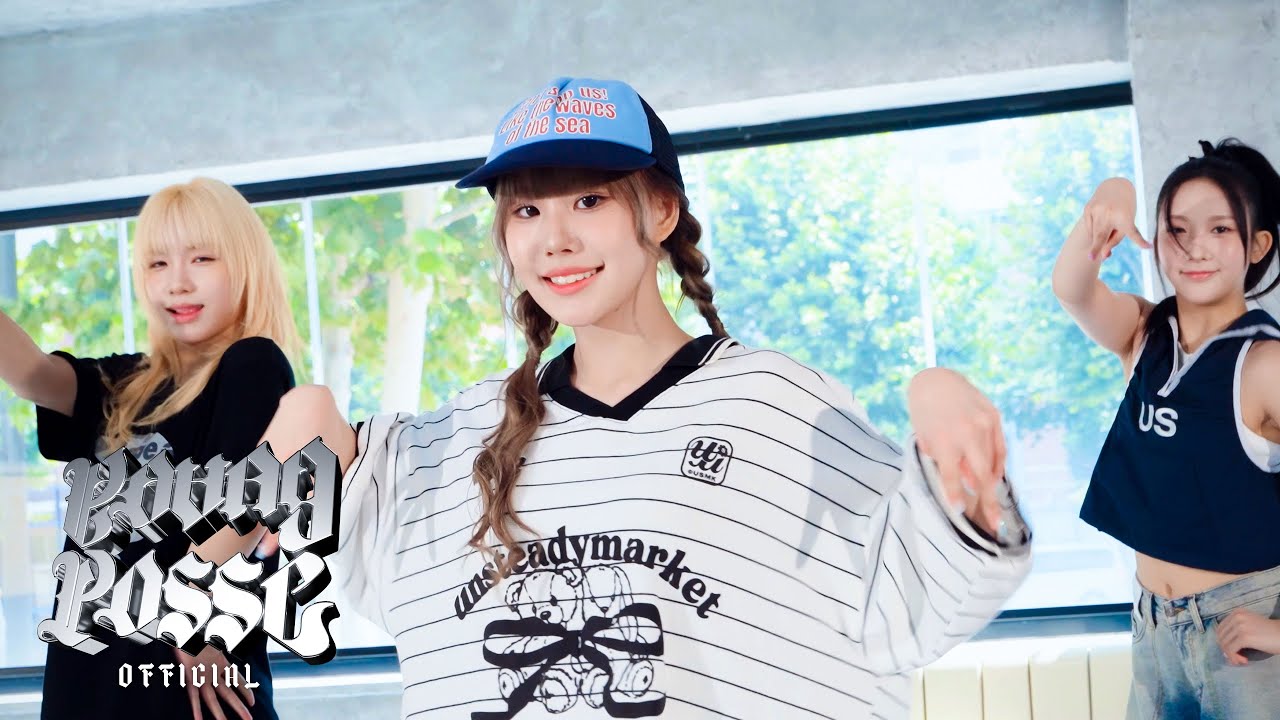
ATE THAT Moving Cam: YOUNG POSSE Let the Lens Join the Crew
The fixed practice proved the steps. The moving camera wants a plate too. YOUNG POSSE let the lens rush the cypher, duck between members and nearly get carried away by its own appetite.
Bottom line:
The moving-camera “ATE THAT” practice turns a clean five-member routine into a conversation between dancer and lens. Kiggen and Deevan’s G-funk bass gives the camera a reason to sway rather than sprint, while each rapper gets a push, retreat or lateral move shaped around her cadence. The best shots make personality feel rhythmic.
The lens sometimes gets greedy. It steals a formation transition for a face the fixed version already proved can hold attention. I still prefer this file for member expression and the fixed file for choreography architecture. Both deserve separate Reacts because they answer different questions.
What the whole thing means
The meaning is not complicated, and it does not need a graduate seminar stapled to it: five young rappers are claiming room, appetite and authorship. The moving-camera performance video matters because it proves that swagger lives in their timing before a game-world budget decorates it.
Release file
Released: August 26, 2024. This React is dated August 28 under the site’s one-to-three-day rule. Runtime: approximately 3:06. Exact upload: YouTube ID p4lq96Uaa3Q.
Label / channel trail: DSP Media and Beats Entertainment through YOUNG POSSE’s official channel. File: “ATE THAT” Dance Practice, Moving Cam version.
Performing lineup: Sunhye, Yeonjung, Jiana, Doeun and Jieun.
Song credits: Lyrics by Kiggen, Rick Bridges, Deevan, Sunhye, Yeonjung and Doeun. Composed by Kiggen, Deevan, Rick Bridges and Chanti of THE HUB. Arranged by Kiggen and Deevan. Deevan is credited for guitar, bass and drums; Kiggen for keyboards.
Sound: G-funk with elastic bass, West Coast synth whine, dry percussion, consecutive rap handoffs and a deliberately ridiculous chant hook.
Sources: The exact official moving-camera practice, Bugs EP record and DSP/Beats release trail are linked below.
The bass should operate the camera
Deevan’s low end stretches and rebounds like suspension. The most effective camera operator hears that physical quality and lets the frame float into a member, settle, then rebound toward the group. A straight rush would miss the song’s lazy confidence.
The synth whine lives higher, so small tilts and changing headroom give the track vertical energy. Camera movement is musical when direction and speed answer specific layers. Waving the lens around because “hip-hop is energetic” would be the cheaper version.
A cypher needs shared attention
“ATE THAT” behaves like a posse cut. One member claims the pocket, hands it to the next and remains part of the room. The camera respects that structure whenever it reveals the incoming rapper before leaving the outgoing one.
Those handoffs create anticipation. We see Yeonjung preparing while Sunhye finishes or catch Doeun already inside the joke before her line begins. The lens becomes part of the group’s timing instead of a machine that discovers each member only after she starts singing.
Sunhye makes a push-in feel earned
Sunhye’s cadence controls distance. She can hold a word behind the beat and make the camera’s approach feel like a response rather than an instruction. Her movement stays grounded, so the closer frame increases pressure without demanding larger gestures.
Her lyric credit matters because the punctuation belongs to her body as much as her voice. The camera knows where a phrase ends because Sunhye does.
Yeonjung gives the lens a curve
Yeonjung’s bounce works best with lateral movement. A slight arc catches her shoulders, feet and expression in one phrase. She does not need the lens to hit every accent for her; her own timing supplies the sharp edges.
She is also excellent at acknowledging another member without abandoning her own performance. The moving file catches those glances, turning five individual parts into crew chemistry.
Jiana cleans up a crowded frame
Jiana’s longer lines and brighter vocal tone create breathing room. The camera can pull back slightly when she takes a phrase because her shape remains clear at distance. That change prevents the video from becoming three minutes of faces at identical scale.
Her expression stays playful without explaining every joke. I appreciate a performer who trusts the lyric and lets one eyebrow do the work of an entire reaction shot.
Doeun knows when the joke is finished
Doeun plants each comic accent and leaves. The camera occasionally tries to linger, but she has already moved to the next musical job. That discipline keeps the “macaroni cheese” callback funny rather than desperate.
Her grounded movement also makes a close approach feel stable. Even while the operator travels, Doeun gives the viewer a strong center.
Jieun treats the lens like another member
Jieun is quick enough to catch a camera entering her space, play the moment and return to formation without turning the whole routine into a selfie. Her youth reads as speed and mischief, not hesitation.
She also keeps performing through exits. The lens may leave her, but her shoulders and feet continue the groove. That background honesty is easier to see when the camera unexpectedly crosses her side of the formation.
The hook becomes a five-person close-up
The chant works because the group shares ownership. Rather than giving every hook to one face, the moving camera travels across the collective shape and catches individual reactions inside it. Five women are eating the previous era together.
The strongest hook shot begins wide enough to establish the formation, closes during the punch line and retreats before the next verse. We understand the choreography and receive the personality. That sequence is the entire moving-cam assignment completed correctly.
When the lens steals the transition
A few close passes cover the feet exactly when center changes. The energy remains, but the evidence disappears. A performance file should not make us choose between charisma and construction every time.
The fixed practice shows that the members complete those routes cleanly, which makes the moving edit easier to forgive. This exact file would be stronger if it trusted the dance enough to show two more full transitions.
The GTA world was never the whole concept
Without cars, police, game interfaces or VFX, the members still carry the song’s swagger. That matters because the official MV could make “ATE THAT” look dependent on an expensive joke. The practice proves the performance idea survives in an ordinary room.
The members generate comedy through timing, shared glances and abrupt shifts in weight. Production design amplified those choices; production design did not invent them.
The cultural receipt does not vanish in practice clothes
G-funk, cypher structure, groove and West Coast hip-hop movement have Black American roots. Removing lowriders from the image does not turn the vocabulary culturally neutral. The bass and bodies still carry that lineage.
These performers were teenagers working through adult creative decisions. Sunhye, Yeonjung and Doeun have real lyric authorship, which gives them agency without making management irrelevant. DSP, Beats and the senior creative team remain responsible for education, credit and avoiding costume-level borrowing.
What I would change
I would give the second verse one uninterrupted wide phrase. The formation passes center beautifully, and the camera currently treats that work like packing material between close-ups. Let us see the handoff.
I would also reduce one exaggerated swing during the last hook. The bass already provides movement. A calmer retreat would make the members’ final group hit feel larger.
What changed every time I replayed it
First replay, Sunhye’s push-in felt like the obvious star shot. Second replay, Yeonjung’s curved path showed how camera direction can match groove. Third replay, Jiana’s wider framing became the reason the video could breathe.
Fourth replay, Doeun’s clean exits and Jieun’s lens awareness made the comedy more precise. Fifth replay, I ignored faces and watched what the camera hid. The file is fun because the operator joins the crew. The file is imperfect because the operator occasionally wants to lead it.
RaeRae verdict
Keep both practices. The fixed camera is the choreography receipt; this moving camera is the personality receipt. I replay this one for Sunhye controlling the push-in, Jieun catching the lens mid-flight and the moments when the operator remembers that joining the crew is not the same as becoming its sixth center.
The exact-file rule
This React covers YouTube ID p4lq96Uaa3Q, the official moving-camera “ATE THAT” dance practice released August 26, 2024. The official MV, fixed practice, album audio and other performance files retain separate tracker records. Attachment 28306 belongs only to this upload and serves as hero, featured image, landing card and social image.