
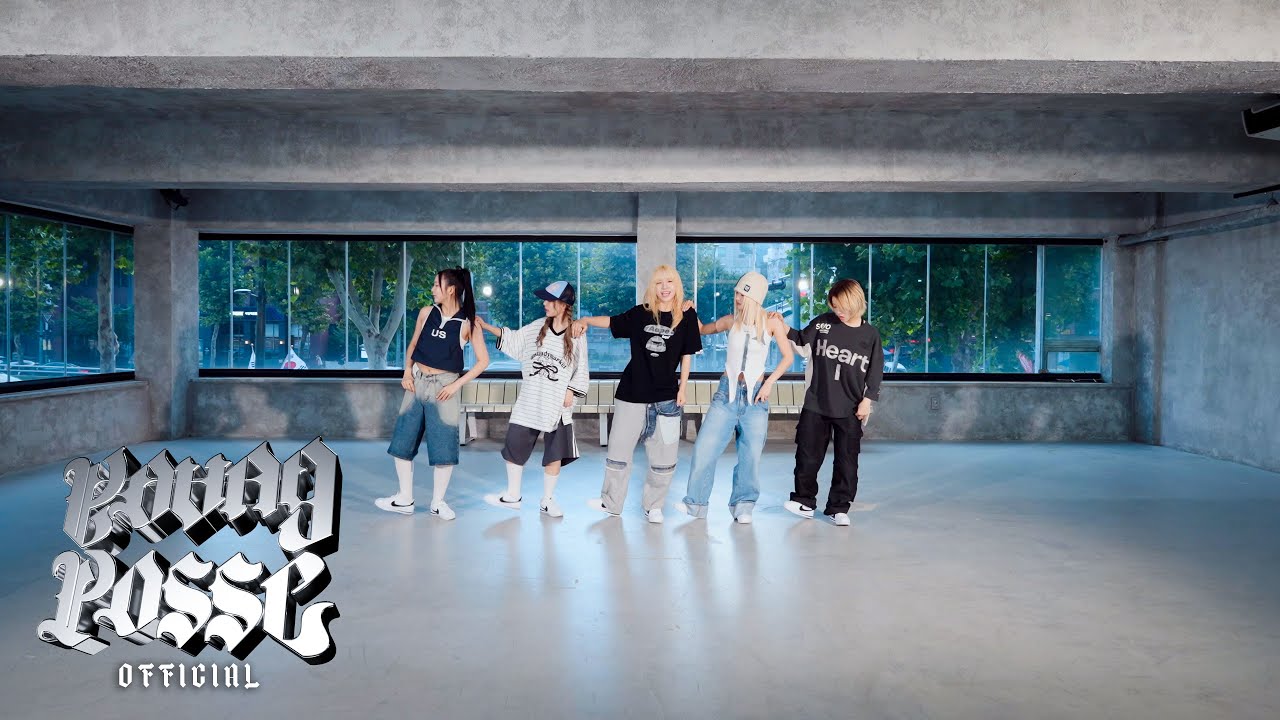
ATE THAT Fix Dance Practice: YOUNG POSSE Made Every Count Look Like a Punch Line
No getaway car, wanted level or effects team. Five women and one locked camera have to prove the joke still lands after the GTA world disappears.
Release file
Released: August 27, 2024
Runtime: 3:06
Artist / channel: YOUNG POSSE
Exact-file focus: The exact fixed-camera dance practice: five-member spacing, G-funk bounce, recovery, formation travel and choreography without the official MV’s GTA editing.
Bottom line:
The fixed “ATE THAT” dance practice proves YOUNG POSSE understand the song below the costume level. Their knees stay loose enough to carry the G-funk bounce, their upper bodies hit the jokes without becoming rigid, and their formations keep changing the person we should watch. The choreography does not imitate rap attitude by scowling at the mirror. It builds swagger through timing.
I prefer this file when I want to study the group. The official MV is funnier and more ambitious, but the locked frame catches every entrance, recovery and distance choice. It also exposes the one weakness the edit can disguise: a few transitions are busier than the musical idea underneath them.
Release file
Released: August 27, 2024. This React is dated August 29 under the site’s one-to-three-day rule. Runtime: 3:06. Exact upload: YouTube ID ZiBvfY1RZjw.
Label / channel trail: DSP Media and Beats Entertainment through YOUNG POSSE’s official channel. File: YOUNG POSSE “ATE THAT” Dance Practice, Fix Version. Performing lineup: Sunhye, Yeonjung, Jiana, Doeun and Jieun. The camera remains fixed so the complete formation stays visible.
Song credits: Lyrics by Kiggen, Rick Bridges, Deevan, Sunhye, Yeonjung and Doeun. Composed by Kiggen, Deevan, Rick Bridges and Chanti of THE HUB. Arranged by Kiggen and Deevan. Deevan is credited for guitar, bass and drums; Kiggen for keyboards.
Sound: G-funk bass, high West Coast synth color, dry drums, consecutive rap handoffs and a chant hook that turns the group’s earlier food references into a victory lap.
Sources: The exact official fixed-camera practice, the DSP/Beats release trail and the Bugs EP credit record are linked below.
The song tells their knees what to do
The bass line behaves like a car on hydraulics, dropping low and returning with a grin. YOUNG POSSE answer through bent knees, sinking hips and shoulders that arrive a fraction after the main count. That delayed weight is the groove. If they attacked every beat at the same volume, the choreography would look like an aerobics routine wearing baggy clothes.
The high synth whine gives their upper bodies a second job. Arms draw longer lines while feet keep the pocket close to the floor. I can see the arrangement in the bodies: bass below, whistle above, snare in the sharper head and elbow accents.
Fixed camera means nowhere to hide
A moving camera can turn a decent transition into an event. A cut can erase the two steps required to reach the next mark. This version offers no such mercy. When the center changes, we watch the outgoing member create space and the incoming member claim it.
That honesty makes the practice useful. The five-member shape stays legible even when the choreography breaks into individual gestures. Nobody vanishes behind a close-up, and the floor plan shows how much of the performance depends on diagonals rather than a permanent straight line.
Sunhye leads with rhythmic ownership
Sunhye moves like she wrote her lines because she did. Her lyric credit and rap phrasing meet in the same place: she presses into a count, lets the next one breathe and then snaps the punch line shut. Her dancing has the same internal punctuation.
She is strongest when the choreography gives her a grounded walk instead of decorative arm work. The confidence comes from knowing exactly how long she can delay before the group catches the next beat with her.
Yeonjung understands the bounce
Yeonjung does not chase power for its own sake. She lets the rhythm travel through her torso and uses smaller facial changes to underline the comedy. The result feels musical rather than aggressively performed.
Her transitions are especially clean. Watch her when another member takes center: she keeps dancing as part of the picture instead of switching off until the next personal line. That background discipline is why a five-person formation looks full.
Jiana gives the formation a bright edge
Jiana’s cleaner lines match the melodic lift in her vocal parts. She stretches shapes a little farther and makes the contrast readable without abandoning the shared groove. When the song needs air after several dense rap bars, her movement provides it too.
I also appreciate her restraint. The choreography already contains jokes. She does not circle every joke in red marker. A quick look and a sharp finish are enough.
Doeun makes the punch lines physical
Doeun attacks her accents as if each one ends a sentence. Her lyric participation matters here because the gestures feel attached to language, not pasted over a finished recording. She knows which word needs a shoulder, which needs a level change and which becomes funnier when she barely reacts.
Her lower center of gravity also steadies the group during the heavier chorus figures. She can hit hard without losing the elastic quality the bass requires.
Jieun keeps youth from becoming hesitation
Jieun brings speed, expression and a slightly lighter attack. The difference helps. Five dancers reproducing one identical texture would flatten the posse idea. Her energy makes the formation feel like five personalities agreeing on a mission.
She is also fearless about the silly details. A comic gesture only works if the performer refuses to apologize halfway through it. Jieun commits and moves on before the gag can ask for applause.
The hook is choreography with a smirk
“That macaroni cheese, I ate that” remains deliberately ridiculous. The dance does not try to make the line respectable. It uses broad, memorable shapes and group timing so the hook reads instantly, even without the MV’s giant game-world punch lines.
The smartest choice is the balance between unison and interruption. Everyone confirms the main groove, then one member adds a face, hand or directional accent that feels personal. The chorus stays recognizable without becoming a row of copies.
Formation changes carry the posse idea
The members trade center frequently because the song itself passes the microphone. Diagonals open a lane for the next rapper, tight clusters make the hook feel conspiratorial and wider spacing gives the bass room to look enormous. The floor plan follows the vocal distribution.
The best transitions happen when one member’s finishing gesture becomes another member’s entrance. Those exchanges feel like conversation. The weaker transitions add extra footwork after the musical thought has already landed. I can see the traffic management, which is precisely why the fixed file matters.
Borrowed style still has a history
The practice room removes the lowriders and GTA scenery, but the movement still speaks through Black American hip-hop foundations. Groove, bounce, party cyphers and West Coast musical language did not appear from a generic “street” mood board. The performance deserves to be enjoyed with that lineage named.
The members are young performers working inside choices made by choreographers, producers, stylists and management. Their skill is real. Adult creative leadership remains responsible for teaching where the vocabulary comes from and crediting more than the people inside the final K-pop production chain.
What I would change
I would simplify two of the center transfers and hold one low, bass-heavy formation for another four counts. The routine sometimes proves how many pictures it can make when the groove would benefit from staying put and letting us watch the members live inside it.
I also wanted a final chorus with fewer literal lyric gestures. The first appearance makes the joke clear. The last could trust the performers’ pocket and give us a harder, less explanatory finish.
What changed every time I replayed it
First replay, I watched Sunhye because her timing announces the group’s center of gravity. Second replay, Yeonjung’s transitions became the quiet reason the formation never looked empty. Third replay, I followed Jiana and noticed how often her longer lines clean up a crowded picture.
Fourth replay, Doeun’s accents revealed which gestures are tied directly to her written phrases. Fifth replay, Jieun made the silliest moments look inevitable. By the sixth, I was listening to the bass through their knees. That is the test a fixed practice should pass: the choreography makes me hear the record differently.
The exact-file rule
This React covers YouTube ID ZiBvfY1RZjw, the fixed-camera “ATE THAT” dance practice released August 27, 2024. The official MV, moving-camera version, album audio and other stage files retain separate tracker records. Attachment 28303 belongs only to this upload and serves as hero, featured image, landing card and social image.
Sources and official routes
Lyrics and meaning
The exact practice is not a lyric video, so meaning comes through how choreography frames the song’s appetite and criminal-comedy swagger. ATE THAT treats taking space as pleasure, not apology. The fixed camera proves that attitude was built into timing rather than pasted on by the MV edit.
RaeRae’s verdict
I prefer this file for studying YOUNG POSSE. The MV is funnier and bigger, but the practice exposes every distance choice and a few transitions busier than the musical idea. Most importantly, the swagger survives fluorescent honesty. That is the receipt.
RaeRae verdict
I prefer this file for studying YOUNG POSSE. The MV is funnier and bigger, but the practice exposes every distance choice and a few transitions busier than the musical idea. Most importantly, the swagger survives fluorescent honesty. That is the receipt.
Video and fixed-camera choreography
The video is deliberately plain: one locked practice-room frame, no getaway-car edit and nowhere for a weak transition to hide. That visual honesty makes spacing, recovery and formation travel part of the review rather than background decoration.