
hold still: Mark Tuan Made Betrayal Danceable
Official MV and performance-video deep dive · released August 15, 2025 · Silhouette
Mark Tuan took the sentence you say before a photograph, turned it into the warning given before somebody pulls a trigger, and put the emotional crime scene on a groove. The beat moves. The lyric bleeds. Mark dances through it like returning to performance cost less than therapy and came with better lighting.
Release File
Released: August 15, 2025
Runtime: 02:28
Label / channel trail: Mark Tuan
Sound: Mark Tuan took the sentence you say before a photograph, turned it into the warning given before somebody pulls a trigger, and put the emotional crime scene on a groove. The beat moves. The lyric bleeds. Mark dances through it like returning…
Sources:  Exact official playlist uploadDaily+2.1KTotal views5.7M.
Release context
Released: August 15, 2025
Runtime: 02:28
Label / channel trail: Mark Tuan
Sound: Mark Tuan took the sentence you say before a photograph, turned it into the warning given before somebody pulls a trigger, and put the emotional crime scene on a groove. The beat moves. The lyric bleeds. Mark dances through it like returning…
Sources: Exact official playlist uploadDaily+2.1KTotal views5.7M.
Quick verdict
I like “hold still” because the central metaphor is immediate, the production understands restraint and Mark looks comfortable reclaiming choreography without returning to somebody else’s version of him. I also want the missing bridge returned to its family. Two minutes and twenty-eight seconds is not a full emotional investigation. It is a very stylish witness statement.
The official file
Artist: Mark Tuan of GOT7
Released: August 15, 2025
Project: Pre-release single later included on Silhouette
Written by: Mark Tuan, Jack Omstead and Nick Vyner
Produced by: Jack Omstead
Music video: Mark Tuan and Will Chan; DNA and Radiance Pictures
Performance choreography: Hugh Aparente
My actual first reaction
First thought: This is far too smooth for a song where somebody has apparently been emotionally shot. Mark sounds calm. The bass is walking around like it did not just enter a crime scene.
The moment I leaned in: the title flips. “Hold still” sounds gentle until the lyric reveals why the other person wanted him motionless. Oh. So we are doing betrayal with ballistics today.
The side-eye: the track ends just as the metaphor has room to become a story. I wanted another verse, a bridge and perhaps the name of a lawyer.
Current status: replayed. Also mildly offended that heartbreak received better choreography than most healthy relationships.
Song first: the person he trusted already had the weapon
The strongest choice happens before the video explains anything. The title begins as stillness, patience or a relationship frozen in time. Then Mark says the other person should have warned him to hold still while taking aim. A soft request becomes a threat without changing a word.
The metaphor is not subtle. He would have taken a bullet for this person and discovers they are the one pulling the trigger. Subtlety is lovely, but sometimes a breakup deserves a giant red arrow. Mark commits to the image through aim, impact, blood and the shock of recognizing who caused the wound.
The emotional center is disbelief rather than rage. He keeps returning to what he would have done for them. Rage says the other person is terrible. Disbelief says your own understanding of the relationship has become unreliable. You grieve the person and your judgment at the same time. Excellent. Two problems for the price of one.
Korea JoongAng Daily framed the song around breakup, love and timing. Timing lives inside the title. If the narrator had been warned, he could have braced. He was not. The betrayal arrives before body or heart can prepare, and the song keeps replaying the instant when trust changes category.
The gun metaphor works—and then reaches its limit
Aim, trigger, bullet, blood and wound all belong to one coherent emotional event. The line about tasting blood on the person’s name works because memory becomes physical injury; even speaking about them leaves something metallic in the mouth. The two-in-the-morning detail adds the less glamorous reality. Emotional clarity rarely books a respectful afternoon appointment.
Mark also refuses to rewrite himself as too clever to be hurt. He admits he would have taken the shot for the person. Loyalty looks foolish in retrospect, but the song does not turn him into a cooler narrator after the breakup. He loved hard. They aimed anyway.
The missing bridge is where the metaphor could have developed or broken. Does he leave? Does the shooter apologize? Does he learn that loving someone is not permission to volunteer as a target? One detail outside the weapon language could have made the emotional world larger. The song sharpens one idea beautifully and exits before consequence arrives.
The groove is doing something emotionally suspicious
Jack Omstead’s production refuses to behave like the lyric. A heavier arrangement could have turned the record into a rock lament with thunder in the hallway. Instead, the rhythm moves with a controlled bounce. Heartbreak becomes danceable without becoming cheerful. That contradiction is the main replay engine.
The bass and percussion supply forward motion while the narrator remains stuck at impact. Bandwagon described the feeling of being left in place while the world moves on. The production makes that split audible: the body can keep a beat long before the mind agrees to continue living normally.
Mark’s voice stays in a comfortable range. He does not force a giant vocal climax to prove the injury matters. The delivery remains almost conversational, which fits the shock. Repetition and rhythm add weight instead of volume. He sounds like somebody explaining the same impossible fact until language finally accepts it.
The chorus earns the title reveal
The hook is built for instant understanding. “Hold still” lands clearly, the melodic shape leaves room around Mark’s tone, and the rhythm makes the phrase bodily before the full threat registers. On the first pass, it is catchy. On the second, it is an instruction from the person causing harm. Catchy became rude.
A weaker song would repeat the line until the metaphor turned into wallpaper. Here, blood and bullet imagery keep tightening the frame. The compact runtime also prevents the hook from exhausting itself, although that is the same efficiency currently wanted for questioning about the missing bridge.
The music video: performance without the old cage
Mark and Will Chan are credited on the music video, produced through DNA and Radiance Pictures. The visual places Mark inside the polished, performance-centered language longtime GOT7 fans recognize. The difference is authorship. He is not waiting for a company to decide whether the quiet rapper receives a full scene.
The camera treats him as the emotional subject. Styling, movement and controlled spaces keep focus on his face and body rather than building a literal girlfriend-with-prop-gun plot. Thank you. The lyric has supplied enough ammunition. Nobody needed to chase him through a warehouse in slow motion.
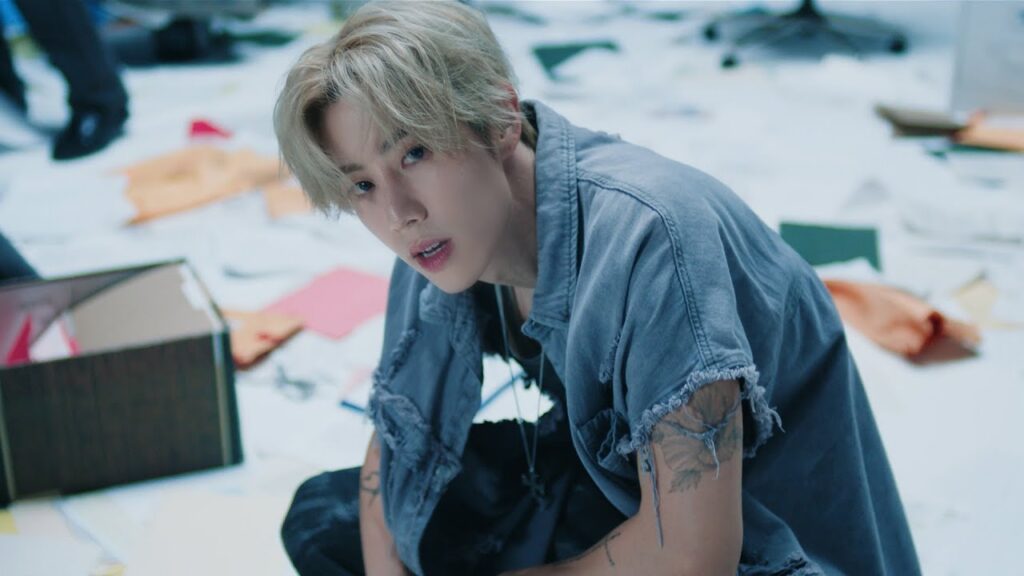
Paper, open books and scattered material create an environment that looks like memory has been pulled apart for evidence. Mark crouches inside the mess, moves through tight frames and keeps returning to direct eye contact. The setting gives betrayal a physical aftermath without staging the trigger itself.
The cool blue and grey palette matters. It keeps the visual from romanticizing the wound with lush red melodrama. His blond hair and skin remain the brightest points, which makes the person—not the metaphorical weapon—the visual center. The production knows exactly where the eye should land.
Choreography as emotional processing
The original MV uses movement as part of the story, and the later official performance video makes the 2025 direction even clearer. Hugh Aparente’s choreography does not pretend the narrator has recovered. It gives the body a way to carry feelings already named in the lyric.
Mark told Forbes that something felt empty after touring and that Silhouette moved closer to his K-pop roots. “hold still” is part of that correction. Returning to choreography does not erase The Other Side or Fallin’. It adds back a language he trained in for years.
Independence does not require rejecting every useful skill the idol system taught him. Mark can write an English-language breakup song, help direct the visual and still rely on the physical precision built through GOT7. The key difference is choice: no flip over six members, no four-second rap followed by a disappearing camera. The movement breathes around his timing.
The GOT7 connection without forcing a reunion story
Mark’s group history matters because it explains the camera knowledge, discipline and performance vocabulary. It does not mean every solo song needs seven-member speculation. “hold still” is a Mark Tuan record, connected to GOT7 through the same human rather than a hidden group comeback clue.
The solo growth can still change how the group is heard. Mark’s restraint makes more sense after listeners spend time with records designed around it. When GOT7 returns, his individual catalog becomes added vocabulary: he can bring the controlled delivery and self-directed confidence back without losing the ensemble chemistry.
The fair counterargument
A listener can reasonably call the metaphor overextended, the runtime underdeveloped or the production too polished for the injury in the lyric. The track does not offer a major harmonic turn, a vocal eruption or narrative aftermath. If you need breakup songs to sit in the damage longer, this one may leave before the paramedics arrive.
My answer is not that brevity automatically equals sophistication. It is that Mark’s delivery and the moving beat create a tension worth replaying. The song knows the wound is not healed simply because the body can dance. That emotional dishonesty would ruin it; the record avoids it.
What changed every time I replayed it
First play: the title trick and bass carried everything. I registered betrayal, groove and the immediate annoyance that the track had already ended.
Second play: the disbelief became more important than the weapon. Mark keeps returning to what he would have sacrificed, which turns the song from a generic accusation into grief over his own mistaken trust.
Third play: the production’s emotional split became the point. Percussion moves forward; the narrator remains at the shot. The song is danceable because the world does not pause respectfully while somebody processes a breakup.
Video replay: the scattered paper and controlled close-ups stopped looking like styling alone. They create an evidence room with Mark trapped inside the case file, while choreography gives him the only clean route through it.
Performance-video replay: the return to K-pop movement read less like nostalgia and more like ownership. He kept the technique and changed who gets to decide what it means.
Replay verdict
Keep it in rotation. “hold still” has one excellent title turn, a persuasive groove and a performer visibly reclaiming a part of himself. It is too short, but the shortness makes me replay it instead of forgiving it. Modern streaming strategy wins this round. I remain unhappy about the bridge.
Keep going
Use the Mark Tuan canonical profile for his GOT7 history, solo evolution, official-video tracker and the connected “Alone” React. The GOT7 hub holds the seven-member story without pretending every solo release is group content.
The larger meaning: the title is also about control
“Hold still” is not only a violent instruction. It is an instruction that removes movement from the target while preserving freedom for the person taking aim. One person controls timing, distance and consequence; the other is expected to cooperate with the conditions of their own injury. That imbalance is what makes the phrase colder after the reveal.
The narrator’s complaint is therefore larger than “you hurt me.” He discovers the relationship’s rules were unequal. He thought sacrifice was mutual and learns that his willingness to protect the other person made him easier to position. The metaphor works because trust itself becomes the mechanism that keeps him from moving.
Mark’s restrained delivery strengthens that reading. A shouted accusation would reclaim control immediately. The conversational vocal sounds like the unequal rules are still being processed. He is naming what happened, but he has not yet reached the part where naming becomes escape.
Editing and camera rhythm follow the beat
The video’s cuts do not fight the song with random speed. Wider frames establish the paper-strewn environment, medium shots keep choreography readable and close-ups arrive when the lyric needs the emotional consequence to register. The editing makes the groove visible without turning every percussion hit into a nervous jump cut.
That discipline is especially important with a short song. The video has fewer than three minutes to introduce the visual space, establish Mark as the sole emotional subject, deliver choreography and leave one coherent afterimage. It succeeds because it repeats visual ideas instead of introducing a new expensive room every twelve seconds.
The repeated return to Mark on the floor matters too. Vertical power has been removed; he is surrounded by the aftermath and has to build movement from a lowered position. When choreography opens the frame later, the change feels like agency arriving through the body even though the lyric never claims the relationship is repaired.
Costume and body language do quieter storytelling
The distressed denim and exposed tattoos keep the styling tactile and imperfect. Nothing about the look says polished heartbreak prince waiting beside a luxury car. Frayed edges, loose layers and the cool palette belong to a person whose emotional environment has already been torn open.
Mark’s body language switches between direct challenge and guarded collapse. He can look into the lens as if addressing the person who caused the wound, then fold back into the set as though the confidence cost more than it appeared to. The contrast prevents the performance from becoming one continuous “cool” face.
Why a fandom reading should stop before private speculation
Ahgase can connect “hold still” to Mark’s longer solo evolution, his return to dance and familiar visual motifs. That context is useful because it compares public work with public work. It becomes less useful when viewers assign the shooter to a rumored partner or treat co-written lyrics as an encrypted confession about one private person.
The song does not need a solved gossip target to matter. Betrayal, unequal sacrifice and delayed recognition are legible without identifying a defendant. Keeping the analysis on the craft protects Mark’s privacy and makes the emotional reading more universal rather than less specific.
How it sits beside “High As You” and “Alone”
The Silhouette period makes more sense as a set of performance choices than as one fixed mood. “High As You” restores confident physicality. “hold still” uses that physicality to process betrayal. “Alone” places isolation inside brighter house-pop motion. Together, the songs test whether Mark can bring dance back without losing the interior voice developed on earlier solo projects.
He can. The common element is not genre; it is control over how movement and vulnerability share the frame. “hold still” may be the cleanest bridge because the lyric describes emotional paralysis while the performance refuses literal stillness. The contradiction contains the whole solo direction in one title.
Receipts
The seven current GOT7 profiles
- GOT7 group profile
- JAY B profile
- Mark Tuan profile
- Jackson Wang profile
- Jinyoung profile
- Youngjae profile
- BamBam profile
- Yugyeom profile
RaeRae verdict
Mark Tuan’s hold still pairs a breakup gun metaphor with a clean groove and self-directed choreography. Full MV and performance-video React.
Bottom line
“hold still” turns betrayal into movement without pretending choreography can solve it. Mark’s controlled delivery, the loaded visual metaphor and the groove pulling against the lyric make this one of those breakup records that gets sharper after the first replay.