
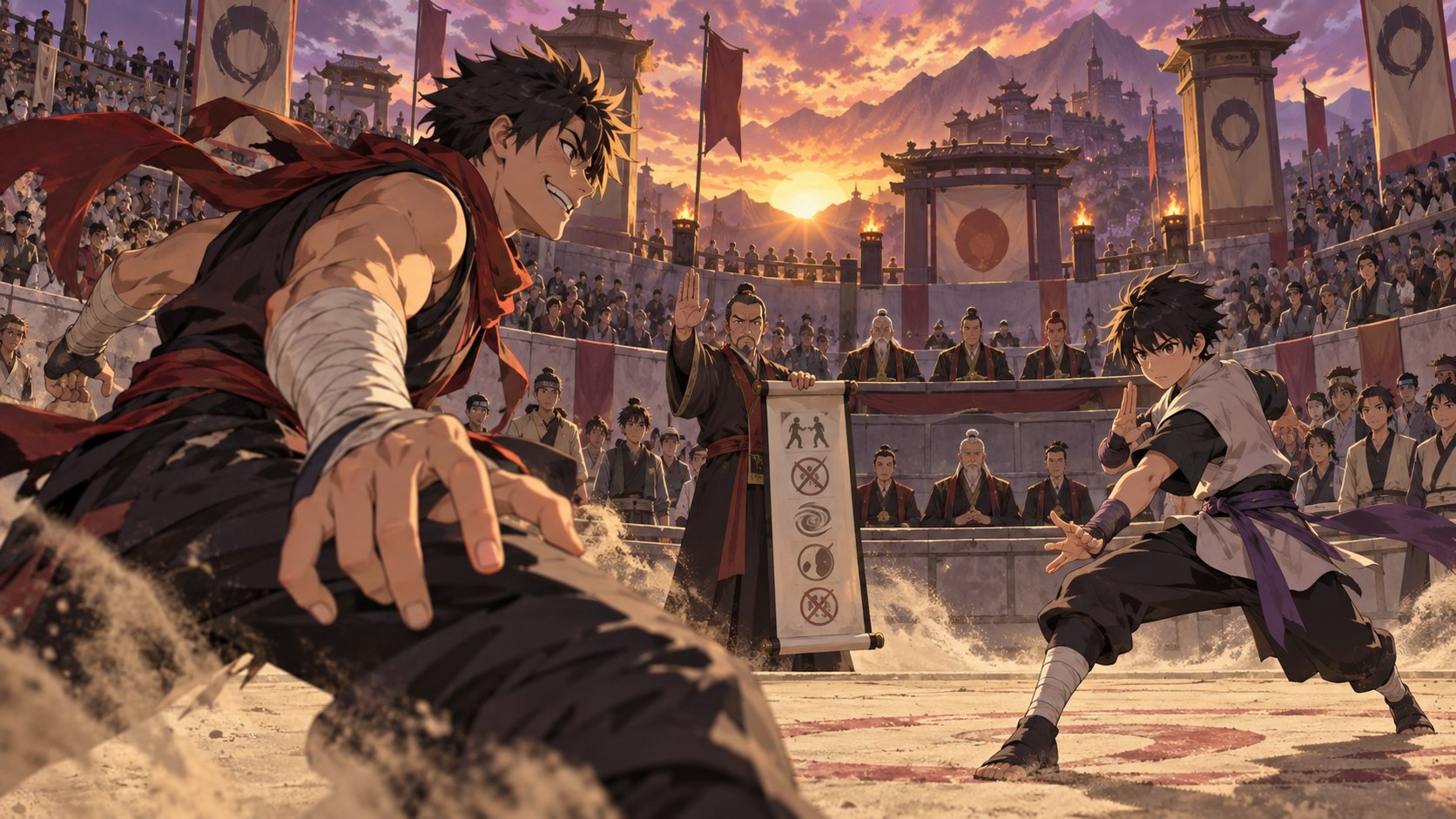
Excerpt: Naruto vs. Konohamaru! turns an older-brother rivalry into an institutional test where strength matters—and Naruto’s lifelong inability to respect a rule at the correct moment matters more.
Focus keyword: Naruto vs Konohamaru review
SEO title: Naruto vs. Konohamaru Review | CVM Sekai
Meta description: Our Chūnin Exam on Fire! Naruto vs. Konohamaru review explores their rivalry, promotion rules, hero worship, institutional growth, and licensed-short status.
Konohamaru Does Not Want Naruto’s Approval. He Wants the Win.
Konohamaru once followed Naruto because Naruto was the first person reckless enough to treat the Hokage’s grandson like a child with his own ambition instead of an extension of a famous name.
By the time of Chūnin Exam on Fire! Naruto vs. Konohamaru!, admiration is no longer enough.
Konohamaru enters the Chūnin Exams and finds Naruto standing across the arena as his opponent. The relationship immediately changes shape. This is not training in a quiet field. It is not a comedy challenge with no record. The institution is watching, promotion is at stake, and Konohamaru wants recognition delivered through a fair result.
He does not want Naruto to go easy on him.
That desire gives the short more emotional weight than a bonus fight needs. Hero worship is safe when the hero remains distant. Competition asks whether the admired person can accept you as a peer-in-progress, somebody allowed to threaten the hierarchy that once gave the relationship meaning.
Naruto understands the hunger to be acknowledged better than anyone.
He is also Naruto, which means understanding the emotional stakes does not guarantee he will remember the exam rules at the moment they matter.
The joke and the lesson arrive together: strength can win a battle while conduct loses the test.
Konohamaru Has Spent His Life Under Somebody Else’s Title
Before Naruto became the village hero, Konohamaru knew what it meant to be seen through a relationship to the Hokage.
Adults deferred to him, protected him, and limited him because he was Hiruzen’s grandson. Respect reached the title before it reached the child. Konohamaru’s dream of becoming Hokage was therefore not simple imitation. It was an attempt to own the office as himself instead of borrowing status from family.
Naruto recognized that frustration because the village also looked at him and saw somebody else’s story—the Nine-Tails rather than the boy.
Their early bond formed through rebellion against inherited definitions.
The exam short shows the consequence of that mentorship. Konohamaru no longer needs to chase Naruto around demanding instruction. He has trained, developed techniques, joined a team, and entered the same institutional ladder Naruto once climbed.
Facing Naruto becomes proof that admiration produced aspiration rather than permanent dependence.
The student’s goal is not to remain the hero’s favorite. It is to become capable of defeating him under rules both agreed to enter.
That is healthy growth, even if Naruto experiences it as a personal challenge.
Naruto’s Strength Has Outgrown His Rank
The short plays with a long-running absurdity: Naruto has achieved extraordinary battlefield power while remaining officially a genin for much of the franchise.
Rank and capability have separated completely.
The Chūnin Exams are meant to evaluate judgment, leadership, tactical discipline, and readiness for greater responsibility—not only destructive capacity. Naruto can overpower most candidates, but the institution is measuring behavior inside constraints.
That distinction creates the short’s central comedy.
Naruto approaches the match with the instincts of somebody who has saved nations. Konohamaru approaches it as the most important formal test of his current career. The same arena means different things to them.
Naruto’s rank no longer accurately describes his practical role, which can make the rules feel ridiculous. Yet formal tests require participants to accept a shared structure. If Naruto enters, he cannot decide that personal power exempts him from the conditions.
The short therefore avoids a simplistic claim that bureaucracy is always wiser than the hero. The institution is imperfect, but Naruto’s inability to respect limits remains relevant to leadership.
A chūnin may need to complete a mission without using the most emotionally satisfying technique available.
The Forbidden Technique Rule Is the Entire Point
Naruto’s use of Sage Mode becomes the decisive violation. Whether viewers find the specific restriction reasonable is less important than the fact that the rule was established for the exam.
He forgets or ignores it in the heat of competition.
That failure is pure Naruto. Excitement narrows his attention. Konohamaru’s challenge activates pride and affection at once. Naruto wants to honor him with full effort, prove his own strength, and win cleanly by the standards inside his head.
The institution has another standard.
Disqualification feels comic because Naruto’s power has become irrelevant to the recorded result. He can dominate physically and still lose officially.
This is not merely bureaucracy humiliating a hero. It demonstrates why leadership requires contextual judgment. Power is useful only when applied within the actual objective. If the objective is “win without this technique,” then using the technique is failure no matter how impressive the impact.
Konohamaru receives the victory, but not as charity. He remained inside the rules Naruto failed to hold.
The result is funny, frustrating, and fair enough to sting.
A Real Rival Is Allowed to Benefit from Your Mistake
Naruto could dismiss Konohamaru’s win as technicality. The emotional test is whether he respects the result.
Rivalry becomes mature when both participants accept that the other person does not owe protection to pride. Konohamaru does not need to apologize because Naruto violated a rule. He is allowed to advance through the consequence.
That matters for their relationship.
Older-brother figures often preserve hierarchy by turning every loss into a lesson they intended to give. If Naruto claimed moral victory, laughed away the official result, or treated Konohamaru’s advancement as a gift, he would reduce the younger shinobi back into a child.
The short’s comedy protects against excessive solemnity, but the structure remains clear: Konohamaru entered the institution on his own terms and received a recorded outcome.
Naruto’s pride has to survive somebody he mentored moving forward partly because Naruto failed.
That is closer to genuine mentorship than permanent superiority.
The Chūnin Exams Have Always Been About More Than Combat
The original Chūnin Exams exposed the gap between stated institutional purpose and political reality. Children fought while villages measured military strength. Orochimaru invaded. The arena became a battlefield before the exam could complete its normal function.
This short returns the format to smaller stakes.
Candidates can compete, officials can enforce rules, and a match can end through disqualification rather than death or invasion. That normalcy is a sign of relative peace.
It also lets the promotion system perform the purpose it claims: evaluate conduct under pressure.
Naruto’s original exam experience taught him to break through fear and social judgment. Konohamaru’s test teaches something different. The next generation inherits a village where procedural discipline can matter because survival is not the only outcome.
That change should be celebrated, even when it makes Naruto look ridiculous.
Peace creates room for rules to be boring again.
Konohamaru’s Techniques Carry Naruto’s Influence Without Copying His Life
Konohamaru has learned from Naruto, including techniques associated with him. The resemblance makes their fight emotionally legible, but it also risks defining the younger character as a miniature replacement.
The short avoids that problem by centering Konohamaru’s goal rather than technique inventory.
He is not trying to reproduce Naruto’s childhood. He wants promotion within his own team and generation. Naruto’s influence becomes part of his training history, not a destiny that eliminates difference.
This is how inheritance should work inside the franchise. Teachers pass tools, stubbornness, and belief forward. Students decide where those things go.
Konohamaru’s victory through Naruto’s procedural mistake is almost too perfect. He inherits the courage to challenge Naruto and benefits because he handles the exam context more successfully.
The student has learned something the teacher still struggles to practice.
The Short Understands Its Scale
Like Grand Sports Festival, this bonus animation knows it is not a feature film or missing arc. The premise is compact, the relationship is already established, and the result lands quickly.
The match supplies enough action to justify the title without pretending the village’s future depends on it. Spectators and officials keep the conflict inside an institutional frame.
The animation prioritizes readable exchanges and comic escalation. Naruto and Konohamaru’s familiarity gives every attack a second meaning: competition, affection, and irritation coexist.
The short would become weaker if extended into a multi-episode tournament. Its value lies in clarity. Two characters meet at a new stage of a long relationship, and one rule reveals how both have changed.
Bonus animation works best when it uses existing investment rather than attempting to manufacture epic importance.
This one does.
Japanese Cast and Performance Notes
Junko Takeuchi gives Naruto competitive excitement that remains affectionate. He is not trying to humiliate Konohamaru. His failure comes from taking the challenge seriously in the most Naruto way possible: too much power, not enough procedural attention.
Ikue Ōtani gives Konohamaru determination without removing the younger character’s familiar energy. The performance communicates that this match matters differently now. He still admires Naruto, but the admiration no longer asks permission to compete.
Officials and spectators establish the formal atmosphere necessary for the final disqualification to land. Without institutional seriousness, the ending would feel arbitrary. The cast makes the rule part of the environment before it becomes the punchline.
Where It Fits—and What It Is
Watch the short during Naruto Shippuden, after Konohamaru has grown into a working shinobi and after viewers understand Sage Mode. It plays best before the war eliminates room for ordinary promotion stories.
VIZ verifies the short as a special feature on the licensed Blood Prison release. It is a movie-bonus animation, not a numbered television episode.
Treat its continuity as optional character comedy. The result fits the characters, but viewers do not need to force the exact exam into the manga timeline.
Final Verdict
Chūnin Exam on Fire! Naruto vs. Konohamaru! is a sharp little relationship update disguised as a tournament gag.
Konohamaru no longer wants symbolic recognition from Naruto. He wants to face him under shared rules and receive the result without being protected by affection. Naruto honors the challenge by taking it seriously—then proves why raw power and institutional judgment are not identical.
The disqualification is not a cheap joke pasted onto the fight. It is the theme.
Naruto can be stronger and still fail the test. Konohamaru can admire him and still accept the win. A student can carry a teacher’s influence without remaining beneath him forever.
The future Hokage once built his identity by rejecting rules that denied his worth.
Leadership also requires knowing when a rule is the assignment.
Rating: 8/10 — A compact, funny, and genuinely meaningful rivalry short that lets Konohamaru outgrow hero worship while Naruto loses to context rather than power.