
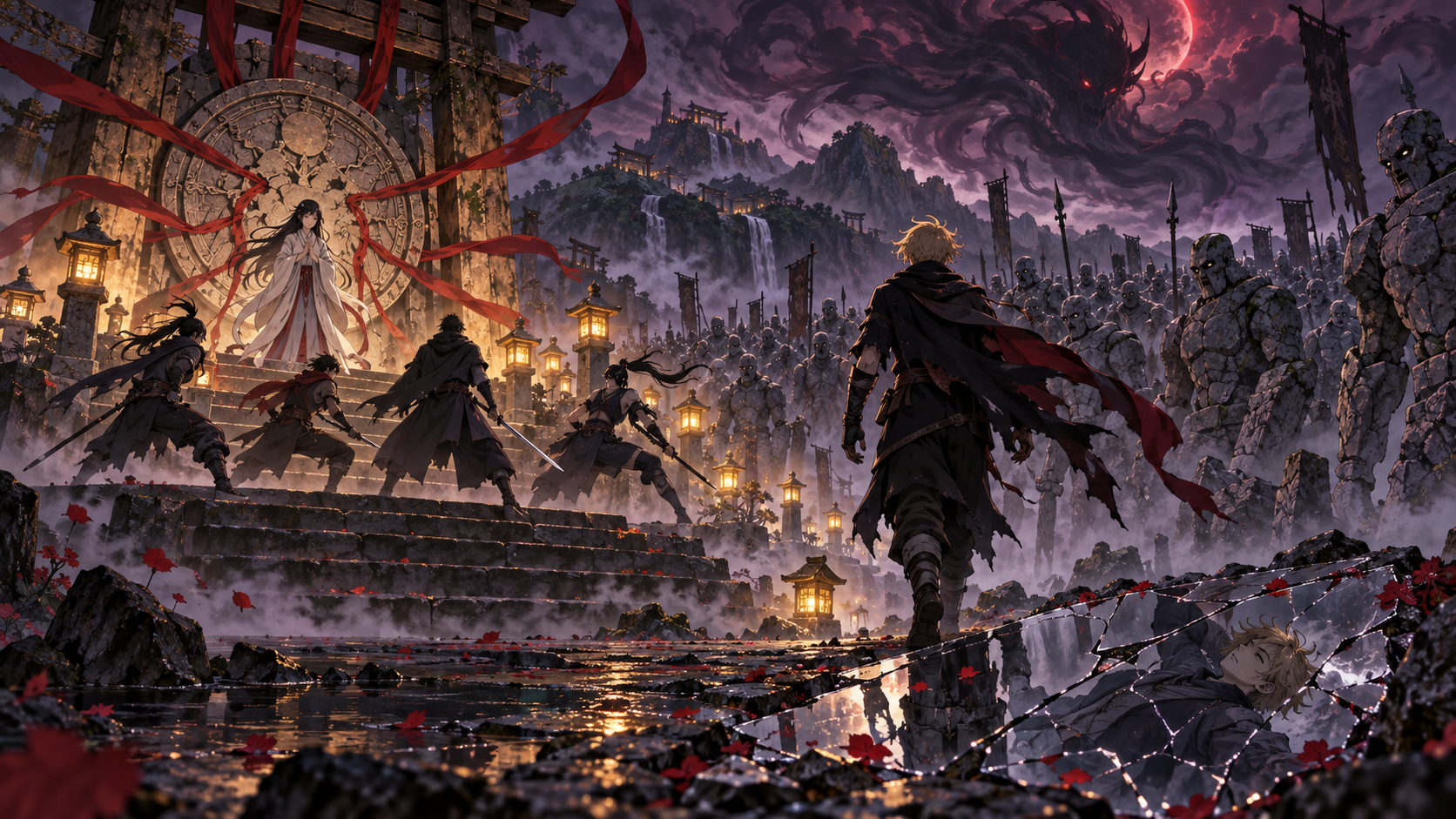
Excerpt: Naruto Shippuden the Movie opens with Naruto’s funeral, then asks whether prophecy describes a future or merely dares frightened people to stop choosing.
Focus keyword: Naruto Shippuden the Movie review
SEO title: Naruto Shippuden the Movie Review | CVM Sekai
Meta description: Our Naruto Shippuden the Movie review examines Shion, Naruto’s foretold death, Mōryō, fate, isolation, and the difference between prophecy and choice.
Naruto Sees His Own Funeral—and Naturally Takes It Personally
The first Naruto Shippuden movie opens by doing what a weekly series could never convincingly do: it kills Naruto Uzumaki.
We see the funeral. We see Sakura crying. We see Kakashi, Lee, and the village carrying the weight of a future in which the boy who promised to become Hokage has already become a memory. Then the film steps backward and tells us that priestess Shion saw it coming.
Naruto’s response is beautifully predictable. He does not become cautious. He becomes offended.
That reaction is why this movie works better than its familiar demon-sealing plot suggests. Shion has survived by treating the future as fixed. Naruto has survived by treating every fixed judgment as an insult. The village said he was a monster. The academy said he was a failure. Neji said destiny had already sorted winners from losers. Sasuke’s departure said some bonds could not be repaired. Naruto’s entire life is one long argument with conclusions delivered before he was allowed to speak.
So when Shion tells him that he will die protecting her, he does not hear wisdom. He hears another person surrendering to a sentence.
The movie is uneven, occasionally overstuffed, and not nearly as interested in its stone army as its action scenes assume we are. But the emotional opposition is clean: prophecy may describe danger; it does not own the choices made inside it.
Shion Is Not Hinata with a Different Job
Shion is introduced as cold, imperious, and isolated behind ritual authority. She speaks to attendants as if affection were an administrative problem. People protect her because the world needs her power, not because they know how to reach her.
That distinction matters. Naruto movies have a habit of introducing a lonely guest character whose pain mirrors Naruto’s, but Shion is not simply another version of him. Naruto’s isolation made him perform. He became louder because attention—even angry attention—proved he existed. Shion responds by withdrawing behind ceremony. She lets the office swallow the person because the person is the part that can be hurt.
Her visions reinforce that withdrawal. If death is inevitable, attachment becomes cruelty. Why let somebody matter when the future has already shown you the body?
The film gives Shion a difficult balance. She must seem unpleasant without becoming unsympathetic, frightened without losing authority, and young without reducing the priestess role to costume. Her sharpness makes sense once we understand it as defensive labor. Everyone around her needs a sacred function. Very few ask what it costs the girl performing it.
Naruto, of course, is catastrophically incapable of respecting emotional distance. That makes him exactly the wrong bodyguard and the right person to interrupt her fatalism.
Prophecy Is Power, but It Is Also a Prison
Shion’s visions do not function like casual prediction. They arrive with the authority of experience. She has seen deaths happen after warning people. She has learned that knowledge does not equal control, and repeated helplessness has hardened into doctrine.
This is where the movie’s argument becomes more interesting than “believe in yourself.” Shion’s fatalism is not intellectual laziness. It is trauma building a system around itself. If every loss was unavoidable, then she did not fail to prevent it. If the future cannot change, she never has to confront whether fear altered the choices she made before it arrived.
Naruto cannot disprove prophecy through debate. He disproves the emotional use of prophecy by refusing to behave like a dead man.
He still eats, argues, boasts, protects, and annoys everyone within range. He treats the vision as information about danger, not a command to stop living. That difference pulls Shion back toward participation. The future may contain death. The present still contains decisions.
The movie does not solve the philosophical problem neatly, and I am glad. Naruto’s refusal is not a scientific explanation of how visions work. It is an ethical position: knowing an outcome does not release you from choosing what kind of person meets it.
Mōryō Is Less Interesting Than the Fear Around Him
Mōryō is an ancient demonic force whose spirit and body must be reunited for his full return. Yomi, the human antagonist, uses dark medical ninjutsu and disposable bodies to move the plan forward while an army of stone warriors advances with the patience of a natural disaster.
On paper, the threat is enormous. In practice, Mōryō is more atmosphere than personality. The movie gains scale from him but not much moral complexity. He exists to make Shion’s ritual role necessary and Naruto’s foretold sacrifice plausible.
That is not fatal to the story because the real antagonist is the emotional system built around inevitability. Mōryō says destruction will happen. Shion’s upbringing says loss must be accepted in advance. The attendants and guards behave as if their own lives are pieces already assigned to the ritual.
Naruto disrupts that system simply by refusing its tone.
The stone army works best visually. Endless identical bodies advancing through mountain passes make the danger feel institutional rather than personal. You cannot reason with an army that has no individual fear, grief, or desire. The heroes have to create space for Shion to perform the one act only she can perform.
The story would be stronger if Yomi carried more ideological weight. He is functional, theatrical, and ultimately less memorable than the priestess he threatens.
The Escort Team Gives Everyone a Job
Naruto travels with Sakura, Neji, and Rock Lee while Kakashi and other shinobi respond to the larger military threat. This is a strong early-Shippuden lineup because each teammate represents a different relationship to fate.
Neji is the obvious one. His entire Chūnin Exam conflict with Naruto revolved around predetermined limits. By this point, he has changed, but the movie leaves some thematic power unused by not giving him more direct material with Shion. A Hyūga prodigy who once used destiny to explain his own cage should have more to say to a priestess using prophecy to explain hers.
Even so, his calm command and strategic awareness stabilize the escort. Neji has learned that discipline does not require surrender.
Rock Lee remains the franchise’s most joyful rejection of inherited limitation. He cannot use ninjutsu or genjutsu, so he trained until the categories meant to exclude him became irrelevant to his value. Putting Lee in a story about fixed futures is almost unfair. His body is a walking counterargument.
Sakura’s medical skill and strength let her operate as more than emotional support. She understands the physical stakes of the mission and can protect without waiting for Naruto to define what protection means. The movie still centers him, but this is recognizably Shippuden Sakura: trained, useful, and capable of changing the battlefield.
The group feels selected rather than assembled from whoever was available.
Naruto and Shion’s Chemistry Is an Argument, Not a Romance
The movie teases enough flirtation to feed fandom discussions, especially in its final joke, but Naruto and Shion work because they irritate each other into honesty.
Naruto hates her condescension. Shion hates his refusal to take ritual certainty seriously. He treats her as a person when everyone else treats her as an office, and that attention is not always gentle. Sometimes recognition feels rude when invisibility has become protective.
Their connection does not need to become a lasting romance to matter. Shion meets somebody who hears “you will die” and answers by increasing his commitment to living. Naruto meets somebody whose loneliness does not look like his own and has to learn that shouting hope is not the same as making it safe to believe.
The best scenes allow both truths to exist. Naruto’s conviction is powerful. It is also exhausting. Shion’s fear is limiting. It is also earned.
The film does not ask her to become cheerful in order to become worthy of rescue. It asks her to choose participation over pre-emptive mourning.
The Action Is Built for a Theater, Sometimes Too Obviously
The movie wants scale: mountain temples, ritual chambers, armies, large formations, demonic energy, and a climax that turns spiritual duty into explosive combat. Much of it looks good. The stone soldiers give the supporting shinobi something substantial to fight, and the environments feel larger than ordinary episode locations.
The problem is rhythm. Repeated clashes with the army can make the middle feel like a delay before the real emotional confrontation. The threat expands outward while the story’s strongest material is inward, between Shion’s certainty and Naruto’s refusal.
The final act improves when those lines reconnect. Naruto’s power matters because it becomes the physical form of a choice Shion had stopped believing she possessed. Shion’s sealing power matters because Naruto cannot simply punch a sacred responsibility out of existence. They need each other’s different forms of agency.
That is the correct conclusion for a film tempted to make Naruto the solution to every problem.
Japanese Cast and Performance Notes
Junko Takeuchi gives Naruto’s defiance a comic edge without undermining the fear beneath it. Naruto does not want to die. He is not too foolish to understand the vision. His refusal becomes meaningful because Takeuchi lets flashes of vulnerability sit underneath the volume.
Ayumi Fujimura’s Shion moves between ceremonial control and the frightened young woman beneath it. Her performance keeps the character’s coldness from becoming a single-note obstacle. The cracks arrive gradually, and when Shion finally reaches for a future beyond the vision, it feels like an action rather than a reward.
The returning Team Guy and Team 7 performers provide familiar texture around the guest character. Lee’s declarations, Neji’s restraint, and Sakura’s urgency each remind us that Naruto’s loudness is one style of courage among several.
The cast does more emotional work than the demon mythology.
Where It Fits—and Whether It Is Canon
The best placement is early in Naruto Shippuden, after the Kazekage Rescue arc and before Sasuke’s next major stretch takes over the narrative. Naruto, Sakura, Neji, and Lee have their post-time-skip abilities, while the political and power landscape still feels like early Shippuden.
The movie is an anime-original side story. The manga and later central continuity do not require Shion’s mission, and Naruto’s foretold death does not become an ongoing concern. Trying to wedge the events into a perfectly documented calendar adds little.
The thematic placement is clearer than the chronological one. Naruto has returned stronger but has not yet faced the series’ largest arguments about inherited hatred and chosen peace. Shion’s prophecy gives him an early theatrical version of that conflict. Is the future a structure people must obey, or a warning that makes present choices more urgent?
Naruto chooses urgency.
Final Verdict
Naruto Shippuden the Movie is a solid first theatrical statement for the time-skip era. Its demon is generic, its stone-army battles sometimes outlast their dramatic purpose, and the screenplay leaves obvious thematic material on the table by not pairing Neji and Shion more directly.
Shion saves it.
Her fatalism has emotional logic. Her isolation differs from Naruto’s in ways that make their conflict useful. The movie understands that “change your destiny” means very little when spoken by somebody who has never watched a warning come true. Naruto earns his influence by stepping into the danger rather than lecturing from safety.
The opening funeral is a trick, but it is an effective one. It asks us to imagine the franchise without the boy whose most unreasonable quality is his insistence that conclusions are negotiable. Then it gives that boy a person who has organized her entire life around the opposite belief.
Prophecy may see a road. It does not decide how anybody walks it.
Rating: 7.5/10 — A visually ambitious early-Shippuden side story elevated by Shion’s trauma, Naruto’s defiance, and a strong prophecy-versus-choice argument.