
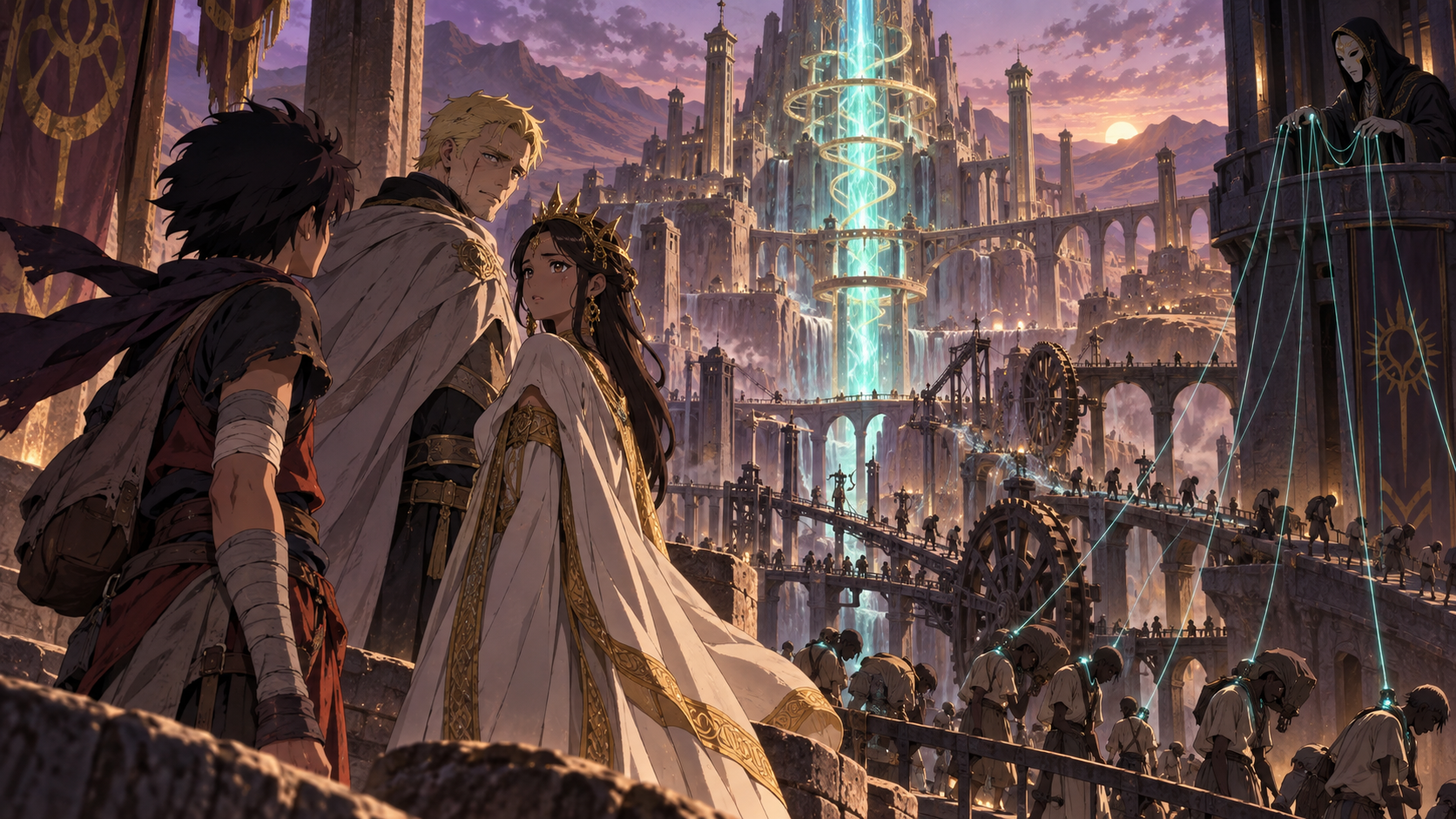
Excerpt: The Lost Tower sends Naruto into Loran’s past, where a young queen inherits a beautiful city whose workers have disappeared beneath the machinery powering it.
Focus keyword: Naruto Shippuden the Movie The Lost Tower review
SEO title: Naruto Shippuden: The Lost Tower Review | CVM Sekai
Meta description: Our Naruto Shippuden: The Lost Tower review explores Loran, Queen Sara, Mukade’s puppet labor, Minato, memory, and leadership built above invisible workers.
Naruto Meets His Father and Is Not Allowed to Know What He Found
Time travel is dangerous in a franchise built around inheritance.
The moment Naruto lands in Loran’s past and meets a calm blond Leaf shinobi leading a mission, the audience understands what stands in front of him. Naruto does not. He recognizes skill, familiarity, and an ease he cannot name. The movie lets him work beside Minato Namikaze without granting either character the reunion fans want them to understand.
That denial is the emotional engine of Naruto Shippuden the Movie: The Lost Tower.
Naruto has spent his life shaped by parents he could not remember. Here, he receives time with his father while the story hides the relationship inside mission protocol. Minato protects him, trusts him, and responds to him with a warmth that never becomes explicit enough to break chronology. Naruto leaves with feeling rather than knowledge.
It is manipulative. It is also effective.
But the movie is not only a father-son almost-meeting. Loran is a city of towers and bridges built around the Ryūmyaku, an immense underground chakra current. Its young queen believes the city prospers. Its trusted minister has turned citizens into controlled labor beneath the machinery.
The city’s beauty depends on people its ruler cannot see.
That argument gives the time-travel spectacle a political spine. Inherited authority is not proven by loving a kingdom from the palace balcony. Leadership begins when the workers holding the kingdom up become visible.
Loran Is Gorgeous Because Exploited Labor Usually Builds Something
The Lost Tower’s best decision is visual. Loran does not look ruined in the past. It looks miraculous.
Vertical architecture rises around a glowing chakra source. Bridges connect enormous towers. Mechanical systems move through the city with a scale foreign to the shinobi villages. The Ryūmyaku promises energy abundant enough to transform urban life.
That splendor is not a contradiction to exploitation. It is evidence of it.
Stories often depict oppressive systems as visibly decayed, as though cruelty cannot produce beautiful buildings, efficient transportation, or public spectacle. Loran is more honest. The city works for the people positioned to see its surface. The violence has been moved below, into controlled bodies and hidden infrastructure.
Queen Sara inherits the finished image. She sees towers, crowds, ceremonies, and the affection Karu—or Anrokuzan, as Mukade has renamed himself—carefully stages around her. She has been taught that prosperity proves legitimacy.
Naruto’s arrival introduces disorder because he keeps asking where actual people are.
That is the right question. A ruler cannot measure justice by how impressive power looks from the top.
Sara’s Naïveté Is Political, Not Personal
Sara is easy to dismiss at first. She trusts her adviser, defends the system she inherited, and reacts to Naruto’s accusations as attacks on her mother’s legacy and her own authority.
But naïveté is not merely a personality flaw here. It has been produced around her.
Mukade controls information, access, and public performance. He makes the queen’s isolation feel ceremonial rather than strategic. Sara’s role is to bless a system she does not administer, while the adviser who “helps” her converts royal legitimacy into control of the Ryūmyaku.
The arrangement is familiar. A young hereditary leader becomes the face of continuity while an experienced official defines what continuity means. Every doubt can be framed as immaturity. Every challenge becomes disrespect toward the crown.
Sara’s growth begins when she stops treating criticism as an insult and follows it toward evidence.
The film could give her more active investigation before Naruto exposes the worst of the system. Still, her eventual choice matters because she risks the identity built for her. If Naruto is right, then her reign has protected an illusion. The citizens calling her queen may be prisoners powering the city she believed she served.
Real leadership starts with surviving that humiliation without making the victims comfort you.
Mukade Builds an Empire Out of Control Threads
Mukade enters Loran’s past before Naruto and uses knowledge of the future to position himself as Anrokuzan, Sara’s trusted minister. He harnesses the Ryūmyaku and develops puppet systems capable of controlling both machines and people.
He is not the franchise’s most psychologically complex villain, but his method fits the story perfectly. Puppetry turns political control into a visible technology. Bodies move. Labor continues. The ruler sees activity and assumes consent.
Mukade’s future knowledge also gives him the confidence of every colonizer who arrives believing superior information creates superior entitlement. Loran’s resources become available to him because he understands how to exploit them better than the people living there.
He does not build partnership. He builds dependency, then uses dependency to hide disappearance.
The Ryūmyaku itself is not evil. Energy becomes oppressive through ownership and control. That distinction matters. The solution is not that Loran should have remained technologically simple. The problem is a system designed so one adviser can convert shared power into obedient bodies.
Mukade’s transformations eventually become larger and less interesting than his administration. The giant puppet threat is spectacle. The minister who makes forced labor look like prosperity is the sharper villain.
Minato Is Familiar Before Naruto Knows Why
Minato appears alongside Chōza Akimichi, Shibi Aburame, and a young Kakashi during a Leaf mission to stop Mukade. The group anchors the past inside recognizable village history without turning the movie into a complete origin story.
Minato’s calm clashes beautifully with Naruto’s instinctive urgency. He observes, plans, marks space, and controls the tempo of danger. Naruto charges toward suffering because delay feels like abandonment. Their methods differ, but their attention keeps landing on the same people.
The film resists explicit revelation because the timeline requires it, yet every shared beat depends on audience knowledge. Minato sees something in Naruto. Naruto trusts him too quickly for a stranger. The connection remains just beneath speech.
This can feel frustrating. We want Naruto to know. After years of watching him carry loneliness, the denial seems almost cruel.
The cruelty is the point. Naruto’s inheritance has always arrived indirectly: a technique, a name hidden from him, a teacher’s choice, a resemblance strangers recognize. The Lost Tower gives him the source for one brief mission and then protects history by taking conscious possession away.
What remains is embodied. Naruto cannot keep the memory clearly, but the experience still helped make him.
Young Kakashi Is a Tiny Gift, Not the Center
The younger Kakashi appears before grief has fully formed the adult mentor fans know. His presence is irresistible, but the movie uses him sparingly.
That restraint is wise. A time-travel story could easily become a parade of familiar faces designed to trigger recognition. Instead, Kakashi contributes to Minato’s team while Loran and Sara retain narrative importance.
The contrast still adds weight. Naruto works near the child who will become his teacher, under the man who was that child’s teacher and Naruto’s father. Three generations overlap without understanding the complete shape.
This is the Will of Fire in its most emotionally persuasive form—not abstract village loyalty, but knowledge, protection, and habits passing through people who rarely receive enough time together.
The movie does not need Kakashi to recognize adult consequences inside his younger self. The audience performs that grief.
The Workers Beneath the City Are the Story’s Moral Test
Sara’s legitimacy is tested not by whether she can defeat Mukade alone, but whether she can see the citizens her palace story excluded.
Hidden labor is not a side detail. It is the truth of Loran.
Mukade’s controlled workers show how easily a system can preserve the appearance of productivity after removing agency. The city continues to move. Machines operate. Towers remain illuminated. From a distance, everything looks efficient.
Efficiency is not evidence of freedom.
The movie’s politics would be stronger if individual workers received more identity and speech. Like the stolen kekkei genkai victims in The Will of Fire, they can become a collective symbol rather than fully realized people. That choice risks reproducing the invisibility the story criticizes.
Still, Sara’s confrontation with them matters. She cannot lead an abstract population after seeing bodies used as components. Her inherited crown becomes a responsibility to restore agency, not merely defeat the man who embarrassed the royal family.
The difference separates liberation from regime change.
Memory Loss Protects Continuity but Costs the Ending
Time-travel stories need rules, and The Lost Tower uses memory suppression to prevent Naruto’s mission from altering the central timeline. Minato seals away the future visitors’ memories as the crisis resolves.
Mechanically, the choice is understandable. Emotionally, it removes the recognition the film spent its entire runtime building.
Naruto cannot return to the present carrying a clear memory of fighting beside his father without changing later reactions. The movie wants the intimacy of reunion and the safety of no consequence. Memory loss supplies both, but the bargain is visible.
What saves the ending is Sara’s daughter, who preserves evidence that the encounter mattered. History remembers differently through families, objects, and stories even when the protagonist cannot articulate what he lost.
The bittersweet effect suits Naruto. So much of his parents’ love reaches him after the moment when it could have felt ordinary. He receives legacy instead of daily life.
The film gives him another fragment.
Action, Puppets, and an Overgrown Final Form
The Ryūmyaku allows the movie to stage combat on a scale distinct from ordinary chakra reserves. Towers become weapons, puppet bodies multiply, and Mukade’s access to the energy source turns architecture into an extension of his control.
Naruto and Minato’s coordinated technique provides the expected emotional payoff. Their power literally combines before Naruto understands the family connection. The image is effective because inheritance becomes collaboration rather than a passive gift.
As in several Naruto films, the villain’s final form is less compelling than the human-scale system that preceded it. Giant transformations simplify responsibility into a target large enough to hit. Mukade the minister made oppression look normal; Mukade the monster makes it obvious.
The action remains entertaining, and the vertical city provides excellent movement. The strongest moments are the ones where combat changes Sara’s access to her people or lets Naruto and Minato respond to one another instinctively.
Scale matters most when it reveals relationship.
Japanese Cast and Performance Notes
Junko Takeuchi plays Naruto’s reaction to Minato with just enough unexamined softness. He does not know why the commander feels important, but his voice changes around the trust before the script can explain it.
Toshiyuki Morikawa’s Minato maintains controlled warmth. He cannot behave as a father, yet the performance allows protective attention to exceed ordinary mission professionalism. The restraint prevents the film from breaking its own premise.
Sara’s performance has to move from ceremonial confidence through denial, shame, and active leadership. Her strongest moments arrive when authority stops sounding inherited and begins sounding chosen.
Mukade shifts from adviserly patience to open domination. He becomes broader as the film proceeds, but the early composure establishes why Sara and Loran accepted him.
Where It Fits—and Whether It Is Canon
Watch The Lost Tower after the Pain arc, once viewers know Minato is Naruto’s father and understand the emotional meaning of that encounter. Seeing it earlier protects Naruto’s ignorance but robs the audience of the movie’s central dramatic irony.
The film is an anime-original time-travel side story. Its events are not required by the manga’s central continuity, and the memory rules deliberately prevent the mission from reshaping later canon.
Its thematic placement is stronger than its calendar placement. Naruto has finally learned his father’s identity, and the film gives him a version of contact that feels intimate precisely because he cannot consciously keep it.
Final Verdict
The Lost Tower is one of the Naruto movies with the clearest visual identity. Loran’s vertical city, the Ryūmyaku, puppet infrastructure, and time-crossed Leaf team create a setting worthy of a theatrical detour.
Its weaknesses are familiar. Mukade becomes less interesting as he becomes larger. The controlled workers need more individual presence. Memory erasure protects continuity at the cost of emotional consequence.
Yet the film’s central images endure: a queen discovering that prosperity was built above invisible bodies, a son fighting beside his father without knowing the relationship, and a city’s shared energy turned into one man’s control system.
Sara learns that inherited power does not create knowledge. Naruto learns nothing he can easily name—and still leaves changed.
Sometimes inheritance is not a speech or a title. Sometimes it is the feeling that a stranger’s faith in you arrived from somewhere older than the mission.
Rating: 8/10 — A visually distinctive time-travel story whose labor politics and bittersweet Naruto–Minato partnership survive an overgrown villain finale.