
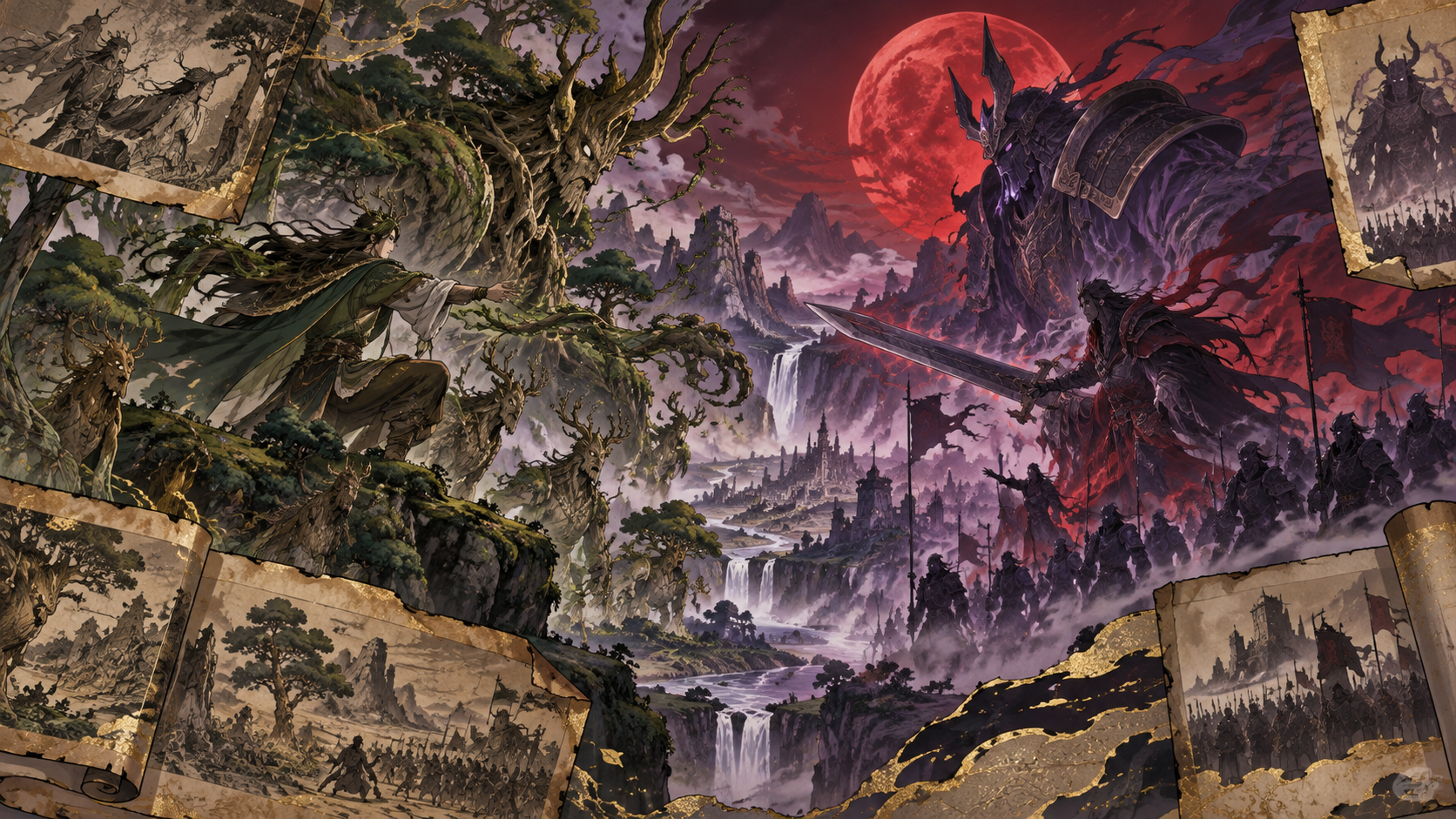
Excerpt: The Storm Generations Hashirama-versus-Madara animation preserves an early version of Naruto’s founding myth—created before later manga and anime material could supply the fuller history.
Focus keyword: Hashirama vs Madara Storm Generations animation review
SEO title: Hashirama vs. Madara Storm Generations Review | CVM Sekai
Meta description: Our Hashirama vs. Madara Storm Generations animation review examines the game-story short, early founding myth, later canon revisions, and adaptation history.
This Is What the Legend Looked Like Before the Story Finished Explaining It
Hashirama Senju and Madara Uchiha stand at the center of Naruto’s founding myth.
One represents the village’s ideal of collective protection. The other becomes the rival whose departure and defeat define the official version of Konoha’s beginning. Their clash at the Valley of the End is remembered in statues, institutions, inherited resentment, and a story told mostly by the civilization that survived to name the valley.
Naruto Shippuden: Ultimate Ninja Storm Generations animated their confrontation before later manga chapters and television episodes supplied the fuller history viewers now associate with the founders.
That timing makes the game animation valuable.
It is not the definitive account.
It is evidence of how the franchise visualized myth under incomplete information.
The distinction turns a short game-story sequence into an adaptation-history artifact. Character designs, attack choices, emotional framing, and the balance between spectacle and context all reveal what creators and audiences believed the founders’ conflict meant at that moment.
Later canon does not simply make the earlier version worthless. It creates a comparison.
Stories revise their own legends as source material catches up.
The Valley of the End Begins as Monument Before It Becomes Memory
For much of Naruto, viewers encounter Hashirama and Madara through aftermath.
Their statues tower above Naruto and Sasuke. Their names carry political weight. The village narrates them as founder and traitor, victory and threat.
Monuments simplify.
They turn relationships into opposing stone. They preserve the outcome more efficiently than the argument.
The Storm Generations animation works inside that simplified mythic frame. The battle is enormous because the audience already understands it as the origin point behind later rivalry.
Hashirama commands living forest and overwhelming scale. Madara answers through armored spectral power and destructive force. Their abilities become symbols for competing visions before the narrative has fully articulated the childhood friendship, clan pressure, failed compromise, and ideological divergence underneath.
That is not necessarily a flaw. Myth often arrives before history.
The short animates the monument. Later material asks who the men were before stone decided what they meant.
Game Storytelling Compresses Because Play Has to Continue
Video-game story modes operate under different constraints from television arcs and manga chapters.
They need to move players between playable encounters, communicate stakes quickly, and deliver recognizable spectacle without requiring hours of noninteractive exposition between battles.
The Hashirama–Madara animation therefore emphasizes conflict legibility.
These are legendary rivals. Their powers are vast. The battle changed the shinobi world. The player should understand why controlling or confronting such figures matters.
Compression can flatten political and emotional history, but it also creates visual clarity.
The animation behaves like an illustrated legend inserted into a game structure. It is not trying to replace the later full account because that account did not yet exist in completed public form.
Reviewing it fairly means asking how well it serves the game’s historical imagination, not punishing it for failing to adapt chapters unavailable at production time.
Hashirama’s Ideal Is Easier to Love Before We See Its Cost
The village system is usually introduced as Hashirama’s hopeful answer to endless clan warfare. Children would no longer die in inherited conflict. Families could build shared institutions. Cooperation might replace revenge.
That ideal deserves admiration.
Later Naruto material complicates it. Hidden villages become militarized states. Children still train for combat. Clan inequality persists. Konoha’s institutions protect some people while sacrificing others.
An early compressed animation can present Hashirama’s side more cleanly because the mythic contrast requires it.
He becomes life, growth, and collective possibility against Madara’s destructive isolation.
The imagery works. It is also political framing.
Forest power looks organic and generative. Spectral armor looks imposing and alienated. Visual design invites viewers to read morality through material.
Later context does not invert the moral balance entirely, but it makes the symbolism less comfortable. A village can grow like a forest and still cast people into shade.
The game animation preserves the cleaner reading that the franchise once relied upon more heavily.
Madara Becomes Threat Before He Becomes Argument
Madara’s power is immediately cinematic. His presence communicates opposition large enough to require Hashirama.
What short animation cannot easily convey is why he rejects the settlement he helped create.
Without deeper history, Madara risks becoming resentment embodied: the man who could not accept peace because rivalry and pride consumed him.
Later material gives the break more structure. Clan distrust, Tobirama’s policies, the Uchiha’s position, Madara’s fear of institutional betrayal, and manipulation surrounding the Eye of the Moon Plan make the path legible even when his conclusions remain catastrophic.
The Storm Generations version should therefore be read as an early layer.
It shows how the threat was framed before the argument was fully dramatized.
This is useful for media literacy. Audiences often treat the latest canonical explanation as if every earlier adaptation secretly possessed it. Production history says otherwise.
Characters evolve not only inside fiction. They evolve across what creators know, what publishers have revealed, and what formats need at a given release date.
Naruto and Sasuke Haunt the Founders’ Fight
Even when Naruto and Sasuke are absent, their relationship shapes how viewers read Hashirama and Madara.
The founders function as precedent, reincarnated pattern, and warning. The valley where Naruto and Sasuke fight carries the earlier clash physically and symbolically.
Game animation benefits from that backward projection.
Viewers recognize movements, positions, and ideological opposition through the younger pair. Hashirama and Madara gain emotional immediacy from a relationship the audience has experienced more directly.
The comparison can also oversimplify both pairs. Naruto is not merely Hashirama repeated, and Sasuke is not merely Madara with a different childhood. Inheritance operates through structural pressure and myth as much as destiny.
The short’s mythic framing encourages parallel reading. Later canon provides tools for resisting total equivalence.
That tension makes the scene richer when watched historically rather than isolated as power spectacle.
New Animation Was a Selling Point
Licensed VIZ coverage of Ultimate Ninja Storm Generations highlighted the game’s substantial new animation and specifically noted the Madara-versus-Hashirama material.
This was not incidental packaging.
Original anime content gave fans narrative imagery unavailable in the weekly television adaptation at that moment. The game could market itself as more than a collection of playable systems; it offered new franchise viewing.
That strategy blurs boundaries between game and anime audience.
Some players arrive for combat mechanics and receive story. Some anime fans buy or watch because the game contains animated material. The franchise expands through cross-format exclusivity.
As with promotional DVDs, this can create archival confusion later. Fans extract and circulate clips without the original game context, and the animation begins to look like an orphaned OVA.
Correct classification restores the relationship: video-game story animation created for Storm Generations.
Later Canon Does Not “Debunk” the Earlier Version
Adaptation differences are often discussed as mistakes to be corrected. That approach is too narrow.
The game animation represents a production decision made with the available source material and release goals. Later manga chapters add history; later television animation visualizes that history differently.
The earlier work becomes nondefinitive, not meaningless.
Comparing versions can reveal:
- which abilities were emphasized before full explanation,
- how moral alignment was framed,
- what visual motifs persisted,
- how the founders’ relationship gained intimacy and political context,
- and how franchise marketing used incomplete myth to generate anticipation.
This is the value of a comparison file.
Viewers should not stitch every difference into one perfect event. They should recognize separate adaptations answering different needs.
Continuity is not improved by pretending production history never happened.
Spectacle Becomes Historical Authority
Animation can make a version of history feel definitive because movement supplies confidence.
A towering technique, decisive strike, or composed facial expression may be remembered more strongly than the caveat that the sequence was produced before later chapters.
The Storm Generations battle therefore participates in mythmaking beyond its official status.
Fans may first encounter Hashirama and Madara’s clash through the game clip. That visual memory can shape how later canon is interpreted, even after a fuller adaptation arrives.
This demonstrates why format labeling matters on a reference site. “Official animation” is not enough. Readers need to know when, where, and for what narrative system the work was made.
The animation’s authority is aesthetic. Its continuity authority is limited.
Both can be respected.
Visual Design and Battle Language
The clash relies on immediate opposition: living forest against spectral armor, organic expansion against concentrated force, growth against destruction.
These images communicate scale faster than dialogue.
The founders appear less like ordinary shinobi and more like forces capable of reshaping geography. That presentation supports the legendary status inherited by later generations.
Game animation also needs to inspire play. Techniques should look desirable to control, survive, or counter. Spectacle becomes mechanical advertisement.
The sequence succeeds when the battle feels both historical and playable.
It becomes thinner when scale substitutes entirely for relationship. Later adaptations improve the latter by giving viewers more time with the men before the valley.
Japanese Cast and Sound Notes
The performances have to establish mythic authority quickly. Hashirama’s confidence should suggest generative strength rather than simple innocence. Madara’s intensity must carry grievance even where exposition is limited.
Music and effects perform major narrative work. Large techniques receive weight through sound design, while dramatic scoring tells viewers this is foundational history.
The game context encourages heightened presentation. The scene must transition between story and playable excitement.
Where It Fits—and What It Is
Watch the animation after the founders’ identities and their connection to Naruto and Sasuke are understood—ideally after the war-era history provides the fuller account.
It is official video-game story animation created for Naruto Shippuden: Ultimate Ninja Storm Generations. It is not a television OVA, numbered episode, or independent canon chapter.
Treat it as a comparison file and production-history artifact: an early visual version of the founders’ clash made before later source material and anime adaptation completed the story.
Final Verdict
The Storm Generations Hashirama-versus-Madara animation is valuable because it is incomplete.
It preserves the moment when Naruto’s founding myth had enough shape to animate but not enough published history to carry the political and emotional complexity later viewers take for granted.
The battle is spectacular, legible, and commercially effective. Hashirama appears as generative village ideal; Madara appears as overwhelming opposition. Naruto and Sasuke’s rivalry supplies emotional context from the future.
Later canon makes the conflict more human.
That does not erase this version. It lets us see the franchise revising its own legend in public.
Rating: 7.5/10 — A compelling game-story artifact whose compressed founding myth becomes more valuable when compared honestly with the fuller canon that followed.