
Excerpt: Hidden Leaf Village Grand Sports Festival turns Naruto’s desperate search for a bathroom into a compact lesson in ensemble comedy, timing, and the dignity no hero can preserve forever.
Focus keyword: Hidden Leaf Village Grand Sports Festival review
SEO title: Hidden Leaf Village Grand Sports Festival Review | CVM Sekai
Meta description: Our Hidden Leaf Village Grand Sports Festival review examines Naruto’s bathroom disaster, the Konoha ensemble, physical comedy, licensed-short status, and placement.
Saving the Village Is Easier Than Finding an Empty Bathroom
Naruto Uzumaki can fight assassins, survive impossible training, and announce his future Hokage title to anybody within shouting distance.
He cannot reach a toilet.
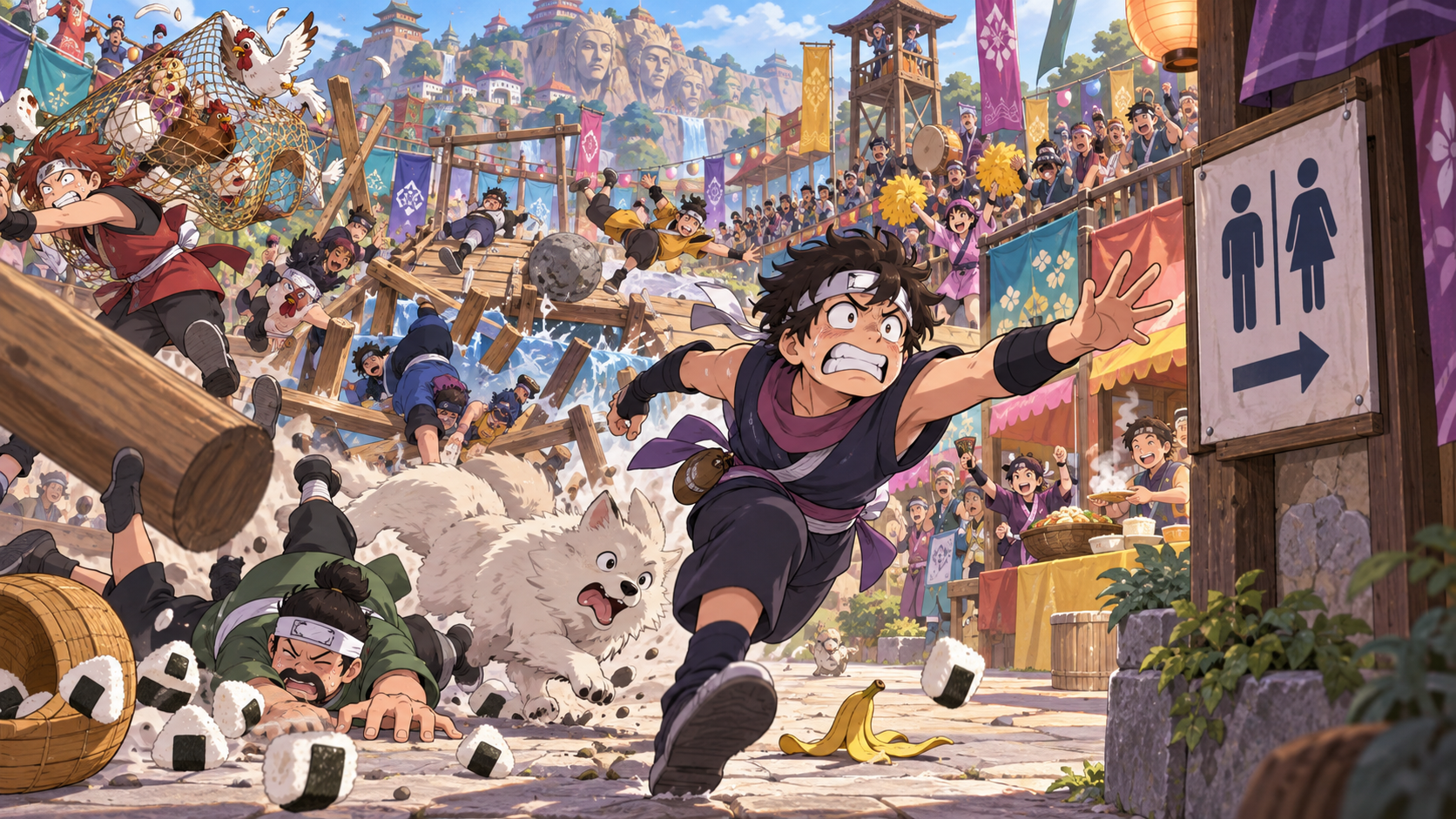
Hidden Leaf Village Grand Sports Festival is broad physical comedy built around one escalating emergency: Naruto needs a bathroom during Konoha’s athletic festival, and every teammate, rival, animal, collision, and badly timed responsibility becomes another obstacle.
That is the plot.
It is also enough.
The short understands that comedy does not require secret lore, hidden trauma, or a villain threatening the world. It requires a clear need, an audience who knows the character, and timing cruel enough to turn an ordinary bodily function into destiny.
Naruto’s dignity is especially vulnerable because he performs confidence as survival. He wants to be seen as powerful, important, and impossible to dismiss. The body does not care about his public image.
That collision makes the joke work. The future hero is defeated by logistics.
The Entire Konoha Cast Becomes an Obstacle Course
The short’s pleasure comes from recognition. Familiar characters appear rapidly, each contributing another delay or collision. The festival structure allows ninja who might never share a mission to occupy the same crowded space.
This is ensemble comedy rather than character development.
The audience already knows the cast well enough for a face, posture, or brief reaction to carry the joke. Team personalities become visual shorthand. Lee’s intensity, Kiba’s animals, Chōji’s relationship with food, teachers, rivals, and background villagers all belong to a machine designed to keep Naruto from the restroom.
The density rewards fans more than newcomers. Without familiarity, the short remains understandable slapstick. With familiarity, every cameo creates a second layer: of course this person would appear here, at exactly the wrong moment, doing exactly the thing Naruto cannot survive right now.
The festival becomes a snapshot of Konoha as community. Not the solemn village of memorial stones and inherited duty—the noisy one where everybody is in somebody else’s way.
That version matters too.
Physical Comedy Depends on a Real Body
Naruto’s techniques often let him multiply, transform, and exceed ordinary physical limits. Comedy pulls him back into a body with inconvenient needs.
The urgency increases while social expectations prevent him from simply announcing the problem. Every delay makes honesty more embarrassing, so he commits harder to concealment, which creates more delay.
This is a classic comic structure: the solution remains simple until pride makes it impossible.
The short does not need dialogue-heavy explanation because movement communicates everything. Naruto’s posture changes. His attention narrows. The distance to relief becomes emotionally enormous. Other people continue treating the festival as important because they do not know his private emergency has become the center of the universe.
That gap between public event and private catastrophe is universal. Everybody else is living a normal afternoon. Naruto is fighting for civilization.
The animation exaggerates without losing the bodily truth. Viewers do not need shinobi training to understand it.
The Joke Works Because Naruto Is Naruto
The premise could happen to any character, but it is funniest with Naruto.
He is impulsive, prideful, visible, and accustomed to forcing obstacles into direct confrontation. None of those traits help. He cannot punch social timing. Shadow clones would multiply the problem rather than restore privacy. Announcing his need would solve the practical issue while destroying the heroic image he wants to protect.
Naruto’s greatest strength—his refusal to give up—becomes comic self-sabotage. A sensible person might abandon the performance, ask for help, or accept embarrassment. Naruto treats the route to the restroom like another promise he must fulfill through determination.
The short therefore remains character comedy rather than random humiliation.
We laugh because the crisis exposes the gap between who Naruto believes he must appear to be and the ordinary child underneath. The joke does not erase his heroism. It makes heroism coexist with digestion.
That coexistence is healthy for a franchise prone to turning children into symbols.
Konoha’s Festival Shows What Peace Is Supposed to Protect
The event is frivolous compared with ninja war, and that is precisely why it belongs in the world.
Villagers gather. Teams compete without lethal consequence. Food stalls operate. Adults cheer. Children run through public space for reasons unrelated to military readiness.
This is what peace should contain.
Naruto’s main story often discusses protecting the village in abstract terms. A comedy short can show the ordinary life hidden inside that phrase. Konoha is not only the Hokage office, mission desk, and shinobi hierarchy. It is crowded festivals where serious people become ridiculous together.
The short does not make a political argument explicitly. Its existence becomes one. If every side story were another attack, the village would never feel worth saving beyond narrative obligation.
Joy, embarrassment, and public silliness are part of the protected world.
Naruto’s disaster unfolds inside communal safety. Nobody is dying. Nobody needs to become a weapon. The stakes are low enough for his body to become the emergency.
That relief has value.
Cameos Are the Content, Not a Continuity Puzzle
Promotional shorts frequently include characters because audiences enjoy seeing them, not because the production team intends to establish a precise timeline.
Grand Sports Festival should be read that way.
The cast density makes exact chronology messy. Familiar figures appear for comedy, including visual cameos that may not align neatly with a single canonical day. Treating every background appearance as evidence of a hidden continuity event misses the format.
This is an animated bonus attached to a theatrical release. It celebrates the ensemble.
The directory classification should therefore remain “animated short” or “licensed movie bonus,” not “lost episode,” “canon OVA,” or a numbered installment of the television series.
Format is part of meaning. A bonus short is allowed to prioritize recognition and timing over timeline engineering.
Fans do not need to explain how the bathroom crisis affected the Fourth Shinobi World War. Thank goodness.
Comedy Without Cruelty
Bathroom humor can become mean quickly. The short’s tone remains affectionate because Naruto is not punished for a moral failure. He is trapped by coincidence, pride, and the escalating machinery of comedy.
The audience laughs at recognition rather than disgust.
Naruto remains active throughout. He schemes, runs, detours, and refuses collapse. The joke does not ask us to believe he is worthless. It asks us to enjoy a hero losing control of the image he works so hard to maintain.
That distinction matters on a fandom site. Not every embarrassing story is secretly abusive, and not every joke deserves a moral tribunal. But comedy works better when we can identify where the affection sits.
Here, the affection is obvious. The production wants to parade Konoha’s cast, let everyone collide, and give Naruto a crisis nobody can solve with a Rasengan.
The indignity humanizes him.
The Short Knows When to End
The premise could not support a full episode without exhausting itself. The short format protects the joke.
Each obstacle raises urgency, cameos accumulate, and the final payoff arrives before repetition becomes punishment. The rhythm resembles a chase sequence more than a narrative arc.
This economy is one reason the work should remain classified correctly. Evaluating it like a standard episode would produce complaints about absent development and plot depth that the format never promised.
The question is whether the gag escalates, uses the ensemble well, and lands.
It does.
The animation is lively enough to keep bodily urgency visible, while the festival setting provides constant visual information. Crowds and obstacles could make the frame unreadable, but Naruto’s objective remains clear.
Comedy direction is often invisible when it works. Here, timing is the craft.
Japanese Cast and Performance Notes
Junko Takeuchi carries the short through vocal panic Naruto is desperately trying to suppress. The performance moves between public bravado and private emergency without requiring explanation.
The ensemble cast contributes brief, recognizable rhythms. Because appearances are short, established vocal identities do much of the work. A familiar reaction can land before a new viewer would finish processing who entered the frame.
The voice performances support the physical animation rather than competing with it. This is a body-first comedy, and the dialogue knows it.
Where It Fits—and What It Is
Watch the short after the original series has introduced the wider Konoha cast. Recognition increases the comedy, and the work does not depend on a particular arc.
VIZ identifies it as part of the licensed original-movie triple-feature package. It is a movie bonus short, not a television episode and not a secret required chapter.
Its canon status is best understood as promotional ensemble comedy. Cameos and events should not be forced into a precise manga timeline.
Final Verdict
Hidden Leaf Village Grand Sports Festival is slight by design and successful on those terms. It does not deepen lore, transform a relationship, or reveal a hidden chapter of Naruto’s journey.
It gives the franchise room to breathe.
The entire village becomes an obstacle between Naruto and one ordinary need. Cameos turn Konoha into a crowded social organism. Physical comedy strips heroic performance down to a child trying not to embarrass himself in public.
Saving the world may make Naruto legendary.
Reaching the bathroom on time would have made him happy.
For a few minutes, that is enough.
Rating: 7.5/10 — A perfectly sized ensemble-comedy bonus whose physical timing, cast parade, and low-stakes indignity make Konoha feel joyfully alive.