
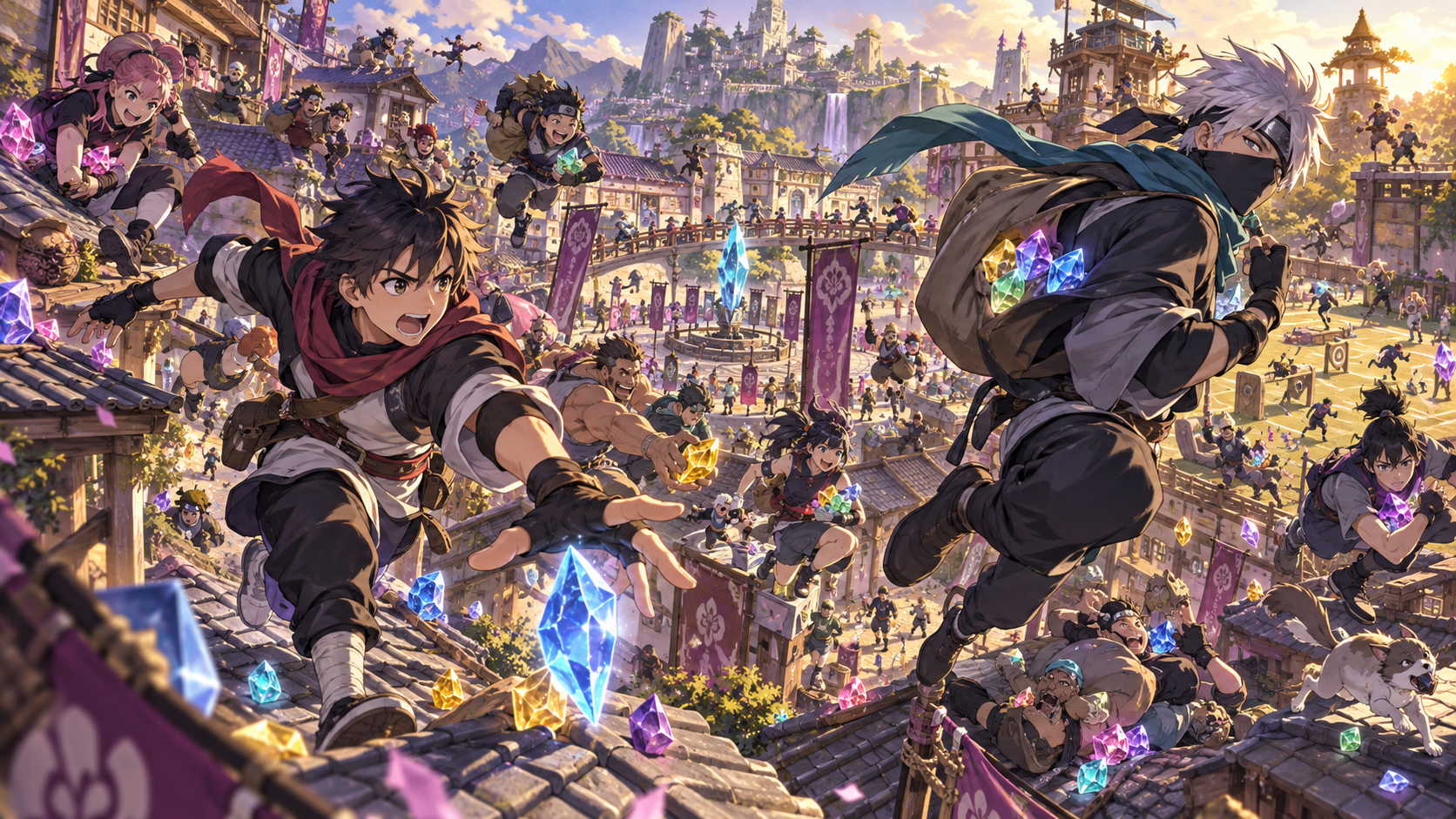
Excerpt: Finally a Clash! Jōnin vs. Genin!! turns Konoha into a village-wide crystal hunt where teachers, students, ranks, and dignity collapse into one promotional battle royal.
Focus keyword: Jonin vs Genin Grand Melee review
SEO title: Jōnin vs. Genin Grand Melee Review | CVM Sekai
Meta description: Our Jōnin vs. Genin Grand Melee review explores the crystal tournament, Naruto and Kakashi, scrambled ranks, ensemble comedy, game-bonus OVA status, and release context.
Konoha Turns Professional Hierarchy into a Crystal-Collecting Riot
Tsunade organizes a village-wide tournament. Jōnin, genin, mentors, students, and familiar competitors chase crystals, ambush one another, form temporary alliances, and treat promotional rules with the emotional seriousness of war.
Naruto wants Kakashi.
Not philosophically. Not as part of a tragic Team 7 reunion. He wants to catch his teacher inside the contest and prove something through points, persistence, and public victory.
Finally a Clash! Jōnin vs. Genin!! Indiscriminate Grand Melee Tournament Meeting!! has a title long enough to contain the entire cast and a premise simple enough to explain in one breath: everybody fights everybody for crystals.
The pleasure is not plot.
It is hierarchy temporarily losing its usual shape.
Teachers run from students. Elite shinobi make petty tactical decisions. Younger competitors discover that rank does not protect anyone from being outnumbered, tricked, or caught while paying attention to the wrong rival.
The village becomes a game board.
Like the best promotional OVAs, the short uses an artificial contest to create interactions the main story’s mission logic would rarely permit. Nobody needs a geopolitical reason for the cast to collide. Tsunade made a tournament. That is enough.
Rank Matters Until the Rules Change What Matters
The jōnin enter with experience, technique, and authority. The genin enter with numbers, ambition, familiarity with their mentors, and very little respect for how rank is supposed to make them feel.
The crystal objective redistributes advantage.
The strongest fighter is not automatically the best collector. Protecting points, reading temporary alliances, exploiting distraction, and understanding the contest’s conditions become as important as combat ability.
This creates comedy because Konoha’s formal hierarchy remains visible while practical hierarchy shifts from moment to moment.
A teacher can command a student on a mission. During the tournament, the same student may be rewarded for setting an ambush.
The temporary permission matters. Play allows subordinates to challenge authority without claiming the institution should disappear. The contest creates a bounded world where disrespect becomes strategy.
That makes the event feel socially useful despite its absurdity. Younger shinobi can test themselves against adults without the fight requiring rebellion, betrayal, or lethal stakes.
The crystals are meaningless enough to make the relationships visible.
Naruto’s Pursuit of Kakashi Is the Emotional Spine
An ensemble this large needs a thread viewers can follow through the chaos. Naruto’s determination to catch Kakashi supplies it.
Their relationship makes the pursuit funny. Kakashi trained Naruto, understands his habits, and knows exactly how to keep the younger shinobi moving toward the wrong opening. Naruto knows Kakashi’s evasiveness and interprets every escape as a personal challenge.
The contest turns mentorship into chase comedy.
Naruto wants the visible victory of catching the person whose approval and authority shaped Team 7. Kakashi is not likely to offer that satisfaction cheaply.
The dynamic also compresses Naruto’s broader growth. Early Naruto struggled to touch Kakashi’s bells. A later contest asks whether he can close the gap through experience rather than surprise alone.
The OVA does not need to resolve the power comparison permanently. The game structure protects both characters. Winning crystals is not defeating Kakashi in a canonical life-or-death fight.
That protection allows the short to flirt with generational reversal without rewriting the hierarchy outside the event.
Tsunade Understands That Training Can Look Ridiculous
Tsunade’s tournament combines evaluation, morale, spectacle, and controlled chaos.
Konoha is a military institution, but repetitive drills are not the only way to develop judgment. A rule-based melee can test improvisation, pursuit, alliance, terrain use, and the ability to distinguish objective from ego.
It can also become a bureaucratic disaster.
That tension fits Tsunade. She is willing to use unconventional structures if they produce useful behavior, and she is experienced enough to know shinobi will take any contest personally once status is visible.
The game’s absurdity does not mean no learning occurs. In fact, low stakes may reveal habits more honestly. Competitors act on pride, rivalry, and opportunism without the moral clarity of protecting lives.
Who chases points? Who protects teammates? Who betrays an alliance the moment another crystal appears? Who forgets the objective because one rival becomes emotionally important?
Play exposes character.
Tsunade creates the conditions and lets the village embarrass itself productively.
Ensemble Fan Service Works Through Impossible Proximity
The main series separates characters through missions, rank, injury, and narrative focus. The tournament gathers them.
Familiar faces can collide without requiring continuity-heavy explanation. Mentors face students. Teammates split and recombine. Background favorites receive brief moments impossible to justify inside a central arc.
This is fan service in the broadest and healthiest sense: service to the pleasure of seeing the ensemble interact.
Not every appearance needs development. A reaction, tactic, or brief matchup can satisfy because viewers bring attachment into the scene.
The risk is crowding. When too many characters receive a moment, the story can feel like a catalog rather than an event.
The crystal objective maintains coherence. Everybody is participating in the same visible system, so cameos contribute to one larger motion.
The OVA does not pretend all participants are equally important. Naruto and Kakashi provide direction; the village supplies texture.
Competition Reveals Affection Through Target Selection
Who somebody chooses to chase can reveal as much as who they protect.
Naruto targets Kakashi because the relationship matters. Students challenge teachers whose acknowledgment they value. Rivals seek one another even when easier crystals exist elsewhere.
This is inefficient strategy and emotionally accurate behavior.
Games create socially acceptable opportunities to demand attention. “Fight me” can mean “see how much I have grown.” “Catch me” can mean “prove you still understand me.” A stolen crystal becomes temporary evidence that the relationship’s balance can change.
The tournament makes these demands safe enough to become funny.
Nobody needs to confess affection. They can ambush it.
Naruto’s world often expresses bonds through combat because direct emotional language is difficult for its characters and culture. The OVA uses that habit without attaching tragedy.
The result is combat as social play rather than trauma repetition.
Game-Bonus Origins Explain the Structure
The animation was distributed as bonus material connected to Naruto: Narutimate Hero 3 / Ultimate Ninja 3, with licensed game listings documenting the original-animation DVD and its relationship to the game’s scenario.
That context is essential.
The OVA behaves like an all-star game mode because it is part of a game ecosystem. Broad cast access, tournament logic, collectible objectives, and compressed matchups reflect interactive design.
It is not a lost television arc.
It is not evidence that every tournament outcome occupies a fixed place in manga continuity.
It is a game-bonus OVA built to make the franchise feel playable even while viewers watch.
Correct classification turns apparent narrative thinness into formal coherence. The crystal collection is not trying to become deep lore. It translates game pleasure into animation.
Crystals Make Progress Visible
Collectible crystals provide immediate visual scoring. Viewers can understand gain, loss, priority, and pursuit without lengthy rules.
The objects also distribute color across the ensemble, helping crowded action remain readable.
Unlike abstract points, crystals can be stolen, hidden, dropped, and physically defended. They give characters something to do with their hands and bodies besides attack one another.
The material objective also creates reversals. A fighter may win an exchange and lose the crystal. Another may avoid combat and lead the score.
This keeps power scaling from dominating the comedy.
The best shinobi in a war is not necessarily the best player in a promotional scavenger hunt.
Animation and Comic Density
The production has to manage many characters, simultaneous movement, and repeated objectives without losing the audience.
Wide village geography helps. Rooftops, streets, fields, and recognizable spaces divide the chaos into zones. Cuts between matchups create the feeling that Konoha itself has become the arena.
Comedy depends on rapid reversal: confident entrance, immediate ambush; mentor advantage, student trick; crystal gained, crystal stolen.
The short format prevents exhaustion. A full arc built on collecting would require deeper strategy and character progression. As a bonus OVA, density is the feature.
The ensemble should feel slightly too large for the rules to contain.
It does.
Japanese Cast and Performance Notes
The returning cast uses established relationships to make brief exchanges legible. Junko Takeuchi gives Naruto relentless pursuit energy, while Kazuhiko Inoue lets Kakashi sound amused, evasive, and just competitive enough to keep the chase personal.
Tsunade’s authority frames the absurdity as sanctioned rather than accidental. The wider ensemble can then commit fully to the tournament without explaining why elite shinobi are behaving this way.
Overlap, shouted challenges, and quick reactions create village-wide momentum.
Where It Fits—and What It Is
Watch the OVA after the original-series ensemble and teacher-student relationships are familiar. Exact timeline placement is less useful than cast recognition.
It is a game-bonus ensemble comedy associated with Narutimate Hero 3 / Ultimate Ninja 3. It is not a numbered television episode or required manga event.
Treat it as optional promotional continuity designed to produce all-star matchups and game-like crystal collection.
Final Verdict
Finally a Clash! Jōnin vs. Genin!! Indiscriminate Grand Melee Tournament Meeting!! is gloriously overnamed and appropriately overpopulated.
The crystal hunt turns Konoha’s hierarchy into temporary play. Students ambush mentors, elite shinobi chase meaningless objects with absolute seriousness, and Naruto converts the entire event into another chance to measure himself against Kakashi.
The plot is thin because plot is not the product.
The product is proximity: a cast too large for ordinary mission logic colliding inside a rule set borrowed from games.
For a little while, rank becomes strategy, mentorship becomes chase, and village order becomes a colorful pile of stolen crystals.
Rating: 7.5/10 — A crowded, joyful game-bonus OVA that uses crystal collection to scramble rank and turn Konoha’s entire ensemble into playable chaos.