
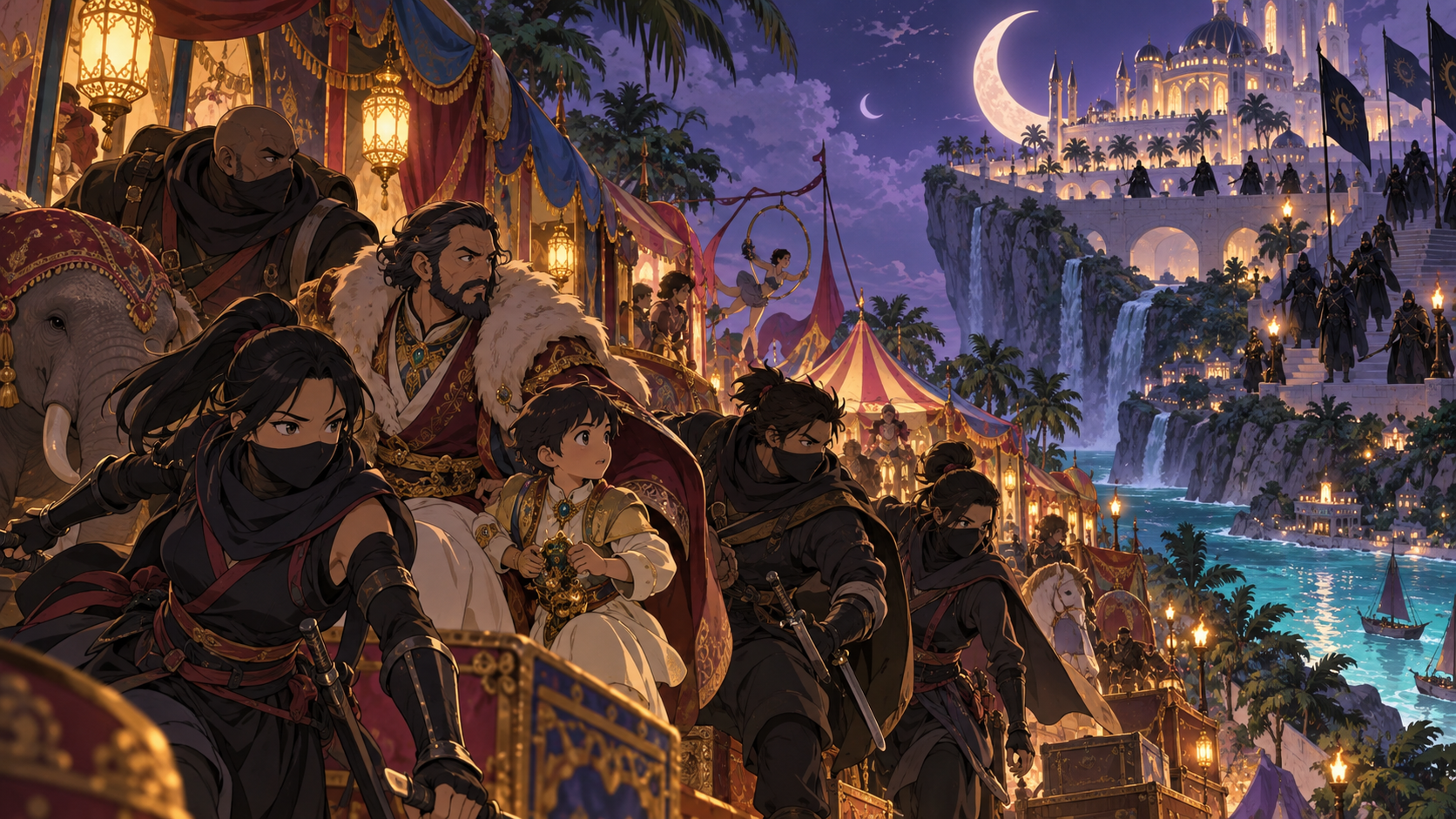
Excerpt: Guardians of the Crescent Moon Kingdom turns a royal escort into a story about spoiled affection, public duty, and the moment inherited power finally has to answer to ordinary people.
Focus keyword: Guardians of the Crescent Moon Kingdom review
SEO title: Guardians of the Crescent Moon Kingdom Review | CVM Sekai
Meta description: Our Guardians of the Crescent Moon Kingdom review explores Michiru, Hikaru, Team 7, royal duty, the coup, and why money cannot replace courage or care.
Money Can Buy a Circus. It Cannot Buy the Courage to Govern.
The third original-series Naruto movie begins with a prince buying a circus because his son likes a tiger.
That sentence tells you nearly everything about Michiru Tsuki at the start of Guardians of the Crescent Moon Kingdom. He is not vicious. He is not even especially complicated. He is a wealthy man who has spent so long translating affection into purchases that he no longer understands why the people closest to him remain unimpressed. When a problem appears, he spends. When his son is unhappy, he spends more. When responsibility becomes uncomfortable, he assumes another expensive gesture will carry him past it.
Then he returns home and discovers that a coup cannot be bribed into becoming a misunderstanding.
This is the lightest of the original Naruto theatrical movies on the surface. The island setting is bright, the traveling circus supplies broad comedy, Rock Lee brings exactly the physical energy you expect, and Naruto spends a good portion of the opening furious at rich people behaving like rich people. Underneath that color is a useful argument about leadership: inherited office means nothing if the person holding it treats the public like background scenery.
The movie is not subtle, and it does not need to be. Michiru’s growth works because the lesson is embarrassingly basic. Love is not what you can purchase for someone. Leadership is not what a crown calls you. Both become real when comfort stops being the priority.
A Team Built for the Late Original-Series Era
Naruto, Sakura, Kakashi, and Rock Lee escort Michiru and his son Hikaru through the Land of the Moon. Sasuke is gone. The mission belongs to the long anime-only stretch after his departure and before Naruto leaves to train with Jiraiya, and the lineup makes that placement visible without anybody delivering a timeline lecture.
Rock Lee is a particularly good choice for this story. He takes duty seriously without confusing seriousness with coldness. He is capable of meeting a circus on its own theatrical terms, then switching into disciplined combat when the assignment turns dangerous. Where Sasuke would have intensified Team 7’s internal tension, Lee steadies the group and lets the royal family remain the emotional problem.
Sakura is also more active here than she was in the earliest version of Team 7. She is still not yet the Shippuden medical powerhouse, but the film allows her competence to register. She observes, protects, and works within a group whose loudest member keeps trying to solve class resentment by yelling directly at the prince.
Kakashi, meanwhile, does what Kakashi often does in side stories: he recognizes the political shape of the mission before the children do and leaves them enough room to discover why it matters. His calm is useful against a setting that initially feels like vacation advertising.
Michiru Is Not Evil. He Is Unprepared.
It would be easy to write Michiru as a greedy royal who learns one lesson and becomes good. The movie does something slightly more interesting. His problem is not that he loves money more than people. His problem is that money has insulated him from learning how people experience him.
He loves Hikaru, but he tries to purchase the child’s admiration. He believes he can repair emotional distance with objects because nobody has forced him to remain present after a gift fails. He is accustomed to servants, schedules, and institutional deference smoothing over the consequences of his personality.
Naruto has no interest in smoothing anything over.
That friction gives the movie its best early material. Naruto grew up with almost nothing and had to fight for every scrap of acknowledgment. Michiru has access to nearly everything and still cannot make his own son respect him. Naruto sees waste and entitlement. Michiru sees an insolent child who does not understand how the world works. Hikaru sees two adults performing versions of strength while neither has yet asked what he needs.
The circus purchase is funny because it is absurd. It is also the purest expression of Michiru’s emotional vocabulary. He cannot join Hikaru inside wonder, so he buys the source of wonder and calls the transaction closeness.
That is not love. It is control wearing a generous coat.
Hikaru Has to Learn a Different Lesson
Hikaru is spoiled too, but the film wisely does not treat the father and son as identical. A child who receives everything has not made the system that gives it to him. He has learned its rules.
Hikaru expects animals, servants, and companions to respond to desire because desire has always produced a result. His relationship with Chamu, the saber-toothed tiger, becomes important because an animal cannot be persuaded by royal status. Trust has to be earned through behavior. Care has to be consistent when nobody is applauding.
Naruto’s role is not to teach Hikaru poverty tourism or make him feel guilty for being born royal. He pushes the boy toward effort. Naruto respects labor because effort is one of the few forms of dignity he has always been able to claim. You may hate him. You may underestimate him. You cannot honestly say he did not try.
Hikaru begins to understand that being cared for and caring are different skills. The distinction sounds obvious, but the entire royal household has trained him to miss it.
His bond with Naruto works best when the movie lets them be children rather than symbols. They argue, compete, misunderstand, and eventually recognize each other. Naruto does not become less irritated by wealth. Hikaru does not become an ordinary village kid. Friendship appears because both start participating instead of demanding.
A Coup Reveals What the Crown Was Worth
The return to the Land of the Moon breaks the movie’s holiday rhythm. Minister Shabadaba has seized power with the help of Ishidate and his hired ninja, King Kakeru has been overthrown, and Michiru’s protected life is suddenly measured against actual public danger.
This is where inherited authority has to prove itself.
Michiru could remain what he has been: a wealthy man expecting loyal people to restore his comfort. Instead, the coup forces him to see the kingdom as a population rather than an inheritance. His father’s office cannot be recovered as a family possession alone. If the crown means anything, it has to mean obligation to people who will never sit at the palace table.
The film does not build a detailed political portrait of the Land of the Moon. We do not learn enough about its economy, institutions, or the public grievances that allowed a minister to seize control. Shabadaba is written as a clear usurper rather than the symptom of a complicated state. That simplicity limits the worldbuilding, but it keeps the emotional test clean.
Will Michiru risk himself for the people whose loyalty he inherited?
For the first time, the answer cannot be purchased in advance.
Ishidate and the Problem of Theatrical Villains
Ishidate’s petrification technique gives the movie a visually distinctive threat. Stone spreading across a body is immediate, readable danger, and it fits a story about wealth and immobility almost too neatly. The royal family has been insulated and emotionally frozen; the villain turns that condition into a weapon.
As a character, however, Ishidate is thinner than the movie’s central family conflict. He is dangerous, cruel, and useful to the coup. He does not have Haido’s ideological manipulation or Doto’s personal connection to an exiled heir. His purpose is to force Michiru, Hikaru, and the ninja team into choices with physical consequences.
That works for the action. It leaves the final confrontation feeling less psychologically rich than the journey toward it.
The movie compensates with movement. Rock Lee’s taijutsu, Sakura’s strength, Kakashi’s control, and Naruto’s determination each occupy recognizable space in the battle. The hired ninja are designed for theatrical readability, with techniques that announce themselves clearly against the island’s bright architecture.
The combat is not the reason to remember the movie, but it pays off the team composition instead of letting Naruto perform every meaningful act alone.
Sakura and Rock Lee Make the Escort Feel Like a Team
This film benefits from a group that looks functional.
Naruto is still the emotional engine, but Sakura and Lee are not decorative witnesses. Lee’s discipline contrasts with Michiru’s softness without becoming a cruel joke about body size. He believes in training because training is how he built access to a world that once told him he could not belong. Michiru has been given access to everything and has trained for almost nothing. The contrast is sharper than a speech would be.
Sakura’s presence also matters around Hikaru and the wounded. The original series too often reduced her to reacting to Naruto and Sasuke. Here, without Sasuke inside the group, she has room to exist as a capable teammate whose attention is not organized around romantic anxiety.
I would still give her more. A story about care, family, and the physical consequences of failed leadership is made for Sakura’s perspective. But compared with the first two films, the ensemble breathes more evenly.
Kakashi’s leadership ties it together. He neither humiliates Michiru nor flatters him. He treats the prince as the mission requires, which eventually forces Michiru to confront the difference between ceremonial respect and earned trust.
The Island Visuals Give the Movie Its Own Identity
The Land of the Moon is the film’s strongest production choice. The tropical palette, palace terraces, circus caravans, sea views, and crescent imagery distinguish the movie from Konoha’s forests and the second film’s desert-mineral fantasy. It feels like a place selected for theatrical color rather than a village background stretched to feature length.
The brightness is not merely decorative. It makes the coup feel like a violation of abundance. This is not a starving kingdom presented as doomed before the heroes arrive. It is a place with beauty, resources, culture, and ordinary life that becomes vulnerable because power is treated as private property.
The circus also contributes more than jokes. Performers create value through practice, coordination, and risk. Michiru initially sees the circus as something that can be owned because it delights his son. The movie keeps placing labor in front of a man accustomed to consuming results without noticing the people who make them.
That is the quiet class argument running beneath the adventure. Wealth allows Michiru to mistake access for relationship. The mission teaches him that people are not acquisitions—not citizens, not performers, not even family.
Japanese Cast and Performance Notes
Junko Takeuchi plays Naruto’s irritation with Michiru at exactly the right temperature. He is judgmental, sometimes unfair, and emotionally honest in a way the royal household is not prepared to absorb. As the danger rises, that irritation turns into belief. Naruto is capable of seeing the person someone might become long before that person has earned the faith.
Yōichi Masukawa’s Rock Lee supplies sincerity without self-consciousness. Lee can make a formal declaration sound completely natural because embarrassment rarely controls him. In a movie about people hiding behind status, his directness is refreshing.
Michiru’s performance has to keep the character from becoming unbearable during the opening. The warmth beneath his vanity matters. We need to believe he is capable of change before the plot asks him to risk himself. Hikaru likewise has to sound spoiled without becoming disposable. Their best scenes are the ones where hurt interrupts entitlement.
The cast sells a family relationship the screenplay sketches in broad strokes.
Where It Fits—and Whether It Is Canon
The most practical placement is late in the original Naruto series, after the Sasuke Recovery Mission and before Naruto’s training journey and the time skip. Sasuke is absent, Rock Lee is healthy enough for fieldwork, and the group fits the anime-only mission era.
The story is not required manga continuity. Later central events do not depend on Michiru, Hikaru, or the Land of the Moon coup. Trying to assign the mission an exact canonical week creates more labor than insight.
That does not make the movie meaningless. It captures a version of Naruto after failure has made him more sensitive to people giving up on each other, but before Shippuden expands his political importance. He is still one loud kid on an escort mission. His influence comes from refusing to let a father and son remain the worst versions of themselves.
Final Verdict
Guardians of the Crescent Moon Kingdom is a warm, straightforward side story with better thematic discipline than its circus comedy suggests. Its villain is thin, its political world could be deeper, and the movie rarely surprises once the coup begins. What it does, it does with clarity.
Michiru learns that generosity without attention is another form of selfishness. Hikaru learns that wanting a bond is not the same as caring for one. Naruto learns—again—that people who irritate him can still be worth defending. The kingdom learns that a crown only matters when the person beneath it is willing to stand where the danger is.
The film’s best idea is simple enough for a child and difficult enough for most institutions: leadership is not ownership.
Money can buy the circus, the caravan, the palace, and every decorative symbol of love. It cannot perform courage on your behalf. It cannot listen to your child. It cannot make citizens trust a ruler who has never noticed their lives.
Michiru becomes worthy of returning home only when home stops meaning the place that belongs to him.
Rating: 7/10 — A colorful, sincere royal-escort story whose family drama and public-duty argument outlast its conventional coup villains.