
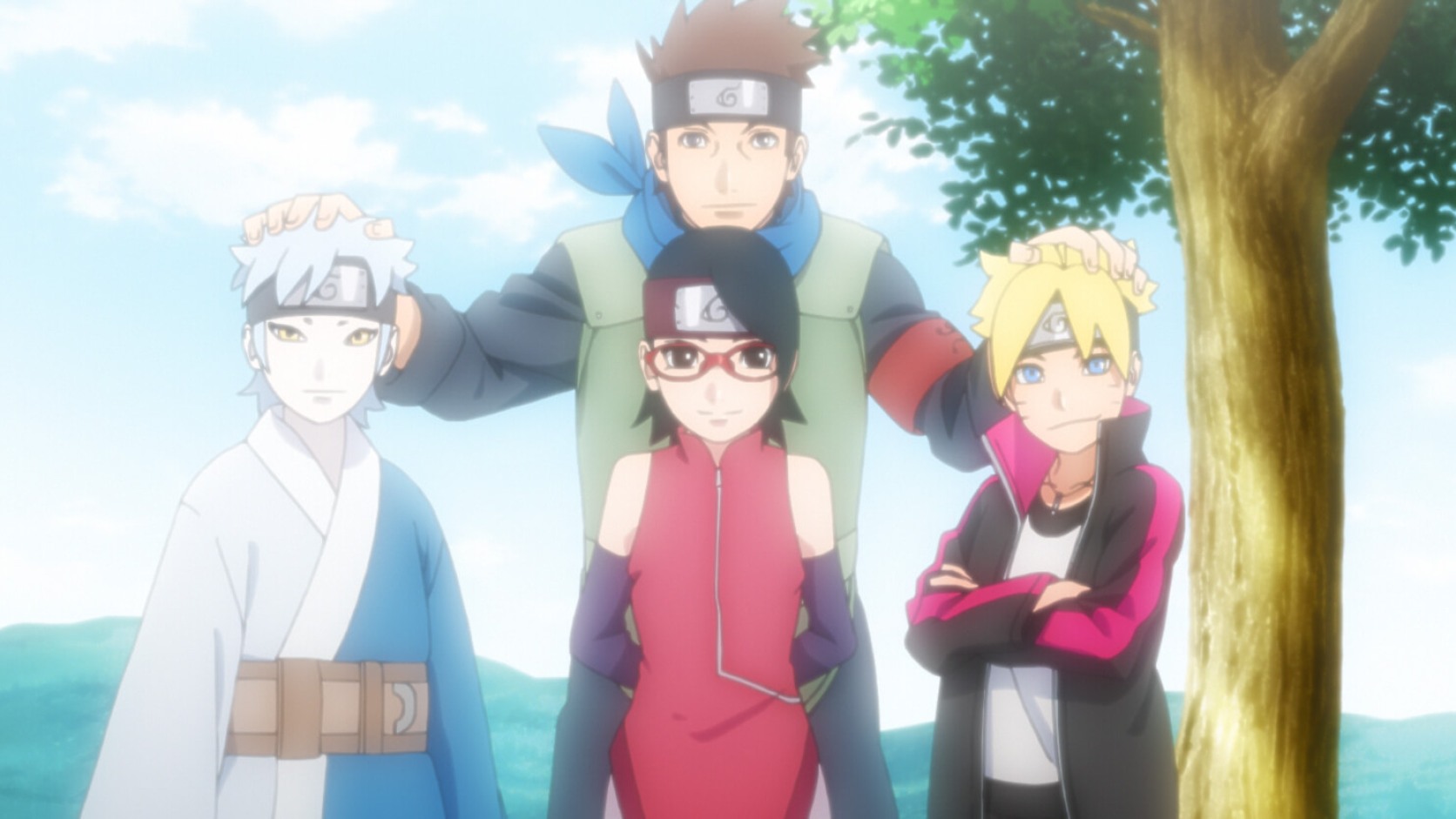
Team 7’s Last Mission?!
Sarada steps into captaincy while Team 7 asks for one final mission under Konohamaru, proving that a healthy transition can hold celebration, grief, and continued mentorship.
Series: Boruto: Naruto Next Generations
Episode: 227 · Team 7’s Last Mission?!
Arc: Chunin Re-Examination
Release: December 5, 2021
Previous: Episode 226 · Samurai vs. Science
Directory: All 293 Boruto episodes
Bottom line
Boruto Episode 227 promotes Sarada into Team 7's captaincy, relieves Konohamaru of his old role, and lets the team ask for one final mission under him when his assignment goes wrong. The episode understands that a healthy transition can still hurt. Nobody has to resent Sarada for the team to grieve a familiar structure.
The question mark and exclamation point in the title do real emotional work. This is not the end of Team 7's relationships. This is the end of one version of daily life. Konohamaru can remain family without remaining captain, and Sarada can lead without pretending she no longer needs mentorship.
The episode at a glance
- Series: Boruto: Naruto Next Generations
- Episode: 227
- Title: Team 7's Last Mission?!
- Arc: Chunin Re-Examination
- Original release: December 5, 2021
- RaeRae rating: Four and a half bowls of ramen out of five
- Core question: How should a village transfer authority to a teenager without withdrawing the support that made growth possible?
Sarada's promotion changes the team
Sarada becoming chunin is not only an individual achievement. Captaincy alters how missions are assigned, who makes final calls, and how responsibility moves between friends.
The village should explain those changes plainly. A new title without written authority and boundaries creates confusion when a dangerous decision arrives.
Her teammates also need space to adjust. Supporting Sarada does not require instant comfort with every consequence.
Konohamaru is relieved of command
The administrative logic makes sense: a chunin can captain a genin team. The emotional transition is larger than a staffing change.
Konohamaru taught, protected, corrected, and accompanied them through formative missions. Removing the title does not erase that labor.
Konoha should mark the transition with a debrief, records handoff, and continuing mentorship plan rather than treating relationships like interchangeable assignments.
Grief does not insult Sarada
Boruto and Mitsuki can feel sad about losing Konohamaru as captain while believing in Sarada. Those truths do not compete.
Young people often hide grief when change is officially positive. Celebration can make sadness seem ungrateful.
The team needs permission to name what ends. Honest grief protects Sarada from becoming the person blamed for feelings nobody discussed.
One final mission can provide closure
Their request to work under Konohamaru again gives the transition a concrete shape. A final shared assignment can create memory, transfer knowledge, and allow goodbye through familiar practice.
The mission should not become a secret test Sarada must pass before she deserves leadership. Her promotion already happened.
Closure works when everybody understands the purpose and no one is forced to perform a perfect farewell.
Konohamaru's missing mission changes the request
When his assignment goes awry, nostalgia becomes concern. Team 7 wants to help the person who has repeatedly helped them.
That loyalty matters. The village still needs to assess information, risk, jurisdiction, and whether emotional closeness may distort judgment.
Approving the team should mean providing intelligence and backup, not simply trusting the strength of their bond.
Naruto's quick approval deserves scrutiny
Naruto knows Team 7's capability and understands their relationship with Konohamaru. Immediate trust can feel affirming.
As Hokage, he also owes a documented risk assessment. Sai and Shikamaru's reservations should not be dismissed as lack of faith.
Good leadership hears concern, explains the decision, and sets contingencies. Confidence is not a substitute for planning.
Sarada needs real command authority
If she is captain, adults and teammates must treat her decisions as meaningful. Symbolic leadership would leave her accountable for outcomes without control over resources or strategy.
She should know mission objectives, escalation rules, communication routes, and conditions for withdrawal.
Authority also includes the power to request help. A leader who cannot call backup has been given blame rather than command.
Sarada is still a teenager
Promotion recognizes demonstrated readiness for greater responsibility. Sarada remains a developing person who needs sleep, guidance, education, and protection.
Konoha should not convert competence into endless availability. Her first commands need adult oversight and structured feedback.
The village proves faith in young leaders by supporting them after the ceremony, not by disappearing.
Boruto must adjust to his friend's authority
Boruto and Sarada already challenge each other. Captaincy gives those disagreements an institutional shape.
He does not become voiceless, but he must learn how to raise concerns without undermining command in front of the team.
Sarada must listen without treating dissent as disloyalty. Their friendship can make that work stronger if both accept new boundaries.
Mitsuki should not disappear between them
Leadership stories can turn Mitsuki into the calm third person who follows whichever friend speaks last. He deserves independent judgment.
Sarada should invite his assessment directly, and Mitsuki should practice disagreement when the plan has gaps.
A team becomes safer when quiet members do not have to compete for permission to be heard.
Konohamaru needs an identity beyond Team 7
Losing a daily command role can create grief for the mentor too. Konohamaru has invested personal pride in the team's development.
He should be allowed to miss the structure without clinging to authority. Growth means recognizing that successful teaching eventually changes the relationship.
Konoha should offer meaningful work and mentorship opportunities rather than treating reassignment as disappearance.
Mentorship should survive promotion
Sarada will face decisions she has never made before. Continued access to Konohamaru can help her interpret mistakes and build confidence.
Mentorship after promotion must avoid covert command. Advice should support her authority rather than replace every uncomfortable choice.
Regular private review gives her room to ask questions without performing certainty for teammates.
The team needs a command protocol
Friendship alone cannot decide how urgent disagreements work. Team 7 should establish who speaks on mission, how objections are raised, and when any member may call for withdrawal.
Emergency authority should be clear before danger. Sarada also needs a process for documenting decisions afterward.
Structure protects relationships because every conflict does not have to become personal.
The rescue mission carries emotional bias
Konohamaru is not an anonymous shinobi to them. Love may sharpen attention and may encourage reckless speed.
Sarada's first major command challenge is separating urgency from panic. She must ask what evidence supports the route and which risks the team can accept.
Adults should account for emotional proximity when approving the assignment.
A last mission should not require a sacrifice
Stories often make transition meaningful through injury or death. Team 7 does not need tragedy to prove love.
The healthier ending allows everyone to return, speak honestly, and continue in changed roles.
Closure built through survival and conversation is not less dramatic. Closure is more useful to young people who must live after the episode.
Mission records should transfer with care
Sarada needs relevant history about team strengths, injuries, recurring risks, and past decisions. Privacy still limits what Konohamaru may disclose.
A proper handoff distinguishes operational knowledge from personal confidences shared with a mentor.
Trust would be damaged if promotion made every private conversation available to a new captain.
Sarada needs administrative training
Captaincy includes reports, logistics, scheduling, equipment checks, and communication with clients. Combat talent cannot replace those skills.
The village should teach her how to document uncertainty, report mistakes, and advocate for team resources.
Invisible labor is still leadership. Konoha should not wait for paperwork failure before offering instruction.
Teammates need a way to report concerns
Boruto and Mitsuki should be able to raise safety or conduct concerns without destroying friendship or bypassing Sarada casually.
The village needs a confidential escalation route for serious issues and a normal team process for ordinary disagreements.
Accountability protects Sarada too. Leaders deserve systems that catch problems before one decision becomes a crisis.
Konohamaru should receive feedback
The team's growth reflects his teaching, and his mistakes deserve review. A transition is an opportunity to examine what prepared Sarada and where Team 7 still lacks support.
Feedback should not become a popularity vote from students. Mission outcomes, safety, communication, and development provide stronger evidence.
Mentors grow when institutions review teaching as seriously as combat.
Naruto must separate father and Hokage
Boruto's presence makes the approval personally complicated. Naruto should not grant access because his son asks or deny access to appear impartial.
Neutral advisors and documented standards can reduce that conflict.
Transparency protects Boruto from favoritism claims and protects the village from decisions shaped by family guilt.
Sai and Shikamaru provide necessary resistance
Advisors who question a mission are not enemies of Team 7. Their job includes seeing risks loyalty may hide.
Naruto should invite concrete objections and answer each one. If the mission proceeds, those concerns should shape safeguards.
A leader surrounded only by agreement loses information.
Sarada's authority needs public recognition
Clients, other shinobi, and officials must know she is captain. If adults keep looking past her toward a male teammate or former leader, responsibility and authority will split.
Konoha should introduce her role clearly and intervene when bias undermines command.
She should not have to overperform toughness to make the title real.
Leadership is not emotional invulnerability
Sarada may worry about Konohamaru while directing the mission. Feeling does not disqualify her.
The relevant question is whether she can recognize emotion, seek input, and prevent fear from silently controlling the plan.
Leaders become dangerous when institutions teach them to hide every human response.
The team can preserve rituals
Losing Konohamaru as captain does not require abandoning every shared routine. Meals, check-ins, or occasional training can continue by choice.
Ritual helps relationships survive structural change. Participation should remain flexible as new responsibilities develop.
Continuity becomes comforting when nobody uses tradition to deny the new reality.
Promotion should increase compensation and support
Greater responsibility deserves practical resources. Sarada needs appropriate pay, equipment access, insurance, medical coverage, and protected recovery.
Praising leadership while relying on unpaid emotional and administrative labor would exploit ambition.
The village must attach material support to the title rather than offering prestige alone.
Failure needs a safe landing
Sarada will eventually make a command mistake. The village needs review procedures focused on learning, accountability, and repair.
One failure should not become proof that a girl, an Uchiha, or a teenager was inherently unfit.
Specific consequences and mentorship create safer leaders than shame.
Success should not end supervision
A strong first mission may tempt adults to withdraw too quickly. Early success can hide luck or unresolved gaps.
Support should taper according to evidence across time, not one satisfying result.
Sarada deserves the freedom to grow gradually even when she looks ready in public.
Team 7 is changing rather than ending
The title teases finality, but relationships outlive a command chart. Konohamaru's role changes, Sarada's expands, and the boys must renegotiate how they participate.
That is a more mature story than preserving childhood structure forever.
Growth asks everyone to release one shape without treating the past as disposable.
What the episode gets right
Episode 227 lets joy and grief occupy the same transition. Sarada's promotion matters, and the team's sadness about Konohamaru remains legitimate.
The final mission gives their bond action without requiring anybody to deny the administrative change.
A captain needs the right to say no
Sarada's authority should include declining an assignment when information, staffing, or recovery time is inadequate. A leader who may only accept orders has responsibility without meaningful discretion.
Refusal should trigger review rather than automatic punishment. Officials can ask for evidence and propose safeguards while respecting that the person closest to the team may see risks a desk misses.
Teaching Sarada to say no responsibly will protect Konoha more than rewarding obedience under every condition.
Team members need informed consent
Boruto and Mitsuki remain subject to mission orders, but young shinobi should understand objectives, known hazards, and limits before departure. Classified details may be restricted without making the briefing empty.
The final mission carries extra emotional weight because Konohamaru is involved. Each member should be able to name concern privately rather than agreeing under friendship pressure.
Consent inside a military system is imperfect, which increases the institution's duty to protect young people from coercion.
Medical readiness belongs in the briefing
Boruto's Karma risk, recent battles, and medication cannot be treated as background whenever the plot wants Team 7 active. Medical staff should assess readiness and provide an emergency protocol.
Sarada needs only information necessary to keep the team safe. Boruto retains privacy beyond operational relevance.
The village should not force him to choose between confidentiality and competent support. Clear boundaries can preserve both.
Konohamaru cannot supervise his own rescue
The person who normally regulates Team 7 is the person in danger. That removes a familiar layer of protection at the exact moment emotions run high.
Another qualified adult should monitor the mission, maintain communication, and hold authority to send backup. Sarada can remain field captain without becoming the only responsible decision-maker.
Redundant support is not disrespect. Redundancy is how serious systems survive unexpected failure.
Rescue goals need clear limits
“Bring Konohamaru home” carries emotional force and operational ambiguity. The briefing should specify the primary objective, civilian risk, intelligence priorities, and conditions requiring retreat.
A rescue team can become additional casualties when success is defined without boundaries. Sarada needs permission to preserve her team even if the first plan fails.
The hardest leadership decision may be withdrawing long enough to return with proper support.
Boruto's initiative needs a channel
Boruto often notices opportunities quickly and acts before consensus. Sarada should not try to crush that instinct. She needs a way to receive the information without losing control of the plan.
A concise challenge protocol can help: Boruto states the observation, risk, and proposed action; Sarada decides or requests more detail.
Structure turns impulsive energy into usable team intelligence.
Mitsuki can stabilize without becoming invisible
Mitsuki reads people and environments quietly, which may help Sarada detect tension before conflict becomes dangerous. That contribution deserves explicit invitation.
He should not be assigned permanent emotional mediation simply because he appears calm. Sarada and Boruto remain responsible for their own communication.
The team benefits when Mitsuki's insight informs strategy rather than merely smoothing other people's relationship.
Sarada needs room to change a decision
Young leaders may cling to an initial plan because revision feels like admitting weakness. Konoha should teach that updating a decision when evidence changes is a core command skill.
Teammates also need language for supporting a revision without celebrating that the captain was wrong.
Flexible leadership protects the mission and makes honest reporting more likely.
Konohamaru's praise should remain specific
Telling Team 7 that they have grown can feel meaningful. Specific observations will serve them longer.
He can name Sarada's judgment, Boruto's awareness, Mitsuki's analysis, and the moments when coordination improved. He should also identify risks that still need work.
Specific praise becomes evidence they can carry into future missions rather than a sentimental farewell line.
The village should document the transition
Personnel changes affect mission eligibility, access permissions, reporting chains, and client communication. Konoha needs records updated before confusion produces harm.
Sarada should receive copies of relevant policies in language she can understand and a named contact for questions.
Administrative clarity is not less important because the team already knows one another.
Clients must respect a teenage captain
Some adults may ignore Sarada, speak only to Boruto, or demand Konohamaru when they see how young she is. The village must back her role publicly.
Support includes explaining the team structure before arrival and providing escalation when a client becomes abusive or discriminatory.
Sarada should not have to win a second Chunin Exam during every conversation.
Leadership training needs simulation
Before high-risk independent command, Sarada can practice briefings, resource allocation, evacuation, casualty decisions, and conflict management through supervised scenarios.
Simulation allows failure without making civilians pay the cost. Feedback can focus on the decision process rather than whether the scripted mission happened to end well.
Combat competence deserves the same structured transition into command that any specialized profession would require.
The team needs protected recovery afterward
A successful rescue may produce relief so strong that everybody skips emotional processing. Delayed fear, anger, or guilt can still appear.
Konoha should schedule medical checks, rest, and a confidential debrief before another assignment. Team members should have access to separate support as well as group review.
Recovery is part of mission completion, not an optional reward.
Konohamaru can mentor without hovering
Continued support should not require him to appear on every mission or overrule Sarada from the sidelines. Availability and scheduled review may be enough.
He must tolerate watching her make different choices from the ones he would make. Advice becomes useful when Sarada remains the author of her command.
The relationship grows when trust includes distance.
Sarada should not inherit every old problem
Promotion may tempt officials to transfer unresolved team dynamics, paperwork gaps, and safety risks to the new captain. A handoff must identify institutional responsibilities rather than quietly privatizing them.
Sarada can work on communication. She cannot repair staffing, medical policy, or mission classification alone.
Leadership development becomes exploitation when the village labels structural failure a teenager's growth opportunity.
A team story needs ordinary continuation
After the final mission, the most convincing sign of transition may be something small: a new briefing routine, Sarada asking for input, Konohamaru meeting them for food, or Boruto catching himself before interrupting.
Large rescue scenes show devotion. Ordinary habits show whether the new structure can last.
Team 7's future will be built in repeated days, not one ceremonial goodbye.
The farewell belongs to all four of them
Konohamaru, Sarada, Boruto, and Mitsuki will each understand the transition differently. No single speech can summarize every bond.
They deserve room for gratitude without rewriting the difficult missions, arguments, fear, and mistakes that shaped the team. Honest memory can hold affection and criticism together.
The final mission matters because they choose one another again under changing terms. That choice gives the old Team 7 shape a respectful ending while leaving every relationship alive enough to grow beyond the title.
Where the episode needs care
Naruto's trust cannot replace formal risk assessment, especially when the mission involves his son and a missing mentor.
Sarada also needs continuing adult support. Making a teenager captain should not become an excuse for institutional withdrawal.
RaeRae verdict
Boruto Episode 227 earns four and a half bowls of ramen out of five. Team 7 does not need to choose between celebrating Sarada and loving Konohamaru. The ache comes because the old structure mattered.
The strongest ending lets Konohamaru step back without vanishing and lets Sarada step forward without pretending she has nothing left to learn. A title changes authority. Care, memory, and mentorship can remain.
Before the next episode
Episode 228, “Kawaki's Path to Becoming a Ninja,” shifts toward Kawaki's attempt to enter a system built around teamwork, rules, and trust he has little reason to believe.
Watch whether Konoha offers preparation and choice or expects belonging to appear through performance.
Sources and lawful viewing
The official Naruto site provides the Episode 227 synopsis and gallery. Crunchyroll carries “Team 7's Last Mission?!” where regional availability permits. Release and streaming details can vary by country.
Official episode reference: Naruto Official episode guide
Licensed episode route: Crunchyroll licensed series page
After watching, ask what support Sarada receives after becoming captain. Promotion without mentorship is abandonment dressed as confidence.