
Return
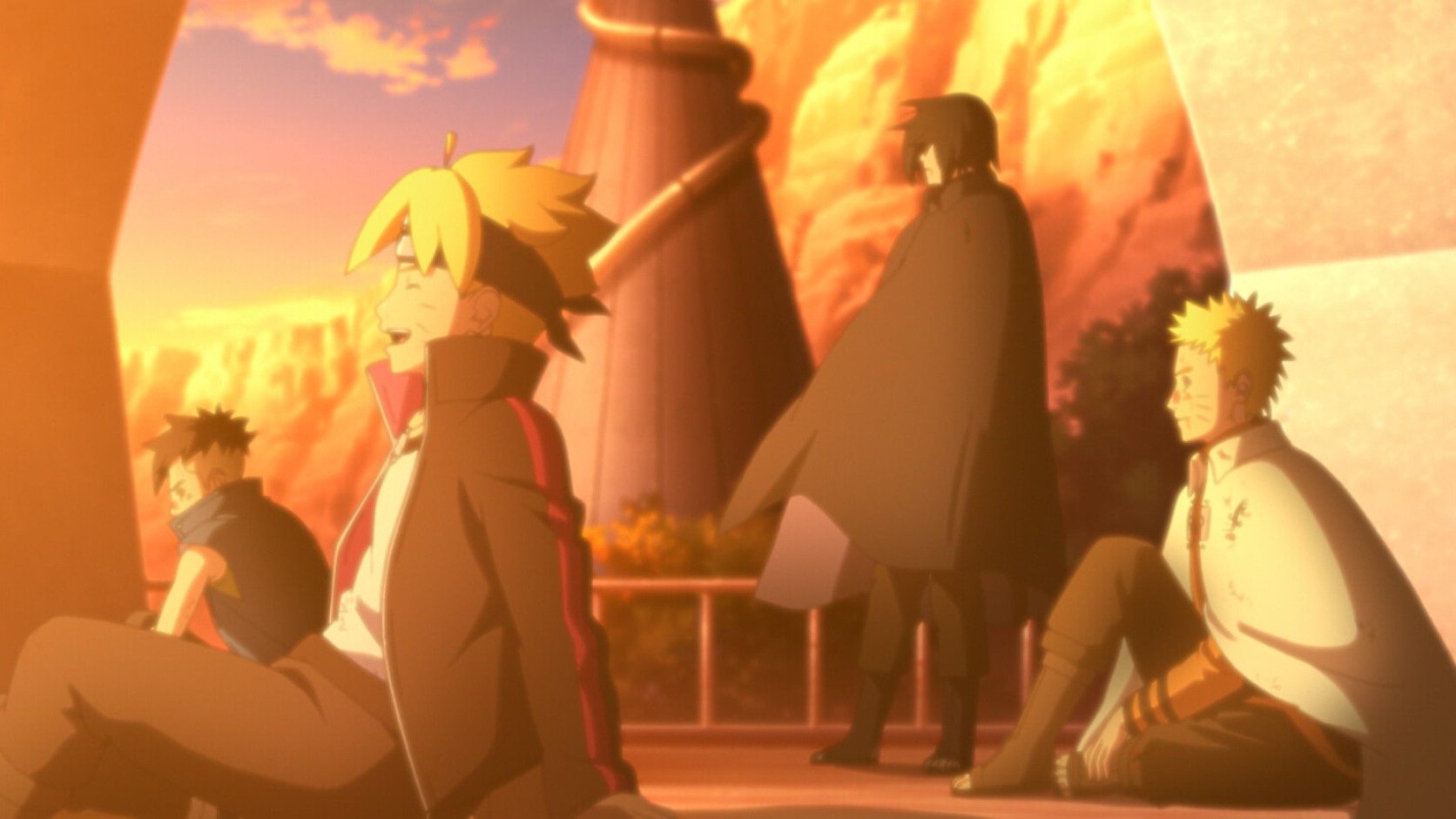
Coming home means using the Karma Boruto fears, facing Sasuke’s injury and Kurama’s absence, and learning that Code can carry Kara’s unfinished violence forward.
Series: Boruto: Naruto Next Generations
Episode: 219 · Return
Arc: Kawaki: Otsutsuki Awakening
Release: October 10, 2021
Previous: Episode 218 · Partner
Directory: All 293 Boruto episodes
Bottom line
Boruto Episode 219 gets Naruto, Sasuke, Boruto, and Kawaki back to Konoha, then asks whether coming home means anybody feels safe. Sasuke’s Rinnegan can no longer open the route. Boruto must use the same Karma that allowed Momoshiki to steal his body and attack his mentor. The portal home becomes a test of control performed by a child who has every reason to fear his own hands.
Konoha celebrates survival while the people who saved Konoha carry a death, a permanent injury, possession trauma, and the knowledge that Kara still has Code and a Ten-Tails. Amado says Code’s power exceeds Jigen’s and explains that limiters restrain him. Isshiki’s final will reaches Code and redirects grief into revenge. The enemy changes, but the dangerous pattern stays familiar: one powerful man treats another person’s devotion as a delivery system for his unfinished plans.
The title promises more than travel
“Return” can mean crossing dimensions, reaching home, regaining consciousness, or finding ordinary life after catastrophe.
The episode completes the first meaning. Every emotional return remains unfinished.
The group has no easy doorway
Sasuke’s Rinnegan once carried the dimensional route. Momoshiki destroyed that capacity through bodily injury.
Getting home now depends on Boruto’s Karma, the same mark everyone has reason to distrust.
Boruto must use the source of his fear
He cannot simply avoid Karma after possession. His family and mentor need the ability connected to the invasion of his body.
That demand is cruel even when necessity makes the attempt reasonable.
Control is not a switch
Boruto cannot prove permanent safety by opening one portal successfully. Consciousness, chakra, exhaustion, emotion, and Momoshiki’s extraction all shape the risk.
A successful return should build evidence, not false certainty.
Sasuke cannot solve the route anymore
His injury changes the group’s logistics immediately. A function once concentrated in one person disappears.
The loss deserves more than surprise over a reduced power set. Sasuke has experienced damage to his body and independence.
Disability is not defeat
Sasuke remains observant, skilled, experienced, and responsible after losing the Rinnegan. Changed capacity does not erase personhood or value.
Konoha should offer treatment and adaptation without treating him as a broken tool.
Boruto may feel responsible for Sasuke’s injury
Momoshiki used Boruto’s body to strike. Boruto will see the wound on someone he loves and remember no choice behind the action.
Adults must name the aggressor clearly. Momoshiki caused the injury.
Guilt can ignore logic
Knowing intellectually that possession removed control may not stop Boruto from feeling shame. Trauma does not wait for a perfect argument.
Support needs patience, repetition, and room for anger as well as reassurance.
Sasuke should tell the truth without blame
Minimizing the injury could protect Boruto for one conversation and deepen guilt later. Honest care works better.
Sasuke can acknowledge pain and loss while refusing to assign responsibility to the child whose body was stolen.
The portal becomes exposure therapy without a therapist
Boruto confronts Karma again almost immediately because everyone needs a way home. No gradual process prepares him.
Success may build confidence. The emergency still should not become a model for future mental-health care.
Kawaki understands the mark differently
He knows the fear of a body becoming a route for another person. His presence can offer recognition without pretending their experiences match exactly.
Shared trauma can create solidarity, but neither boy should become the other’s only support.
Naruto cannot rely on Kurama
The inner presence that accompanied him since infancy is gone. His body, chakra, senses, and emotional world have changed at once.
The episode should treat that absence as bereavement, not merely a combat adjustment.
Survival can feel wrong after loss
Naruto expected Baryon Mode to kill him. Kurama died instead. Relief may arrive beside guilt.
Living does not betray the partner who chose to save him.
The village sees a returning Hokage
Residents may read Naruto’s presence as proof that the crisis ended cleanly. They cannot see every cost.
Public reassurance should not require Naruto to hide grief or perform strength before receiving care.
Family should come before the podium
Hinata and Himawari deserve direct information about Naruto and Boruto before official statements turn them into symbols.
The Hokage office can wait long enough for a family to see one another.
Homecoming needs triage
Naruto needs assessment after Baryon Mode. Sasuke needs treatment for his eye. Boruto needs evaluation after possession. Kawaki needs trauma support after facing Isshiki.
One victory report cannot substitute for four care plans.
Medical privacy remains real
Karma and Baryon Mode carry security implications. Public interest does not erase patient rights.
Konoha should separate information needed for defense from details that belong to the people receiving treatment.
Boruto’s fear deserves adult language
He worries that Momoshiki will take control again. Calling the fear weakness would be ridiculous after Sasuke’s injury.
Fear here is evidence. Adults should help him build safeguards around accurate danger.
Reassurance needs a plan
“Everything will be fine” cannot answer possession. Boruto needs monitoring, warning signs, consent-based containment, and clear emergency roles.
Specific preparation offers more comfort than empty certainty.
Containment should preserve childhood
Security measures can easily become constant surveillance, isolation, or exclusion from school and friends.
Konoha must protect people without turning Boruto’s entire identity into Momoshiki risk.
Kawaki also needs ordinary life
Isshiki’s death removes the immediate attempt to reclaim him. Years of abuse and modification remain.
Freedom should include breakfast, school, arguments, training, privacy, and futures unrelated to vessel status.
No new Karma is a real victory
Kawaki denied Isshiki’s final attempt. That freedom deserves recognition before the next threat swallows every conversation.
He should hear plainly that his body belongs to him.
Victory does not create instant healing
The absence of Isshiki may leave Kawaki waiting for punishment that never comes. Trauma often preserves an abuser’s schedule inside the survivor.
Predictable care can help his body learn that the danger changed.
Amado redirects the room toward Code
The scientist introduces the next threat while everyone still processes the last one. Operationally, Konoha needs the warning.
Emotionally, the timing can prevent survivors from receiving any pause.
Code was never a footnote
He guarded the Ten-Tails and remained loyal to Isshiki. Leadership death can activate a follower rather than dissolve an organization.
Kara’s danger cannot be measured only through the person at the top.
Power exceeding Jigen changes the threat model
Amado says Code possesses exceptional strength restrained by limiters. Konoha now knows another enemy may surpass the form Naruto and Sasuke barely survived.
That claim demands evidence, details, and contingency planning.
Limiters create a dangerous dependency
If Amado installed or understands Code’s restraints, he may hold critical knowledge about removal, maintenance, and failure.
Konoha should not let one defector remain the only archive for that system.
Ask who can remove the limiters
A restraint matters only while access remains controlled. Investigators need identities, locations, authentication methods, and fallback risks.
Vague knowledge that limiters exist can produce false confidence.
Amado’s accuracy increases trust narrowly
His explanation of Isshiki’s resurrection and lifespan proved useful. That supports confidence in related expertise.
Correct predictions do not grant blanket innocence or complete credibility.
Every new claim needs its own evidence
Code’s power, loyalty, abilities, and restrictions should be recorded separately. Konoha can update confidence as facts emerge.
Good intelligence resists the temptation to trust a personality instead of evaluating information.
Isshiki turns death into an order
His remaining will appears before Code and frames continuation as devotion. The dying leader refuses to let his goals die with him.
Legacy becomes another form of possession.
Code receives grief and assignment together
He reveres Isshiki, so loss creates emotional vulnerability. Isshiki gives that pain a target and mission.
Manipulation often works by making obedience feel like the only meaningful way to mourn.
Devotion does not erase agency
Code remains responsible for choices he makes after receiving Isshiki’s will. Influence explains direction without making future violence automatic.
Accountability and manipulation can exist in the same person.
Kara builds identity around usefulness
Members become vessels, guards, scientists, cyborgs, and tools. Code’s loyalty grows inside a system that measures people by service to Isshiki.
The organization survives because roles replace selves.
Konoha should offer exit routes
Not every person connected to Kara may share Code’s devotion. Safe surrender, witness protection, and rehabilitation could weaken the network.
Military response alone can reinforce the belief that nobody has another home.
The Ten-Tails remains a living threat
Isshiki’s death does not remove the creature from Kara’s custody. A world-ending resource still exists.
Konoha needs location intelligence, access planning, and cooperation beyond one village.
International warning cannot wait forever
The Otsutsuki threat crosses borders and dimensions. Other villages deserve enough verified information to prepare.
Secrecy should protect operations, not preserve Konoha’s control over knowledge.
Naruto’s reduced capacity affects diplomacy
Other leaders may calculate differently once Kurama is gone. Hiding the change could create surprise and mistrust.
Disclosing every detail could expose vulnerability. Naruto needs a deliberate strategy rather than shame-driven silence.
Sasuke’s injury changes shared defense
Dimensional travel and reconnaissance become harder. Allied villages may need to contribute different abilities or technology.
Redundancy should grow through cooperation, not pressure to replace Sasuke as a person.
Boruto becomes essential and endangered again
His Karma may now provide the best dimensional route while Momoshiki makes using Karma dangerous. The strategic need can intensify coercion.
Adults must keep consent visible every time they request his ability.
One successful portal does not create permanent duty
Boruto helping everyone return does not obligate him to become Konoha’s dimensional transportation system.
Emergency contribution should not harden into unpaid lifelong service.
The village needs alternatives
Scientific tools, sealing research, allied techniques, and recovered Kara data may support future travel. Developing backups protects Boruto from exclusivity pressure.
Innovation should reduce dependence on endangered children.
Return requires a route for the injured
Opening a portal is only part of extraction. Naruto and Sasuke may need physical support crossing, while everyone remains alert for another Momoshiki shift.
Logistics turn a supernatural doorway into an actual rescue.
The group must trust Boruto again
Sasuke has just been attacked through Boruto’s body. The return depends on Boruto controlling the same mark.
Trust here is not denial of risk. Trust is a choice supported by observation and shared need.
Boruto must trust himself enough to try
Possession can fracture confidence in every sensation and decision. Opening the portal requires action despite uncertainty.
Success belongs to Boruto without proving future fear irrational.
Kawaki can support without taking over
He understands Karma mechanics and Boruto’s terror. Encouragement can help.
The final decision to use the mark remains Boruto’s whenever circumstances allow a decision.
Naruto’s presence may steady both boys
He cannot summon Kurama’s old power, but care does not vanish with chakra. His belief still shapes how Boruto and Kawaki see themselves.
Fatherhood is not a technique that expires.
The story needs room for Kurama’s absence
Moving immediately to Code risks treating Kurama’s death as the price already paid and filed. Naruto’s grief deserves continuity.
Loss should affect quiet scenes, habits, dreams, and identity beyond one goodbye.
Memorial should name Kurama as a person
Konoha may remember the Nine-Tails through attack, fear, or Naruto’s victories. A full account should include captivity, anger, choice, partnership, and sacrifice.
Calling him Naruto’s power would repeat the oldest injustice.
Sasuke’s recovery should remain visible
Bandages cannot close every consequence. He may face depth-perception changes, pain, altered technique, and reliance on others during healing.
Adaptation belongs in the story, not outside the frame.
Boruto needs sleep without suspicion
Momoshiki appeared when Boruto was exhausted. Rest may now feel dangerous to him and everyone nearby.
Medical monitoring should create safety without making sleep resemble detention.
Families need guidance about uncertainty
Hinata and Himawari may fear Boruto while fearing for Boruto. Both reactions can exist without reducing love.
Professionals should help the family discuss risk, boundaries, and reassurance openly.
Public rumor can harm Boruto
If residents learn that Momoshiki attacked Sasuke through him, some may label Boruto an enemy. Secrecy alone cannot contain every story.
Leadership should prepare accurate language that protects the child and acknowledges safety concerns.
Public gratitude can harm him too
Calling Boruto the hero who saved everyone may pressure him to hide terror and continue using Karma.
Praise should leave room for refusal, treatment, and ordinary adolescence.
Kawaki may face public blame
Isshiki attacked Konoha to reclaim him. Residents could confuse being targeted with causing the attack.
Naruto should state clearly that Kawaki bears no responsibility for another person’s violence.
Amado’s asylum needs continued terms
Useful information supports protection from Kara. The agreement should also require disclosure, evidence preservation, and cooperation with oversight.
Asylum and accountability do not cancel each other.
The village needs an independent record
Amado should not become the author of every official account about Kara. Testimony from Kawaki, Boruto, Sasuke, recovered data, and other sources matters.
History controlled by one expert becomes another dependency.
Code needs analysis beyond power level
Motivation, attachments, beliefs, access, allies, and decision patterns may reveal more useful openings than raw strength.
Konoha defeated Isshiki through time and relationships, not a simple number.
Grief can make Code predictable and unpredictable
Devotion may drive him toward named targets. Pain may also produce choices Isshiki never ordered.
Threat planning should use patterns without assuming total control.
Victory should fund prevention
Konoha survived because individuals spent bodies, abilities, and lives. The response should invest in medical care, intelligence redundancy, civilian readiness, and child protection.
A parade without reform asks the same people to pay again.
Return should restore choices
Boruto needs choices about treatment and training. Kawaki needs choices beyond security. Naruto needs choices about grief and leadership. Sasuke needs choices about rehabilitation.
Home matters because home should offer agency.
The episode understands unfinished safety
Isshiki is gone, the group returns, and Konoha remains standing. Code, the Ten-Tails, Momoshiki, and trauma remain.
Safety can improve without becoming absolute.
Debriefing should not become interrogation
Konoha needs an exact account of Isshiki’s abilities, Momoshiki’s takeover, the portal, Baryon Mode, and Kawaki’s shadow clone. Fresh memories have operational value.
The survivors are injured and grieving. Investigators should pace questions, permit advocates, distinguish medical care from intelligence collection, and avoid treating gaps in memory as deception. Boruto literally lost control of consciousness. A humane debrief can preserve evidence without turning trauma into another test he must pass.
Mission reports need multiple voices
Naruto, Sasuke, Boruto, and Kawaki experienced different parts of the battle. Amado observed through information he already understood. No single account can contain the full event.
Separate statements help Konoha identify uncertainty and contradiction without forcing consensus too early. Shared truth grows stronger when institutions do not make the most authoritative adult the automatic owner of everyone else’s memory.
The academy needs a careful response
Boruto’s classmates may notice absence, rumors, new restrictions, or fear around Karma. Teachers need accurate guidance that protects privacy and prevents bullying.
School should remain a place where Boruto can learn and belong, not another security checkpoint. Safety accommodations should be developed with him, his family, medical staff, and educators rather than announced as punishment.
Himawari needs age-appropriate truth
Adults may decide that silence protects her from Naruto’s condition, Kurama’s death, or Boruto’s possession. Children usually notice fear long before adults finish hiding the cause.
She deserves an explanation matched to her age, permission to ask repeated questions, and reassurance grounded in the actual care plan. Family protection should not make her responsible for decoding every whisper.
Hinata carries invisible aftermath
Her husband and son disappear into another dimension, return injured, and bring home losses that reshape daily life. Public stories may center the fighters while expecting her to organize recovery quietly.
Emotional labor, medical coordination, parenting, and grief are work. Hinata needs support rather than an assumption that love automatically supplies unlimited capacity.
Naruto’s office should distribute responsibility
The Hokage cannot recover if every security decision, public statement, and diplomatic call waits at his bedside. Delegation protects both leader and village.
Shikamaru and established teams should carry defined authority while Naruto heals. A government that collapses without one exhausted person has confused charisma with resilience.
Sasuke’s family deserves honest inclusion
Sakura and Sarada should not receive only a clinical summary or sanitized mission line about the Rinnegan. The injury affects family routines, future missions, and Sasuke’s sense of self.
They deserve direct communication and room for their own reactions. Sasuke’s privacy matters, and privacy should not become isolation from people he trusts.
The next threat should not cancel the current patients
Code may demand immediate planning. The Ten-Tails may demand international attention. Those dangers do not make Naruto, Sasuke, Boruto, or Kawaki less worthy of present care.
Institutions reveal their values when a new emergency arrives before the last survivors recover. Good leadership expands teams and distributes work rather than pushing injured people back into service because their knowledge remains useful.
Returning home should include food and sleep
Epic battles still end inside ordinary bodies. The group needs hydration, nutrition, warmth, clean clothing, pain relief, and uninterrupted rest.
Those details may sound small beside an Otsutsuki invasion. Small care tells survivors that they are people again, not mission assets awaiting the next briefing.
What the episode gets right
Episode 219 makes the route home depend on Boruto confronting the power he fears. That tension keeps return from feeling automatic.
The Code warning also refuses the fantasy that one leader’s death dissolves an abusive organization.
Where the episode needs care
Amado’s exposition can pull attention away from the injured and grieving people in front of him. Intelligence matters, but aftermath needs space.
Boruto’s possession fear should remain a healthcare and autonomy issue, not only a future battle complication.
RaeRae verdict
Boruto Episode 219 earns four and a half bowls of ramen out of five. Everybody comes home, and nobody comes home unchanged. Boruto has to trust the Karma that betrayed him. Sasuke returns without the eye that once opened dimensions. Naruto returns without the partner who lived beside his heartbeat. Kawaki returns free from Isshiki and still surrounded by the machinery Isshiki built.
Then Amado says Code. Of course he does. Kara does not disappear because the worst man in the room finally dies. Systems leave followers, weapons, secrets, and grief ready for recruitment. Return matters because home should become the place where survivors receive care and where institutions learn enough to stop demanding the same sacrifice with a different villain’s name.
Before the next episode
Episode 220, “Remaining Time,” brings Boruto’s Karma progression and future into direct discussion. Watch who controls the timeline, which treatments get offered, and whether a frightened child receives enough truth to consent.
A countdown can guide care or become coercion. The difference lives in who gets a voice.
Sources and lawful viewing
The official Naruto site provides the Episode 219 synopsis and gallery. Crunchyroll carries “Return” where regional availability permits. Release and streaming details can vary by country.
Official episode reference: Naruto Official episode guide
Licensed episode route: Crunchyroll licensed series page
After watching, ask what home owes the people who return. Applause is easy. Treatment, privacy, grief, accountability, and alternatives require a village to do more than celebrate.