
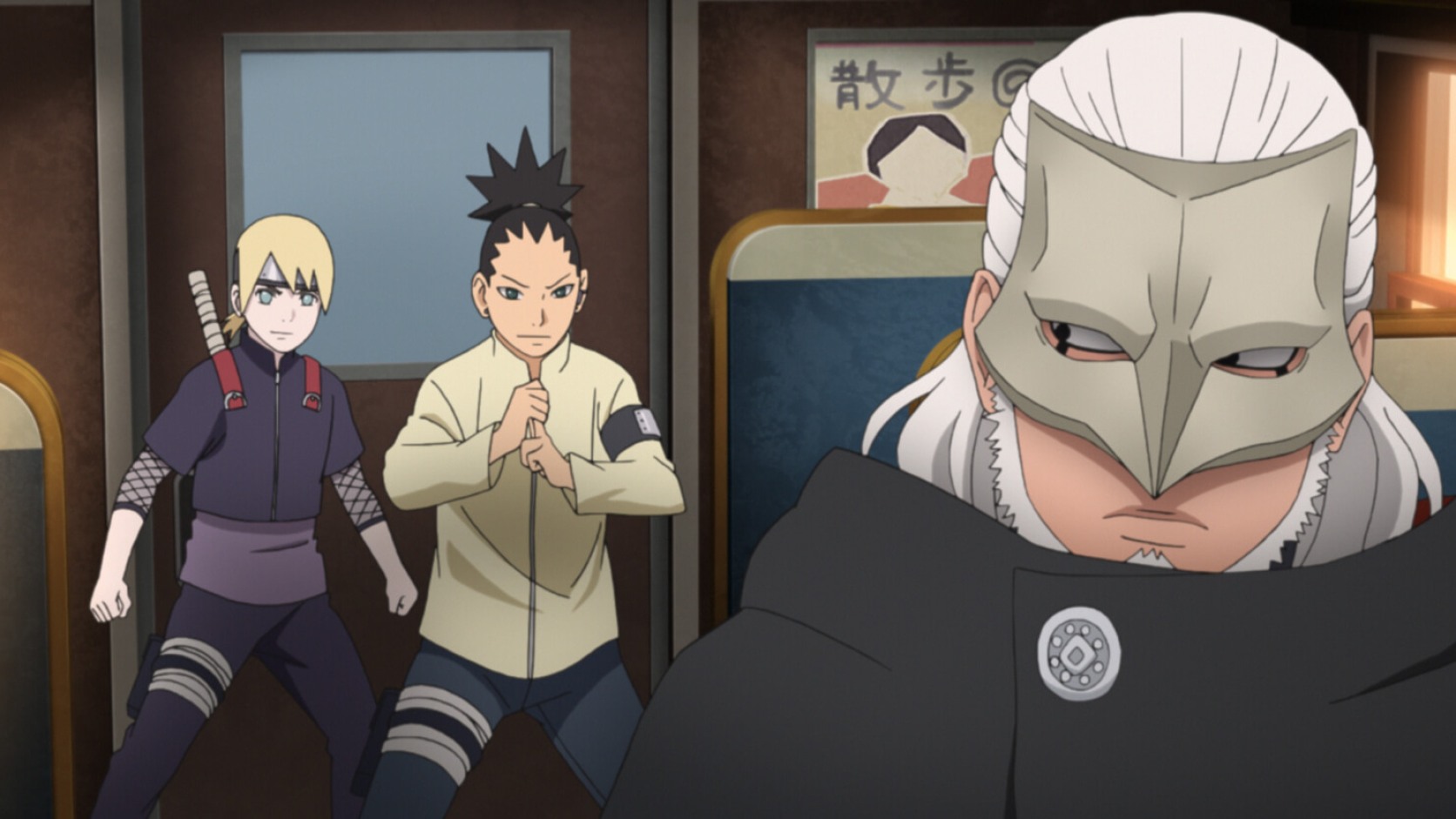
The Chase
Kashin Koji turns Konoha’s pursuit into cover for an archive theft, while Kakashi and Team 10 discover that the visible escape was only the loud half of a quieter plan.
Series: Boruto: Naruto Next Generations
Episode: 211 · The Chase
Arc: Kawaki: Kara Clash
Release: August 15, 2021
Previous: Episode 210 · Clues to Kara
Directory: All 293 Boruto episodes
Bottom line
Boruto Episode 211 turns a masked trespasser into a test of how Konoha protects information, and the village fails in ways shinobi muscle cannot repair. Kashin Koji enters the archive, lets a false escape draw security toward the wrong target, and uses the confusion to reach older physical records that never entered the digital system. Team 10 follows the available evidence. Kakashi recognizes that the obvious chase may be theater. Nobody behaves foolishly, yet Koji still leaves with knowledge he chose in advance.
The episode works because the theft is not random villain business. Koji knows Konoha well enough to predict patrols, barriers, pursuit habits, and archival weaknesses. His interest in records from before the Fourth Great Ninja War points toward identity, memory, and a connection the story has refused to name. Kara appears united from the outside, but Koji’s private mission says otherwise. The intruder is stealing from Konoha while also preparing to break from the organization that sent him.
A chase can hide the real crime
The title promises movement, and the episode gives viewers movement through streets, trees, rooftops, and guarded corridors. That speed is useful camouflage. Everyone watching the masked figure run can forget to ask which object already moved in the opposite direction.
Koji understands attention as a resource. He does not need to defeat every guard when he can decide where guards look. The pursuit becomes part of the burglary, which makes the village’s strongest response help the thief finish his work.
The archive holds more than paper
Konoha’s archive stores identities, missions, techniques, deaths, alliances, and decisions that powerful people once classified. A record room is a map of who the village trusted, feared, used, protected, and abandoned.
Stealing one file can expose a person. Stealing a carefully chosen set can expose how an institution thinks. Koji wants more than trivia about old shinobi, and the period he targets makes that intention hard to dismiss.
Digital security creates a comfortable illusion
The village appears to treat digitized records as the modern center of information security. Screens, alerts, copied files, and monitored access produce the feeling that every important movement can be seen.
Older material complicates that confidence. Records that never entered the system remain outside digital monitoring, search logs, and automated alarms. Konoha protected the newer door while Koji came for the older room.
Physical records are not automatically safer
Paper cannot be hacked across a network, but paper can be photographed, removed, misfiled, burned, replaced, or read by someone already standing inside the building. Physical custody still needs access controls and a reliable chain of possession.
Konoha’s archive appears to rely heavily on location and guards. Koji turns both protections into predictable obstacles. A locked room offers little safety when an intruder knows the route, the staffing pattern, and the response plan.
Team 10 starts with evidence
Shikadai, Inojin, and Chocho receive reports about a cloaked man and begin tracing what witnesses saw. They do not have the complete answer, so they follow the visible sequence.
That approach is responsible. Investigators should not invent a hidden plan before evidence supports one. The problem comes when the opponent deliberately manufactures the evidence trail everyone is trained to follow.
Shikadai notices the story is too convenient
Shikadai’s strength has never been magical certainty. He watches how pieces relate, tests the obvious explanation, and looks for the cost of accepting the first answer.
The escaped figure draws an enormous amount of attention away from the archive. Once Shikadai recognizes that imbalance, the chase stops looking like the whole operation and starts looking like bait.
Inojin brings surveillance without omniscience
Inojin can search from above and extend the team’s visual reach. His birds help track movement that ground patrols could miss.
More coverage still does not create perfect knowledge. A camera, sensor, or ink bird records a field chosen by somebody. Koji succeeds partly because he shapes that field before the watchers arrive.
Chocho refuses to become background labor
Chocho participates in the search rather than serving as comic relief between Shikadai’s deductions. Her presence matters because a team should not become one strategist with two assistants.
Different eyes catch different behavior, and distributed attention makes a pursuit harder to manipulate. The episode could give Chocho more decisive material, but she remains part of the working investigation.
Kakashi recognizes performance
Kakashi has spent decades reading traps, false movements, substitutions, decoys, and people who hide one intention inside another. A masked intruder performing an obvious escape speaks a language he understands.
His experience does not make him psychic. Kakashi reaches the stronger explanation because the intruder’s choices fail to match a simple getaway. Behavior becomes evidence when the analyst can explain the mismatch.
The former Hokage still patrols the village
Kakashi no longer holds the office, yet retirement has not removed his responsibility or his instincts. He moves through Konoha as someone who knows the public streets and the classified architecture beneath them.
That role creates a useful contrast with Naruto’s administration. Kakashi can act without managing the entire village response, while Naruto must think about Kawaki, Kara, security, diplomacy, and public risk at once.
Koji knows how Konoha will react
The intruder predicts that visible theft will trigger pursuit, alerts, and tightened exits. His plan depends on village competence, not village stupidity.
That detail makes the breach more serious. A defense can fail because the opponent studied standard procedure and built the operation around predictable success. Training creates strength and patterns an adversary can exploit.
Familiarity is the loudest clue
Koji moves through Konoha with ease that exceeds ordinary reconnaissance. Streets, barriers, archive practices, and shinobi habits feel known rather than recently memorized.
The story has been planting that discomfort for a while. Episode 211 does not provide the full answer, but viewers have enough evidence to treat his relationship with the village as personal history rather than tourist-level intelligence.
The mask protects more than a face
Koji’s mask blocks identification, but secrecy also protects the meaning of his reactions. Kakashi cannot read recognition from an exposed expression, and Konoha cannot place the intruder inside a familiar biography.
The disguise turns a person into a threat category. That helps Koji escape because defenders respond to an unknown enemy instead of asking which known life could explain his knowledge.
Kakashi and Koji mirror one another
Both men use patience, deception, technical skill, and a deep understanding of shinobi behavior. Neither treats the encounter as a contest that must end with a dramatic knockout.
Their brief confrontation feels tense because recognition almost exists without a name. Kakashi reads methods that belong too comfortably inside Konoha’s history. Koji reads a veteran capable of ruining the timetable.
The Rasengan changes the question
Koji’s Rasengan is not merely a dangerous technique. The jutsu carries lineage, training history, and association with people deeply tied to Konoha.
A technique cannot prove identity by itself. Shinobi knowledge can be copied, stolen, taught, or reconstructed. The Rasengan still narrows the mystery because the story has already paired the technique with Koji’s physical and tactical familiarity.
Recognition should remain evidence, not a verdict
Viewers may already have theories about Koji. Kakashi’s reaction encourages those theories without authorizing every conclusion.
Good mystery writing allows an audience to assemble clues before confirmation. Good editorial reading keeps the difference between supported inference and revealed fact visible, especially when later knowledge makes earlier scenes look obvious.
Koji wants records from before the war
The date boundary matters. He does not take the most recent Kara intelligence or a random list of active shinobi.
Prewar records may contain identities, biological histories, mission files, remains, techniques, or administrative traces that later systems summarized badly. Koji knows which era contains the missing answer he needs.
The undigitized gap preserves forgotten power
Institutions often digitize what staff consider useful, current, or easy to classify. Material that appears obsolete can remain on shelves with weaker discovery and weaker oversight.
That gap can protect history from deletion and hide history from accountability. Whoever controls the old boxes controls facts that modern dashboards cannot display.
Metadata would have helped Konoha
Even when a physical document stays on paper, a secure catalog can record title, date, classification, location, authorized users, and every access event. The catalog does not need to expose the document’s contents.
Konoha’s response suggests that the village cannot immediately identify what Koji targeted. Better inventory would narrow the damage and help officials determine which people need protection.
Least privilege matters in a shinobi archive
No guard, clerk, or investigator should receive access to every record simply because someone works inside the building. Access should match a role, mission, and verified need.
Koji’s plan exploits the assumption that reaching the archive equals reaching the information. Layered compartments could force him to reveal more of his objective before locating the correct material.
A barrier is not an incident-response plan
Konoha has sensory defenses and controlled entrances, but detection only begins the response. Staff must verify the alarm, preserve evidence, protect other zones, and avoid sending every defender toward the same visible threat.
Koji turns the first alarm into direction for the second breach. A mature response would split containment, pursuit, archive lockdown, and evidence review among separate teams.
Decoys exploit organizational habits
The false intruder works because Konoha values catching the person seen fleeing. That goal feels urgent, visible, and easy to explain.
Protecting the records requires a quieter decision: some shinobi must stay behind while everyone else runs. Koji gambles that the spectacle will outrank the boring responsibility, and he wins enough time.
Speed cannot replace coordination
Shinobi can cross rooftops in seconds, but fast bodies do not guarantee fast understanding. Each unit sees one part of the breach and acts on local information.
Shared communication needs more than shouting that a suspect escaped. Teams need a current incident picture, confirmed facts, uncertainty labels, protected zones, and someone responsible for testing whether the apparent goal makes sense.
Team 10 learns while moving
The younger shinobi revise their theory instead of defending the first version out of pride. Shikadai connects the diversion to the archive, and the team redirects attention.
That correction deserves respect. Competence does not mean guessing correctly before the episode begins. Competence means noticing when evidence changes and moving before ego wastes the remaining window.
Children still carry adult security failures
Team 10 performs well, but the village once again places young shinobi inside a threat connected to a transnational organization experimenting on children and attacking a Hokage.
Training assignments can build judgment. Kara-level incidents require adult backup, medical readiness, and clear authority. Praising Team 10 should not erase the institution’s duty to control the danger around them.
The mission gives Team 10 meaningful agency
The episode does not make the younger team wait for Kakashi to explain every clue. They interview, search, interpret, and act within the unfolding response.
Their contribution changes the pursuit even though Koji escapes. Agency can matter without manufacturing a child victory over a far more experienced opponent.
Failure is not the same as uselessness
Konoha does not stop the theft, and Koji avoids capture. The investigators still learn how the breach worked, which records drew interest, and how the intruder operates.
An honest debrief should preserve those gains without pretending the outcome was acceptable. Institutions improve when staff can name both competence and failure in the same report.
Koji chooses information over spectacle
He does not stay for a grand fight with Kakashi. The records matter more than proving superiority.
That discipline separates Koji from villains who treat every encounter as a stage. His willingness to withdraw tells viewers that the hidden project has a deadline and a purpose larger than personal pride.
Kara’s internal fracture is already active
Koji’s mission makes little sense as ordinary Kara intelligence gathering when Amado is preparing his own escape. The organization’s members no longer share one future.
Private plans turn every piece of stolen information into leverage. Koji may serve a conspiracy inside the conspiracy, which means Konoha faces both Kara and the collapse happening within Kara.
Amado needs a bargaining position
A defector cannot walk into a powerful village and expect trust because he says the enemy is dangerous. He needs knowledge, proof, and something the village cannot easily obtain elsewhere.
Koji’s archive theft may strengthen that position by filling gaps about people, identities, or historical material tied to their plan. The records become part of a negotiation Konoha does not yet know has started.
Defection does not erase responsibility
Leaving Kara would not make Amado or Koji innocent. Both men participated in an organization that kidnapped, modified, deceived, and killed people.
Konoha may need their information. Necessity should produce conditions, monitoring, testimony, and accountability rather than automatic moral clearance.
Stolen information can still reveal a true threat
Koji’s methods violate Konoha’s security, but the knowledge he seeks may help expose Kara. Harmful acquisition and useful content can coexist.
The village will need to separate the value of evidence from the trustworthiness of the person delivering the evidence. Accepting a fact does not require accepting every motive attached to the fact.
Konoha should notify people exposed by the breach
Once officials identify the stolen records, anyone whose identity, family, technique, medical history, or mission history appears inside should receive a warning when disclosure does not create greater danger.
Silence may protect institutional embarrassment more than people. Those affected need enough information to change routines, protect relatives, and report suspicious contact.
Classified status does not cancel personal stakes
A file may belong legally to the village while describing a human life. Officials often treat classified loss as damage to the institution alone.
Koji’s theft can endanger descendants, teammates, witnesses, and communities whose names remain inside old records. Security response should account for those living consequences.
The archive needs provenance after the breach
Investigators must determine which shelves Koji reached, which containers moved, whether pages were copied, and whether any document was replaced.
Without provenance, Konoha could later trust a record Koji altered. Integrity matters alongside secrecy because a false document inside a trusted archive can misdirect future decisions for years.
Preservation and security are not enemies
Officials may respond by locking old records away so completely that historians, families, and accountable investigators can never examine them. That reaction would protect secrecy and deepen institutional amnesia.
Konoha needs tiered access, preservation copies, audit trails, and review rules. A secure archive should support legitimate memory rather than bury every uncomfortable decision.
Old records may contain old injustice
Prewar Konoha includes Root, clan surveillance, secret missions, jinchuriki policy, wartime choices, and decisions made by leaders who rarely explained themselves to affected families.
Koji’s theft reminds viewers that hidden history still shapes present danger. The village cannot defend every old secret merely because an enemy wants the file.
Security review should ask why the file existed
After a breach, institutions often focus on doors, guards, passwords, and blame. Those questions matter, but they do not address whether the archive collected too much or kept harmful information without review.
Konoha should examine retention, consent, accuracy, and appeal alongside physical security. A protected record can still represent an unjust policy.
Kakashi carries institutional memory
He has served as child soldier, ANBU operative, teacher, wartime commander, and Hokage. Few people can connect archive security to the human consequences hidden inside those roles.
His pursuit of Koji therefore carries more than tactical tension. Kakashi is chasing someone through a history he helped inherit and partly governed.
The episode trusts quiet intelligence work
No giant battle settles the mystery. Observation, route analysis, record selection, and timing drive the conflict.
That choice gives the Kara storyline needed texture. Threats built from laboratories, archives, identities, and defectors require more than stronger jutsu.
Direction keeps the intruder ahead without making everyone slow
Koji controls when characters see him, where they follow, and which clue arrives late. The episode’s staging makes the gap feel planned rather than protected by plot armor.
Kakashi closes that gap through experience, and Team 10 closes part through reasoning. Koji escapes because his objective was narrow and his exit prepared.
The village setting makes the threat personal
Kara previously felt connected to remote facilities, hidden bases, cult compounds, and battlefields. Koji moves through ordinary Konoha streets and enters a room built from village memory.
The breach removes comfortable distance. Naruto’s home, government, family, and history now occupy the same operational space as Kara’s internal plans.
Koji’s silence does narrative work
He does not explain his history to Kakashi or announce Amado’s strategy. The silence protects the mission and forces behavior to carry meaning.
That restraint works because the episode supplies concrete clues. Mystery becomes irritating only when writers hide answers without giving viewers anything useful to examine.
Shikadai inherits a difficult kind of intelligence
His father serves Naruto through strategy and administration. Shikadai increasingly confronts problems where the correct move depends on institutions, incomplete reports, and other people’s concealed goals.
The episode lets him practice revision under pressure. That skill may matter more than solving a classroom puzzle because real intelligence work punishes certainty built on partial facts.
Inojin’s family history fits the breach
Sai knows secret organizations, controlled records, false identities, and the damage created when a village hides its methods. Ino works inside communication, sensory networks, and community care.
Inojin stands at the meeting point of those histories. The episode does not lecture about that inheritance, but his role in tracking a concealed intruder fits naturally.
Chocho deserves a sharper investigative payoff
Her confidence and social awareness could help with witnesses, contradictions, or noticing behavior that a pure tactical model overlooks. Episode 211 leaves some of that potential unused.
Team 10 works better when each member changes the answer. Future missions should give Chocho evidence nobody else can gather rather than treating participation as sufficient development.
An incident report should preserve uncertainty
Konoha knows a masked intruder entered, a decoy redirected pursuit, old records were targeted, and Kakashi encountered a skilled shinobi with familiar techniques. Officials do not yet know the full identity or purpose.
Recording those boundaries matters. A confident but unsupported name could trigger retaliation, surveillance, or diplomatic action against the wrong person.
Surveillance evidence is not neutral
Every sensor reflects placement, capability, access, and institutional priority. Konoha sees what the village decided to watch.
Koji uses unwatched spaces and expected reactions. The breach shows that more surveillance does not automatically create better judgment, especially when one adversary understands the system’s blind spots.
Security can become an excuse for wider control
The Hokage’s office could answer the breach by expanding monitoring across residents, visitors, and former outsiders. That move may collect more data while increasing suspicion around people who had no connection to Koji.
Targeted improvements should begin with archive design, response coordination, access logs, and known Kara methods. Indiscriminate surveillance would shift the cost toward the public.
The village needs independent review
Security teams auditing themselves may focus on individual mistakes and protect the system that shaped those mistakes. An outside review can ask why procedures encouraged everyone to chase the same target.
Independent does not mean uninformed. Reviewers need clearance, technical knowledge, and authority to examine leadership decisions without punishment.
Nobody should become the scapegoat for Koji’s planning
A guard followed an alarm. Team 10 followed witnesses. Kakashi pursued the real intruder and forced him to adapt. Each action made sense within the information available.
Blaming one person would hide the structural weakness Koji exploited. Accountability should identify choices, training gaps, and design failures without pretending one embarrassed employee caused the breach.
What the episode gets right
“The Chase” respects intelligence as a process rather than a magical answer. Team 10 gathers evidence, Shikadai revises the theory, Kakashi reads the opponent’s performance, and Koji succeeds through preparation.
The episode also connects Kara’s next phase to Konoha’s buried history. A theft of old records becomes a bridge between institutional memory and a conspiracy breaking apart from within.
Where the episode needs care
Chocho receives less investigative weight than Shikadai and Inojin, and the archive’s staff remain mostly functional background. More attention to the people responsible for records would make the breach feel less like a room waiting for named shinobi.
Konoha’s follow-up also matters. Security stories often end when the intruder escapes, even though notification, document review, and procedural repair should begin at that moment.
RaeRae verdict
Boruto Episode 211 earns four bowls of ramen out of five. The masked man running through Konoha is the easy part to watch. The better part is realizing that the chase was designed to make competent people protect the wrong thing at the right speed.
Koji leaves with records, Kakashi leaves with suspicion, and Team 10 leaves with a lesson no academy puzzle can teach cleanly. Evidence can be real and still be planted. A modern archive can be vulnerable because nobody mapped the paper room. A defector can carry useful truth while remaining responsible for serious harm. Konoha has a security breach, but Kara has a loyalty breach, and the second problem is about to walk through the village’s front door.
Before the next episode
Episode 212, “Amado’s Defection,” moves the internal Kara fracture into public view when Amado seeks asylum in Konoha and brings information powerful enough to force a hearing.
Watch how the village separates urgent intelligence from trust, and whether Amado treats knowledge as testimony, leverage, threat, or all three at once.
Sources and lawful viewing
The official Naruto site provides the Episode 211 synopsis and gallery. Crunchyroll carries “The Chase” where regional availability permits. Release and streaming details can vary by country.
Official episode reference: Naruto Official episode guide
Licensed episode route: Crunchyroll licensed series page
After watching, ask which failure matters more: Koji reaching the archive, or Konoha having no immediate way to know every life contained in the records he took. The answer should shape the response long after the rooftops become quiet.