
Clues to Kara
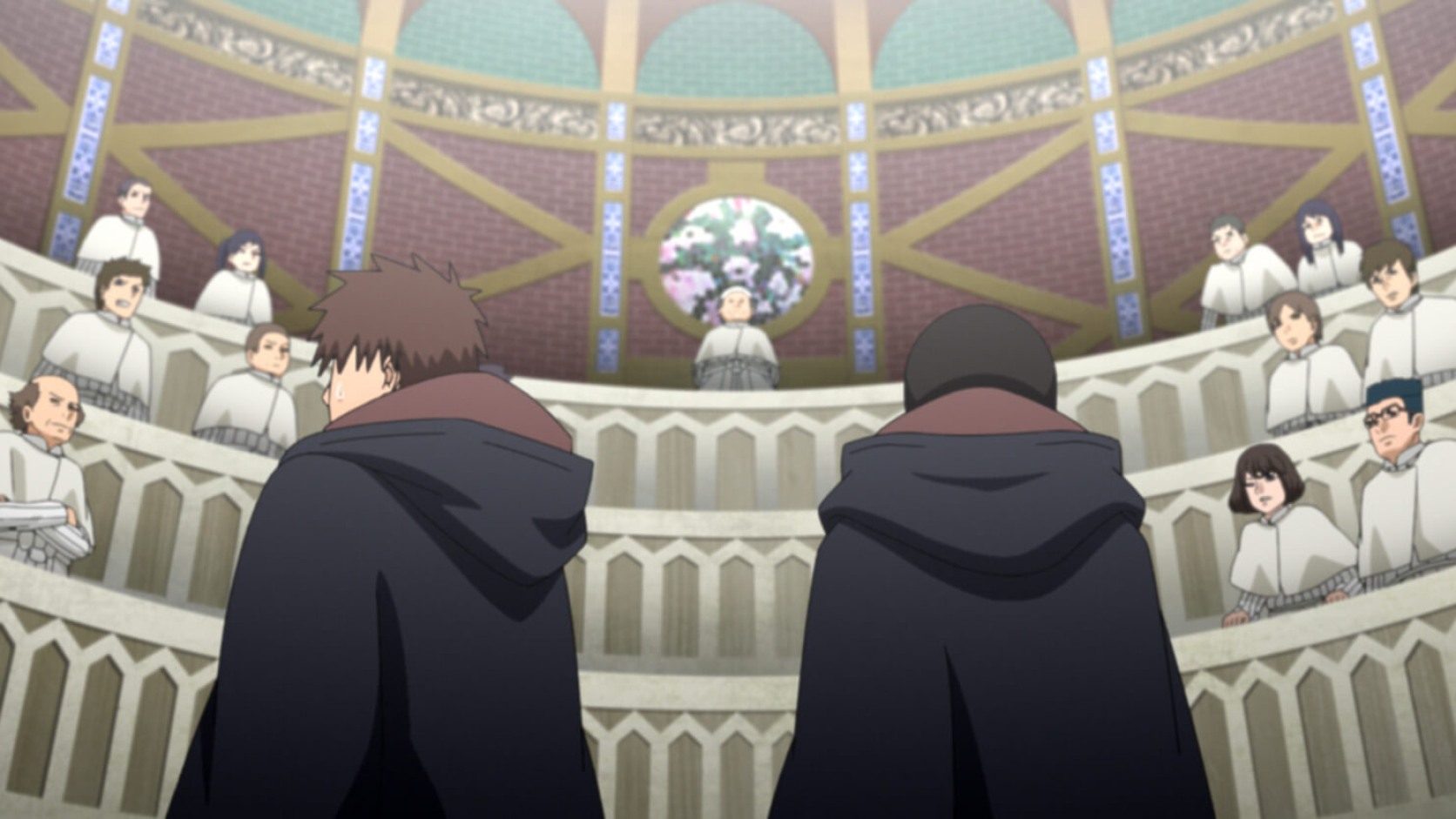
Sai and Konohamaru enter Boro’s congregation for intelligence and discover that Kara’s most revealing evidence lives among people taught to mistake exploitation for salvation.
Series: Boruto: Naruto Next Generations
Episode: 210 · Clues to Kara
Arc: Kawaki: Kara Clash
Release: August 8, 2021
Previous: Episode 209 · The Outcast
Directory: All 293 Boruto episodes
Bottom line
Boruto Episode 210 sends Sai and Konohamaru into Boro’s cult looking for Kara and finds something harder than a villain’s filing cabinet. The congregation contains sick, grieving, displaced people who received care when larger institutions offered little. Boro used that real relief to build authority, preach Infinite Tsukuyomi as salvation, collect personal information, and feed bodies into Kara’s experiments. Sai maintains the mission’s discipline. Konohamaru struggles when Akari’s dead brother becomes proof that Boro continued manipulating followers through fabricated messages. The investigators uncover records, but Delta destroys the compound before Konoha can preserve every answer. Kara’s trail is damaged. The people Boro exploited are left with grief, disbelief, and a future no raid can repair automatically.
The title promises evidence rather than closure
“Clues to Kara” sets an appropriately modest objective. Konoha does not expect one mission to explain the entire organization.
Clues can establish patterns, names, movement, and methods without producing a complete theory. Responsible investigation leaves uncertainty visible.
Naruto chooses infiltration after direct combat
The Hokage has seen what Kara can do in battle. Force alone cannot reveal networks, supply routes, recruiters, or hidden sites.
Assigning Sai and Konohamaru recognizes that intelligence work is another form of defense.
Sai brings experience with controlled organizations
Root shaped him through secrecy, obedience, emotional suppression, and assigned purpose. He understands how institutions can make coercion feel like necessity.
That history gives him useful discipline and a reason to notice what control does to individual identity.
Konohamaru brings moral urgency
He cares about Naruto, Team Seven, and the village. Learning that Boro used vulnerable people makes professional distance difficult.
Urgency can motivate investigation while also endangering cover. Sai helps him separate feeling from impulsive action.
Their disguises create ethical discomfort
They enter by presenting themselves as seekers rather than Leaf shinobi. Deception is necessary for access and still affects people who may respond sincerely.
Undercover work should acknowledge the trust being borrowed. Mission necessity does not make every manipulation morally weightless.
The congregation does not look like an enemy army
Followers gather in white garments inside an impressive hall. Many appear hopeful, anxious, or curious rather than violent.
Reducing the room to enemy affiliation would erase the conditions Boro exploited.
Boro recruited through unmet needs
Illness, poverty, isolation, and grief created openings. His organization offered treatment, food, shelter, certainty, or community.
Followers did not need to be foolish. They needed help, and Boro attached control to the help.
A useful service can belong to a harmful system
Some people were genuinely healed. That outcome gives the cult credibility and complicates disclosure.
Evidence of benefit does not cancel coercion, secrecy, experiments, or monopolized truth. Both realities must be named.
Gratitude becomes organizational armor
Followers may defend Boro because his care arrived when nobody else did. Criticism can sound like an attack on their survival.
Investigators should avoid mocking the gratitude. The target is the leader who converted relief into obedience.
Inori serves as guide and witness
She explains the community, its members, and Boro’s teachings. Her account reflects sincere belief shaped by experience.
Listening gives Sai and Konohamaru access to the organization’s emotional logic, not only physical layout.
Infinite Tsukuyomi is marketed as salvation
Boro reframes imposed dream captivity as escape from suffering. The promise appeals because real life has delivered pain without adequate repair.
The doctrine offers peace by eliminating agency. A painless prison remains a prison.
The cult controls the future by interpreting death
Akari wants connection to her missing or dead brother. Boro’s organization claims continued communication and offers a story she desperately wants to believe.
Grief becomes leverage when one authority controls every message from the absent person.
The lie about Akari's brother is intimate violence
Fabricated communication enters a private bond and reshapes mourning. Boro does not merely hide a fact. He occupies the relationship after death.
Such manipulation can delay grief, redirect loyalty, and make questioning feel like betraying the deceased.
Konohamaru reacts as a person before an operative
The cruelty angers him. His impulse to expose the lie reflects moral clarity.
Acting immediately could endanger Akari, the congregation, Sai, and the evidence. Emotion needs strategy to become protection.
Sai contains the moment without dismissing the harm
He reminds Konohamaru of the mission and the need to preserve cover. Restraint protects their ability to learn more.
Discipline should serve accountability rather than numbness. Sai’s history makes that distinction especially important.
Intelligence work asks people to carry unbearable knowledge quietly
They know Boro is dead, Kara is dangerous, and followers are being deceived. Revealing everything at once could trigger panic or violence.
Silence may be tactically necessary and emotionally costly. Operatives need debriefing after using restraint around visible harm.
The records reveal a system
Names, medical histories, recruitment pathways, and research connections transform vague suspicion into organizational evidence.
Kara did not operate only through spectacular fighters. Administration helped exploitation scale.
Paperwork can participate in violence
Forms and lists may appear neutral. Within Kara’s system, records identify vulnerable people, possible test subjects, and useful bodies.
Documentation becomes harmful when collected without consent and used to assign human value.
Followers may have been screened as material
Boro’s charitable front gave Kara access to sick or desperate populations. Care created proximity for experimentation.
The betrayal reaches beyond false doctrine. People seeking treatment may have entered a selection pipeline they never understood.
Consent cannot exist inside concealed experiments
A patient cannot agree meaningfully when the organization hides purpose, risk, sponsor, and alternatives.
Receiving treatment does not authorize unrelated research or bodily use.
The cult functions as Kara infrastructure
Belief supplies loyalty, secrecy, recruits, cover, and access to bodies. Boro’s sermons are operational assets.
Ideology and logistics reinforce one another. Destroying a fighter does not dismantle that network automatically.
Boro's death does not end his control
Followers continue repeating doctrine, protecting records, and trusting messages attributed to him.
Charismatic systems can survive leaders because members have reorganized identity and community around the structure.
Exposure must offer an alternative
Telling followers that Boro lied removes certainty, care, and belonging at once. Facts matter, but facts alone do not provide housing, medicine, or community.
Exit support should begin before disclosure whenever possible.
Akari deserves truth with care
She needs accurate information about her brother and Boro’s manipulation. She also deserves control over how, when, and with whom she processes that truth.
Public revelation could turn private grief into evidence for everyone else.
Followers are not equally responsible
Some may have recruited others, enforced rules, concealed harm, or participated in experiments. Others may have arrived recently seeking medicine.
Accountability should follow knowledge, action, power, and coercion rather than applying one label to the entire congregation.
Victim and participant can overlap
A manipulated member may also pressure new recruits or defend abuse. Harm suffered does not erase harm caused.
Repair needs room for complex responsibility without declaring anyone permanently irredeemable.
Sai and Konohamaru need evidence that can survive challenge
Suspicion about Kara is not enough for later action. Records need provenance, context, and secure handling.
Reliable evidence protects against rumor and helps distinguish Boro’s propaganda from operational facts.
Copying information can protect sources
Removing original records might alert the cult or deprive members of documents tied to their lives. Reproducing evidence may preserve cover.
Data collection should still minimize unnecessary personal information and protect vulnerable names.
Personal data needs ethical custody
Konoha may receive medical histories and identities gathered through coercion. Possession of stolen data creates responsibility.
Access should be limited to rescue, investigation, and restitution rather than expanding village surveillance.
Delta arrives as cleanup
Kara understands that abandoned sites and surviving followers can expose operations. Destruction becomes a method of information control.
Her intervention proves that the cult was never independent from the organization’s strategic needs.
Destroying the compound treats people as disposable evidence
The building, archives, and congregation become acceptable losses once secrecy is threatened.
Kara’s disregard confirms the falsehood beneath Boro’s promise of salvation. Followers were resources, not protected believers.
Spectacular destruction can erase quiet victims
The blast or attack may dominate memory because visual scale is dramatic. The deeper loss includes records, histories, shelter, and people’s only community.
An investigation should document those quieter harms.
Evidence destruction does not erase every clue
Sai and Konohamaru have observations, names, doctrine, behavior, and whatever records they preserved. Survivors also carry knowledge.
Kara can damage the archive without restoring complete secrecy.
Witness testimony needs protection
Followers who cooperate may face retaliation from Kara or rejection from remaining believers. Konoha should plan confidentiality and safety before asking for disclosure.
Information extracted without aftercare would repeat the pattern of using vulnerable people.
Konoha's mission cannot end at intelligence collection
The village wants Kara locations and capabilities. The cult reveals humanitarian needs that remain after the report.
Medical care, shelter, grief support, and reintegration belong in the response.
National power helped create the opening
Smaller communities and marginalized people may have lacked reliable institutions long before Boro arrived. Major villages cannot treat that neglect as unrelated background.
Kara recruited where existing systems left needs unanswered.
Countering cult recruitment requires material support
Public warnings about manipulation will not compete with medicine, food, and belonging. Prevention must offer credible alternatives.
People become harder to exploit when survival does not depend on one charismatic gatekeeper.
Faith should not become shorthand for gullibility
The problem is not that followers seek meaning or spiritual community. The problem is centralized authority, deception, coercion, and conditional care.
Healthy faith communities can protect questioning, outside relationships, distributed leadership, and the right to leave.
Infinite Tsukuyomi promises escape without justice
Boro offers a dream instead of changing conditions that produce suffering. The doctrine removes people from reality rather than repairing reality.
Justice asks who caused harm, who controls resources, and what must change. Fantasy surrender asks everyone to stop demanding answers.
Konohamaru sees another side of the enemy facing his students
Team Seven fought Boro’s body. Their teacher now sees the social machinery around that body.
The mission expands his responsibility from combat preparation to helping students understand the system they confronted.
Sai can recognize emotional suppression as control
Root taught him that feelings interfere with duty. Boro’s cult teaches followers to route grief through doctrine.
Different organizations can control emotion through opposite performances: numb obedience or ecstatic belief.
Infiltration risks reenacting control
The investigators lie about identity, gather private information, and influence people who cannot consent to the encounter.
Mission necessity may justify limited deception, but later handling should minimize harm and restore truth where safe.
Operational success can coexist with moral residue
Sai and Konohamaru gain clues and survive. They also leave people whose trust was borrowed and whose world was damaged.
A successful report should name what remains unresolved.
Kara's secrecy relies on compartmentalization
Followers know doctrine. Administrators know records. Inners know pieces of the larger plan. Few people can describe the whole organization.
Investigators must assemble partial accounts without assuming any single witness has complete knowledge.
Contradictions are evidence too
Differences between sermons, records, and observed behavior reveal where propaganda meets operations.
Sai’s discipline helps preserve discrepancies instead of forcing a neat story too early.
The dead brother becomes a test of institutional honesty
Konoha could use Akari’s grief to secure cooperation, repeating Boro’s exploitation in a new direction.
Ethical investigators provide truth without making support conditional on testimony.
Followers need the right not to become informants
Survivors may know valuable details and still refuse involvement because of fear, loyalty, shame, or exhaustion.
Care should not be withdrawn when someone declines to help the investigation.
Accountability should reach beyond Boro
His death cannot absorb responsibility for every experiment, order, and resource flow. Kara benefited as an organization.
The investigation should identify designers, funders, recruiters, guards, and decision makers without turning one villain into a convenient endpoint.
The cult's destruction may strengthen belief
Remaining followers could interpret an attack as persecution or proof that outsiders fear Boro’s truth.
Facts need trusted messengers and material support because destruction alone can reinforce the story leadership taught.
Reintegration cannot demand instant disbelief
People may continue believing parts of Boro’s doctrine after learning about abuse. Identity does not reorganize on command.
Safe exit allows doubt, grief, anger, and contradiction without requiring a perfect ideological conversion.
Community loss deserves mourning
Even a controlling group may contain genuine friendships, routines, and mutual care among members. Leaving can mean losing real relationships.
Acknowledging that grief does not legitimize the organization. Acknowledgment helps people build another life.
The village should audit its own blind spots
How did Boro recruit widely, move resources, and operate medical programs without effective intervention? Kara’s secrecy explains part, not every gap.
Prevention requires examining neglect rather than treating infiltration as the complete answer.
Clues create obligations
Once Konoha knows followers were screened or used, the village cannot treat records only as a path to Kara leadership.
Each name may represent someone needing notification, care, protection, or restitution.
The episode values adult teamwork
Sai restrains Konohamaru when emotion threatens cover. Konohamaru keeps human urgency visible when discipline could become detachment.
Their partnership works because each corrects a different risk.
Neither man should become the sole moral model
Pure restraint could abandon people in front of them. Pure confrontation could destroy the mission and expose everyone.
Ethical action emerges through tension between evidence preservation and immediate care.
Intelligence should serve people rather than consume them
Kara gathered data to classify bodies. Konoha gathers data to stop Kara. Different goals matter.
Methods also matter. Consent, minimization, security, transparency, and restitution keep the investigation from repeating the enemy’s logic.
The investigators need a trauma-informed interview plan
Survivors may tell stories out of order, omit details tied to shame, or repeat Boro’s language while questioning his authority. Those patterns do not automatically prove deception.
Interviews should explain purpose, allow breaks, avoid repeated retelling, and separate access to services from cooperation. Better care also produces more reliable evidence because fear no longer controls every answer.
Akari's brother should remain a person
His death becomes proof that Boro lied, but a human life should not be reduced to the contradiction that breaks a case open. Investigators need to document who he was, what happened, and who else was affected.
Returning that history to Akari matters independently from any lead toward Kara. Restitution begins when the person taken by the system receives a name beyond the file.
Inori may need protection from both sides
As someone who guided newcomers and repeated doctrine, she may face anger from survivors while also carrying information Kara wants erased. Her degree of knowledge and coercion needs careful investigation.
Protection does not cancel accountability. Accountability does not justify exposing her to retaliation before facts are established.
Destroyed records create uncertainty that must stay visible
Partial documents can tempt investigators to fill gaps with assumptions. A name beside a procedure might identify a victim, worker, witness, or intended subject.
Konoha should mark confidence levels and seek corroboration before acting. Urgency cannot turn ambiguous data into a verdict about someone’s role.
Public communication will shape survivor safety
If Konoha announces that the compound was a Kara facility, neighbors may stigmatize every former member as collaborator. If officials say nothing, rumors can let Boro’s remaining leadership control the story.
A responsible statement distinguishes exploited followers from decision makers, protects identities, and explains where people can receive help.
Medical follow-up may reveal hidden experimentation
Former members could carry infections, modifications, implanted devices, or untreated conditions connected to Boro’s work. Screening may be urgent.
Testing must remain voluntary wherever possible and cannot become detention by another name. Patients deserve results, choices, privacy, and treatment unrelated to their value as evidence.
Long-term support is part of counterintelligence
People abandoned after disclosure may return to surviving cult networks because those networks still offer belonging. Reliable care reduces that vulnerability without making support conditional on ideological compliance.
Security and compassion reinforce one another when the goal is durable freedom. Treating survivors as disposable sources would recreate the same opening Kara exploited.
Follow-up should remain available after public attention moves elsewhere. Recovery rarely follows the mission calendar, and trust may arrive months after investigators first ask for help.
What the episode gets right
“Clues to Kara” shows that Boro’s danger continued through records, doctrine, and followers after his death. The cult is not decorative villain scenery.
Sai and Konohamaru bring complementary skills, and their disagreement gives the mission moral texture.
Where the episode needs care
The congregation receives limited individual depth, which can make members appear as a single manipulated crowd. Akari and Inori help, but more voices would strengthen the story.
Konoha’s responsibility toward survivors also deserves follow-through beyond intelligence value.
RaeRae verdict
Boruto Episode 210 earns four and a half bowls of ramen out of five. The most disturbing clue is not a secret weapon. The clue is a room full of people who trusted Boro because he met needs everyone else left unanswered, then learned that care placed them inside Kara’s machinery.
Sai and Konohamaru recover evidence, but the episode wisely leaves moral debris everywhere. Exposing a lie does not return Akari’s brother. Destroying a compound does not build another community. Finding Kara must include caring for the people Kara taught everyone to overlook.
Before the next episode
Episode 211, “The Chase,” follows a masked figure who steals information from Konoha as the village tries to identify the intruder. Kara’s secrecy moves from a distant compound into Leaf surveillance.
Watch how investigators distinguish evidence from assumption and whether protecting information becomes an excuse for indiscriminate suspicion.
Sources and lawful viewing
The official Naruto site provides the Episode 210 synopsis and gallery. Crunchyroll carries “Clues to Kara” where regional availability permits. Release and streaming details can vary by country.
Official episode reference: Naruto Official episode guide
Licensed episode route: Crunchyroll licensed series page
After watching, ask what Konoha owes the congregation after collecting the clues. If the answer ends with a report about Kara, the village has learned from Boro’s files without learning from the people inside them.