
Escape
Kawaki wakes in another laboratory, and Konoha must prove that medical care and security can survive his refusal without becoming ownership.
Series: Boruto: Naruto Next Generations
Episode: 190 · Escape
Arc: Vessel
Release: March 14, 2021
Previous: Episode 189 · Resonance
Directory: All 293 Boruto episodes
Bottom line
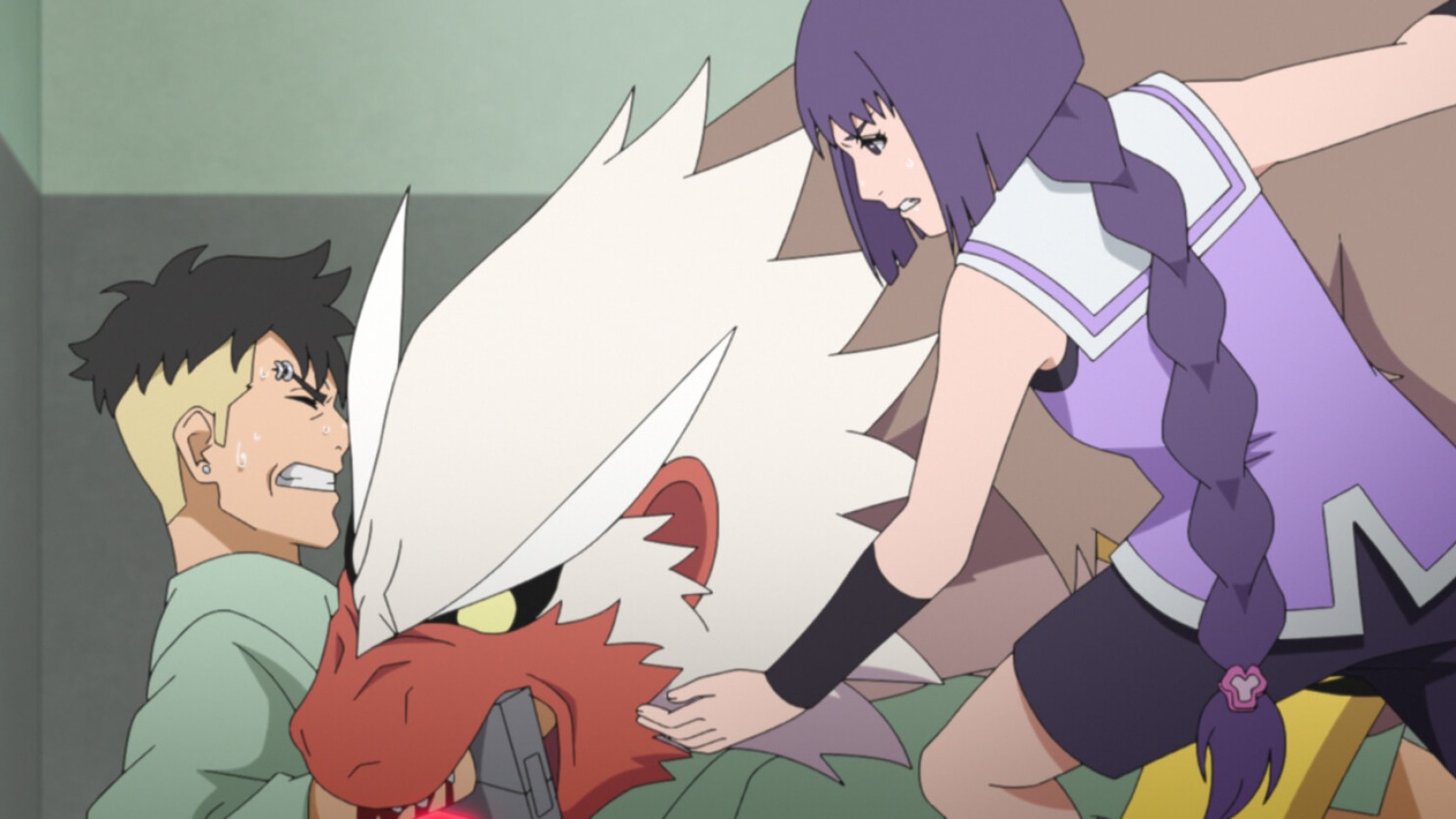
Boruto Episode 190 understands why Kawaki runs, then makes the adults earn the right to call their facility safer than Kara. Team 7 brings an unconscious child to the Advanced Technology Research Institute because medical care and protection are urgent. Kawaki wakes inside a laboratory, under observation, surrounded by scientific ninja tools, and given no reason to believe this institution differs from the one that rebuilt his body without consent. Sumire approaches with patience because she recognizes weaponized childhood, but shared trauma does not grant automatic access. Kawaki refuses food, questions, touch, and containment. Nue attacks when Sumire faces danger, leaving Kawaki injured as he escapes. Nobody gets a clean victory. Care remains ethical only when care survives refusal, security remains legitimate only when restrictions stay accountable, and rescue becomes real only after the rescued person gains choices.
The research institute solves one emergency
Kawaki needed treatment after the fight with Garō. Leaving him unconscious near Kara operatives would have invited recapture or death. Team 7 also needed a secure place where Katasuke could assess modifications nobody else understood.
Those facts justify the transport. They do not settle every decision afterward. Emergency authority answers an immediate danger, not a person's entire future.
Konohamaru reports while Kawaki wakes elsewhere
Konohamaru returns to Konoha to brief Naruto about Ao, Kashin Koji, the crashed transport, Kāma, and the Vessel. Reporting matters because the mission has exposed threats beyond one team's authority.
Kawaki experiences the other side of that process. Adults exchange information about him while he remains absent from the room. Necessary reporting can still make a survivor feel reduced to a case file.
Naruto treats Kara as a village-level threat
Naruto decides to travel to the institute after hearing Kawaki's connection to Kara and Boruto's mark. The Hokage cannot delegate every decision when a hostile organization has altered a child and targeted his son.
Personal concern and public responsibility overlap. Naruto must keep both visible so protecting Boruto does not quietly become permission to control Kawaki.
Kawaki wakes in another laboratory
The institute is not Kara. Katasuke's team works openly, values civilian benefit, and wants to heal rather than manufacture a Vessel. Kawaki cannot verify those distinctions by reading the staff's intentions.
He sees machines, restraints, monitoring, researchers, and a body everyone wants to examine. The visual evidence matches the environment where previous adults hurt him.
A safe place can still trigger terror
Safety is not only the absence of an attacker. A room can be physically secure and emotionally terrifying when every object resembles earlier abuse.
Kawaki's alarm does not prove the institute failed morally by existing. His alarm tells the staff that care must include explanation, predictability, privacy, and control over proximity.
Sumire enters as a caregiver and survivor
Sumire brings food and speaks gently. She also carries her own history of being shaped into a weapon through an adult's grievance. Her connection with Nue began inside coercion and became something chosen.
That history gives her insight, not magical authority. Recognizing another survivor can guide better questions without guaranteeing welcome.
Food is never just food under captivity
Offering a meal looks like the simplest kindness. Kawaki has learned that resources may create debt, lower defenses, or precede another demand.
Refusal therefore communicates more than appetite. He wants proof that accepting nourishment will not become evidence of cooperation or consent to remain.
Care must survive a no
Sumire's good intentions face a real test when Kawaki rejects the offer. Ethical care does not punish refusal through withdrawal, ridicule, or escalating pressure.
She can leave food within reach, explain that no answer is required, and return later. Respect becomes credible through repetition rather than one perfect sentence.
Kawaki studies the room for exits
Kawaki evaluates doors, staff movement, equipment, and possible barriers. Researchers may describe that behavior as agitation. From his perspective, environmental scanning has kept him alive.
The institute should treat escape planning as information about fear. Security precautions may remain necessary, but staff can reduce uncertainty instead of demanding blind trust.
Containment needs a stated reason
Konoha has reasons to prevent Kawaki from disappearing: Kara is searching, his body contains dangerous technology, and civilians could encounter a frightened combatant. Silent confinement still resembles ownership.
Someone must explain each restriction, who authorized the measure, how long the measure lasts, and what evidence could change the decision. Unnamed authority feels permanent.
Sumire knows weaponized childhood from inside
Her father used grief, ideology, and scientific preparation to turn Sumire into an instrument against Konoha. Adults saw a quiet student while she carried an imposed mission and a dangerous power.
That history helps her understand why polite behavior reveals little about internal fear. A child can comply while planning survival.
Similar histories do not become identical histories
Sumire found classmates, received another path, and chose how to live with Nue. Kawaki has just escaped repeated bodily modification and Kara's ownership claim.
Shared themes create empathy, not equivalence. Sumire should avoid promising that her recovery route will work on his timetable.
Kawaki hears scientific ninja tools and expects harm
The institute builds technology meant to assist people. Kawaki's body proves that technology can also enforce domination when consent disappears.
His suspicion targets context rather than engineering alone. Every device exists inside a relationship, and his previous relationship with advanced science involved pain.
Katasuke's team must separate treatment from research
Doctors need information to stabilize Kawaki. Researchers want information about Kara, Kāma, and his modifications. Those purposes overlap without becoming interchangeable.
Kawaki deserves to know whether a scan protects his health, advances general research, or supports intelligence work. Hidden purpose turns care into extraction.
Medical privacy matters during a security crisis
Kawaki's condition concerns Naruto, Katasuke, Team 7, intelligence officers, and probably village leadership. Interest does not grant universal access.
Records should reach only people with a genuine role. Gossip, curiosity, and status should never decide who sees a child's bodily data.
Boruto wants answers too quickly
Boruto's Kāma resonated with Kawaki's mark. His future may depend on information Kawaki carries. Urgency therefore comes from fear, not simple nosiness.
Boruto still cannot demand disclosure from someone waking after severe violence. His right to understand his own body does not cancel Kawaki's right to control testimony.
Kawaki's hostility is not proof of Kara loyalty
Suspicion, threats, and escape attempts can look like resistance to rescue. They can also reflect a survivor who assumes every institution communicates with the captor.
Konoha must evaluate concrete evidence rather than treating noncompliance as allegiance. Fear of authorities is not loyalty to the people who caused the fear.
Sumire's gentleness has limits
Gentle tone helps lower immediate tension. Tone alone cannot repair locked doors, surveillance, and uncertainty about what adults plan to do.
Kind individuals need ethical structures behind them. Otherwise the entire system depends on whether one sympathetic worker remains present.
Kawaki refuses to become a grateful rescue story
People who rescue someone often expect visible gratitude because their intentions feel obvious to themselves. Kawaki offers no reassuring performance.
He does not owe calmness, disclosure, affection, or obedience as payment for surviving. Gratitude may come later, or never. Rights cannot depend on emotional reward.
Escape begins as a survival reflex
Kawaki does not have a stable destination, money, allies, or medical plan. Running still feels safer than waiting for strangers to decide his fate.
That choice is dangerous and understandable. Calling the plan irrational without naming the captivity behind the calculation would miss the point.
Sumire tries to stop immediate harm
Allowing Kawaki to leave untreated could expose him to Kara, civilians, and physical collapse. Sumire therefore has reason to intervene.
Her challenge is stopping danger without turning intervention into punishment. The difference appears through proportional force, clear explanation, and what happens after restraint.
Nue responds to danger around Sumire
Nue protects Sumire because their bond has grown beyond the role her father designed. The creature reads Kawaki's movement as a threat and acts.
Protective instinct carries real consequences. A response meant to save one survivor injures another survivor who already expects every creature and device to serve a captor.
Kawaki and Nue mirror weaponized lives
Both were shaped through adult projects that treated living beings as instruments. Sumire helped transform her bond with Nue through care and choice. Kawaki has barely reached the possibility of such a transformation.
Their clash shows how weaponized survivors can become threats to each other even when neither created the original system.
Sumire restrains Nue
Sumire does not celebrate the attack or use Nue to force submission. She pulls the creature back because protecting herself does not require allowing unlimited harm.
That choice demonstrates accountability inside a loving bond. Care for Nue includes boundaries when fear produces danger.
Kawaki leaves injured
The escape succeeds in the narrowest sense: Kawaki exits the institute. Nue's attack leaves him bleeding and physically weaker.
Freedom without shelter, treatment, or information remains fragile. An unlocked path matters, but survival also needs resources freely offered rather than held behind obedience.
The institute's security fails in both directions
Staff cannot prevent a high-risk patient from fleeing, and their response allows a dangerous confrontation inside a care setting. That failure deserves practical review.
Better locks alone would answer the wrong question. The institute needs stronger communication, trauma-informed staffing, clear responsibility, and escape prevention that does not resemble a prison.
Containment by force would confirm Kawaki's fear
Konoha could deploy more guards, restraints, sedation, or sealing techniques. Those measures might reduce short-term flight.
Heavy force would also prove Kawaki's assumption that cooperation never mattered. Security planning must consider how each action shapes the next encounter.
Letting him run without support is not freedom
Respect for agency does not require adults to shrug while an injured child enters an unfamiliar city pursued by Kara. Abandonment can hide behind the language of choice.
The responsible response is a proportionate search focused on safety, paired with an offer that leaves room for refusal and negotiation.
Naruto should meet Kawaki as a person
The Hokage has strategic questions about Kara and Kāma. Naruto also has a chance to approach without leading with interrogation.
Names, food, pain, immediate fears, and desired distance should come before intelligence value. The order of questions tells Kawaki what the village believes he is.
Naruto's childhood offers insight and risk
Naruto remembers adults fearing a power sealed inside his body. He understands what happens when a village converts a child into a public threat symbol.
That parallel can support empathy. Naruto must avoid assuming shared loneliness means he already understands Kawaki's captivity, bodily modification, or needs.
Sai's presence will affect the encounter
Sai represents security, intelligence, and a childhood shaped by institutional control. His experience could help him recognize trained emotional defense.
His official role may also make Kawaki more cautious. Transparency about who Sai is and why he came matters more than a friendly expression.
Boruto should not serve as leverage
Kawaki may respond to Boruto because their marks resonate. Adults could exploit that connection by sending Boruto to persuade, monitor, or emotionally contain him.
One child should not become another child's compliance tool. Friendship needs voluntary space, and adult institutions must carry adult responsibility.
Sumire deserves more than caretaker status
The episode uses Sumire's patience and history effectively, but her role should not collapse into endless emotional labor for damaged boys.
She is a researcher, survivor, shinobi, and person with ambitions. Compassion gains power when chosen, not when everyone assumes a girl will absorb danger and provide therapy.
Her past does not disqualify her from care work
Sumire once intended to attack Konoha under her father's plan. Some viewers may treat that history as hypocrisy when she approaches Kawaki.
Recovery can create expertise. Accountability, changed choices, and respect for others make her past relevant without making her permanently untrustworthy.
Kawaki's past does not decide his future
Kara calls him Vessel because the organization wants biology to settle identity. Konoha could repeat that mistake by treating every survival response as permanent character.
Behavior requires boundaries. Identity still remains open. A child can learn new responses when the environment genuinely changes.
Trust needs observable evidence
Promises such as “we are not Kara” will carry little weight. Kawaki needs facts he can test: food without conditions, treatment explained beforehand, questions he can decline, and restrictions that adults review.
Trust grows through boring consistency. Grand speeches cannot substitute for the fifth respectful choice after the first four receive no gratitude.
The episode rejects instant healing
Sumire does not share one perfect line that dissolves Kawaki's fear. He escapes despite her concern and despite Konoha's intentions.
That refusal makes the story more honest. Severe captivity changes expectations through repetition, and recovery cannot arrive during one conversation.
Anime-original material earns a purpose here
The institute escape expands the transition between Kawaki's recovery and his arrival in Konoha. The extra space lets Sumire meet him and lets viewers see why any laboratory triggers resistance.
Added material works when character logic deepens rather than stalling the main plot. Episode 190 makes Kawaki's distrust concrete.
The title names action and history
“Escape” describes leaving a building, but Kawaki has been escaping since before Team 7 found him. Every institution, hand, machine, and question passes through that history.
The episode asks whether freedom can become more than permanent flight. Running creates distance; trustworthy relationships must create somewhere safe to stop.
Kawaki needs an advocate who is not an interrogator
Katasuke's staff understands technology. Naruto controls village policy. Sai represents intelligence. Team 7 has emotional and operational stakes. Every group brings knowledge, but none automatically represents Kawaki's wishes.
An independent advocate could explain procedures, carry questions between rooms, document objections, and challenge unnecessary restrictions without losing professional standing. Kawaki may reject that person too. The role still matters because institutions behave differently when somebody has explicit authority to defend the patient rather than the mission. Good intentions become stronger when a system expects disagreement and creates a safe route for disagreement to matter.
Restraint should answer a specific danger
Kawaki can transform his body into lethal weapons. Pretending no security risk exists would endanger staff, patients, and Kawaki himself. The answer requires more precision than “restrain him because he is dangerous.”
Officials should identify the immediate behavior they seek to prevent, choose the least harmful effective measure, monitor medical consequences, and remove the restriction when the danger changes. Restraint used for convenience, punishment, research access, or forced conversation would be abuse. A safety tool becomes domination when nobody has to justify continued use.
Fear changes how truthful information lands
Sumire can accurately say that the institute wants to help. Kawaki's nervous system may still hear a rehearsed line captors use before another procedure. Truth alone cannot cross every trauma response.
Staff should pair words with choices that make the claim observable. Stand farther away. Place food down and leave. Name the next action before moving. Ask permission twice when uncertainty appears. Allow silence without filling the room with more persuasion. Communication succeeds when the listener can process the message, not merely when the speaker states a fact correctly.
Sumire can challenge the institution from within
Her value extends beyond calming Kawaki. Sumire can tell Katasuke and Naruto why the environment triggered him, which approaches escalated fear, and how scientific language sounded from the patient's side.
Speaking upward carries risk for a junior researcher. A healthy institute should welcome that correction rather than rewarding obedience. Sumire's own past shows what happens when adults place a project above a child's reality. Her recovery gains public meaning when she helps prevent another institution from repeating that pattern under kinder leadership.
Boruto must learn patience with unanswered questions
Kāma affects Boruto directly, and uncertainty about Momoshiki threatens his body and identity. Waiting for Kawaki to feel safe may sound unfair when the danger belongs to both boys.
Adults owe Boruto independent research, honest updates, and emotional support so his safety does not depend on pressuring another child. The village created a failure if the only path to answers runs through a frightened captive. Patience becomes possible when responsible adults continue searching instead of telling Boruto that Kawaki alone holds the solution.
Escape exposes a gap between policy and experience
Konoha probably believes the institute operates under humane rules. Staff may follow established medical and security procedures. Kawaki's flight reveals that policy did not produce an experience he could recognize as safe.
That gap deserves investigation without turning Kawaki into the person responsible for fixing every process. Review the room, staffing, explanations, surveillance, response times, and assumptions made before he woke. Ask what information staff lacked and why. Institutions improve when outcomes can challenge self-image, especially when everyone involved meant well.
The next encounter should offer a different choice
Searching for Kawaki is necessary because he is bleeding, unfamiliar with the city, and still hunted. The search team should decide in advance what happens when they find him.
Charging forward with weapons would confirm pursuit. A better approach creates distance, offers treatment, names Kara as the shared threat, and lets one calm speaker lead. If immediate danger requires restraint, adults should explain the reason during and after the action. The second encounter must demonstrate learning from the first rather than replaying the same fear with more personnel.
Ordinary dignity belongs inside crisis care
Kawaki needs more than scans and guards. He needs clean clothing, a private place to wash, food he can choose, control over lighting and noise, and a way to sleep without strangers constantly watching his face.
Those details can look small beside Kāma and Kara. Captivity often works through small daily losses of control. Restoring ordinary decisions tells a survivor that his body and preferences matter beyond strategic value. Dignity is not an optional comfort added after security. Dignity helps create the conditions where safety, communication, and cooperation become possible.
RaeRae verdict
Episode 190 refuses the fantasy that rescue automatically feels like rescue. Konoha brings Kawaki to a safer institution for defensible reasons, yet his eyes find a laboratory, surveillance, scientific tools, and adults discussing his body. Of course he runs. The village knows its own intentions. Kawaki knows the evidence of his life.
Sumire becomes the right person for this encounter because she understands what adults can build into a child and how identity can survive that design. Her history does not let her skip consent. Her strength comes from continuing to care after Kawaki rejects her, restraining Nue when protection becomes excessive, and recognizing that his fear carries information.
Kawaki's escape is dangerous. The institute cannot simply release an injured child hunted by Kara into an unfamiliar city. The answer is not tighter ownership. The answer is accountable protection: explain, ask, listen, limit force, separate medicine from intelligence gathering, and provide choices wherever danger allows. Konoha will prove the difference from Kara through procedure and patience, not branding.
Carrying forward
Boruto Episode 191, “Stray Dog,” follows Kawaki into the city while blood loss, hunger, fear, and a wounded dog strip away the illusion that escape alone creates safety. Sumire's pursuit and Naruto's arrival will test whether concern can reach him without becoming another capture.
Sources and lawful viewing
Official episode reference: Naruto Official episode guide
Licensed episode route: Crunchyroll licensed series page