
Resonance
Kāma links Boruto and Kawaki before trust exists, while Garō’s ownership language exposes the institution that turned both fighters into equipment.
Series: Boruto: Naruto Next Generations
Episode: 189 · Resonance
Arc: Vessel
Release: March 7, 2021
Previous: Episode 188 · Awakening
Directory: All 293 Boruto episodes
Bottom line
Boruto Episode 189 turns Kawaki and Garō into a brutal demonstration of what Kara does to people, then lets Kara pretend the resulting violence belongs only to them. Garō calls Kawaki property. Kawaki answers with a body Kara rebuilt as a weapon. Their fight looks spectacular because the animation finally gives Kawaki's altered anatomy the weight, speed, and danger the story has promised, but the emotional truth stays ugly: two damaged survivors are attacking each other while the adults who engineered the conditions watch from safety. Boruto's Kāma resonates with Kawaki's mark and restores his power, linking them before either boy has chosen a relationship. That connection may save Kawaki from recapture, yet power cannot teach freedom. Konoha's next responsibility is not to claim a valuable Vessel first. The village has to treat Kawaki as a child, provide care without turning medicine into access, and prove that rescue can exist without ownership.
Garō arrives speaking Kara's language
Garō does not begin with a question about Kawaki's injuries, fear, or reasons for running. He talks about recovery, orders, and the company property that escaped. The vocabulary tells us exactly where Kara places Kawaki in its moral ledger.
A person becomes equipment when usefulness replaces personhood. Kara can then describe captivity as maintenance, punishment as correction, and forced return as retrieval. Garō's contempt sounds personal, but the organization supplied the grammar.
Delta wants the Vessel alive, not safe
Delta warns Garō not to kill Kawaki because Jigen wants the Vessel returned. That boundary is operational, not compassionate. Kara protects the function Kawaki may perform while accepting any pain that leaves the function intact.
Keeping someone alive can coexist with profound abuse. Food, repairs, medical intervention, and survival mean little when every service preserves another person's control. Kara's version of care protects an investment.
Garō carries a grudge inside an assignment
Garō wants revenge for damage Kawaki caused during an earlier escape attempt. His anger may come from real pain, permanent bodily loss, humiliation, or all three. None of those experiences grant him ownership over another survivor.
The distinction matters because victimhood and abusive conduct can occupy the same body. Garō may have suffered under Kara's system, yet he now enforces that system and directs rage toward the child with less power.
Kara turns injured people against each other
Jigen's organization benefits when Garō blames Kawaki instead of the people who modified, deployed, and controlled them both. Survivor-on-survivor hostility keeps attention below the chain of command.
Garō sees the boy who injured him. Kawaki sees another captor wearing a familiar symbol. Neither man nor child receives space to name the institution that created the collision. Kara sits above the violence and calls the result proof that both weapons need tighter control.
Kawaki recognizes recapture immediately
Kawaki does not need a briefing when Garō appears. Posture, language, and history identify the threat. His body shifts into combat because capture has never meant a respectful conversation followed by choices.
Team 7 may see an exhausted stranger escalating a dangerous scene. Kawaki sees the return of a known pattern. Trauma does not make every strike harmless, but understanding the pattern explains why surrender feels more dangerous than fighting while barely able to stand.
The animation makes bodily modification impossible to ignore
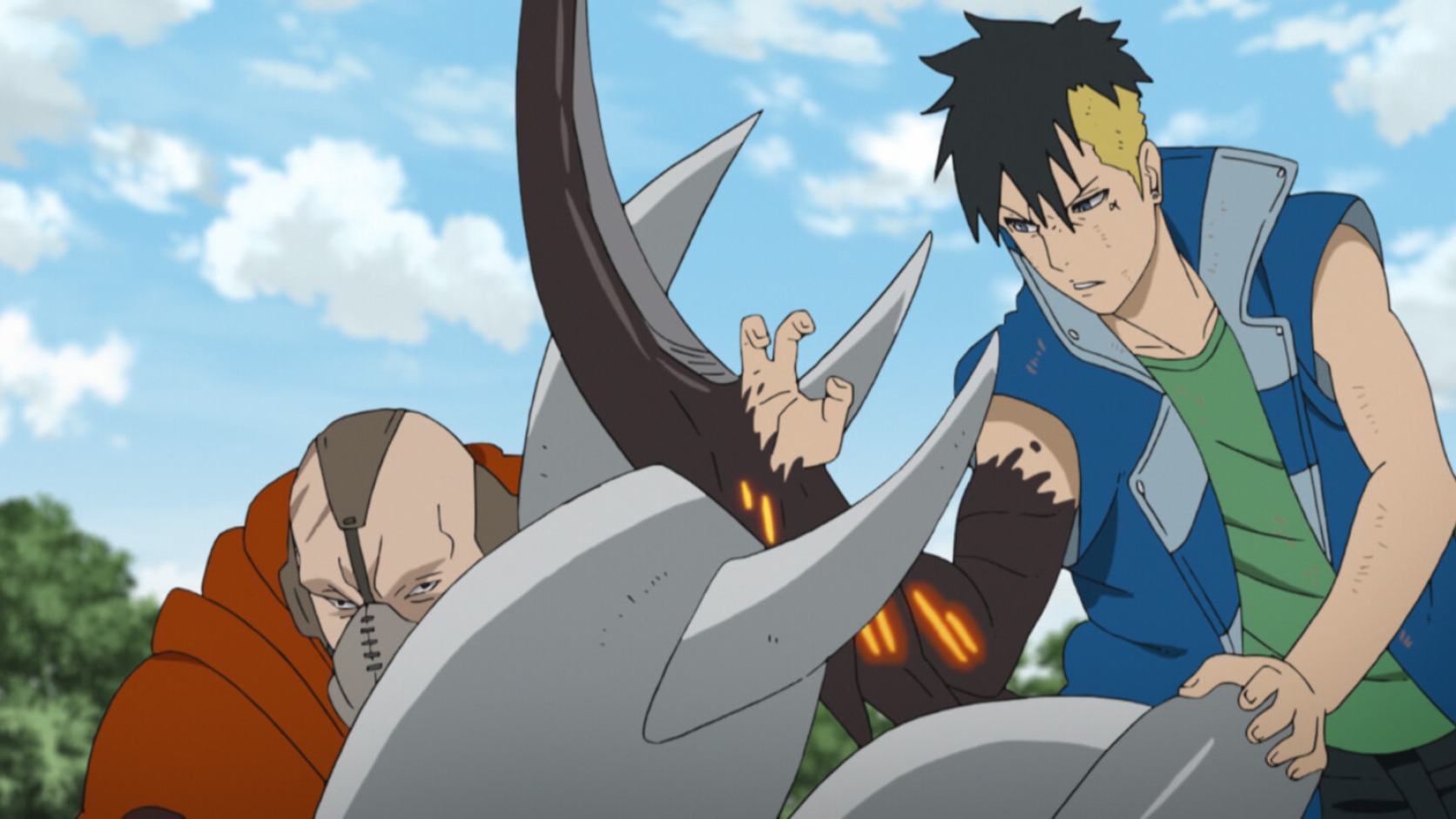
Episode 189 gives Kawaki's transformed arm mass. Tissue, machinery, heat, and force seem to move together rather than appearing as a decorative power effect. Garō's modified body carries the same terrible physical credibility.
The craft matters because Kara's abuse lives in anatomy. These are not detachable gadgets chosen from a toolbox. Their bodies have become battle infrastructure, and every exchange reminds viewers that someone installed this capacity through coercion.
Scientific ninja tools are not the villain
Katasuke's work has already shown technology supporting mobility, communication, medicine, and protection. Garō and Kawaki do not prove that scientific ninja tools corrupt everyone who uses them.
The moral question concerns consent, purpose, and control. A prosthetic selected by a patient differs from invasive modification imposed by an organization. Technology reflects the relationship surrounding its use. Kara builds ownership into the procedure.
Garō treats pain as proof of authority
Garō believes suffering entitles him to punish Kawaki. Each attack carries the logic that Kawaki owes him submission because resistance previously cost Garō part of his body.
That demand erases the context of escape. When a captive injures an enforcer while trying to get free, the enforcer cannot remove captivity from the story and present retaliation as ordinary justice. Power shaped the original encounter.
Kawaki's body remembers before anyone offers care
Exhaustion does not prevent Kawaki from transforming. His response looks automatic because Kara trained survival into flesh as much as mind. The altered arm becomes shield, blade, and distance from the person coming to drag him back.
That reflex deserves medical and psychological attention later. Konoha should not admire the weapon so loudly that nobody asks what repeated terror taught a child to do on waking.
Team 7 faces the bystander problem
Boruto wants to intervene. Konohamaru understands that entering a fight between two unfamiliar modified bodies could worsen the danger for everyone. Restraint can be responsible when responders lack information and a safe opening.
Restraint cannot become moral disappearance. The team has direct evidence that Garō intends forced removal. Once the threat becomes clear, neutrality would favor the armed adult acting on behalf of the captor.
Konohamaru must protect without claiming
As team leader, Konohamaru has to keep Boruto, Sarada, Mitsuki, and Katasuke alive while preventing Kara from taking Kawaki. Those goals justify defensive action.
Protection still needs a boundary. Saving Kawaki from Garō does not automatically grant Konoha authority over his body, testimony, movement, or future. Emergency custody should remain temporary, transparent, and reviewable.
Boruto's urgency comes from his own mark
Boruto is not watching a random duel. Kawaki carries Kāma, the same unexplained sign that Momoshiki placed on Boruto. Every change in Kawaki's body may foreshadow Boruto's future.
Wanting answers is reasonable. Fear makes the need immediate. Boruto must still learn that shared bodily danger does not give either boy unrestricted access to the other's history.
Resonance begins without permission
Boruto's Kāma activates in response to Kawaki's mark. Neither boy requests the connection, negotiates terms, or understands the mechanism. Their bodies communicate before trust exists.
That is why resonance should not be romanticized as instant brotherhood. A forced link can eventually support solidarity, but the relationship must be chosen afterward. Biology or supernatural design cannot manufacture consent.
Borrowed power changes the balance
Kawaki's depleted strength returns when the marks resonate. The sudden increase prevents Garō from completing the capture and exposes how much power Kara planted inside the Vessel project.
The rescue value is obvious. The long-term danger is equally obvious. A system that can activate across bodies may be exploited by people who understand Kāma better than Boruto or Kawaki. Every victory reveals another vulnerability.
Power cannot explain itself
The episode gives viewers a thrilling surge, but neither boy receives an instruction manual. Energy arrives without context, and the adults nearby can only observe effects.
Konoha should resist the usual institutional temptation to test first and ask ethical questions later. Unknown power inside children demands caution, independent advocacy, and limits on who can authorize research.
Kawaki's counterattack carries accumulated terror
Once strengthened, Kawaki does not fight like someone resolving a sports contest. His attack carries every prior recapture, procedure, beating, and threat that Garō represents. The force becomes overwhelming because the stakes feel absolute.
That history explains the intensity. Explanation should not erase the frightening reality of what Kawaki can do. Compassion and risk assessment belong in the same room.
Garō is dangerous and still human
Garō's weaponized body, cruelty, and willingness to return a child to Kara make intervention necessary. The story should not require viewers to pretend he has no history beyond villainy.
Kara likely found a wounded, angry, or disposable person and offered power tied to service. Recognizing exploitation does not excuse his choices. Recognition places responsibility both on the enforcer and on the organization that manufactured enforcers.
The finishing blast refuses a clean heroic frame
Kawaki's final attack is visually magnificent and morally uncomfortable. Garō intends recapture, so Kawaki has compelling reason to stop him. The scale of destruction also reveals how survival has become indistinguishable from annihilation in Kawaki's training.
The scene works because triumph does not feel simple. Freedom purchased through overwhelming violence still leaves the survivor carrying the weapon and the memories afterward.
Asking whether Team 7 belongs to Kara is rational
After defeating Garō, Kawaki turns suspicion toward the people watching. Calm explanations have little value when Kara can use spies, masks, laboratories, and polite professionals.
His question is evidence gathering, not pointless hostility. Team 7 should answer clearly, avoid surrounding him, and allow observable behavior to support their words. Trust grows from consistent choices.
Katasuke sees a whole body rebuilt
Katasuke concludes that Kawaki's modifications extend throughout his body. Kawaki is not carrying one advanced prosthetic. His entire physical system functions as an organic scientific ninja tool.
That discovery raises urgent medical questions: pain, maintenance, remote control, energy demands, hidden failsafes, and the consequences of removing Kara's support. Curiosity must remain subordinate to care.
Medical treatment needs real consent
Kawaki may be unconscious or medically unstable when the team transports him. Emergency care can proceed to preserve life, but emergency authority has limits.
Once stable, Kawaki deserves plain explanations, choices wherever possible, privacy, and an advocate whose role does not depend on extracting intelligence. A patient is not an unlocked research archive.
Konoha could repeat Kara with kinder branding
The village may describe Kawaki as a guest, protected witness, security concern, or valuable source. Any label can hide coercion when doors lock, questions never end, and refusal carries punishment.
The difference between Konoha and Kara cannot rest on nicer rooms or gentler voices. The difference has to appear through rights, accountability, and the possibility that Kawaki can say no.
Naruto's leadership will be tested by a child
Naruto understands loneliness and institutional suspicion, but empathy based on shared pain can become overconfidence. Kawaki's history is not Naruto's history with different names.
Good leadership means listening before projecting, protecting the village without criminalizing survival responses, and building safeguards strong enough to restrain even benevolent officials.
Boruto and Kawaki need separate identities
Kāma creates an obvious narrative pairing. The boys may become mirrors, rivals, brothers, or all three. The story must still let each person exist beyond the mark.
Boruto has family conflict, privilege, fear, and aspirations unrelated to Kawaki. Kawaki has a history and future that should not exist solely to explain Boruto's power. Connection works best when individuality survives.
Sarada watches institutional choices form
Sarada wants to become Hokage. Kawaki's arrival offers a practical lesson that leadership includes deciding how a frightened outsider encounters state power.
She should notice who speaks for him, who asks permission, who treats silence as guilt, and who benefits from his information. Heroic intentions matter less than the system those choices create.
Mitsuki knows created bodies are still persons
Mitsuki's origin gives him a distinct perspective on bodies designed through another person's project. Creation, modification, and expectation do not settle allegiance or identity.
His calm observation can help the team, but Konoha should not make Mitsuki responsible for translating every experience of engineered personhood. He also deserves boundaries around his own history.
Delta and Koji turn suffering into surveillance
Delta and Kashin Koji watch rather than protect. Garō's pain, Kawaki's desperation, and Team 7's danger become useful data about Kāma and the Vessel.
Surveillance creates distance from responsibility. Kara's leaders can later discuss performance, failures, and unexpected resonance while pretending they merely observed events that their orders caused.
Jigen remains present through other people's bodies
Jigen does not need to stand on the battlefield. His ownership claim moves through Garō's orders, Delta's warning, Koji's attention, Kawaki's fear, and the modifications inside both combatants.
That is institutional power: one person can shape every available choice without appearing in the immediate conflict. Defeating Garō does not defeat the structure.
The episode understands spectacle and consequence
Episode 189 is rightly remembered for exceptional animation. Movement clarifies character rather than pausing the story for empty display. Kawaki's speed feels desperate, Garō's bulk feels invasive, and every transformation reinforces the bodily stakes.
Praise for craft should include what the craft communicates. The visual team makes abuse legible through weight, impact, and expression. Beauty serves the argument rather than hiding the harm.
Survival skills do not equal moral failure
Kawaki lies ready to strike, distrusts strangers, and uses catastrophic force. Those behaviors create danger, but they also emerged from an environment where hesitation invited capture.
Recovery will require new choices. Konoha should teach those choices through safety and accountability, not shame. A child cannot unlearn captivity while adults recreate captivity as discipline.
Accountability must reach upward
Garō owns his decision to pursue and punish Kawaki. Kawaki owns harm he causes beyond necessary defense. Team 7 owns the choices made during extraction and care.
Jigen and Kara hold the greatest responsibility because they designed the hierarchy, modifications, mission, and incentives. Ethical analysis fails when consequences stop at the lowest person visible on screen.
Freedom requires more than defeating the pursuer
Garō's defeat prevents immediate recapture. Kawaki still carries Kara inside scars, reflexes, technology, and Kāma. Physical distance from the organization cannot instantly create freedom.
Real freedom will require control over daily choices, access to trustworthy care, information about his own body, and relationships not conditioned on strategic usefulness.
Konoha needs a survivor-centered protocol
The village should separate medical staff from interrogators, limit records to people with a genuine need, document every invasive procedure, explain security measures, and provide a route to challenge decisions.
Those protections sound procedural because safety often depends on procedure. Kind individuals can leave. Rights must remain when personalities change.
Boruto should not become Kawaki's guarantee
Boruto's disclosure and resonance create a bridge, but adults may be tempted to use that bridge as a management tool. Asking Boruto to calm, monitor, persuade, or report on Kawaki would burden one child with another child's stabilization.
Friendship should remain voluntary. Konoha owes both boys professional care and adult responsibility rather than outsourcing difficult work to their bond.
Episode 190 must answer the rescue question
The immediate path leads toward the Advanced Technology Research Institute and an attempted escape. That response will make sense if Kawaki wakes in another controlled environment surrounded by people interested in his body.
The next episode should be judged by more than whether Team 7 means well. The real measure is whether Kawaki can perceive a meaningful difference between protection and confinement.
Emergency authority expires
Team 7 can move an unconscious Kawaki away from an active Kara recovery mission. Leaving him beside Garō's remains would expose him to Delta, Koji, another retrieval team, untreated injuries, and the environmental damage from the fight. Immediate transport is justified by necessity.
Necessity cannot become a permanent blank cheque. The moment Kawaki can understand options, the village must explain where he is, what treatment occurred, who has access to him, and which restrictions remain. Officials should revisit each restriction instead of treating the first emergency as permission for everything afterward. Trauma survivors often encounter systems that turn one crisis decision into months of control. Konoha can avoid that pattern only by making authority narrow and temporary.
A laboratory is not emotionally neutral
Katasuke may offer advanced equipment, skilled medical assessment, and genuine concern. Kawaki will still encounter machines, scans, observation, and adults discussing modifications installed without his consent. The room carries a meaning that good intentions cannot erase.
Staff should anticipate fear rather than interpreting fear as proof of hostility. Explain devices before bringing them near his body. Let him see exits. Reduce the number of observers. Ask which procedures feel tolerable. Provide clothing, food, water, and privacy before demanding a coherent history. None of those choices eliminate security risk. They stop the care environment from needlessly reproducing Kara's sensory world.
Data can become another form of extraction
Kawaki's body contains information Konoha urgently wants: Kara's engineering, Kāma behavior, possible tracking systems, and threats to Boruto. Gathering some information may protect both boys and the village. Urgency does not make every method ethical.
Medical findings should not flow automatically into intelligence files. Kawaki needs to know when a procedure serves his health and when researchers want broader knowledge. Those purposes may overlap, but hiding the second purpose inside the first destroys trust. Consent obtained through fear of losing care is not meaningful consent. Katasuke's integrity will show through the questions he refuses to ask without permission.
Spectators inherit responsibility too
Boruto, Sarada, and Mitsuki are young shinobi following Konohamaru's lead, so adult responsibility remains primary. They still witness a moment that will shape how they understand power. They see an enemy call a boy property, technology consume bodies, and an institution monitor violence from a distance.
Their later choices should reflect that knowledge. Boruto can challenge language that reduces Kawaki to Kāma. Sarada can question procedures that confuse security with punishment. Mitsuki can reject assumptions that designed bodies belong to their creators. Witnessing injustice does not make children solely responsible for fixing institutions, but silence should not become the lesson they carry forward.
The fight exposes hierarchy through camera position
Kawaki and Garō occupy the ground, trading pain at intimate range. Delta and Koji observe from removed positions where they can evaluate results without absorbing comparable risk. Team 7 stands near enough to face consequences but outside the history driving the duel.
Those spatial relationships tell the political story. The least powerful bodies endure the greatest physical cost. Higher-ranking Kara members preserve themselves while extracting information. Kawaki gains temporary control only by releasing destructive force through modifications the hierarchy imposed. The episode's staging therefore keeps power visible even during its fastest action.
Recovery must include ordinary life
Medical stabilization, intelligence safeguards, and Kāma research will dominate Konoha's first response. Kawaki also needs boring human experiences that Kara never valued: choosing food, sleeping without a guard's threat, learning household boundaries, making mistakes that do not trigger violence, and discovering preferences unrelated to survival.
Ordinary life is not a sentimental reward after the serious work ends. Ordinary life is part of the serious work. A person treated only as a patient remains defined by damage. A person treated only as a security problem remains defined by danger. Kawaki needs room to become annoying, curious, uncertain, funny, angry, and young without every emotion entering a threat report.
RaeRae verdict
Episode 189 earns its reputation because the action finally matches the emotional violence underneath Kara's Vessel project. Kawaki looks powerful, but every transformation exposes what was taken from him. Garō looks monstrous, but the real monster is the system that turned suffering into equipment, rank, and revenge.
The resonance between Kāma marks saves Kawaki from one captor while warning that neither boy fully controls his own body. That is not destiny handing them a friendship certificate. That is a violation creating shared stakes. Whatever bond follows must be built through choices.
Konoha now has a chance to prove another model exists. Protect Kawaki from Kara. Treat the injuries. Tell him the truth. Set safety limits without humiliation. Ask before studying. Let trust arrive at the speed his experience permits. Anything less risks changing the logo on the cage.
Carrying forward
Boruto Episode 190, "Escape," moves Kawaki into the Advanced Technology Research Institute, where medical observation and security will collide with his expectation that every laboratory belongs to a captor. Watch how the adults explain their intentions, whether Kawaki receives meaningful choices, and how Team 7 responds when survival tells him to run.
Sources and lawful viewing
Official episode reference: Naruto Official episode guide
Licensed episode route: Crunchyroll licensed series page