
Awakening
Kawaki wakes expecting recapture, and Team 7 must decide whether rescue means safety or another institution claiming a child’s altered body.
Series: Boruto: Naruto Next Generations
Episode: 188 · Awakening
Arc: Vessel
Release: February 28, 2021
Previous: Episode 187 · Karma
Directory: All 293 Boruto episodes
Bottom line
Boruto Episode 188 introduces Kawaki as a wounded child who wakes surrounded by armed strangers and reasonably assumes Kara has sent people to reclaim him. Team 7 sees hostility. Kawaki sees another transfer of ownership. Boruto breaks the standoff by showing his own Kāma, creating recognition without instant trust. Katasuke identifies a body altered through scientific ninja technology, while Kawaki’s fear reveals the person Kara buried beneath the word Vessel. Rescue cannot mean replacing one institution’s claim with another. Konoha has to earn safety through consent, medical care, transparent limits, and the willingness to believe a survivor before demanding cooperation.
Koji retreats because Boruto has become valuable
Kashin Koji leaves Team 7 alive after seeing Kāma spread across Boruto’s arm. The withdrawal may look like relief after Konohamaru’s rescue, but Koji has not developed mercy.
New information changed the mission. Boruto’s body now connects the Hokage’s family to Kara’s missing Vessel and Ōtsutsuki power. Koji preserves a target because observation may produce more value than immediate elimination.
Survival does not make the battlefield safe
Konohamaru remains injured. The team has fought Ao, survived drone fire, escaped sealing, watched Koji kill a compromised operative, and seen Boruto’s unknown mark activate.
Returning toward Konoha should be an extraction, not another exploratory mission. The crashed transport and destroyed puppets force attention because the original assignment remains unresolved. Duty continues while every body on the team needs rest and assessment.
The destroyed puppets record someone else’s fight
Team 7 finds autonomous machines broken across the ground. Damage patterns show that another combatant moved through the area with enough force to defeat Kara’s defenses.
The wreckage is not a neutral clue. Every puppet represents a system sent to capture or contain the person who escaped the airship. The battlefield tells a story of pursuit before the survivor can speak.
Kawaki appears as a patient before becoming a mystery
An unconscious boy lies among the destroyed machines. Team 7 immediately notices the strange mark, altered body, and connection to the transport.
Those details matter for safety. The first fact should still be simpler: a young person is unconscious after severe violence. Medical stabilization must come before interrogation, classification, or debate over strategic value.
Vessel is Kara’s word, not Kawaki’s identity
Kara names Kawaki according to what his body can hold for someone else. “Vessel” removes childhood, preference, history, and personhood from the sentence.
Konoha risks repeating the same harm through friendlier terms. Asset, witness, host, key, threat, and research subject can all reduce a person to usefulness. Names should guide protection without replacing the human being named.
Team 7 approaches with incomplete information
Boruto, Sarada, Mitsuki, Konohamaru, and Katasuke do not know whether the boy attacked the puppets, survived another attacker, carries remote weapons, or remains connected to Kara.
Caution is justified. Caution does not require assuming guilt. A responsible approach separates immediate hazards from moral conclusions and leaves room for evidence that has not arrived.
Katasuke sees technology written through flesh
The scientist recognizes that Kawaki’s body contains extensive modifications beyond an ordinary prosthetic. Machinery and biology no longer sit in separate categories.
Katasuke’s expertise helps the group understand physical risk. The same expertise creates temptation to study before asking. Scientific wonder must not outrank the patient’s ownership of his own body.
Boruto sees the mark before he sees the history
Kāma gives Boruto an immediate point of identification. Another person carries a pattern resembling the one Momoshiki placed on him.
Shared marks do not produce shared lives. Boruto grew inside a family and village, even with serious emotional gaps. Kawaki appears to have grown inside captivity, experimentation, punishment, and repeated claims over his body.
Kawaki wakes inside a circle of strangers
From Team 7’s perspective, the group has found and protected an injured person. From Kawaki’s perspective, consciousness returns with armed shinobi positioned around him and no trusted adult nearby.
His first response comes from the scene his eyes can verify. He has no reason to assume uniforms, calm voices, or medical language mean safety.
Hostility can be a survival response
Kawaki becomes defensive, demands distance, and prepares to fight. Konoha training may label that behavior aggression or noncompliance.
Kara taught him that capture leads to ownership and pain. Resistance is maladaptive inside a genuinely safe clinic, but rational inside the world that shaped him. Support begins by understanding the origin without pretending every action becomes harmless.
Trauma does not make every choice acceptable
Kawaki’s history can explain why he threatens people. Explanation does not grant permission to injure anyone nearby.
Team 7 can maintain distance, establish boundaries, and protect themselves without humiliating him. Accountability becomes more credible when responders distinguish danger management from punishment for being afraid.
Boruto interrupts the standoff through disclosure
Rather than answering Kawaki’s fear with a larger attack, Boruto shows the mark on his own palm. The gesture reveals vulnerability and changes the information available to both boys.
Boruto cannot prove safety through one similarity. He can demonstrate that Kawaki is not the only person carrying this sign and that Team 7’s interest is not completely one-sided surveillance.
Showing Kāma costs Boruto privacy
Boruto’s choice helps prevent immediate violence, yet the disclosure also exposes bodily information before he understands the consequences. Crisis narrows privacy choices.
Adults should not later treat that moment as permanent consent to share his condition with every investigator. Emergency disclosure has a purpose and a boundary.
Kawaki finally supplies the name Kāma
Team 7 has seen the mark activate without knowing the term. Kawaki recognizes Boruto’s palm and identifies Kāma.
The word gives Konoha a route toward research, but Kawaki does not owe a complete briefing while injured and terrified. One answer should not become an opening for coercive interrogation.
Knowledge does not prove allegiance
Kawaki knows Kara’s terminology because Kara controlled his environment. Familiarity with the organization does not establish willing membership.
Survivors often learn the language of people who harm them because survival requires reading rules, moods, ranks, and threats. Investigators must separate knowledge gained through captivity from evidence of voluntary participation.
Boruto wants answers for understandable reasons
Momoshiki placed Kāma on Boruto without explanation. Koji recognized the pattern. Now a stranger carries a related mark and knows the name.
Boruto’s urgency is not mere curiosity. Information concerns his body and future. His right to answers still does not override Kawaki’s right to safety, rest, and control over disclosure.
Two harmed children should not become each other’s treatment plan
Boruto and Kawaki may understand aspects of bodily violation that adults around them cannot. That possibility can support connection.
Konoha must not assign either boy responsibility for stabilizing the other. Peer recognition helps. Medical professionals, advocates, caregivers, and accountable leaders still owe the real infrastructure of care.
Sarada reads the confrontation as a leader
Sarada watches posture, distance, escape routes, and the way Kawaki responds to Boruto’s mark. Her future ambition gives every command decision ethical weight.
A leader has to protect the group while refusing to turn fear into proof of guilt. Sarada’s challenge is creating enough safety for information to emerge without demanding trust on command.
Mitsuki understands designed bodies differently
Mitsuki was created inside Orochimaru’s project and given staged conditions meant to shape identity. He knows that biological origin and personal allegiance are not the same.
His experience could make him sensitive to Kawaki’s position. The story should also protect Mitsuki from becoming the endlessly calm child expected to process everyone else’s bodily trauma.
Konohamaru carries command responsibility while injured
Konohamaru must decide whether the team approaches, restrains, retreats, or requests reinforcement. His recent burns and earlier wounds may affect judgment.
Command systems need a transfer plan when leaders become patients. Requiring Konohamaru to remain fully responsible because nobody else was assigned backup places the entire team at unnecessary risk.
Katasuke must separate care from research
Kawaki’s modifications may contain unfamiliar materials, weapons, interfaces, and medical complications. Katasuke can contribute valuable technical assessment.
The scientist needs clear limits. Emergency treatment should not become permission to collect unrestricted samples, duplicate technology, or prioritize national advantage over Kawaki’s health.
A trauma-informed approach still includes security
Responders cannot ignore the possibility of embedded weapons, remote activation, tracking, or involuntary attacks. Kawaki may not know every function inside his body.
Security should protect him as well as everyone nearby. Scanning for external control, creating physical distance, and using nonlethal containment differ from treating the child as an enemy by default.
Kara may have built coercion into Kawaki’s body
Scientific modifications can enforce obedience without visible guards. Pain triggers, shutdown systems, trackers, hormonal manipulation, or remote commands would make escape incomplete even outside Kara’s facility.
Konoha needs to assume coercion remains possible until evidence rules coercion out. Punishing an involuntary response would extend Kara’s control through another institution.
Kawaki expects return, not rescue
His suspicion rests on a lifetime where powerful adults move him according to their needs. A new group saying “help” may sound like another owner changing the label.
Trust cannot begin with demands for gratitude. Konoha must explain where he is, who has authority, what procedures are proposed, and which choices genuinely belong to him.
The absence of shackles does not prove freedom
Kawaki stands outside a cell, but he remains surrounded, injured, monitored, and unable to leave safely. Material freedom requires more than removing visible restraints.
Transportation, shelter, medical care, legal status, information, and protection from Kara all shape whether refusal becomes possible. Consent without a survivable alternative is fragile.
The title Awakening belongs to more than consciousness
Kawaki physically wakes, and Team 7 begins waking to the human reality beneath Kara’s Vessel project. Boruto also learns that his private mark belongs to a larger system.
The episode’s awakening is uncomfortable because knowledge creates duties. Nobody can return to treating Kāma as a strange scar or the Vessel as missing cargo.
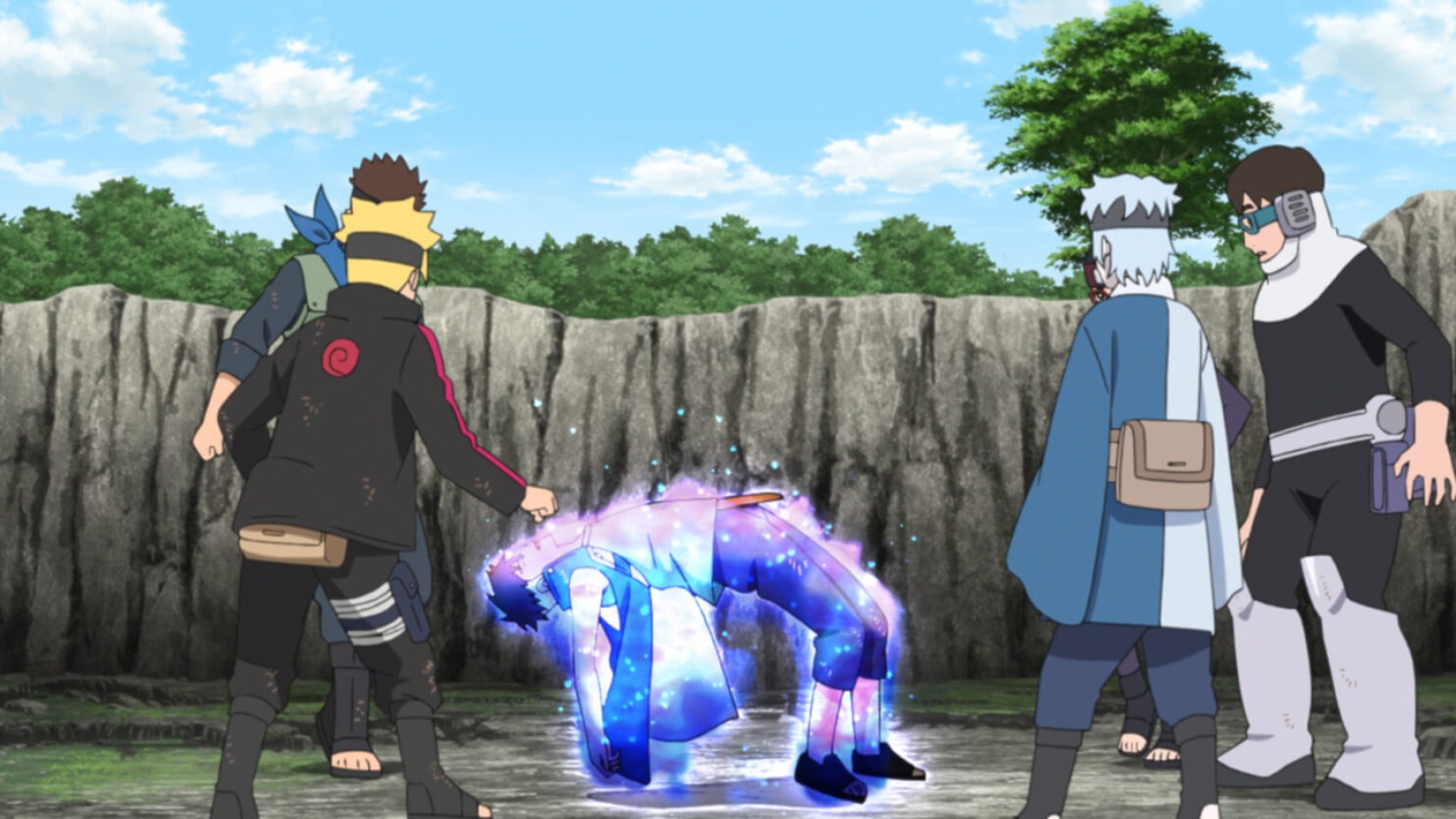
The canonical image captures a defensive body
Kawaki bends forward while energy outlines his altered form and Team 7 holds a cautious circle around him. The frame does not present a calm rescue.
Every posture records a different fear. Kawaki expects recapture. Boruto wants recognition. The adults assess danger. Sarada and Mitsuki watch a stranger whose body may become a weapon before consent enters the conversation.
Amado’s work raises accountability questions
Kawaki’s modifications did not appear naturally. Skilled adults designed procedures, selected materials, managed pain, recorded results, and continued despite the child’s suffering.
Responsibility cannot stop with Jigen as the visible leader. Technicians, researchers, guards, suppliers, and people who normalized the program all helped make captivity operational.
Expertise does not excuse participation
A scientist may claim that someone else would have performed the procedure or that technical work remained separate from Kara’s goals. Kawaki’s body disproves that separation.
Knowledge becomes conduct when applied to a captive child. Ethical accountability includes what professionals built, what warnings they ignored, and which exits they refused to take.
Konoha should preserve evidence without consuming the patient
Kawaki’s body may prove crimes involving experimentation and trafficking. Evidence collection could support future accountability.
The pursuit of justice must not recreate violation. Photographs, scans, samples, and testimony need consent boundaries, secure storage, limited access, and an advocate focused on Kawaki rather than the prosecution.
Medical records could become weapons
Detailed information about Kawaki’s modifications may help doctors keep him alive. The same records could help military researchers reproduce Kara’s work or design methods to disable him.
Access controls are part of care. Every person who opens the file should have a defined reason, and Kawaki should eventually know what information exists.
Boruto’s privilege can help without becoming authority
As Naruto’s son, Boruto has access to leadership, housing, medical experts, and people likely to believe him. He can use that access to demand humane treatment.
Privilege does not make him Kawaki’s guardian or interpreter. Support should widen Kawaki’s choices rather than replace Kara’s commands with Boruto’s preferences.
Naruto’s response will define Konoha’s difference
The Hokage will soon receive a child connected to an enemy organization and a dangerous seal. Security officials will want containment and intelligence.
Naruto knows what happens when a village sees a weapon before seeing a boy. Memory should guide policy, not merely produce a compassionate speech. Housing, guardianship, medical consent, schooling, and protection need durable decisions.
Hinata and Himawari deserve preparation too
If Kawaki eventually enters Naruto’s home, the household cannot be treated as an extension of Hokage security. Hinata and Himawari are people whose safety, privacy, and consent matter.
Care for one traumatized child should not quietly assign emotional labor or physical risk to another child. Family placement requires resources, boundaries, and ongoing support for everyone involved.
A home cannot function as an unstaffed containment site
Warm meals and belonging may help Kawaki, but love does not replace clinical care or security planning. Naruto’s family should not carry the entire village response behind a residential door.
Professional support must remain available without turning the house into constant surveillance. Safety and dignity require careful balance rather than one heroic family absorbing institutional responsibility.
Kawaki’s aggression tests whether compassion has conditions
People often offer sympathy to survivors while those survivors remain quiet, grateful, and easy to manage. Kawaki is frightened, angry, suspicious, and capable of harm.
Konoha’s values matter most when care becomes inconvenient. Boundaries can remain firm without withdrawing personhood. Safety plans can remain serious without making affection a reward for obedience.
Garo’s arrival confirms Kawaki’s fear
Kara sends an Outer connected to Kawaki’s earlier suffering. The pursuer’s presence proves that recapture is not a story Kawaki invented to justify hostility.
Team 7 now sees the threat approaching from outside the boy. That evidence should reshape every judgment formed during the first confrontation.
Recognition does not create instant alliance
Boruto and Kawaki share Kāma, while Team 7 and Kawaki share an enemy in Kara. Neither fact automatically creates trust.
Alliance needs choices, information, consistent behavior, and time. Forcing emotional closeness because the plot has linked two bodies would repeat the logic that other people can decide what Kawaki’s connections mean.
Episode 188 asks who gets believed before proof arrives
Kawaki wakes expecting capture and responds before Team 7 sees Garo. The group must decide how much credibility to grant a frightened stranger whose behavior appears dangerous.
Waiting for the abuser to arrive before believing the survivor places safety behind evidence outsiders find comfortable. Responsible caution can coexist with provisional belief.
Emergency consent begins with explaining the next minute
Kawaki cannot give thoughtful permission for an entire treatment plan while newly conscious, injured, surrounded, and expecting recapture. Medical urgency may justify limited action needed to prevent immediate death or irreversible harm.
Even during emergency care, responders can explain each step: who will touch him, what scan comes next, whether a restraint is necessary, and when the procedure will stop. Small truthful choices help return ownership after Kara trained him to expect pain without warning.
Silence would make efficiency look like another assault. A frightened patient may still refuse, freeze, threaten, or misunderstand. Staff need de-escalation training and enough time to distinguish inability to consent from a refusal that deserves respect.
Independent advocacy matters when the Hokage is also Boruto’s father
Naruto will hold several conflicting roles once Kawaki reaches Konoha. He leads village security, parents the other Kāma carrier, commands shinobi who found the boy, and may decide where Kawaki lives.
Compassion cannot remove that concentration of power. Kawaki needs an advocate who does not answer to intelligence objectives or family convenience. Boruto needs separate support so officials do not treat one child’s needs as evidence against the other.
An independent advocate can document consent, challenge unnecessary testing, explain appeal routes, and make sure fear does not become a reason to remove every choice. Good intentions need checks because authority remains authority when the person holding power feels kind.
Dangerous behavior should not become a permanent identity
Kawaki wakes ready to fight, and later evidence will show that his altered body can cause enormous damage. Risk assessment is necessary. “Dangerous child” is still a label that can swallow every future action.
Konoha has made this mistake before. Naruto’s seal became the village’s excuse to interpret loneliness, pranks, anger, and ordinary childhood need through the Nine-Tails. Adults claimed public safety while leaving a child isolated enough to keep escalating for acknowledgment.
Kawaki deserves boundaries built around current behavior and specific capabilities. Reviews should change when evidence changes. Permanent suspicion would teach him that escape from Kara only moved him into a kinder-looking sentence with the same conclusion.
Team 7 needs permission to process what they witnessed
Boruto, Sarada, and Mitsuki have watched Ao die, Konohamaru burn, Kāma activate, and Kawaki wake in terror. Shinobi culture may send them directly into reports and another assignment because everyone remains alive.
Survival does not mean the experience caused no harm. The team needs medical screening, private debriefing, factual updates, and space to express fear without losing mission status. Boruto especially needs reassurance that an imposed mark does not make him responsible for every danger connected to Kara.
Konohamaru needs care too. A mentor can acknowledge fear and uncertainty without making students comfort the adult. Honest recovery would model strength as responsibility toward the body rather than another performance of invulnerability.
What I am watching next
Garo has found Kawaki, Team 7 remains exhausted, and the clearing is about to become another battlefield. Kawaki’s body contains weapons Konoha does not understand, while Kāma links his condition to Boruto.
Episode 189 must show whether Team 7 can witness Kawaki’s violence without forgetting the captivity that shaped every response. The battle should produce information, not permission to reduce him back to Vessel.
RaeRae’s verdict
“Awakening” introduces Kawaki through fear before asking viewers to judge his aggression. He wakes wounded, surrounded by strangers, and certain that Kara has sent another retrieval team. That belief is not irrational. Kara altered his body, called him a Vessel, and built a world where every powerful adult represented ownership. Boruto’s decision to reveal Kāma interrupts the standoff because shared vulnerability offers something commands cannot.
The episode also establishes Konoha’s ethical test. Katasuke sees extraordinary technology. Shinobi see a security risk. Boruto sees the first possible answer about his mark. Every perspective contains valid concern, and none grants ownership over Kawaki. Rescue becomes different from capture only when the rescued person gains information, choices, medical care, advocacy, and a future not conditioned on usefulness.
Garo’s arrival confirms the danger Kawaki expected. Team 7 can protect him without romanticizing every action or asking children to become one another’s treatment plan. The awakening that matters most belongs to the adults: a Vessel is a child, a designed body still belongs to the person living inside, and trust must be earned after the cell opens.
Sources and lawful viewing
Official episode reference: Naruto Official episode guide
Licensed episode route: Crunchyroll licensed series page