
Memory, Sorrow, and Thorn: The Complete Series Plot
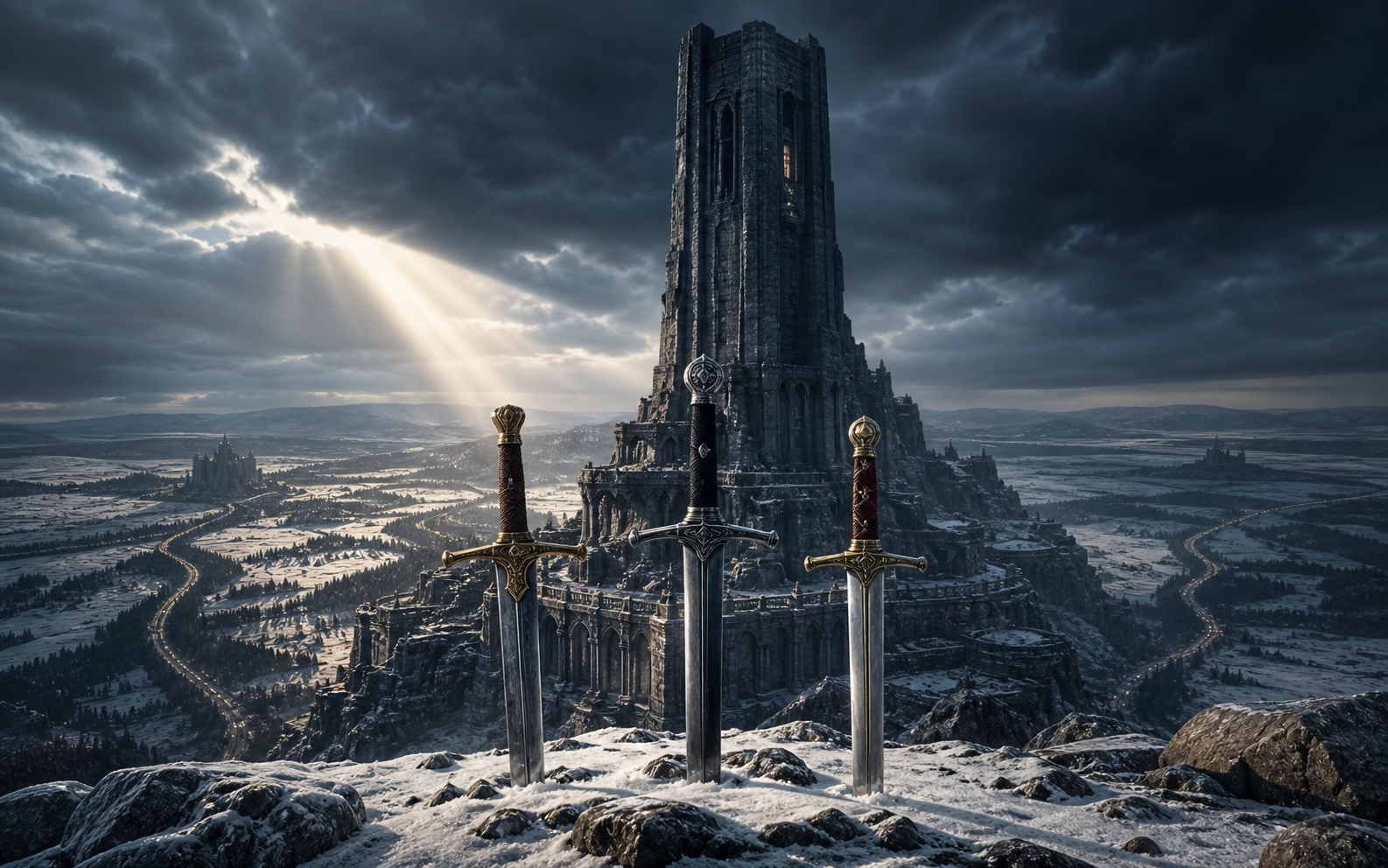
The quest for three legendary swords is the bait. The real story is how a kingdom’s prettiest founding myth delivers those blades to the catastrophe waiting underneath it.
Movement One
A golden age dies, and the lie underneath it wakes up
Prester John’s death does not simply create a succession crisis. It removes the man whose legend has been holding several contradictions in place: the Hayholt is celebrated as a human stronghold although it is the conquered Sithi city Asu’a; peace is treated as John’s gift although it rests on expulsion and silence; and his elder son Elias inherits the throne without inheriting his father’s ability to make the story feel stable.
Simon begins below all of this—an orphaned scullion more interested in hidden corridors and Doctor Morgenes’s mysteries than court power. His accidental witness to Prince Josua’s imprisonment turns him from spectator into participant. He helps Josua escape, Morgenes dies buying him time, and Simon leaves the only home he knows carrying a manuscript, a white arrow, and almost none of the information needed to understand either.
Movement Two
The road keeps replacing legend with witnesses
Binabik rescues Simon from starvation and becomes teacher, friend, nuisance, and moral anchor. Jiriki’s white arrow opens a relationship with the Sithi that human histories had filed under enemy or absence. At Naglimund, Josua gathers resistance while Elias and Pryrates bind kingship to the black sword Sorrow and to Ineluki’s long design. The siege destroys any comforting belief that a stout wall and a righteous cause are sufficient.
Simon’s mountain search for Thorn culminates not in clean heroism but in confusion, terror, and the dragon Igjarjuk. The dragon’s blood marks him; the sword is found; the quest appears to be advancing. Yet every apparent confirmation of prophecy is also moving the pieces where the Storm King needs them.
Movement Three
Refuge becomes a political practice, not a hiding place
At Sesuad’ra, the Stone of Farewell becomes a refuge only because people keep choosing to make it one. Josua’s coalition must feed refugees, survive winter, negotiate old grievances, and decide whether resistance can become more than a military camp. Simon is knighted, but the title does not solve the boy inside it. Miriamele flees court under assumed names, travels with Cadrach, crosses Nabban and the sea, and discovers that escape without a plan can still deliver her into other people’s power.
Amerasu’s revelations at Jao é-Tinukai’i draw the Sithi catastrophe, the Norn schism, and Ineluki’s death into one history. Utuk’ku’s attack murders the person best able to explain it. The truth arrives fragmented, which is exactly why the survivors must compare witnesses rather than wait for one perfect authority.
Movement Four
The swords reach Green Angel Tower—and perform the enemy’s ritual
The final movement scatters and recombines nearly every road. Josua’s army moves toward Erchester; Miriamele confronts Elias, Pryrates, Aspitis, and the court’s plans for her body; Simon crosses Norn-held country and learns how badly courage can coexist with error; Camaris returns carrying a past he cannot fully bear. Nabban, Hernystir, the Sithi, Qanuc, Rimmersmen, Wrannamen, and Hayholt survivors become necessary to a victory no single bloodline can own.
At the tower, Memory, Sorrow, and Thorn do not defeat Ineluki. Their reunion opens the road through Time that permits his return. The prophecy was not false; its hopeful interpretation was. Pryrates’s machinery, Elias’s torment, Camaris’s presence, and the Five Houses’ terror all feed the event. Elias finally turns against the bargain consuming him. Simon’s decisive act is not superior swordplay but refusing Ineluki the matching hatred that would complete the cycle.
The Ending
The kingdom survives by changing what inheritance means
Simon is revealed as Eahlstan’s descendant, but the ending refuses to let ancestry do the moral work. He becomes King Seoman because of the person formed through service, error, loyalty, grief, and choice—not because a hidden genealogy retroactively makes the scullion costume cute. Miriamele refuses a political husband and names Simon as the person she loves. Josua steps away from the crown. The Great Table is rebuilt to make room rather than display hierarchy.
The Dragonbone Chair, once the icon of John’s conquest and Elias’s corrupted rule, becomes something children can climb on. The tower becomes a library. Those are not decorative epilogue details. They are the series’ answer: power must be repurposed, memory must stay accessible, and a future worth having needs space for people the old story did not imagine.
How the Plot Actually Moves
No single hero carries the story; people keep handing survival to one another
The complete plot looks like a sword quest from far away, but the machinery underneath it is a relay. Morgenes cannot leave the Hayholt with Simon, so he buys the boy a road with his life and sends knowledge forward in damaged form. Binabik cannot solve the prophecy alone, so he teaches Simon how to compare a song, a manuscript, an object, and a living witness. Jiriki’s White Arrow turns one rescue into an obligation that crosses peoples. Miriamele’s disguises move information through spaces where a princess cannot travel openly. Tiamak carries the League’s surviving scholarship out of the Wran. Rachel keeps people alive inside the occupied castle long enough for any grand answer to matter.
That relay also explains why betrayal is so destructive. Cadrach does not merely make a bad personal choice when he yields the copied pages and later abandons Miriamele; he breaks a chain of custody. Pyrates thrives whenever knowledge is isolated inside one frightened person. The League of the Scroll succeeds only after its surviving fragments stop behaving like private owners of truth and begin treating evidence as something that must reach the next pair of hands.
Simon, Binabik, Jiriki, and the swords
Simon’s road supplies the quest objects, but it also dismantles the human histories he inherited. The deeper he travels into Sithi, Qanuc, Norn, and dwarrow space, the less credible the kingdom’s clean map becomes.
Miriamele, Josua, Nabban, and the Hayholt
Miriamele’s movement exposes how succession converts women into routes between men. Josua’s coalition exposes the daily cost of making legitimacy feed, house, and protect people rather than merely announce itself.
By Part I of To Green Angel Tower, convergence finally seems possible. Camaris wakes. Josua has an army. Sithi and mortals are moving toward shared purpose. Williams immediately refuses the victory pose. The Talons enter the camp under cover of hospitality, Vorzheva’s pregnancy makes campaign time answer to the body, and Miriamele rides toward Elias because the political problem is also a daughter’s unfinished grief. Simon follows not because he has solved her but because his promise cannot depend on being obeyed.
Part II turns every handoff into a test. Guthwulf, the disgraced servant of Elias, frees Simon and brings Bright-Nail. Cadrach remembers the road he once helped expose and chooses to hold it open. Rachel mistakes Guthwulf for Simon yet still feeds the person in front of her. Camaris reaches the ritual carrying both Thorn and the truth he spent a lifetime avoiding. Elias recovers enough will to reject the immortality consuming him. None of these acts erases prior harm. Together they interrupt a design that assumes wounded people can only repeat what wounded them.
The Five Houses reveal the enemy’s matching relay: terror gathered across distant sites becomes one ritual circuit. Three swords made from violated materials are pulled toward reunion. Pryrates does not invent every grievance; he organizes grief, conquest, ambition, and prophecy into infrastructure for Ineluki’s return. The heroes win only after they stop treating the visible quest as the whole plot and recognize the system underneath it.
That is why the Afterword matters. Josua refuses the throne and goes south with Vorzheva and the twins. Binabik returns toward Sisqi. Tiamak writes. Strangyeard builds an archive where the tower stood. Rachel supervises rebuilding with the same authority she once used in the kitchen. Simon and Miriamele inherit work rather than a restored golden age. The plot ends by redistributing the future among people who carried it all along.
The geography makes this relay visible. The Hayholt, Naglimund, Urmsheim, Sesuad’ra, Jao é-Tinukai’i, Nabban, Hernystir, the Wran, Nakkiga, and Green Angel Tower are not stops on one hero’s itinerary. They are simultaneous pressure points whose people act without knowing whether another road has survived. When the narrative cuts away at the moment certainty would feel good, it is teaching the reader the coalition’s central condition: nobody owns the whole map. Victory becomes possible only when partial routes, damaged witnesses, local knowledge, and acts of care are allowed to meet without pretending they were one perfect plan all along.
On the Record
Receipts, scope, and where to go next
Coverage: all four owned Kindle volumes, read front-to-back, with the original trilogy architecture preserved across four published-volume records. This page is an interpretation of the complete text, not a substitute for it.
Return to the complete series hub · Meet the full cast · Open Tad Williams’s author profile