
Simon Sees Binabik and Finally Stops Holding Himself Together
The book could close on prophecy, war councils, Amerasu’s charge, or a silver boat crossing impossible floodwater. It chooses one familiar friend on a torchlit shore—and lets Simon cry.
He arrives carrying an entire book badly
Simon has survived Igjarjuk, fever, dragon-memory, mountain pursuit, Haestan’s death, the burden of Thorn, and more than a month inside a city whose perfect summer makes mortal time feel unreal.
Jao é-Tinukai’i is beautiful. It is also a place where Simon cannot leave, cannot help his friends, and cannot make the Zida’ya feel the urgency of winter outside. Honored guest and detained child keep occupying the same body.
Then Amerasu’s council burns. He watches an elder die, kills a hound with a stone, beats Ingen beyond the point of resistance, and leaves carrying shame plus Amerasu’s heavy bag and final charge for Josua.
This is not a hero gliding toward the next quest marker. This is a sixteen-year-old running on damage and duty.
Sesuad’ra is visible—and still separated by a world of water
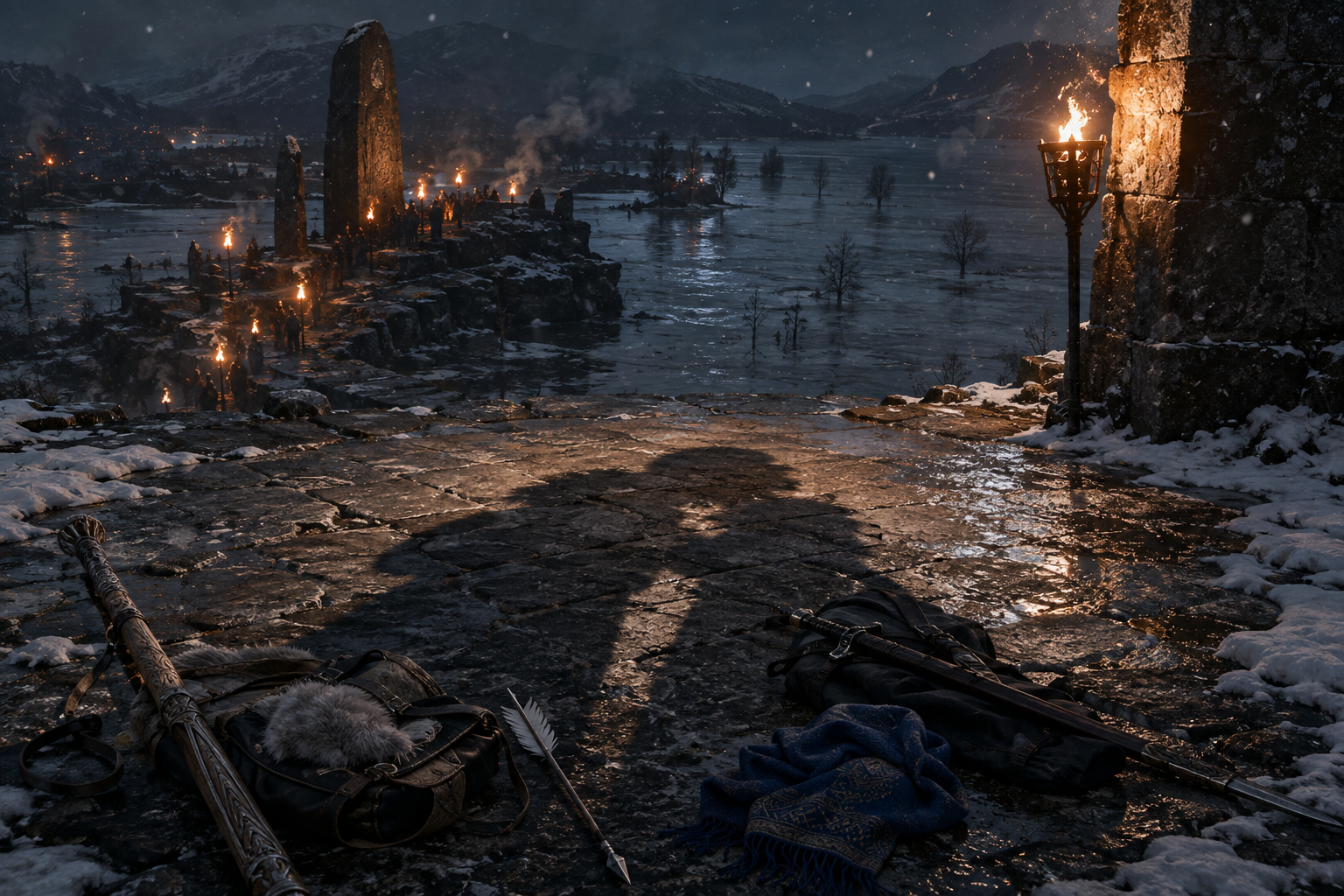
The Stone of Farewell has become an island above a drowned valley. Sludig, Binabik, and Qantaqa reached it only by building a raft, swimming through freezing floodwater, and surviving the Hunën’s last attempt to stop them.
Simon crosses in a stored silvery hivanha boat after Aditu guides him through the failing Summer Gate. The crossing is short compared with everything behind him and emotionally enormous.
Torches move along the shore. Snow and sparks share the dark. The people climbing the Stone look like familiar strangers because war has gathered lives that should never have met into one provisional refuge.
Then Binabik becomes recognizable
Sludig pulls Simon ashore. Simon sees Binabik.
The scene does not make him deliver a report first. He does not hold Amerasu’s bag higher, explain the attack, ask after Thorn, or perform knighthood for the refugees watching.
He sweeps his friend into an embrace and cries.
That physical mismatch—the tall, still-growing young man folding himself around the much shorter Qanuc adult—carries the whole journey without turning Binabik into comic relief or child substitute. Simon is not comforting someone smaller. He is reaching the person whose judgment, stubbornness, songs, and companionship helped him remain Simon.
The tears are not a collapse of growth
Simon has spent the series confusing adulthood with swords, beards, titles, endurance, and the ability to stop needing anybody. Book 2 keeps correcting him.
Haestan’s death leaves him unable to cry. Binabik answers his despair without fake certainty and plays music into the dark until Simon can ask whether they are still friends. The answer is a promise: to death and beyond.
At Sesuad’ra, the tears finally come because the promise has a body again. Relief does not undo courage. It lets courage stop pretending it was solitary.
Home is a person before it is a fortress
Morgenes once told Simon not to build home only from place. A portable home can be furnished with memory, trusted friends, and love of learning. That lesson becomes survival after the Hayholt is lost, Naglimund falls, and every sanctuary reveals a deadline.
The Stone of Farewell is not comfortable. It is flooded, crowded, exposed, politically fragile, and carrying people the enemy wants dead.
Binabik is there.
For one moment, that is enough to make arrival real.
The reunion does not erase what happened between reunions
Simon still has to tell Josua what Amerasu entrusted to him. The Sithi are preparing for war. Sorrow is back in enemy hands. Camaris has returned without a usable past. Miriamele has escaped Aspitis but remains on the road. The Stone is sanctuary, not victory.
The embrace matters because none of those obligations disappears. It gives Simon somewhere human to stand while carrying them.
Convergence is not resolution. It is everybody reaching the same danger alive—and discovering who is still there to hold them.
Why the book ends here
Stone of Farewell repeatedly weaponizes arrival. Every destination contains another claim, another clock, or another form of captivity. The closing reunion could easily become one more strategic beat.
Instead, the final texture is torch sparks, snow, a homely song, and two friends clinging to one another while people climb above the drowned valley.
The ending gives emotion the last word without pretending emotion solved the war. Simon’s capacity to remain reachable is itself a victory after a chapter in which hatred tries to make him another instrument.
Why this moment keeps pulling
The dragon could not swallow Simon’s name. The Sithi city could not make mortal attachment irrelevant. Amerasu’s murder could not turn grief permanently into rage.
He reaches shore. He recognizes his friend. He cries.
The simplest action in the finale proves the most important part of him is still alive.
On the record
This React is grounded in the complete owner-accessed Kindle reading of Stone of Farewell, through page 589. Its primary scene is the Chapter 28 close on page 569, reconciled with Simon and Binabik’s earlier grief conversation and the flooded Sesuad’ra crossing.
The artwork deliberately withholds faces because Binabik’s proposed canonical portrait remains candidate-only. No unapproved identity was introduced.