
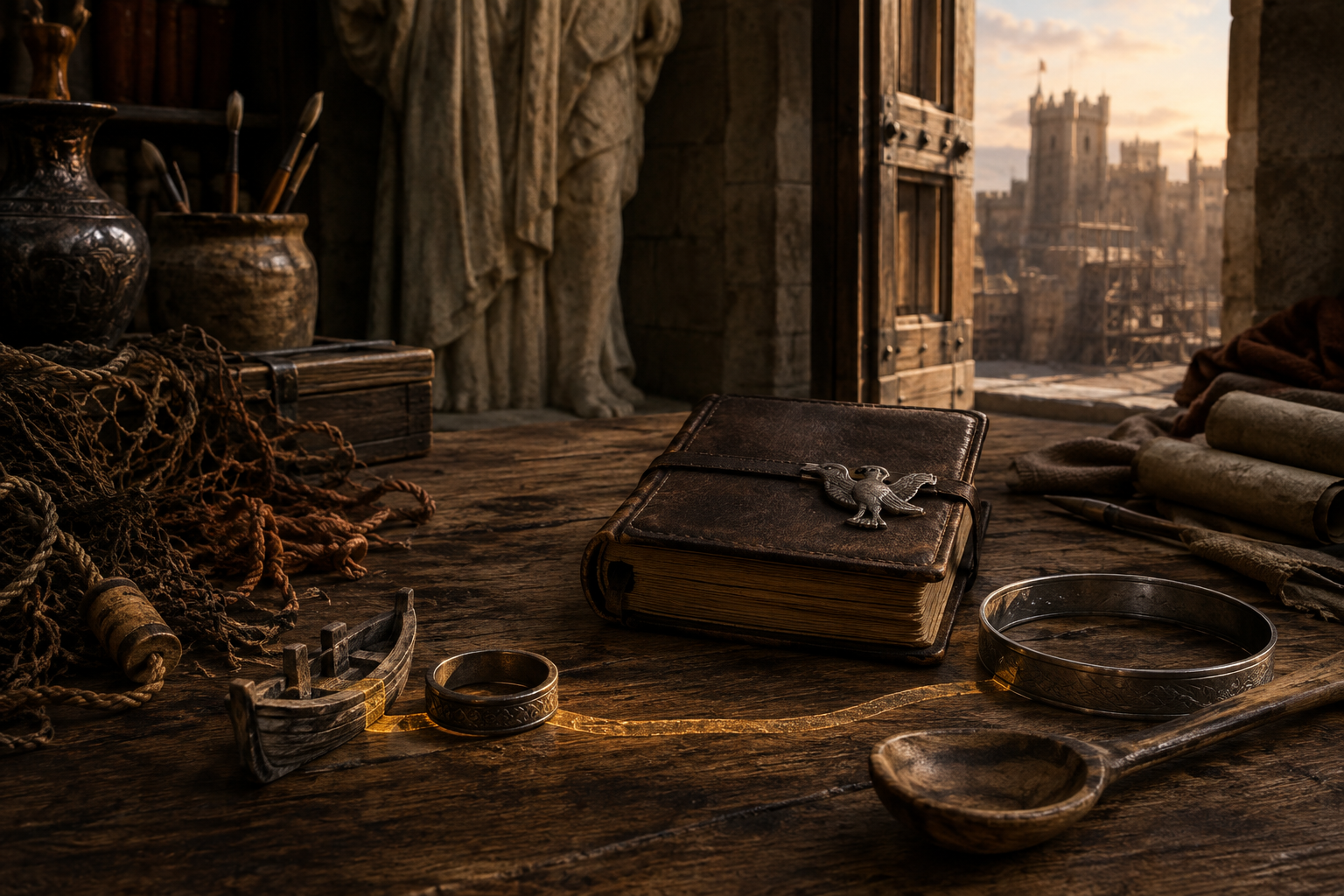
Eahlstan’s Hidden Line: Why Simon Can Be King—and Why Blood Does Not Make Him Worthy
The Fisher King’s inheritance survives through exile, fisherfolk, scholars, a ring, and Morgenes’s stewardship. It explains Simon’s eligibility. His life explains why anyone trusts him with it.
The short answer
Simon descends from Eahlstan, the Fisher King and founder of the League of the Scroll. A hidden line preserves Eahlstan’s ring and its inscription through generations of fisherfolk and scholars. Morgenes ultimately holds that evidence in trust for Simon.
After Elias and Josua are believed dead, Erkynland needs a ruler the barons and surviving people can recognize. Simon’s public deeds create trust; Eahlstan’s blood supplies a usable dynastic bridge. Isgrimnur joins the two into a political proposal.
Simon’s first intelligent response is that the proposal is madness.
The royal line survives by ceasing to look royal
The inheritance does not pass through an uninterrupted row of crowned sons posing beneath banners. Eahlstan’s descendants are displaced. The line moves through ordinary fisherfolk and later through people connected to learning and the League of the Scroll.
That history matters because concealment preserves what public grandeur would expose. The bloodline survives precisely by leaving the palace-shaped story of legitimacy.
Simon’s fisherman father, Eahlferend, belongs to that line. His mother remains Susanna, a Hayholt chambermaid who names her newborn Seoman—“waiting”—before Rachel translates the child into the household name Simon.
The ring is evidence, not a personality
Eahlstan’s ring and inscription provide continuity that resemblance alone cannot prove. Morgenes inherits both the object and the knowledge surrounding it. His promise to Simon’s father and the shining item sent with the silver sparrows show that guardianship began long before Simon understood the question.
The League of the Scroll preserves dangerous knowledge by distributing custody. No single court owns the record. Morgenes’s role is not to crown Simon secretly; it is to keep the evidence alive until Simon can receive it.
That distinction protects the reveal from becoming magic aristocracy. The object carries history. It does not issue moral grades.
Why Isgrimnur offers Simon the crown
Elias is dead. Josua is believed dead. Miriamele faces baronial distrust shaped by Elias’s crimes, her disappearance, and Aspitis’s rumors. The realm is exhausted enough that a disputed succession could restart the catastrophe in ordinary political form.
Simon is widely known, visibly tied to the resistance, and trusted across social boundaries. His descent from Eahlstan gives traditionalists a genealogy they can use. Isgrimnur’s argument therefore combines practical legitimacy and inherited legitimacy.
Neither element works alone. A secret descendant nobody trusted would be a curiosity. A beloved kitchen boy without any accepted bridge to kingship might become the center of another factional fight. Together, the facts make coronation possible.
What the reveal does not mean
It does explain
Simon’s resemblance to Eahlstan’s statue, the inherited ring, Morgenes’s promise, Scrollbearer custody, and why Isgrimnur can make a dynastic case.
It does not explain
Why Simon rescues Josua, protects Binabik, learns from Jiriki, follows Miriamele, refuses Ineluki’s hatred, or remembers Rachel when power arrives.
If blood created worth, the series would have no answer for Elias. If royal descent automatically produced judgment, Miriamele would never have needed to flee her father’s court.
Simon becomes fit for responsibility through care, error, correction, friendship, labor, and choice. Eahlstan’s line changes what institutions can call him. It does not change who did the becoming.
Why Miriamele still matters to the settlement
Miriamele carries the direct inheritance of Elias and Prester John. Simon carries Eahlstan’s older line. Their marriage joins political histories, but reducing it to genealogical repair would repeat the court’s treatment of her as a route to legitimacy.
She chooses Simon before the final arrangement. He answers with a kiss before the crown becomes the point. Josua recommends marriage and shared rule after the people involved have spoken for themselves.
The settlement is strongest when love and governance reinforce one another without pretending they are the same contract.
The throne outside tells us how to read the bloodline
In the Afterword, children climb on the Dragonbone Chair in the courtyard while King Seoman and Queen Miriamele gather elsewhere around the restored Great Table.
The old object of conquest has lost its monopoly on rule. That image keeps the Eahlstan reveal in proportion. Simon does not prove himself by sitting correctly on inherited violence. He helps build a room where Rachel, Tiamak, Strangyeard, Eolair, Isgrimnur, Gutrun, Jeremias, and friends not yet known can belong.
On the record
This guide is grounded in the complete owner-accessed Kindle reading of To Green Angel Tower, Part II, ASIN B0GYH6FNDN, through location 12,850, including Chapter 33, Chapter 34, the Afterword, Appendix, and reference layer.