
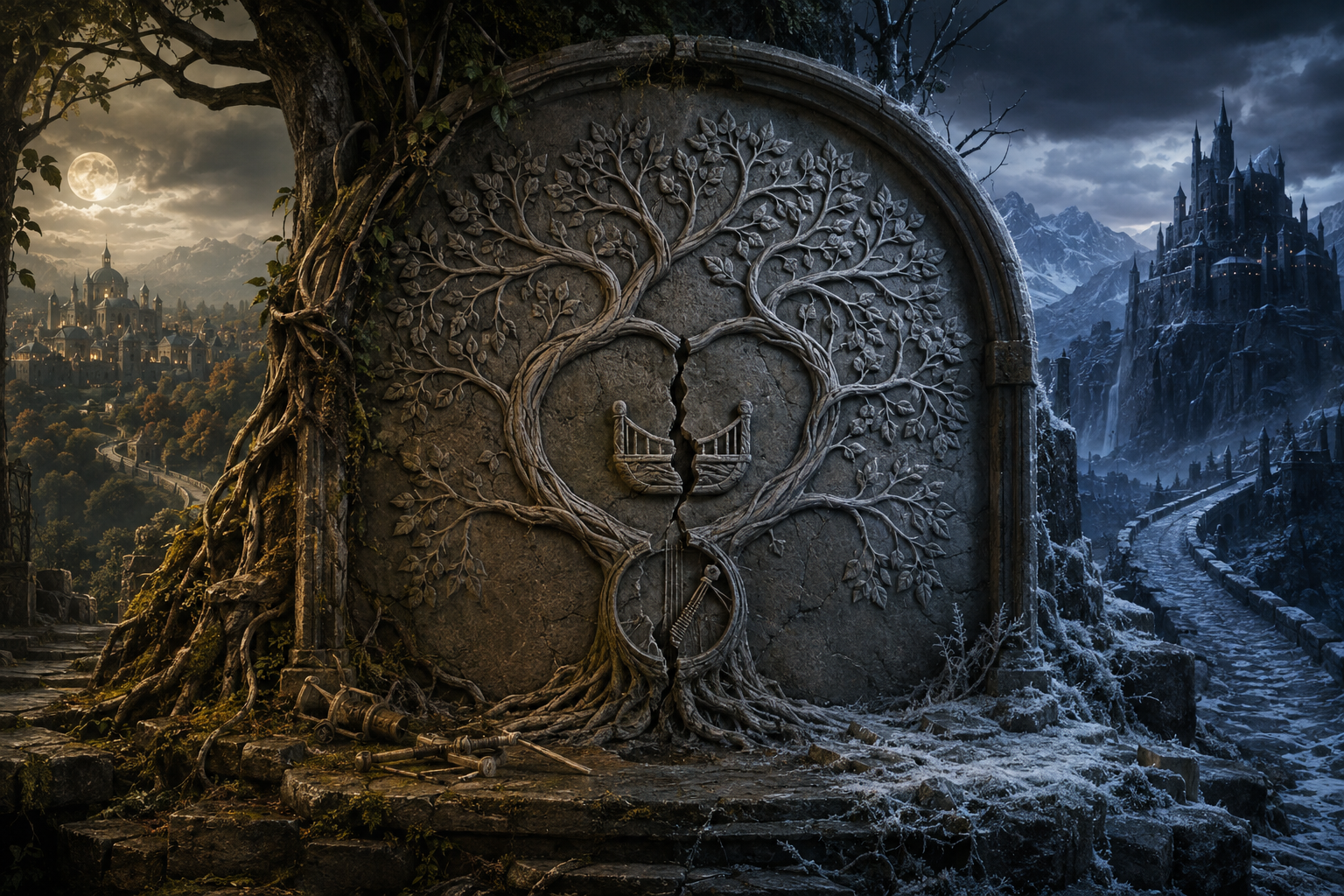
Nenaïs’u and Drukhi: How a Family Tragedy Became a Civilizational Border
An accidental mortal arrow did not single-handedly create the Sithi–Norn split. It struck a family already divided over mortals, then grief, retaliation, confinement, self-willed death, and political choice hardened the fracture.
The family map
Nenaïs’u’s house
She is the daughter of Jenjiyana of Year-Dancing and Initri. That places her within a family associated with the Zida’ya side of the later division and with Jenjiyana’s contested restitution to Ruyan’s people.
Drukhi’s house
He is the son of Utuk’ku and Ekimenišo. Utuk’ku opposes the marriage and already belongs to the harder anti-mortal political current.
The marriage crosses more than a private family preference. It joins people positioned inside an argument about mortals, hierarchy, and the future of the Gardenborn in Osten Ard.
What happened
A mortal huntsman sees Nenaïs’u’s bright clothing and mistakes it for plumage. His arrow kills her accidentally.
The accident does not produce a moderate response. Drukhi demands mortal extermination. He is confined at Si’injan’dre Cave, and there he makes himself stop living.
Two deaths now carry different kinds of agency: Nenaïs’u is killed by catastrophic mortal error; Drukhi chooses death after grief and retaliatory desire meet confinement.
Utuk’ku preserves the loss as a permanent political claim. Centuries later she keeps Drukhi’s pale body beside her, turning private grief into a physical relic that can never contradict the interpretation built around it.
How grief becomes a border
After the Pact of Sesuad’ra, Utuk’ku and Ekimenišo lead their clan north. The departure does not begin history from zero. It consolidates divisions already shaped by attitudes toward mortals and older conflicts involving Hernystir.
The Hikeda’ya treat mortals as creatures or worse. The Zida’ya reject that judgment. Nenaïs’u and Drukhi’s deaths become proof each side can attach to an existing political imagination.
That is how a family tragedy becomes civilizational: grief supplies moral heat, factions supply interpretation, leaders supply direction, and institutions keep the chosen meaning available after witnesses die.
Why Utuk’ku’s grief explains but does not absolve
Utuk’ku lost a son. The loss is real. Her desire to annihilate mortals and eventually drag the world toward Unbeing is also real.
Explanation is not acquittal. The series refuses the easy equation in both directions: suffering does not make her evil unreal, and evil does not make the original suffering imaginary.
Her power lies partly in keeping every later event inside the first wound. No mortal action can become evidence of change because the category “mortal” has already been sentenced. No living future can outweigh the body she refuses to release.
The story survives as song—and song changes with the singer
Hernystiri tradition remembers Drukhi and Nenaïs’u through “The Leavetaking Stone.” Maegwin sings it while tending Lluth and Gwythinn’s cairns, overlaying the old lovers’ flight and loss onto her own dead family and displaced people.
The song becomes useful because it carries grief across cultures. It becomes dangerous when the listener treats resemblance as identity. Maegwin’s suffering is real; the old story does not automatically interpret every voice, vision, or decision for her.
Aditu later supplies the family and political detail that song alone cannot preserve. Emotion and archive must be allowed to correct one another.
Hierarchy hides inside the claim that nobody is above another
Sithi language and etiquette may refuse blunt declarations of superiority. Their history still contains enslavement, controlled knowledge, family authority, faction, and judgments about which attachments are acceptable.
The Nenaïs’u–Drukhi tragedy reveals how hierarchy can operate while a culture denies the vocabulary. Utuk’ku’s opposition to the marriage, anti-mortal politics, and the treatment of Tinukeda’ya show that equality cannot be proven by beautiful manners.
What not to flatten
Too simple
“A human killed an immortal woman, so the Norns left.” This erases accident, Drukhi’s retaliation, confinement, self-willed death, existing political division, leaders, and the Pact.
Supported
The killing and deaths became a decisive symbolic hinge inside older disputes. Utuk’ku and Ekimenišo then made a political departure that hardened family grief into the Zida’ya/Hikeda’ya fracture.
Why this matters at the end of Part I
Aditu tells Simon this history while he believes the class boundary between himself and Miriamele is natural and immovable. The stories are not equivalent, but the placement is not accidental.
Private love becomes political when hierarchy claims authority over who may belong together. Grief becomes historical when institutions decide which interpretation future generations must inherit.
Simon’s task is smaller and still serious: stop treating the social order as nature before fear writes the ending for both of them.
On the record
This guide originates in the complete owner-accessed Kindle edition of To Green Angel Tower, Part I, ASIN B0GYH22SLL, through location 12,656. It reconciles Aditu’s Chapter 26 account with Maegwin’s earlier song and Utuk’ku’s later preserved-body receipt without pretending the later evidence was spoken in the earlier scene.