
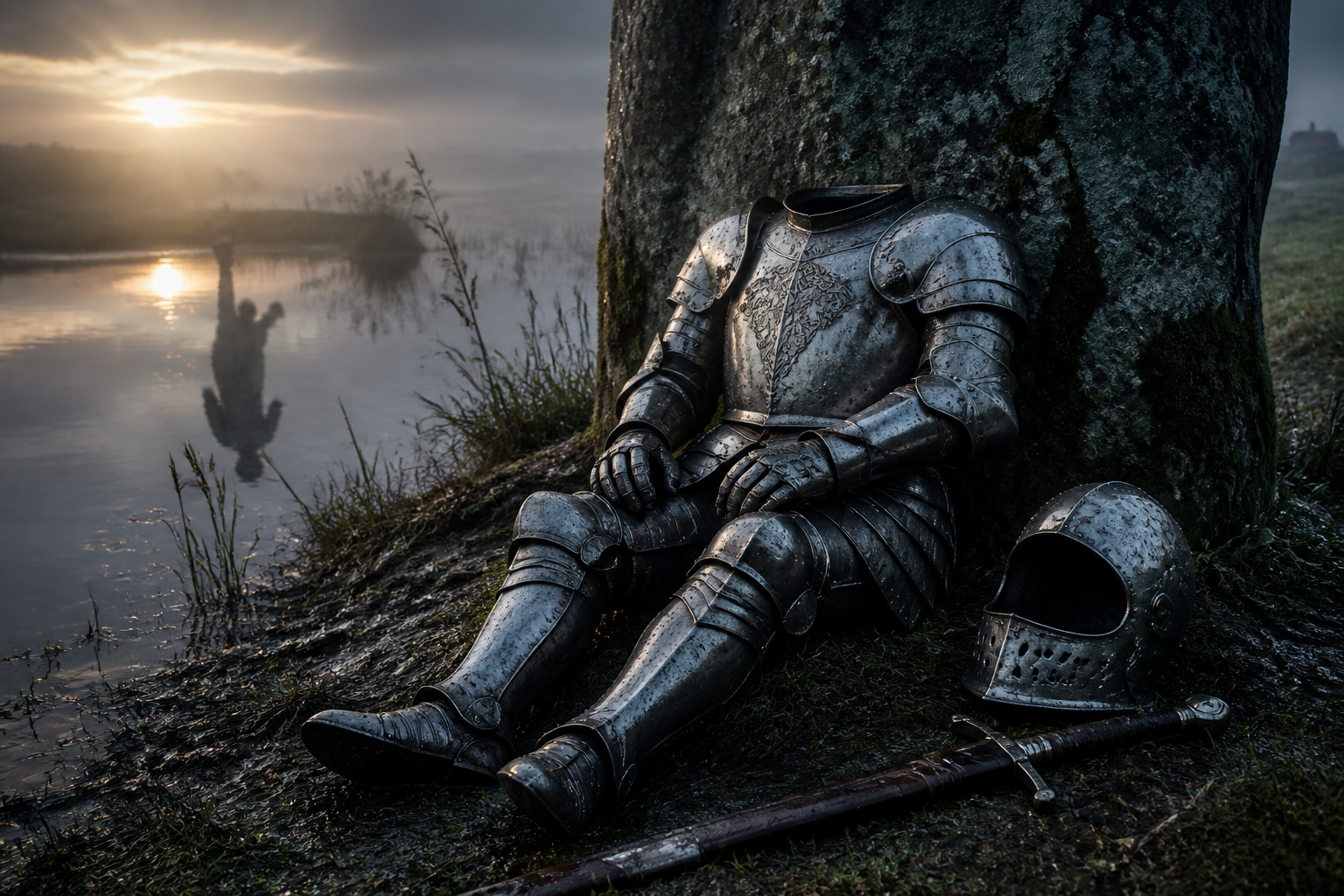
Camaris Is a Person, Not Military Equipment You Found in a Swamp
Congratulations, the greatest knight in Osten Ard is alive. Unfortunately for everyone’s battle plan, “alive” is not the same thing as restored, obedient, or available for deployment.
The resistance finds a man and immediately starts mentally inventorying the weapon
I understand the panic. Elias has Sorrow. Ineluki is turning winter into government policy. Josua’s coalition has refugees, brave people, insufficient food, and approximately one usable miracle divided between several unreliable prophecies.
Then Camaris appears.
The greatest knight of the old age. The absent center of royal history. The man whose name has spent years doing jobs his body was not present to perform.
Of course everybody wants him to be the answer.
But the person they recover does not arrive with the legend’s user manual. He is alive, silent, wounded in identity, and separated from the easy heroic function other people preserved for him. That is not a frustrating delay before the useful Camaris comes back. That is Camaris.
Legend is what happens when everybody else gets custody of your identity
Camaris has been remembered as a finished object: perfect knight, measure of courage, lost standard, solution deferred. A legend is convenient because it cannot object to the assignment.
A living person can.
The moment Camaris returns without clean memory or speech, everyone discovers how little room the legend left for his humanity. His body is treated like recovered national property. His silence becomes a problem to solve. His past becomes evidence other people need.
The series is full of inherited objects whose meanings have hardened beyond the people who made or suffered them: a chair built from a dragon’s bones, a castle built inside Asu’a, swords made from violated matter, prophecies read as instructions. Camaris is the human version of the same danger. History has converted him into an artifact.
His silence is not empty space waiting for strategy
The old knight’s condition does not mean nothing is present. His intimate recognition of Amerasu’s song proves that memory survives in forms the watching coalition cannot neatly access. Something inside him knows. That does not mean everybody else is entitled to force it into service.
Recovery is not a door with “war effort” painted on the other side.
The resistance needs Camaris, but need does not erase personhood. Trauma does not become less real because the apocalypse has a schedule. A survivor does not owe the world the version of himself it misses most.
And yes, later Camaris carries Thorn and becomes crucial. That later usefulness does not retroactively justify treating his earlier vulnerability as malfunction.
The fantasy genre loves a restored weapon. This book keeps returning a person.
There is a familiar heroic promise here: find the lost king, lost knight, lost sword, lost heir, or lost knowledge and the broken present can inherit the old world’s strength.
Memory, Sorrow, and Thorn does not entirely reject restoration. It makes restoration answer questions.
What if the old hero remembers things nobody wants known? What if his greatness belongs to compromises hidden by the official story? What if bloodlines complicate rather than settle legitimacy? What if returning him to battle repeats the habit of valuing him most when he can absorb violence for everyone else?
Camaris is not compelling because the legend was true. He is compelling because the person remains larger, stranger, and more vulnerable than the legend.
Being needed is not consent
This is the piece grand coalitions hate. Desperation creates real obligations, but it also creates a vocabulary for turning people into resources.
The healer becomes “healing.” The scholar becomes “information.” The princess becomes “legitimacy.” The knight becomes “military advantage.” Every noun loses the person doing the work.
Camaris’s return exposes that grammar. The coalition sees armor before it sees recovery. It sees the sword-arm before the wound. It sees the story it was promised before the man who survived becoming unavailable to it.
A just cause can still instrumentalize people. The fact that the enemy is worse does not make every use righteous.
Final word
Camaris is alive. That is not a requisition notice.
If he fights, the choice matters because the person makes it. If he remembers, the truth matters because it belongs to a life, not because history successfully restarted a device. If he remains silent, that silence is still part of the man Osten Ard recovered.
The greatest knight in the world does not stop being a person when the world needs a weapon.
Put the legend down gently. Ask the man what survived.
On the record
This rant is grounded in the complete owner-accessed Kindle edition of Stone of Farewell through page 589 and the reconciled later-volume evidence about Camaris. It is one canonical editorial with Book 2 as its origin and cross-volume relevance; it is not a duplicate character profile.