
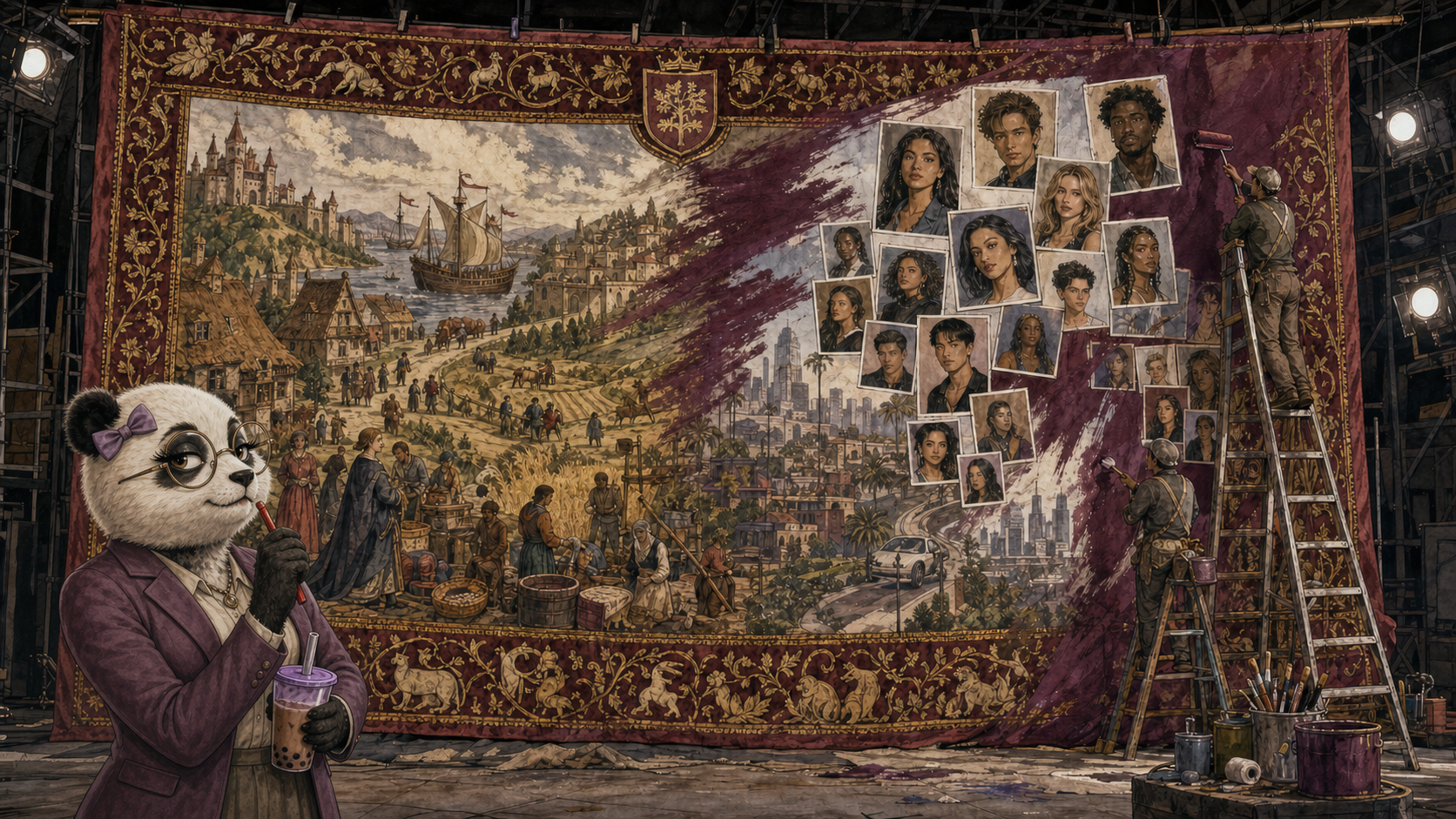
Representation Is Not a Substitute for Worldbuilding
If you want a modern multicultural kingdom, build one. Give me the migrations, marriages, trade routes, neighborhoods, prejudices, alliances, languages, and history that created the place. A remake cannot borrow the costume rack of a specific past, drop a 2026 American casting philosophy into the middle, and expect applause to cover every seam.
The original did not ask to become a demographic spreadsheet
Disney’s animated fairy tales were already adaptations. Snow White turned a German tale into a 1937 American musical fantasy. Beauty and the Beast turned a French literary fairy tale into a Broadway-shaped romance. None of these movies was a documentary. But each one established a visual and cultural grammar. When Disney remakes that exact branded version,same dress, same castle, same songs, same enchanted furniture,it is asking us to recognize the original while also pretending recognition creates no obligation.
If the company wants to change the world, then change the world. Do not keep every profitable icon and call anyone who notices the mismatch hostile to representation.
Snow White is fiction. That does not make every choice invisible.
Rachel Zegler is a talented Colombian-American and Polish-American actress. Her casting does not erase an actual medieval German princess because Snow White was never one. That is the easy answer, and it is factually correct.
That answer is also not the end of the conversation. Disney kept the visual branding of its European heroine, sold the movie as a return to the “timeless” 1937 story, then rewrote the origin of a name traditionally tied to the girl’s appearance. A Latina actress belongs in fantasy. Obviously. My problem is Disney making this particular character carry the company’s diversity update instead of creating a Latina fairy-tale heroine with her own world, family, mythology, and visual identity from birth.
A race swap can create an acting opportunity. A new character can create an inheritance.
Beauty and the Beast almost admits it is building a different France
The 2017 Beauty and the Beast places Black characters throughout its court and village. Because the castle staff were transformed objects and the story is openly magical, the casting did not bother me in the same way. The movie has room to imply a kingdom operating by different rules.
But it still illustrates the larger problem. The production carefully stressed its French period inspiration while leaving the social structure conveniently vague. If this France developed differently, I want to know how. Were the kingdom’s ports connected to Africa and the Caribbean? Were these families established merchants, soldiers, artists, diplomats, or aristocrats? Did the enchantress’s magic change more than one castle? Fantasy is not an excuse to stop building after the costume fitting.
Real Black people lived in Europe long before modern cinema decided to “insert” them. Their lives were not a color-blind montage. Their presence was shaped by empire, trade, faith, enslavement, freedom, law, work, and family. Erasing those conditions is not automatically kinder. Sometimes it turns real historical struggle into decorative proof that the studio has good intentions.
Why Asian historical dramas often feel more solid
Many Chinese, Korean, and Japanese historical productions preserve the ethnic and cultural center of the society they portray. That does not make every drama perfectly accurate. They compress dynasties, beautify palaces, invent romances, and commit their own nationalist distortions. But the characters usually understand that clan, region, court rank, surname, marriage, language, and foreign origin mean something.
A foreign trader does not simply appear as if he grew up next door to the minister’s daughter. His presence creates a story. A woman from another kingdom brings political assumptions with her. A mixed household has history. Difference becomes part of the narrative rather than a casting announcement floating above it.
That is what I appreciate: integrity does not mean purity. Integrity means the world remembers how its people got there.
The melting pot is not the only moral society
American entertainment repeatedly treats the modern metropolitan melting pot as the final form of human goodness. Every fictional kingdom must look like a Los Angeles commercial or viewers may not feel included. But inclusion does not require pretending every place, period, and community had the same demographic shape.
I can love a Korean story centered on Koreans. I can love a Nigerian story centered on Nigerians. I can love a Polish fairy tale that looks Polish. Cultural specificity is not an insult to everyone outside the frame. Sometimes it is the reason the frame has meaning.
And yes, global stories can contain migration and mixed communities. History is full of them. Write those stories. Show the port city instead of pretending the isolated mountain village was one. Show the Silk Road household, the Moorish court, the colonial violence, the diplomatic marriage, the sailor who stayed, or the child growing between languages. That is not less inclusive. That is inclusion with roots.
Do not erase historical cruelty in the name of comfort
My deeper discomfort is not the sight of a diverse cast. My concern is what the color-blind fairy-tale world can imply: that the past had already solved exclusion as long as everyone owned a nice waistcoat.
History was not kind. People crossed borders, loved one another, built families, and reached positions of power,but they also faced slavery, religious persecution, caste, conquest, expulsion, anti-miscegenation laws, and colonial rule. When a movie borrows the architecture and hierarchy of that past while removing every trace of how difference operated, the story does not repair history. The fantasy can sugarcoat the past.
What inclusive casting gets right
Audiences deserve to see people of many races, cultures, bodies, and family histories occupying the full range of fantasy roles. A child should not learn that wonder belongs to one face while everyone else enters only as comic relief, a villain, or a lesson about suffering. Casting can challenge habits that were never required by the genre and open doors that studios kept closed for reasons unrelated to story.
Historical Europe was not an airtight white room. Trade, empire, war, pilgrimage, enslavement, diplomacy, migration, and scholarship moved people across continents. Courts and cities differed from isolated villages. Port towns differed from inland farms. A fantasy world has even more freedom because magic, nonhuman peoples, invented empires, and alternate geography can produce histories that never existed here.
The complaint is not that a Black princess, an Asian knight, or a mixed royal family needs permission. The complaint is that a studio often wants the visual result without doing the narrative labor that would make the world feel inhabited. Representation becomes a casting announcement instead of a feature of history, community, and power.
A kingdom should remember how its people arrived
Real diversity leaves evidence. Food changes. Languages borrow words. Religions share neighborhoods, compete for authority, and create hybrid practice. Clothing responds to climate, law, trade, class, and taste. Families carry stories about where grandparents came from. Political factions form around land, money, marriage, military service, and access to institutions.
A multicultural capital may sit along a major trade route. A dynasty may have united regions through marriage. Refugees may have settled after a magical disaster. A navy may recruit from distant islands. An empire may have moved people through conquest and forced labor. None of those explanations needs a lecture in the opening scene, but the production design, dialogue, names, customs, and conflicts should reveal the history.
When every character shares the same cultural assumptions while only appearance varies, the kingdom feels like a casting room. Viewers notice because human difference is more than skin tone. People inherit rituals, jokes, fears, loyalties, recipes, beauty standards, and arguments. A world becomes richer when those inheritances shape choices without reducing anyone to an ethnic brochure.
Colorblind fantasy can hide power
A story may choose a world where race never became a system of hierarchy. That can be a legitimate fantasy. The writer still must decide what organizes power instead. Bloodline, magical ability, religion, citizenship, species, land ownership, gender, language, or class might determine who receives safety and status. A society with no meaningful divisions at all rarely generates believable politics.
Colorblind casting can also create accidental meaning when a production borrows a recognizable historical setting. A royal court may look diverse while every institution, costume, and tradition comes from one European elite. Characters of color appear included, but their cultures have left no mark on the world. The frame says everybody belongs while the design says only one heritage built civilization.
The answer is not a racial census for every fairy tale. The answer is attention. If the setting claims history, let history have consequences. If the setting rejects our history, build the alternate one. If race truly has no political meaning, make another system legible enough that viewers understand how advantage and exclusion operate.
Why remakes keep choosing substitution
Familiar titles reduce financial risk. Studios know the castle, songs, heroine, villain, and marketing silhouette already carry recognition. A new multicultural fantasy would require executives to trust an unfamiliar world and teach audiences why the characters matter. A remake can advertise progress while keeping the old brand underneath.
That bargain burdens actors. Performers of color become the public face of decisions they did not control and absorb anger aimed at the studio. Debate narrows to whether an actor is allowed to play a role, while questions about writing, design, historical logic, and corporate risk disappear. The company receives attention either way.
Fans are then pushed into two dishonest camps. One side pretends every change is flawless because criticism might feed racism. The other treats any visible change as proof that the story has been destroyed. Both positions protect weak filmmaking. Representation deserves criticism serious enough to ask whether the world supports the people placed inside it.
How the fantasy could become better
Start with the society before selecting which old property can carry the casting headline. Decide where the kingdom sits, who trades there, what wars changed its borders, which languages survive, and how the royal family gained legitimacy. Then let characters emerge from that history. The princess will feel specific because her obligations belong to a particular place rather than a generic palace.
Give communities interior variety. Two characters with similar ancestry should not share one opinion. Class, generation, region, religion, education, and personality create disagreement inside every group. Representation becomes worldbuilding when characters have relationships with their own communities, not only with the white protagonist or the main plot.
Let design teams build a visual language from more than decorative sampling. Architecture, textiles, hair, music, weapons, and ceremony should carry coherent histories. Consultation needs authority early enough to alter the premise, not merely approve a costume after the story has already decided what culture means.
Most important, fund original worlds. A new heroine does not need to inherit Snow White’s dress to prove that she belongs in a fairy tale. Give her the entire mythology, including the mistakes, contradictions, family history, romantic choices, and political structures that make a character worth remembering.
Make the new story. I promise I will come.
If Disney wants a Latina princess, create her world and let little girls inherit the entire mythology,not somebody else’s old dress. If the studio wants a genuinely multicultural European fantasy, make the trade empire, magical migration, or alternate history the premise. If it wants a kingdom where race does not organize power, show what does.
What I reject is corporate substitution: keep the old title because it is financially safe, swap visible traits because it is socially current, refuse to rebuild the story around either decision, and call the result progress.
The original did not need to change. A new story needed permission to exist.