
Character File · Toy Story · Full Franchise
Mr. Potato Head
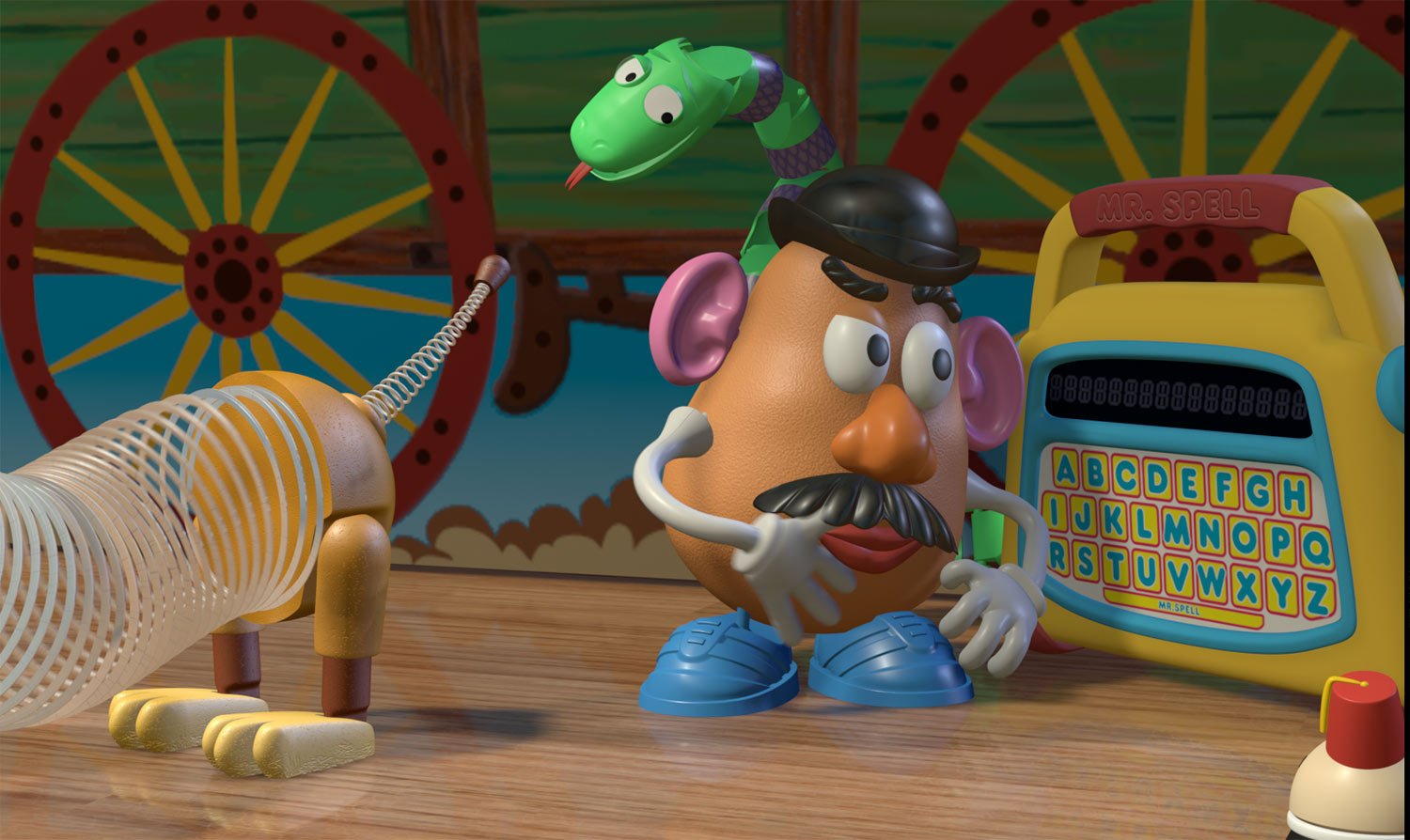
His face comes apart. His suspicion arrives fully assembled.
Quick file
Full identity: Mr. Potato Head, a modular plastic potato toy whose facial features, limbs, hat, shoes, and accessories can be removed and rearranged. Primary voice: Don Rickles in the first four feature films and related shorts. Spouse: Mrs. Potato Head. Home communities: Andy’s room, Bonnie’s room, and the larger Toy Story family.
Core relationships: Woody as the leader he challenges, Hamm as a fellow cynic, Slinky as the loyal friend whose trust he tests, the Aliens as children he slowly accepts, and Mrs. Potato Head as the person who sees tenderness under the complaints. Core conflict: his body is designed to come apart, while his personality fights constantly against being treated as disposable.
The face can fall off without erasing the person
Mr. Potato Head’s body makes Toy Story’s personhood question impossible to ignore. An eye, ear, mouth, arm, or entire arrangement can change while memory and identity continue. The movies use the pieces for slapstick, but the joke rests on a radical claim: no individual component contains the whole person.
That matters in a franchise built around mass production. His body is commercially standardized and mechanically replaceable. His history is not. The person who argues with Woody, marries Mrs. Potato Head, adopts the Aliens, and survives Sunnyside cannot be reduced to a list of parts in a box.
The removable face also makes emotion physical. Anger can send features flying. Panic leaves him literally disorganized. Recovery often requires help from somebody who knows which pieces belong to him. Dependence is visible without making dependence the opposite of dignity.
Don Rickles gives irritation a moral vocabulary
Rickles performs every line as if the room has already wasted five minutes he will never get back. The speed, bite, and disbelief make Mr. Potato Head funny before the content of the complaint fully lands. He does not merely disagree. He acts offended that nonsense was permitted to exist near him.
The performance could have made him one-note. Instead, affection leaks through timing. Concern often arrives disguised as an insult, and fear becomes louder sarcasm. He protects vulnerability by attacking the situation before anyone can notice how much it matters to him.
Rickles also gives the ensemble necessary friction. Woody’s plans sound different when somebody refuses automatic applause. Skepticism forces leadership to answer questions, and the voice makes those questions entertaining enough that the film can keep them inside family banter.
Andy introduces him as a villain before he gets a choice
The opening play sequence casts Mr. Potato Head as One-Eyed Bart, a bank robber threatening Bo Peep’s sheep. Andy uses detachable parts to create a criminal persona because the toy’s face already invites transformation and disguise.
That role tells us how children can assign morality through appearance and play function. Mr. Potato Head does not remain the villain when the humans leave. He becomes a member of the room with loyalties, grievances, and a social position that Andy’s script cannot contain.
Toy Story quietly separates performed villainy from ethical behavior. A child can make him rob a bank without making him cruel. Later films can let him be suspicious, selfish, brave, loving, and wrong because personhood begins where the assigned scenario stops.
He questions Woody before the room is ready to admit doubt
Mr. Potato Head is one of the first toys willing to challenge Woody’s authority openly. Some of that resistance is personality. Some comes from understanding that favorite status protects Woody from consequences other toys would face immediately.
When Buzz arrives, Potato Head enjoys watching the hierarchy wobble. His reaction is petty, but it is also politically observant. Woody has treated leadership, friendship with Andy, and moral authority as if they naturally belong to the same person. Buzz exposes the difference.
The skeptic is not always correct. Potato Head can rush toward accusation and enjoy Woody’s humiliation too much. Still, a community that silences him would lose its clearest warning system for favoritism, secrecy, and leadership built on reputation rather than evidence.
The window accusation is understandable and still incomplete
The toys see Woody’s hostility toward Buzz, witness the lamp incident, and then watch Buzz fall from the window. From their position, attempted murder is not a ridiculous conclusion. Woody has motive, opportunity, and a story that sounds designed after the fact.
Mr. Potato Head leads the accusation because he is already primed to distrust Woody’s privilege. The danger is not skepticism itself. The danger is certainty arriving before the room has access to the whole event. He turns suspicion into a verdict and helps the group move toward punishment.
The scene makes him a useful moral complication. Communities need members willing to question leaders. They also need procedures that keep questioning from becoming mob judgment. Potato Head embodies both the necessity of dissent and the harm caused when anger outruns proof.
Woody’s Buzz-arm performance confirms his worst fear
When Woody uses Buzz’s detached arm to fake proof of life, Mr. Potato Head does not see a clumsy rescue attempt. He sees a leader manipulating evidence and displaying what appears to be part of a dead friend. His horror follows logically from the information available.
The moment validates his suspicion so completely that reconciliation becomes harder. Woody knows Buzz is alive, but the toys across the yard experience the puppet show as deception layered over violence. Their refusal to help is a boundary, not simple disloyalty.
Potato Head’s reaction reminds viewers that intention cannot control impact. Woody wants transportation. The performance communicates domination. A leader who needs trust cannot demand that everyone ignore the image he deliberately created.
Sarcasm is armor for a body anybody can rearrange
A modular toy lives with constant physical exposure. Hands can remove his eyes, relocate his mouth, exchange his accessories, or leave pieces behind. Human play treats transformation as the product’s appeal, while the conscious person experiences the same feature as vulnerability.
Sarcasm gives Mr. Potato Head a boundary humans cannot hear. He narrates absurdity, complains about handling, and refuses to act grateful for every indignity. The voice asserts a stable self even while the body is being rearranged.
That does not make every insult healthy. Armor can strike friends. The profile becomes interesting because the defense works and costs him something. He protects himself from helplessness by sounding untouchable, then depends on the same community he has been poking.
Mrs. Potato Head reveals the domestic self
Toy Story 2 introduces Mrs. Potato Head through Andy’s gift, and Mr. Potato Head responds with immediate romantic delight. The relationship lets the franchise move him beyond the role of room critic without removing the critic.
Their marriage is comic, affectionate, argumentative, and practical. She remembers items, packs supplies, worries about his safety, and calls him on behavior. He responds with devotion that looks almost startling beside his usual impatience.
The contrast is not evidence that his public personality is fake. People contain different registers. Mrs. Potato Head receives tenderness because intimacy gives him somewhere to place concern without pretending concern is a debate he might lose.
Packing for camp turns marriage into teamwork
Mrs. Potato Head’s habit of packing extra accessories becomes a running joke, but the accessories repeatedly matter. A spare pair of shoes or eyes is not clutter when bodies can lose essential pieces during escape.
Mr. Potato Head complains because complaint is his resting language. He also carries, uses, and benefits from the care. Their partnership works through knowledge of material needs rather than abstract declarations alone.
The movies understand domestic love as logistics. Somebody remembers what your body may require when you are frightened, rushed, or incomplete. The bag of parts is funny because it is excessive and moving because it is attentive.
The Aliens test the limits of his family imagination
The three Pizza Planet Aliens enter the Potato Heads’ life through Mrs. Potato Head, who credits them with saving her and embraces them as children. Mr. Potato Head initially reacts as if the adoption occurred without adequate committee review.
His resistance is comic, but it exposes a real limit. He understands family through chosen attachment until the choice disrupts his own comfort. The Aliens repeat phrases, follow the claw, and occupy space differently from the toys he already knows.
Acceptance grows through experience rather than one magical speech. He remains exasperated while becoming protective. Family does not require him to find every behavior convenient. It requires him to stop treating inconvenience as proof that somebody does not belong.
The landfill rescue changes what the Aliens mean to him
At the incinerator, the Aliens operate the claw and rescue the entire group. The franchise returns their oldest joke as an act of technical competence and devotion. The characters Mr. Potato Head underestimated become the reason he survives.
His gratitude lands because it corrects years of distance. He cannot keep framing them as Mrs. Potato Head’s strange attachment after they choose the family under impossible pressure. They are his children in action before he can comfortably say it.
The embrace does not erase every impatient joke that follows. It changes the foundation underneath them. Irritation now occurs inside acknowledged family rather than being used to deny the relationship.
Toy Story 2 turns skepticism toward the rescue mission
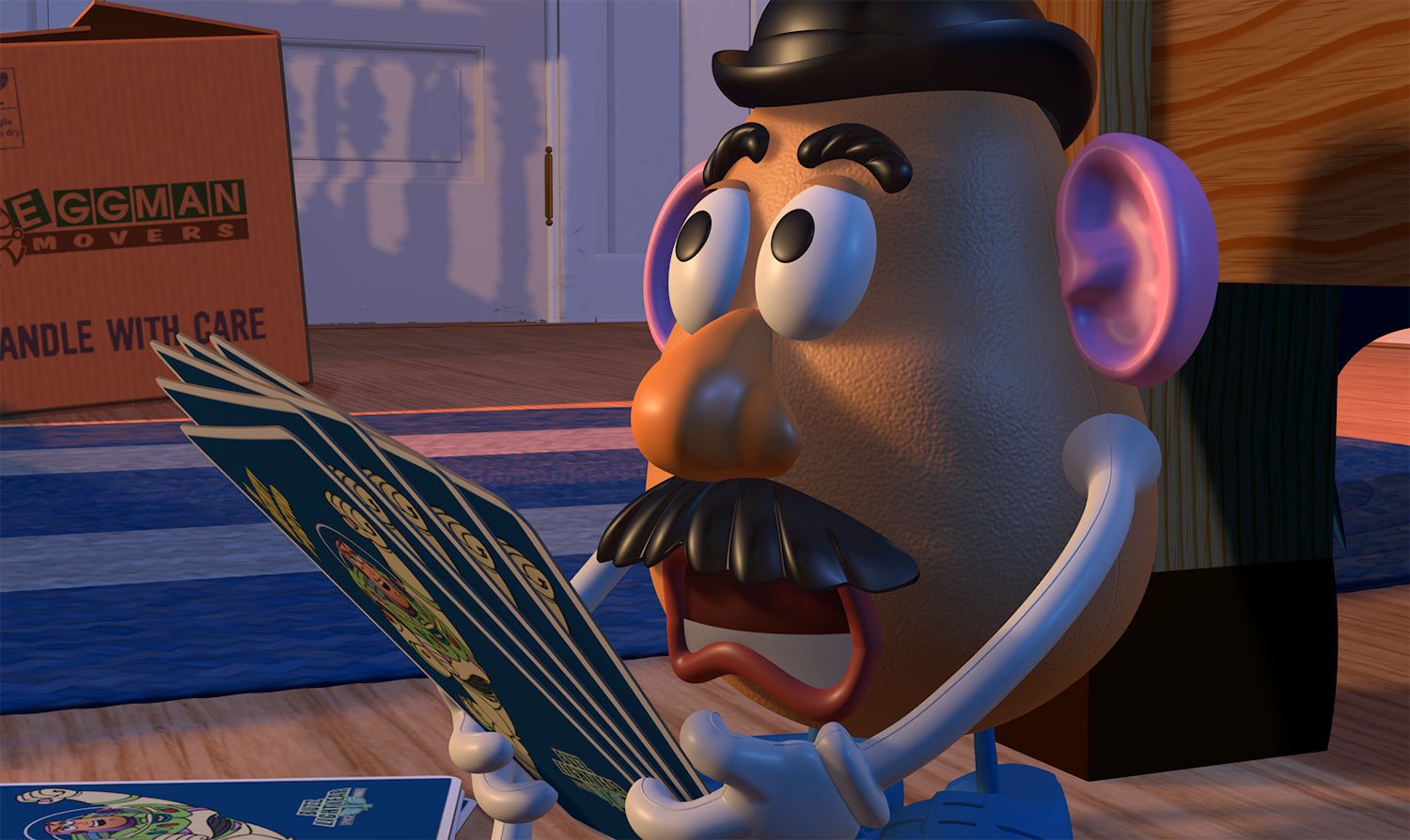
When Woody is stolen, Mr. Potato Head joins the effort despite his habitual resistance to Woody’s plans. Participation proves that criticism has not cancelled loyalty. He can believe Woody is difficult and still consider his disappearance an emergency.
The mission also places Potato Head under Buzz’s field leadership. A character who once enjoyed Buzz as a challenge to Woody now has to cooperate with the person rather than the symbol. The ensemble becomes less dependent on one favorite leading every action.
His complaints keep danger legible. Crossing roads, infiltrating Al’s Toy Barn, and navigating an airport are ridiculous risks for small plastic bodies. Humor does not mean he is wrong to notice the odds. It lets fear remain present without freezing the group.
His body makes the Al’s Toy Barn world especially strange
A toy store contains unopened versions, loose accessories, replacement bodies, and shelves organized by product category. Mr. Potato Head moves through a space that treats his kind as inventory rather than community.
For him, a wall of parts would be both abundance and existential threat. Replacement offers repair while also suggesting the individual body can be substituted indefinitely. Toy Story never fully resolves that tension because consumer culture cannot resolve it for conscious products.
His stable personality becomes the answer the films trust. Parts may be compatible across packages, but memory, relationship, and choice create the person who knows which face feels like his own.
Toy Story 3 begins with the fear of being thrown away
The garbage-bag misunderstanding hits Mr. Potato Head at the level of body and history. He knows how easily a detachable, aging toy can be interpreted as clutter. Andy’s silence appears to confirm the market logic they have always feared.
His anger helps push the group toward Sunnyside. Woody asks for trust based on years of relationship, while the bag looks like direct physical evidence. Potato Head chooses the evidence he can see, even though the larger context remains incomplete.
The decision is not foolish. It is emotionally accelerated. Fear makes Sunnyside’s promise of endless play feel like independence, and Lotso knows exactly how to convert that fear into consent before the newcomers understand the terms.
The Caterpillar Room attacks modular bodies differently
Toddlers pull, throw, mouth, and scatter toy parts without the coordination older children possess. Mr. Potato Head’s design makes rough play especially dangerous because disassembly can become loss. One missing eye changes navigation. One missing mouth changes speech.
The scene treats bodily difference as a material reality, not a moral weakness. His modularity gives him extraordinary adaptability later, but it also creates access needs in chaotic environments. A fair system would account for those needs instead of concentrating risk on newcomers.
Lotso’s hierarchy does the opposite. It assigns vulnerable bodies to dangerous labor so privileged toys can remain intact. Potato Head’s suffering exposes exploitation more clearly than a generic claim that the daycare is mean.
The sandbox punishment targets sensation and access
Sunnyside’s guards confine Mr. Potato Head outside in a sandbox. Dirt enters openings, cold affects plastic, moisture threatens parts, and isolation prevents friends from helping him reassemble or navigate.
The punishment is designed around his body. It demonstrates that the regime studies difference in order to hurt efficiently. Knowledge that could support accessibility becomes a tool of control.
His anger afterward is not comic overreaction. The scene places slapstick language around sensory violence and solitary confinement. The franchise stays watchable for children while leaving adults enough evidence to name what the institution is doing.
The tortilla body proves identity can travel
During the Sunnyside escape, Mr. Potato Head attaches his parts to a tortilla after his plastic body is unavailable. The result is unstable, floppy, vulnerable to birds, and visually ridiculous. It is also one of the franchise’s clearest demonstrations that personhood exceeds the original shell.
Eyes, mouth, limbs, and consciousness coordinate through temporary material. The potato body is familiar and practical, not metaphysically required. He remains himself while embodied through food, then later uses a cucumber with similar improvisation.
The joke advances the lore. Toy Story repeatedly avoids explaining consciousness through science, but Mr. Potato Head provides experimental evidence. Identity appears distributed through animated parts and relational continuity rather than locked inside a central plastic core.
Modularity becomes survival intelligence
The same removable pieces that make him vulnerable allow him to slip through openings, scout, change scale, and improvise bodies. Disability and advantage are not opposite categories fixed inside the design. Environment determines which traits become barriers or tools.
Mr. Potato Head survives because he understands his body practically. He does not wait for the world to become ideal. He recruits available material and keeps moving, while still deserving a world that does not punish him for needing parts.
That combination matters. Celebrating adaptability should not become an excuse to ignore access. His ingenuity is impressive because the system failed him, not proof that failure was acceptable.
His eye gives Mrs. Potato Head a remote view of Andy’s room
Mrs. Potato Head leaves an eye behind, allowing her to see what happens at Andy’s house while the group is elsewhere. The gag extends modular perception across distance and makes a misplaced part narratively powerful.
For the couple, bodily knowledge becomes shared emergency information. The eye helps correct the belief that Andy intended to discard them. One tiny component carries evidence that changes the group’s understanding of home.
The scene also complicates ownership of parts. An eye belongs to Mrs. Potato Head, but its information serves the whole community. Bodies remain personal while access can become collective through consent and circumstance.
He recognizes Lotso’s class system quickly
Mr. Potato Head’s suspicion, so damaging when aimed too quickly at Woody, becomes useful inside Sunnyside. He notices contradictions between the welcome speech and the treatment of newcomers. Cynicism protects him from accepting comfort language at face value.
Lotso’s regime depends on toys treating hierarchy as natural. Potato Head already assumes leaders may be protecting privilege. That instinct helps the group understand they entered an institution rather than one bad playroom.
Character traits do not carry one permanent moral value. Suspicion can wound friendship or expose propaganda depending on evidence, timing, and power. The films let him remain consistent while changing what the situation asks of consistency.
He is brave without performing nobility
Mr. Potato Head rarely announces courage as a principle. He complains while entering danger, insults the plan while following it, and expresses love through participation more often than speeches.
That cadence makes his bravery believable. Fear does not disappear when action begins. The commentary running beside the action reminds us that survival has costs and that loyalty can coexist with a very accurate desire not to be crushed.
The ensemble needs this kind of courage. Woody offers certainty, Buzz offers mission language, and Potato Head offers the voice of somebody who knows the plan is terrible and refuses to leave everyone anyway.
He can be cruel when the joke gives him cover
Sarcasm is not morally harmless because it is funny. Mr. Potato Head sometimes targets insecurity, enjoys another character’s embarrassment, or turns concern into contempt before anyone can answer.
The group often absorbs the comment because this is his established role. Familiarity can normalize harm, especially when the person delivering it is useful and ultimately loyal. The films do not always stop to adjudicate each line.
A deep profile has to hold both truths. His wit protects the community from false authority, and it can make the room less safe for somebody already frightened. Honesty does not require humiliation.
His marriage survives because Mrs. Potato Head answers back
Mrs. Potato Head is not written as a silent reward for his hidden softness. She interrupts, corrects, worries, jokes, and establishes priorities of her own. Their affection includes resistance.
That dynamic matters for a character accustomed to using verbal speed as control. She can match the rhythm without disappearing inside it. Love does not require her to interpret every insult as secret tenderness.
The partnership works best when the films let both characters be specific people. She is organized, emotionally direct, and expansive about family. He is skeptical, reactive, and fiercely present. Difference becomes a daily negotiation rather than a gendered punchline alone.
The franchise uses him to test leadership legitimacy
Woody’s authority is strongest when Mr. Potato Head’s questions can be answered with evidence and shared stakes. It is weakest when Woody expects history with Andy to end debate.
A dissenter gives leadership a chance to become accountable. The room does not need Potato Head to take command permanently. It needs somebody willing to say that the favorite toy’s plan may serve the favorite toy first.
His error in the first film does not invalidate that function. Democratic communities do not eliminate criticism because a critic once misread a scene. They build better ways to investigate, deliberate, and repair after judgment.
The character design keeps expression legible through parts
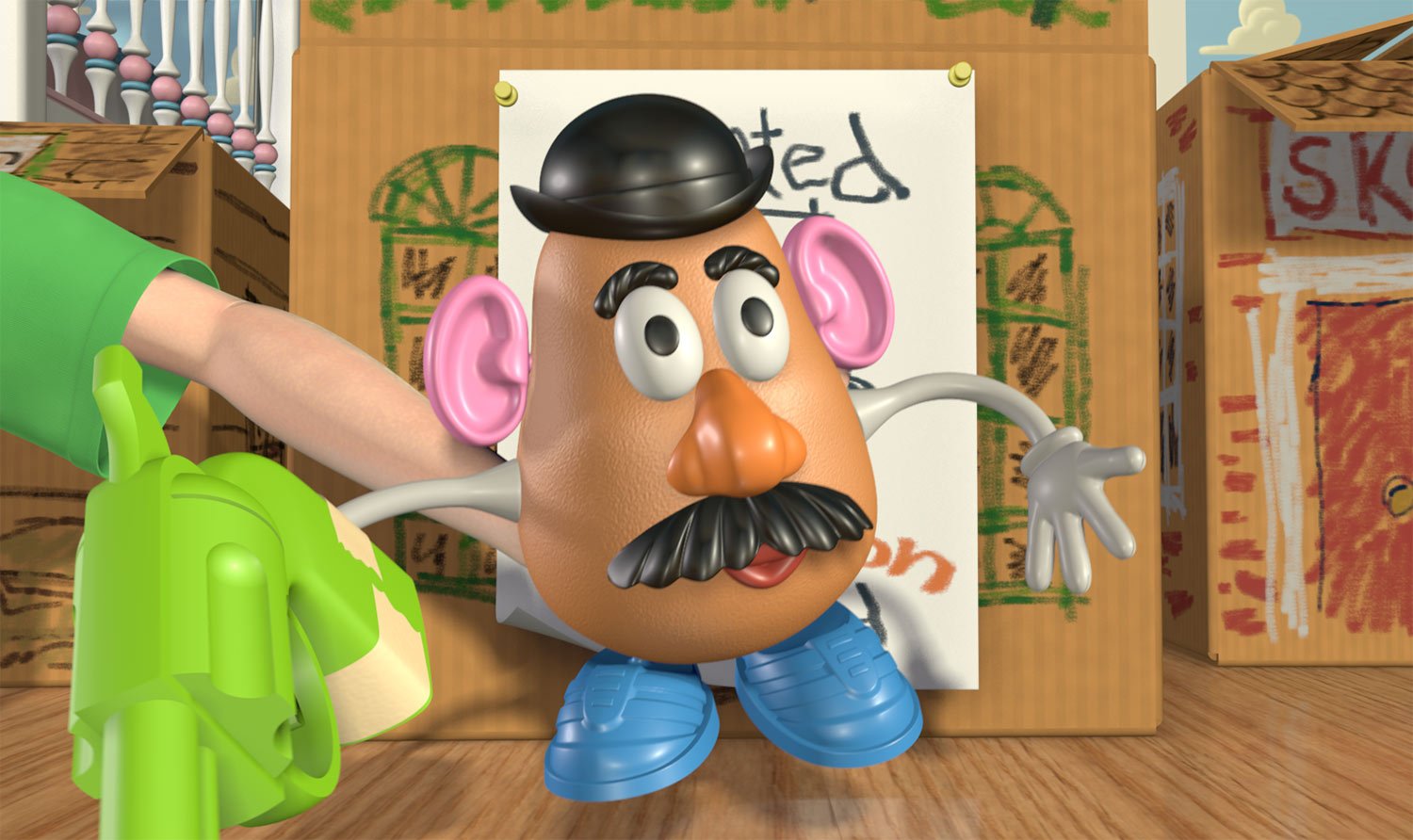
Large eyes, thick brows, a flexible mouth, oversized ears, white gloves, blue shoes, and the bowler hat create a face children can rearrange while animators preserve strong silhouettes.
Because features sit on pegs, every expression contains a faint possibility of collapse. Anger feels physically risky. Surprise can scatter the face. Composure looks like active assembly rather than a default state.
The design team turns product mechanics into acting tools. A raised eyebrow is not merely drawn higher. It is a separate object with weight, placement, and comic potential. Character animation grows from what the toy actually is.
The bowler hat and mustache perform adulthood
Mr. Potato Head’s accessories borrow the visual language of an older adult man: hat, mustache, pronounced brows, and shoes that suggest a formal public self. Andy can cast him as a criminal, but the design also makes him look like somebody who expects to be consulted.
The adult coding sharpens his irritation with reckless leadership. He behaves as if he has already survived enough meetings to recognize a bad proposal. The joke lets a child’s toy carry middle-aged exhaustion into every crisis.
Yet adulthood does not make him independent of care. He loses pieces, needs help, loves his spouse, adopts children, and panics. The profile refuses the idea that maturity means invulnerability.
The voice transition after Don Rickles requires care
Don Rickles died in 2017 after decades of defining the character. Toy Story 4 used archived recordings, outtakes, and existing material with the family’s approval to preserve his presence rather than immediately replacing the performance.
That production choice makes the fourth film’s voice work unusual. Lines had to be shaped from a finite archive, which limits how prominently the character can participate while honoring a performance audiences recognize immediately.
A franchise profile should name that history instead of pretending voices are interchangeable. Character continuity includes performers, editorial choices, family consent, and the ethics of using recorded work after death.
Toy Story 4 places him inside a changing ensemble
By the fourth film, the group has moved to Bonnie’s room and Jessie holds more visible leadership. Mr. Potato Head remains part of the community, but the story’s road adventure centers Woody, Forky, Bo, and newer carnival toys.
Reduced screen time does not erase his accumulated life. Ensemble franchises shift attention, and a supporting character can remain structurally important without receiving a new personal crisis every installment.
The challenge for future stories is to avoid turning familiarity into furniture. His relationship with Mrs. Potato Head, the Aliens, Jessie’s leadership, and changing technology all offer material that belongs to him rather than another round of generic complaints.
Toy Story 5 can ask what modularity means beside screens
A tablet antagonist or rival changes the room’s relationship to replaceable parts. Digital devices are repaired, updated, discarded, and personalized through systems different from a plastic toy’s pieces.
Mr. Potato Head is well positioned to interrogate claims that newer technology is uniquely flexible. He has changed bodies, distributed perception, replaced components, and remained himself across decades without pretending hardware determines personhood.
The useful conflict would not be old toy versus new device. It would compare who controls modification, who receives repair, what data preserves identity, and why some replaceable bodies are cherished while others enter waste streams.
He complicates the franchise’s treatment of masculinity
The character performs gruffness, impatience, and verbal aggression, yet his deepest attachments are domestic. He loves his wife, protects adopted children, fears loss, and repeatedly depends on communal care.
The comedy sometimes uses tenderness as a surprise because the public persona is so sharp. A better reading does not treat affection as contradiction. Care is already present inside his vigilance, even when expressed badly.
Masculinity becomes less about emotional absence than emotional translation. Mr. Potato Head has feelings everywhere. His growth lies in allowing gratitude and belonging to become more direct, especially with the Aliens.
The Aliens make him a father without changing his personality
Adoption does not suddenly make him patient, soft-spoken, or delighted by repetition. The films avoid the false idea that family legitimacy requires a complete personality makeover.
He becomes responsible while remaining recognizably himself. Exasperation and love occupy the same scenes. The distinction is whether irritation threatens belonging or occurs inside a relationship whose belonging is secure.
Mrs. Potato Head leads the emotional expansion, and the landfill rescue makes denial impossible. His family grows because other people choose connection before he finds the language to welcome it.
The room needs the person who remembers bad evidence
Toy Story communities are vulnerable to charismatic certainty. Woody can sound sure because he is afraid. Lotso can sound kind because he controls information. Stinky Pete can sound wise because isolation gave him time to prepare an argument.
Mr. Potato Head’s suspicion is a defense against performance. He notices whose interests a story protects and whether the available evidence supports the confidence. That instinct is valuable when disciplined by patience.
His arc is not learning to stop questioning. It is learning that questions should open investigation rather than close it. The same mind that accused Woody too quickly can later detect institutions built on selective truth.
His body turns repair into a relationship question
Replacing a lost part may restore function, but it can also change texture, color, fit, memory, or the sense of bodily continuity. The films treat spare pieces casually because comedy moves quickly, yet the underlying issue is rich.
Who chooses the replacement matters. A child rearranging him for play, Mrs. Potato Head packing spares, and a guard removing pieces involve different relationships of consent and power even if the same peg enters the same opening.
Accessibility is not just availability of parts. It includes agency over when, why, and by whom a body is altered. Mr. Potato Head makes that ethical distinction visible in a form children understand immediately.
He is not merely comic relief
Comic relief usually releases tension without changing the moral structure. Mr. Potato Head repeatedly changes it. His accusations isolate Woody, his doubts affect group decisions, his body enables escape, his eye-related family connection supplies evidence, and his relationship with the Aliens pays off the landfill rescue.
The jokes work because consequence surrounds them. A mouth in the wrong place is funny and also proves identity can persist through radical reconfiguration. A tortilla body is absurd and also saves a prisoner. Irritation entertains and also checks leadership.
Calling him comic relief alone misses how Toy Story thinks. The franchise hides philosophy inside product mechanics, and Mr. Potato Head is one of its most productive philosophical bodies.
What he gets wrong about Woody
Potato Head often assumes Woody’s worst motive before allowing room for uncertainty. The suspicion grows from real evidence and real frustration with favoritism, but it can become emotionally gratifying. Watching the leader fall feels like justice before justice has been established.
He also underestimates how much Woody’s anxiety comes from the same disposability every toy fears. Privilege protects Woody, but favorite status creates its own terror of falling. Recognizing that shared fear would not excuse sabotage. It would make accountability less eager to become exile.
Their relationship improves through repeated action rather than a single apology. Rescue missions, losses, daycare, and the end of Andy’s childhood give both characters evidence larger than the window. Trust becomes historical and revisable.
What Woody needs to learn from him
Woody needs a critic who cannot be charmed by leadership language. Potato Head reminds him that being Andy’s favorite does not make every plan communal, that intention does not guarantee trust, and that the room contains people who experience risk differently.
The lesson is especially important as Woody becomes less central in Bonnie’s room. Leadership must survive succession, disagreement, and changed relevance. A community dependent on one person’s certainty is fragile even when that person is brave.
Mr. Potato Head’s presence keeps the franchise from treating devotion as self-validating. Loyalty needs consent, evidence, and attention to who absorbs the consequences of a rescue.
What accountability looks like for the skeptic
He owes Woody more than retroactive loyalty after a mistaken accusation. Accountability would mean admitting when certainty exceeded evidence, recognizing the pleasure he took in humiliation, and changing how quickly suspicion becomes collective punishment.
At the same time, the room owes him a structure where dissent can be voiced before crisis. If every objection is treated as personality noise, frustration will continue erupting only after something goes wrong.
Repair belongs to both individual and community. Mr. Potato Head must sharpen skepticism into responsible inquiry, while leaders must stop making inquiry feel like betrayal.
Why he belongs in the core character hub
Woody and Buzz carry the central friendship, Jessie and Bo expand the franchise’s account of autonomy, and newer characters reopen personhood from different angles. Mr. Potato Head supplies the long memory of a community member who rarely receives narrative control.
He witnesses leadership, replacement fear, marriage, adoption, institutional abuse, bodily improvisation, and the transition between children. His story connects the domestic room to the franchise’s largest political questions.
Leaving him as a background card would flatten both the comedy and the world building. The body that comes apart helps hold the ensemble’s argument together.
RaeRae’s final character read
Mr. Potato Head acts like he is the only adult trapped in a meeting that should have been an email. Half the time, I understand him. The other half, he has already convicted somebody because the accusation finally made his irritation feel important.
What saves the character from becoming one long insult is how deeply he remains attached. He goes on the rescue. He survives the prison. He loves his wife. He becomes a father after complaining all the way into the relationship. He keeps showing up while insisting everyone know showing up was inconvenient.
Character verdict: Mr. Potato Head is the franchise’s detachable conscience. Sometimes the pieces are in the wrong order, sometimes the mouth moves faster than the evidence, but the room is healthier because somebody keeps asking whether the favorite toy’s plan actually serves everybody.