
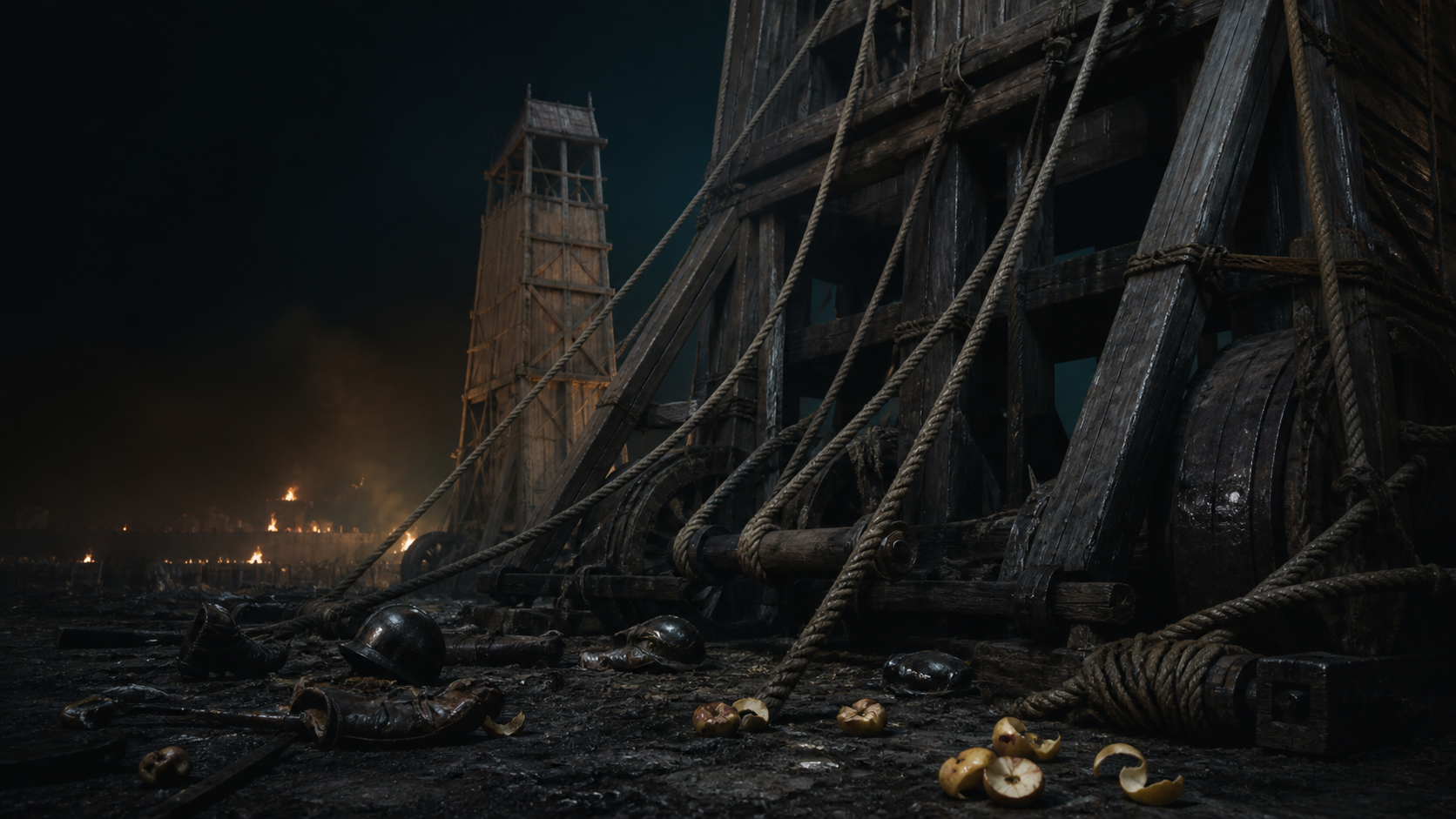
Elias Spends Soldiers Like Apple Peelings
The siege towers are spectacular until Deornoth makes us look underneath them and count the hands the king considers replaceable.
The thesis
Resource advantage becomes moral anesthesia
Naglimund and Elias’s army are not fighting the same war. The defenders count every injured shoulder, burned supply, exhausted archer, and named death because they cannot replace them. Elias can send another crew to the ropes. Deornoth’s apple-peeling comparison turns “larger army” from strategy jargon into the governing horror of the scene.
The king is spending his own subjects. That detail matters. These are not abstract enemy pieces materializing on a board; they are people whose abundance allows their ruler to treat loss as tolerable pressure. The siege’s scale is not proof of Elias’s strength. It is proof that he possesses more lives to waste.
The receipts
Every impressive machine has bodies hidden under the engineering
The towers, ropes, slingstones, fire, ladders, and countermeasures deserve tactical explanation because the chapter earns it. But the machinery cannot become a clean equipment list. Men die beneath wheels they are pushing. Crews are replaced. Named defenders fall holding breaches. The resource asymmetry is the mechanism powering every cinematic image.
Then Elias rides out with Sorrow beside burning towers and orders rain. The scene makes entitlement supernatural in scale: after spending people as though the supply were proof of righteousness, he expects the sky to validate the same logic. The laughter stops when everyone understands he is not performing madness. He believes refusal itself is an offense.
RaeRae’s take
“Epic” is not a moral category
A siege can be thrilling on the page and still be an indictment of the system moving it. Williams does not ask us to choose between craft appreciation and grief. He makes the engineering legible enough that the waste becomes more specific. A rope is not just rope when someone has to keep pulling after the person beside them disappears under a wheel.
Deornoth’s phrase survives because it refuses the anesthetic language of scale. Apple peelings are scraps produced by use, discarded without ceremony because the valuable part has supposedly gone elsewhere. Elias’s kingship has reached the point where his people occupy that category. The tragedy is not only how many die. It is that their ruler’s arithmetic requires them to be cheap.
On the record
Full-spoiler reading receipt
Return to The Dragonbone Chair hub → · Open every Book 1 Rants → · Open the series hub →