
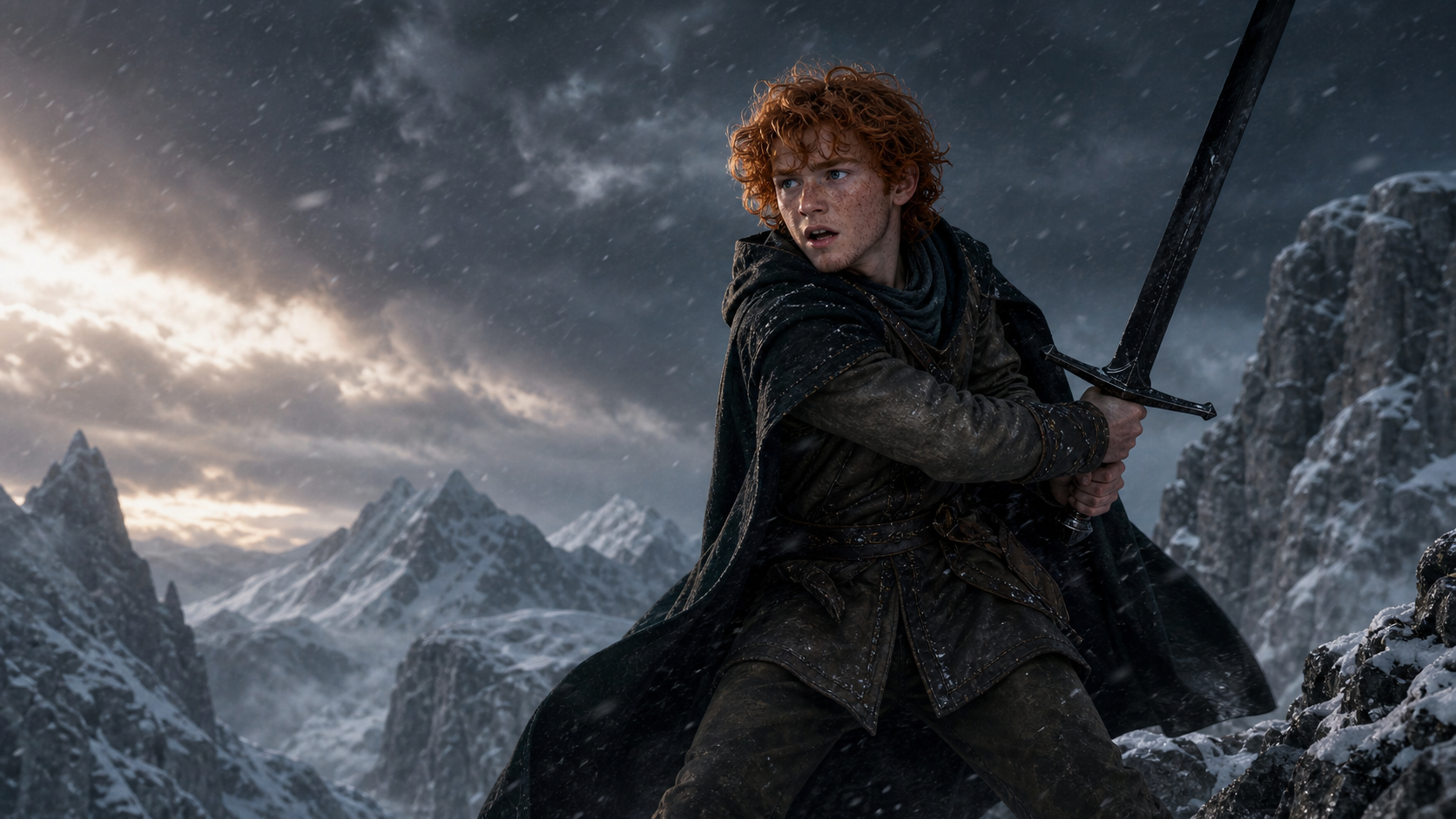
“Here I Am. I Am Simon.”
He does not shout a prophecy, title, or bloodline. The mooncalf everybody named as useless names himself—and brings Thorn down.
The moment
Wolf-song becomes the sentence Simon needs
Jiriki has already given Simon the sentence without knowing that Simon will need it. Around the fire, the prince explains that wolves do not sing histories the way the Sithi do. Their cry is immediate and stubborn: I am; here I am. Simon hears it while feeling small, cold, homesick, and furious that everybody around him seems to possess a secret version of his life. The lesson does not arrive as prophecy. It arrives as company in the dark.
By the time Igjarjuk rises beneath the Uduntree, the journey has stripped every comfortable label from him. He is no longer the protected scullion of the Hayholt. He is not a knight. He is not the master of Thorn. He is a fourteen-year-old standing among dead and wounded companions while a creature older than human kingdoms turns its attention toward him. Even the sword in his hands feels less owned than awake.
Jiriki is trapped near the valley edge. An’nai lies bloodied in the snow. Binabik has vanished into the crevice. Haestan and Sludig are fighting men who came to serve Utuk’ku. There is no adult left who can tell Simon where to stand or what name will make him brave enough. That is when the wolf-song becomes usable.
“Here I am. I am Simon.” The line is not a boast that fear has vanished. It is presence spoken through fear. Simon does not claim dragon-slayer, prince, prophesied hero, or secret heir. He names the awkward boy whose attention, friendships, failures, and stubbornness carried him this far. Then he acts.
Why it hits
The climax chooses identity before victory
Epic fantasy often makes the name reveal proof that the hero was secretly larger than ordinary life. This scene moves the other direction. Simon’s power comes from refusing to abandon ordinary identity for a grander story. The words make the action emotionally legible before Thorn ever strikes.
The entire book has trained him to believe Simon is the embarrassing preliminary draft. Rachel calls him mooncalf because he wanders away from assigned work. Morgenes teaches him because curiosity might become discipline, but even that education surrounds him with mysteries he is not permitted to understand. Josua’s people value what he carried out of the Hayholt more quickly than they learn to value the carrier. Again and again, Simon is useful because somebody older knows what his experience means.
Urmsheim removes that borrowed interpretation. Thorn answers his hands when stronger men cannot move it, but the scene refuses to turn this into effortless coronation. The sword is terrible, heavy, and alive enough to have desires of its own. Simon’s choice matters precisely because power does not arrive with an instruction card. He must decide what kind of person is holding it before he knows what it can do.
Everything the book called useless is inside the declaration: wandering attention, memory, empathy, the need to know who built the floor, the habit of collecting people and stories. Those traits carried him through tunnels, let him notice voices other people dismissed, and made friendships across borders that supposedly could not be crossed. “Simon” is not a placeholder waiting for a better title. It is the answer.
And bless the scene for refusing a polished speech. He does not suddenly sound like a king carved on a monument. The words are almost childishly plain because plain truth is the only thing large enough for the moment. A dragon fills the valley; a star-sword fills his hands; history is trying to turn him into a symbol. Simon answers with the one fact nobody else gets to define for him.
Aftershock
He has to choose Simon again inside the dragon
The scene would already work as a triumphant sword moment. Book 1 immediately complicates it. Igjarjuk’s black blood burns like fire and pours an ancient consciousness through Simon. He feels the dragon’s birth, its growth, the earth’s infant ages, and the terrible seduction of scale. One mortal life begins to look like a spark in windy darkness. Victory becomes another form of disappearance.
That is the nastier and better version of the heroic test. Simon does not merely risk being killed by something enormous. He risks agreeing that his own smallness makes him disposable. The dragon’s perspective can name mountains and millennia; Simon’s perspective remembers kitchens, scolding, friendship, embarrassment, and love. The cosmic view is not automatically wiser because it is larger.
Rachel appears bent and old in an empty room. Josua stands on a hillside beyond Simon’s reach. Miriamele watches the sea from a ship and wishes for more time. Morgenes returns crowned in flame to warn him about a false messenger. These are not abstract virtues. They are faces attached to unfinished feeling. Each one gives the boy another particular reason not to dissolve into majesty.
So the declaration returns as a survival tool. He remembers the awkward boy crawling through tunnels, the frightened boy watching white-faced figures beneath the moon, and the same boy beneath a burning roof. He refuses the invitation to become everybody and nobody. The name comes back: Simon.
When he wakes, Jiriki does not hand him a clean victory. Igjarjuk is gone, perhaps dead, perhaps not. An’nai and Grimmric are buried together under the Uduntree. Binabik and Sludig are prisoners. Thorn has somehow come where it wished to go. Survival opens more problems than it closes. That is exactly why the line remains powerful: identity is not a prize awarded after the danger. It is what Simon must keep carrying through the next danger.
The dragon marks his body anyway. Black blood leaves a long facial scar and turns a swath of red hair white. The visual transformation matters, but it does not replace him with a cooler, more marketable hero. Simon wins twice: first by saying who he is, then by remembering why that small identity is enough. The scar is history written on Simon, not a new name written over him.
On the record
The scene receipt
Return to The Dragonbone Chair hub → · Open every Book 1 React → · Open the series hub →