
RaeRae Reviews · Volume 7 · Complete owned-Kindle read
Breaking the Killing Stone is not the climax. “Save me” is.
A spectacular rescue story that understands force can open the door but cannot decide whether Haruhime walks through it.
Loves, teeth and the honest verdict
What works
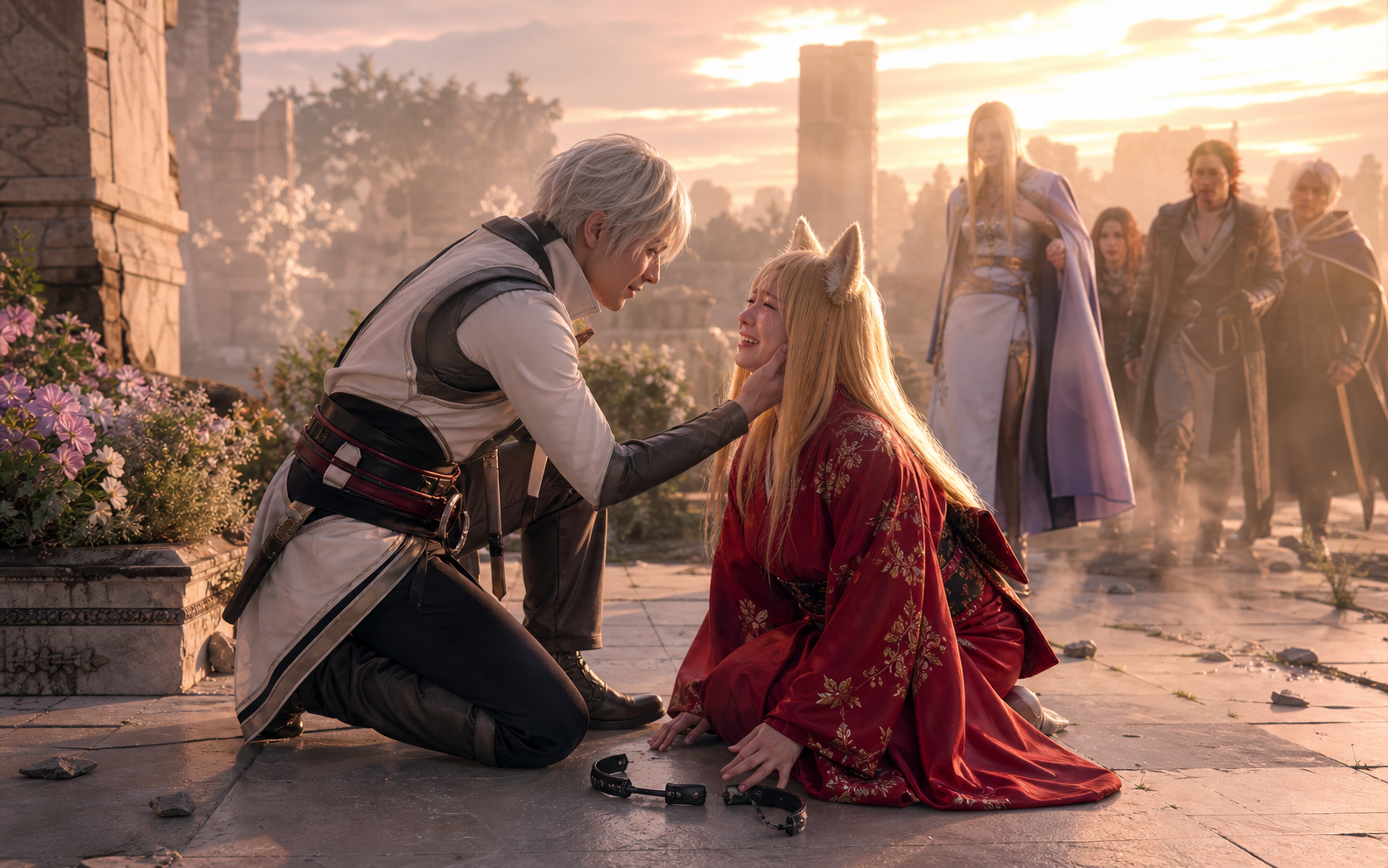
Haruhime owns the final emotional turn
The story does not let Bell’s heroism replace the decision only Haruhime can make.
The long verdict
Volume 7 knows a hero cannot finish somebody else’s emotional sentence.
I expected the Night District book to be the one where Bell charged into a dangerous neighborhood, did Bell things and left with another girl added to the orbit. That version is sitting right there, easy to write and probably easy to sell. Fujino Omori refuses it at the point where refusal matters. Bell gets the gate, the sprint and the shattered Killing Stone. Haruhime gets the climax.
That distinction saves the entire rescue. Haruhime is not waiting in emotional storage until Bell arrives. She has history with Mikoto, a fraught shelter inside Aisha’s protection, a relationship to her own magic and a self-image built from years of punishment. The Night District has not only contained her body; it has convinced her that containment is the proper shape of her life. A rescue that ignores that belief would move her address and leave the cage intact.
Bell works here because his simplicity becomes discipline. He does not need Haruhime to prove purity, usefulness or bravery before he decides she should live. The book also refuses to let that clean instinct settle every question. Mikoto’s guilt complicates the reunion. Aisha’s knowledge complicates the promise. Haruhime’s terror complicates the exit. Everybody who loves her has to accept that love does not grant authority over the speed of her healing.
Aisha is the volume’s other triumph. She is compromised, violent, protective, furious and more honest about the risks than the heroes are. She understands Ishtar Familia from inside and knows exactly how little a speech can be worth tomorrow morning. Her duel with Bell is not romantic gatekeeping. It is quality control performed by the person who has been absorbing the consequences. She makes the fantasy prove it can survive contact with reality.
The Killing Stone material has teeth because it turns exploitation into infrastructure. Haruhime’s level-boost magic is valuable, so the institution develops a method to distribute it. That is the ugliest logic in the book: once a person is classified as a resource, cruelty can call itself efficiency. Mikoto’s fall and Bell’s attack break the machinery, but Haruhime’s chosen use of Uchide no Kozuchi is the real reversal. The power returns to its owner.
My complaint is Freya. Not because the Goddess War lacks impact—it absolutely lands—but because the book invites the visual language of liberation while keeping Freya’s motive possessive. She does not punish Ishtar for what Ishtar did to Haruhime. She punishes Ishtar for touching Bell. That distinction should stay visible. A woman can benefit from somebody else’s territorial feud without the feud becoming feminism.
The other discomfort is deliberate and necessary: the story uses the language of purity hard enough that a reader could mistake repetition for endorsement if they stop before the answer. The answer is not that Haruhime secretly qualifies as pure. The answer is that purity was the wrong admissions test. Her right to safety never depended on passing it.
And then the book gives us welcome home. No ritual, no goddess army, no hero pose. Just the beginning of life after the rescue, which is where found family either becomes real or reveals itself as a slogan. Volume 7 understands that the rabbit hole gets bigger after the door opens. Haruhime is not finished; she is finally allowed to continue.

What works
Aisha has enough integrity to be difficult
She protects Haruhime, participates in Ishtar’s system, resists the ritual and still refuses to trust Bell cheaply.
The long verdict
Volume 7 knows a hero cannot finish somebody else’s emotional sentence.
I expected the Night District book to be the one where Bell charged into a dangerous neighborhood, did Bell things and left with another girl added to the orbit. That version is sitting right there, easy to write and probably easy to sell. Fujino Omori refuses it at the point where refusal matters. Bell gets the gate, the sprint and the shattered Killing Stone. Haruhime gets the climax.
That distinction saves the entire rescue. Haruhime is not waiting in emotional storage until Bell arrives. She has history with Mikoto, a fraught shelter inside Aisha’s protection, a relationship to her own magic and a self-image built from years of punishment. The Night District has not only contained her body; it has convinced her that containment is the proper shape of her life. A rescue that ignores that belief would move her address and leave the cage intact.
Bell works here because his simplicity becomes discipline. He does not need Haruhime to prove purity, usefulness or bravery before he decides she should live. The book also refuses to let that clean instinct settle every question. Mikoto’s guilt complicates the reunion. Aisha’s knowledge complicates the promise. Haruhime’s terror complicates the exit. Everybody who loves her has to accept that love does not grant authority over the speed of her healing.
Aisha is the volume’s other triumph. She is compromised, violent, protective, furious and more honest about the risks than the heroes are. She understands Ishtar Familia from inside and knows exactly how little a speech can be worth tomorrow morning. Her duel with Bell is not romantic gatekeeping. It is quality control performed by the person who has been absorbing the consequences. She makes the fantasy prove it can survive contact with reality.
The Killing Stone material has teeth because it turns exploitation into infrastructure. Haruhime’s level-boost magic is valuable, so the institution develops a method to distribute it. That is the ugliest logic in the book: once a person is classified as a resource, cruelty can call itself efficiency. Mikoto’s fall and Bell’s attack break the machinery, but Haruhime’s chosen use of Uchide no Kozuchi is the real reversal. The power returns to its owner.
My complaint is Freya. Not because the Goddess War lacks impact—it absolutely lands—but because the book invites the visual language of liberation while keeping Freya’s motive possessive. She does not punish Ishtar for what Ishtar did to Haruhime. She punishes Ishtar for touching Bell. That distinction should stay visible. A woman can benefit from somebody else’s territorial feud without the feud becoming feminism.
The other discomfort is deliberate and necessary: the story uses the language of purity hard enough that a reader could mistake repetition for endorsement if they stop before the answer. The answer is not that Haruhime secretly qualifies as pure. The answer is that purity was the wrong admissions test. Her right to safety never depended on passing it.
And then the book gives us welcome home. No ritual, no goddess army, no hero pose. Just the beginning of life after the rescue, which is where found family either becomes real or reveals itself as a slogan. Volume 7 understands that the rabbit hole gets bigger after the door opens. Haruhime is not finished; she is finally allowed to continue.

What bites
The rescue inherits another possessive goddess
Freya’s victory solves Ishtar, not the series’ habit of letting divine desire become policy.
The long verdict
Volume 7 knows a hero cannot finish somebody else’s emotional sentence.
I expected the Night District book to be the one where Bell charged into a dangerous neighborhood, did Bell things and left with another girl added to the orbit. That version is sitting right there, easy to write and probably easy to sell. Fujino Omori refuses it at the point where refusal matters. Bell gets the gate, the sprint and the shattered Killing Stone. Haruhime gets the climax.
That distinction saves the entire rescue. Haruhime is not waiting in emotional storage until Bell arrives. She has history with Mikoto, a fraught shelter inside Aisha’s protection, a relationship to her own magic and a self-image built from years of punishment. The Night District has not only contained her body; it has convinced her that containment is the proper shape of her life. A rescue that ignores that belief would move her address and leave the cage intact.
Bell works here because his simplicity becomes discipline. He does not need Haruhime to prove purity, usefulness or bravery before he decides she should live. The book also refuses to let that clean instinct settle every question. Mikoto’s guilt complicates the reunion. Aisha’s knowledge complicates the promise. Haruhime’s terror complicates the exit. Everybody who loves her has to accept that love does not grant authority over the speed of her healing.
Aisha is the volume’s other triumph. She is compromised, violent, protective, furious and more honest about the risks than the heroes are. She understands Ishtar Familia from inside and knows exactly how little a speech can be worth tomorrow morning. Her duel with Bell is not romantic gatekeeping. It is quality control performed by the person who has been absorbing the consequences. She makes the fantasy prove it can survive contact with reality.
The Killing Stone material has teeth because it turns exploitation into infrastructure. Haruhime’s level-boost magic is valuable, so the institution develops a method to distribute it. That is the ugliest logic in the book: once a person is classified as a resource, cruelty can call itself efficiency. Mikoto’s fall and Bell’s attack break the machinery, but Haruhime’s chosen use of Uchide no Kozuchi is the real reversal. The power returns to its owner.
My complaint is Freya. Not because the Goddess War lacks impact—it absolutely lands—but because the book invites the visual language of liberation while keeping Freya’s motive possessive. She does not punish Ishtar for what Ishtar did to Haruhime. She punishes Ishtar for touching Bell. That distinction should stay visible. A woman can benefit from somebody else’s territorial feud without the feud becoming feminism.
The other discomfort is deliberate and necessary: the story uses the language of purity hard enough that a reader could mistake repetition for endorsement if they stop before the answer. The answer is not that Haruhime secretly qualifies as pure. The answer is that purity was the wrong admissions test. Her right to safety never depended on passing it.
And then the book gives us welcome home. No ritual, no goddess army, no hero pose. Just the beginning of life after the rescue, which is where found family either becomes real or reveals itself as a slogan. Volume 7 understands that the rabbit hole gets bigger after the door opens. Haruhime is not finished; she is finally allowed to continue.