
LION KING CHARACTER · FORMER HEIR, MURDERED BROTHER, FAILED KING, AND THE LIE THAT OUTLIVED HIS BODY
Scar: The Brother Who Turned a Succession Wound Into Murder, Famine, and Somebody Else’s Blame
Scar understands everybody’s hunger except his own. He can read a child, recruit the excluded, murder a king, rewrite the record, and still cannot govern a reality that refuses to flatter him.
The quick file
Scar is Mufasa’s brother, Simba’s uncle, a former heir displaced by Simba’s birth, architect of the wildebeest stampede, murderer of Mufasa, and ruler of the Pride Lands during its collapse in the 1994 animated continuity. Jeremy Irons gives the original performance its cultivated contempt, dry humor, theatrical rage, and dangerous ability to make cruelty sound like intelligence.
Later branches expand or revise him. Simba’s Pride follows the loyalists and children shaped by his rule. The Lion Guard returns Scar as history and spirit. The 2019 photoreal remake casts Chiwetel Ejiofor and changes his posture, history, and relationship with Sarabi. Mufasa: The Lion King names the young photoreal character Taka, voiced by Theo Somolu and Kelvin Harrison Jr.
Name, title, family, and continuity
The animated film calls him Scar and identifies Mufasa as his brother. Simba’s arrival moves him down the succession line. The movie supplies no confirmed birth name, parents, childhood, or detailed origin for the facial scar. Later books, series, merchandise, and adaptations offer additions, but those additions do not all belong to one uninterrupted biography.
The photoreal branch makes Taka the earlier name and builds a childhood around a royal family that takes in orphaned Mufasa. That history belongs to the 2019 and 2024 continuity. Treating Taka as the secret birth name of every animated Scar flattens two productions that make different arguments about inheritance, brotherhood, resentment, and chosen family.
Jeremy Irons makes contempt sound entertaining
Irons stretches vowels, drops volume, changes tempo, and lets pauses become little acts of domination. Scar rarely needs to shout while he believes the room belongs to him. The performance invites the audience to enjoy his wit before the plot requires them to confront the bodies underneath it. Charm is not evidence of hidden goodness. It is one of his tools.
The voice also protects Scar from becoming a flat coward. He is funny, observant, vain, frightened, cruel, and capable of improvising when a plan changes. Irons lets contradictory impulses occupy the same sentence. Scar can resent Mufasa, flatter Simba, threaten Zazu, and amuse himself without any of those behaviors canceling the others.
The first scene tells us how Scar uses information
Scar’s introduction begins with a mouse trapped beneath his paw. He delays eating because control interests him as much as hunger. Zazu’s interruption brings news of Mufasa, Simba, and royal expectations. Scar responds by converting a missed ceremony into a performance of injured dignity rather than admitting that the cub’s existence threatens his political future.
He collects information, reveals little, and makes other characters explain themselves. Even his jokes test boundaries. Zazu treats the hostility as manageable family behavior, while Mufasa answers with physical certainty. Scar learns that nobody sees his contempt as an operational threat yet. Underestimation becomes the opening his conspiracy needs.
Former heir does not mean rightful king
Scar’s grievance contains a fact: before Simba’s birth, he stood closer to the throne. The grievance does not create a right to murder his brother and nephew. Succession rules can be unfair, opaque, and emotionally brutal while Scar remains responsible for choosing assassination over argument, departure, alliance building, reform, or any nonlethal response.
The story rarely asks whether the wider Pride Lands consent to hereditary rule. Scar does not ask either. His complaint is personal displacement, not democratic principle. He wants the same concentrated authority Mufasa holds, stripped of the duties that made Mufasa’s version tolerable. His rebellion challenges who sits at the top and preserves the pyramid.
Relationship with Mufasa
Mufasa treats Scar as an exasperating brother who can still be ordered into line. He recognizes disrespect without recognizing a coup. Their physical contrast matters: Mufasa occupies space with weight and confidence, while Scar survives through distance, angles, language, and proxies. Open combat would favor the king, so Scar designs circumstances where strength becomes predictable.
Scar studies Mufasa’s love for Simba and turns it into an assassination mechanism. He knows the father will enter the gorge, climb through the herd, and exhaust himself saving the cub. The murder succeeds because Scar understands Mufasa intimately enough to weaponize his best quality. Family knowledge becomes tactical intelligence.
Relationship with Simba
Scar performs the indulgent uncle while feeding Simba information that will place him in danger. He makes the elephant graveyard sound like forbidden proof of bravery, then places the cub inside the gorge and tells him to practice a roar. The child thinks he is earning adult recognition. Scar is arranging a body at the scene.
After Mufasa dies, Scar does not need evidence. He needs Simba’s developmental vulnerability. He tells a grieving child that the death is his fault, then presents exile as mercy. The lie joins guilt to survival so tightly that Simba spends years believing return would expose him as the cause rather than reveal Scar as the killer.
Grooming works before the stampede begins
Scar’s manipulation is effective because he does not begin with an unbelievable command. He begins with attention. Simba wants to be treated as older, braver, and more important than adults allow. Scar offers confidential knowledge and frames disobedience as proof of maturity. The technique converts a child’s ordinary need for recognition into access.
Calling the behavior grooming is useful when the word remains precise: an adult builds trust, isolates the child from safer guidance, normalizes secrecy, and prepares conditions for harm. Scar is not merely lying in the final scene. He has been shaping Simba’s choices so the child arrives at danger believing the idea belongs to him.
The elephant graveyard is a recruitment map
The graveyard reveals a population living beyond Mufasa’s protected border and a prince who knows almost nothing about them. Scar already moves between the royal court and hyena territory. His access exposes a political failure inside the supposedly stable kingdom: an excluded community can be approached by one insider without any visible diplomatic channel competing with him.
Scar offers the hyenas food, access, and reversal of the order that kept them outside. He exploits real scarcity and converts it into loyalty to himself. The coalition is not liberation because he treats the hyenas as instruments, withholds responsibility, and later blames them when his rule collapses. Shared resentment does not create shared power.
Be Prepared is a political sales pitch
The song stages Scar as director, lecturer, recruiter, and future dictator. He turns murder into choreography and lets repetition produce certainty before the plan has succeeded. The hyenas move from hungry listeners to a mass formation. Spectacle makes hierarchy feel like participation while every important decision remains Scar’s.
The imagery deliberately borrows the visual grammar of authoritarian rallies. That choice gives the sequence menace and also invites care with historical comparison. Scar is a fictional monarch using mass spectacle, scapegoating, militarized formation, and promises of abundance. Analysis should name those mechanisms without reducing real atrocities to an aesthetic reference.
The stampede is engineered murder
Scar places Simba in the gorge, signals the hyenas to start the herd, alerts Mufasa at the correct moment, watches the rescue, and waits above the cliff. Every stage anticipates another character’s response. The wildebeest are not villains or fate. They are frightened bodies forced into a weaponized environment.
Mufasa reaches the ledge alive. Scar looks into his brother’s face, grips his paws, says the family phrase with deliberate cruelty, and throws him back into the gorge. The act removes any ambiguity about responsibility. Whatever grievance preceded it, Scar chooses intimate execution after watching Mufasa save his child.
Long live the king is cruelty with an audience of one
Scar’s line is theatrical because he has always imagined power as a role that should have been cast differently. He uses royal language at the instant he destroys the king. Mufasa receives the truth Scar hides from everybody else: this death is personal, intentional, and connected to succession.
The phrase also shows why Scar needs performance even when no public is watching. He wants his brother to understand who won. Political murder alone would remove an obstacle. The whispered declaration converts murder into recognition, forcing Mufasa to witness Scar’s claimed transformation before the fall.
Blame transfer is the second murder weapon
Scar tells Simba to run, then sends the hyenas to kill him. When they fail, he assumes the child is dead and addresses the pride as a grieving survivor. He replaces the actual sequence with a public story before witnesses can ask questions. Control of the narrative becomes the bridge between violence and legitimacy.
His method repeats at the end. Faced with defeat, Scar tells Simba the hyenas are the enemy and calls them revolting scavengers. He expects another audience to accept another transfer of guilt. This time the intended scapegoats hear him, and the coalition learns exactly how disposable it always was.
The funeral speech is propaganda
Scar announces Mufasa and Simba’s deaths together, claims sorrow, and positions himself as the only remaining path forward. The pride receives grief and succession in one package. There is no investigation, body accounting for Simba, testimony from the gorge, or pause in which another adult can organize doubt.
The speech uses emotional exhaustion as political opportunity. Sarabi and the lionesses are mourning. Scar supplies certainty while withholding evidence. By bringing the hyenas into Pride Rock immediately, he adds coercive force to a story presented as lawful inheritance. Mourning becomes the moment when resistance is least prepared.
Scar’s rule confuses possession with governance
Once crowned, Scar gains the title he claimed would solve his grievance. The land deteriorates, prey disappears, hunting fails, and hunger spreads. The film connects ecological collapse to bad rule with fairy-tale speed. Scar responds to material evidence by demanding obedience and refusing to change course.
He wants recognition without accountability. Sarabi’s report about food is treated as disrespect because Scar experiences reality as an attack on status. A ruler who cannot receive bad information will eventually govern a fantasy. Everybody else pays the cost of maintaining it.
Relationship with Sarabi
Animated Sarabi confronts Scar as queen, lead hunter, mother, and witness to the difference between regimes. He demands that the lionesses hunt beyond what the land can supply. She names the failure directly. Scar answers by invoking Mufasa, demanding comparison, and striking her when the comparison does not flatter him.
The 2019 remake adds history suggesting Scar once wanted Sarabi and resents her choice of Mufasa. That material belongs to the photoreal branch. It makes gendered entitlement more explicit, but the animated confrontation already shows a ruler who treats a woman’s factual dissent as personal betrayal.
Relationship with the hyenas
Shenzi, Banzai, and Ed are collaborators, enforcers, witnesses, and eventual executioners in the animated film. Scar offers them access to food and political inclusion, then leaves the kingdom unable to feed anyone. He depends on their labor and despises the group whose support made his rule possible.
The alliance fails because it was never reciprocal. Scar hoards authority, the hyenas absorb public blame, and resources remain organized around his appetite. Their final attack is revenge and the consequence of hearing his attempted betrayal. It does not erase their participation in murder, occupation, or coercion.
Scar, hunger, and the limits of the Circle
The Circle of Life describes interdependence and return, but Scar treats the kingdom as a storehouse. More bodies enter the Pride Lands while leadership refuses ecological limits. The result is extraction without recovery. Hunger becomes evidence that political promises cannot suspend carrying capacity, migration, rainfall, or prey behavior.
Mufasa’s earlier border deserves scrutiny, yet Scar’s answer is conquest rather than repair. He opens access through a coup, eliminates accountability, and offers no sustainable plan. Inclusion language becomes cover for concentrating resources around the new regime. A broken boundary and a murderous solution can both be wrong.
The final confrontation
Simba returns with incomplete knowledge and challenges Scar as the presumed cause of Mufasa’s death. Scar isolates him at the cliff, forces a confession of false guilt, and whispers the truth when Simba appears defeated. The admission gives Simba the fact needed to separate grief from responsibility.
Scar still tries to manipulate the public account. Simba forces him to confess before the pride, but the confrontation becomes physical before any broader reckoning can occur. The kingdom is restored through defeat of the usurper. Questions about institutions, succession, hyena relations, and shared governance remain for later stories.
Scar’s death is not Simba’s execution
Simba defeats Scar and tells him to leave, echoing the false mercy once offered to the cub. Scar attacks again. Simba throws him from the ledge in self-defense, but the fall does not kill him. The hyenas surround Scar after hearing him blame them and complete the final violence.
Responsibility remains layered. Scar created the coalition, used it for murder, governed through coercion, attempted betrayal, and initiated the last attack. The hyenas choose revenge. Simba chooses banishment and defense rather than a deliberate killing. Keeping those actions separate prevents the climax from becoming one vague category called justice.
Simba’s Pride and Scar’s afterlife
Scar is absent as a living body and present through Zira, the Outsiders, Kovu’s grooming, Simba’s trauma, and the border dividing the prides. Zira treats loyalty to Scar as identity. Simba treats resemblance to Scar as evidence of danger. The dead ruler continues organizing relationships because nobody has processed the regime together.
Kovu is selected as Scar’s heir without being his biological son. That plot fact deserves precision even though Scar’s ideological legacy matters more than blood. Kovu’s refusal proves that inheritance can be interrupted. Kiara’s alliance shows that children can reject a conflict adults trained them to continue.
Zira preserves Scar as doctrine
Zira remembers Scar as rightful king and converts loss into a household program. The Outsider cubs grow up inside a story where revenge is duty and Simba’s pride is the sole source of exile. Scar becomes a political symbol cleansed of famine, betrayal, and the conditions that ended his rule.
Her devotion also demonstrates that propaganda can outlive its author. Scar does not need to control every later statement. A community organized around grievance repeats the useful version and trains children to embody it. Countering that legacy requires relationships capable of surviving contact with evidence.
The Lion Guard gives Scar a military past
The Lion Guard expands animated continuity by describing Scar as a former leader who possessed the Roar of the Elders. He lets power and praise feed ambition, destroys members of his own guard after they refuse his plan, and loses the Roar after using it for evil. The series makes his betrayal part of an earlier pattern.
This history reframes the 1994 coup without excusing it. Scar had authority, a team, supernatural power, and opportunities to lead before Simba existed. His grievance cannot be reduced to one cub taking one inheritance. He repeatedly treats other lives as obstacles to recognition.
Scar as fire and spirit
The series returns Scar through volcanic fire after Ushari and Janja’s actions reconnect his spirit to the living world. David Oyelowo voices this branch. Scar becomes strategist and distant commander again, using intermediaries while seeking control of the Pride Lands through alliances among predators and resentful outsiders.
The spiritual return turns memory into an active antagonist. Kion cannot solve the threat by repeating Simba’s exact victory because the mechanism is different. Knowledge, cross-species cooperation, and understanding how Scar returned matter alongside force. The franchise makes historical literacy part of defense.
The 2019 photoreal Scar
Chiwetel Ejiofor gives Scar a harsher, less playfully aristocratic performance. The photoreal design is lean, damaged, and visually closer to a lion shaped by prolonged conflict. His resentment toward Mufasa and Sarabi is more explicit, and the hyena alliance is negotiated with a more independent Shenzi.
Naturalistic faces reduce the elastic theatricality available to the 1994 design, so menace moves into voice, framing, gait, sound, and physical wear. The interpretation feels less amused by its own intelligence. It also loses some of the seductive entertainment that made animated Scar’s manipulation so uncomfortable to enjoy.
Taka belongs to the photoreal prequel
Mufasa: The Lion King presents Taka as a royal cub who welcomes displaced Mufasa before brotherhood turns toward jealousy, fear, betrayal, and the identity later associated with Scar. Theo Somolu voices the cub and Kelvin Harrison Jr. voices the older young Taka. Their work builds a branch-specific emotional history.
The prequel changes the succession argument because Mufasa begins outside Taka’s birth family and eventually becomes the leader associated with Milele. Taka can experience displacement without earning the right to harm others. A wound can explain the emotional route to betrayal while responsibility remains attached to the choices made along it.
The scar does not explain Scar
A facial injury is part of the character’s visual identity, and adaptations have supplied different contexts for it. The injury does not cause treason. Connecting bodily difference directly to moral corruption repeats a long visual shorthand where villains are marked as damaged and heroes are granted symmetry, health, and socially approved beauty.
Critiquing that shorthand does not require removing the feature from every adaptation. It requires refusing the implication that the mark reveals a soul. Scar’s cruelty is legible through decisions: manipulation, murder, coercion, scapegoating, and abandonment. The face carries history. The behavior carries guilt.
Design, color, and shape language
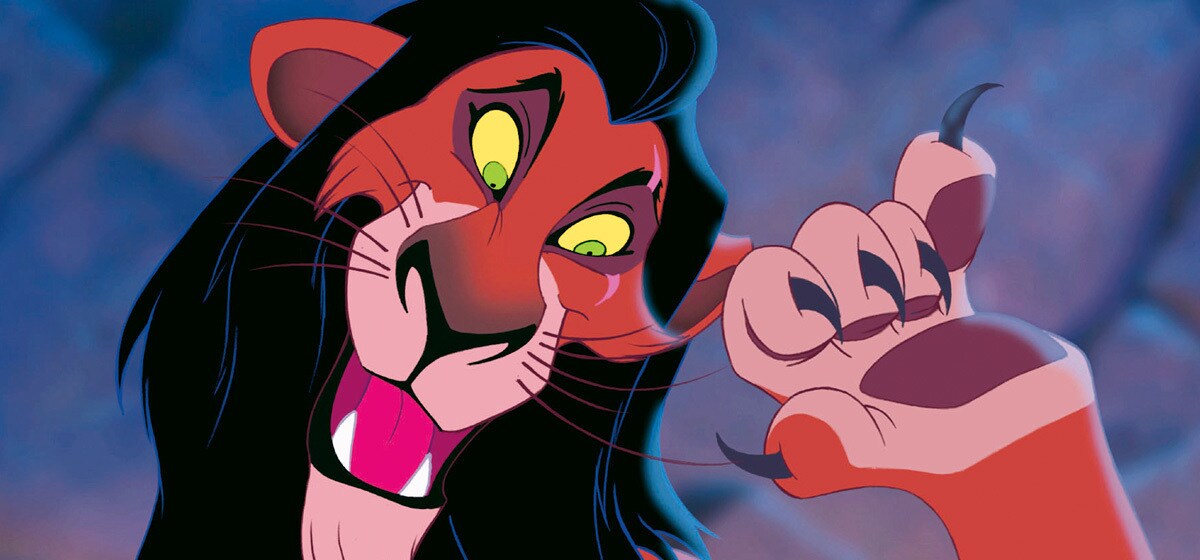
Animated Scar uses a dark mane, angular face, green eyes, narrower frame, controlled paws, and a posture that bends around stronger bodies until he can strike from advantage. Mufasa is broad and warm; Scar is sharp and cool. The visual system communicates rivalry before dialogue explains succession.
The contrast is elegant and ethically complicated. Thinness, darkness, injury, and nonconforming gestures collect around the villain, while muscular warmth belongs to the good king. Viewers can admire the craft and examine which bodies animation repeatedly trains audiences to trust or fear.
Queer coding, theatricality, and caution
Scar’s vocal refinement, gestures, disdain for conventional masculinity, and theatrical self-presentation have often been discussed as queer coding within a larger Disney villain tradition. Coding is not the same as confirmed identity. The film does not name Scar’s sexuality, and interpretation should not turn mannerism into proof.
The cultural question concerns pattern. When villains receive wit, elegance, gender nonconformity, and expressive freedom while heroes receive heterosexual family legitimacy, audiences learn associations beyond plot. Scar can remain compelling without treating queerness as the secret source of danger. His politics and violence are already sufficient.
Common fandom misconceptions
Animated Scar’s birth name is not confirmed as Taka by the 1994 film. Kovu is Scar’s chosen heir, not his biological son. Simba does not deliberately execute Scar. The hyenas participate in the coup and are also exploited by Scar. A grievance about succession does not make the murder a liberation movement.
Scar is intelligent and repeatedly makes catastrophic governing choices. Mufasa’s rule can contain structural problems without making Scar’s coup justified. The 2019 and 2024 additions can illuminate parallel themes without becoming automatic facts about the animated branch. Separating continuity is care, not nitpicking.
What future stories owe Scar
Animated stories could examine his earlier leadership, relationship with Sarabi, history with Mufasa, contact with the hyenas, political work before the coup, and how the court normalized escalating hostility. Any origin should expand responsibility rather than manufacture one wound that supposedly explains every later choice.
Photoreal stories can let Taka remain a person whose loyalty, jealousy, fear, affection, and ambition shift over time. A prequel becomes richer when betrayal is not destiny hiding inside a cub. The audience should see alternatives close, choices accumulate, and other characters affect the road without becoming responsible for his violence.
Profile conclusion
Scar is brother, uncle, former heir, recruiter, murderer, propagandist, failed king, scapegoater, memory, and franchise warning about mistaking grievance for justice. His intelligence is real. So are the people he manipulates, the bodies he spends, and the land that collapses while he demands applause for finally receiving the title.
Return to The Lion King hub for every film and series branch, reviews, Reacts, rants, guides, and the complete character directory. The hub keeps animated Scar, photoreal Scar, and Taka connected without pretending their histories are one interchangeable canon.
The character receipt Pride Rock cannot flatten
Scar cannot be reduced to a place in the royal family tree. The profile’s central problem is exclusion converted into entitlement, grievance converted into recruitment, and intelligence used to make other people carry his risk. That argument becomes visible through decisions, not biography labels. The story tells us who belongs near Pride Rock, but the character receipt asks who has information, who controls movement, whose fear is believed, and who performs the work after a public decision becomes a private emergency.
The relationship map includes Mufasa, Simba, Sarabi, Nala, the hyenas, Zazu, and the Pride Lands population he treats as proof of his own denied status. Each connection places a different demand on Scar. Love may require truth, friendship may require interruption, leadership may require listening, and family may require a boundary that ceremony cannot override. A complete profile follows what changes between two people after conflict. Repeating the word family is not evidence that repair occurred.
The performance matters at the same level as plot: Jeremy Irons gives contempt a musical rhythm and lets charm curdle into threat; Jim Cummings completes portions of the sung performance as the voice grows more feral. Breath, tempo, silence, posture, and distance frequently carry what the screenplay leaves unspoken. The Lion King uses animals with highly readable human emotion while preserving movement drawn from observation. That balance lets a lowered head or delayed step become moral evidence without translating every feeling into dialogue.
The 1994 film also places Scar inside an African-inspired world assembled by an American studio through research, music, language, landscape photography, theatrical tradition, and fairy-tale structure. The result is culturally meaningful to many viewers without becoming a documentary map of one country or people. The profile names specific influences where evidence supports them and does not use “Africa” as a decorative adjective that ends the inquiry.
Later films, television series, stage productions, photoreal remakes, and the Mufasa branch revise Scar through different continuities. More screen time can expose a missing motive, but it can also tidy a contradiction that made the original performance interesting. The comparison asks what each version permits Scar to know, choose, refuse, remember, and repair. Visual realism alone does not make a characterization more truthful.
The final JIN test is whether Scar leaves behind a person rather than a symbol. Symbols can carry grief, monarchy, exile, ecology, parenthood, or chosen family, but people contradict the role assigned to them. The best future scene would let Scar make an ordinary choice with no ceremony watching, then allow that choice to matter later. Continuity begins when the franchise remembers what the character already paid to learn.